Menopause: the seaweeds Japanese women eat every day
Seaweeds stand out for their exceptional density of calcium, iodine and bioavailable minerals, and some contain phytoestrogens studied by researchers. A woman who regularly eats wakame and kombu can top up her calcium intake without dairy products, and calcium is needed for the maintenance of normal bones. With more than 18 years of experience at Biovie, and as co-author with Aurélie of « Algues au quotidien » (Gallimard, 2024), I wanted to share with you what scientific data and our daily experience teach us about menopause nutrition and the role of seaweed.
If you are looking to live through menopause well, naturally, this article is for you.
Why does menopause create such specific nutritional needs?
In France, around 15 million women are going through menopause or perimenopause. Of these, 70 to 80% experience hot flushes, and according to INSERM, 1 woman in 3 will develop osteoporosis after 50. These are not small numbers, and yet the nutritional response to these issues very often remains insufficient.
What makes this period so particular in terms of menopause nutrition is how quickly the need for certain micronutrients changes, while intake often stays the same. That is where things get stuck. And that is exactly where it pays to take care of the nutritional density of your plate.
The 5 most common nutritional shortfalls after 50
At menopause, several nutrients become critical, often at the same time:
Calcium: bone density starts to decline from perimenopause onwards. Needs increase significantly, which a conventional diet rarely covers without a deliberate effort. Dairy-free calcium-rich foods for menopause, such as seaweed, then become interesting.
Iron: needs drop once periods stop, but many women reach menopause with already low reserves. Iron contributes to the reduction of tiredness and fatigue: the question of menopause fatigue and diet therefore also involves iron, provided you choose the right sources.
Magnesium: involved in more than 300 enzymatic reactions, it contributes to the reduction of tiredness and fatigue and to normal psychological function. A deficiency is often silent but very widespread after 50.
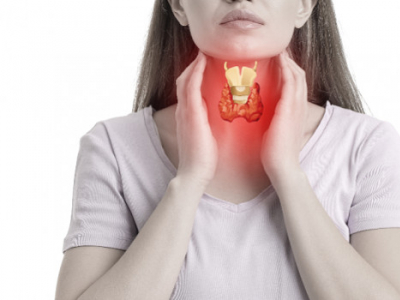
Iodine: a slowing thyroid affects 1 woman in 5 after 50. Iodine, in a bioavailable form and in adequate amounts, can contribute to the normal function of the thyroid at this turning point.
Phytoestrogens: these plant molecules, found in phytoestrogen-containing seaweeds, have been studied, mainly in the laboratory, for their ability to bind to oestrogen receptors. Their real effect in menopausal women still remains to be clarified.
These are the five nutritional pillars to keep an eye on.
What falling oestrogen really does to your body
The gradual drop in oestrogen does not only affect the reproductive sphere. It has measurable repercussions throughout the body:
Bones: oestrogens inhibit bone resorption. Without them, bone mass erodes faster, which is the direct mechanism behind the increased risk of osteoporosis. This is why people often talk about seaweed, calcium and osteoporosis: calcium is needed for the maintenance of normal bones, and some seaweeds are very rich in it.
Metabolism: menopausal weight gain and natural nutrition often become a central concern, with increased insulin resistance and a general slowing of basal metabolism.
The thyroid: the hormonal links between oestrogens and the thyroid are well established. Many women notice their thyroid gradually slowing during this period, without necessarily identifying the cause.
The cardiovascular system: oestrogens had a protective effect on vessel walls. Their decline alters certain lipid parameters and increases some long-term risks.
Mood and sleep: falling oestrogen affects serotonin, dopamine and melatonin. Irritability, anxiety and insomnia become frequent companions.
This is where a hormone-free menopause diet, dense in natural micronutrients such as seaweed for menopause, can find its place, alongside medical follow-up.
Which seaweed should you choose for your needs?
This is the question I am asked most often, and the answer really depends on your nutritional needs. Here is a suggested breakdown of seaweeds for menopause in practice, according to the most common needs:
A dense daily intake → spirulina + chlorella: protein, chlorophyll, B vitamins
Calcium for bones → wakame + kombu: up to 1,000 mg of calcium per 100 g, magnesium, boron
Iron and fatigue → spirulina: 28 mg of iron per 100 g (iron contributes to the reduction of tiredness and fatigue), the best source of plant-based iron there is, 60-70% complete protein
Iodine and thyroid → kombu, nori, wakame: natural iodine, which contributes to the normal function of the thyroid
Skin → dulse + nori: iodine, which contributes to the maintenance of normal skin, trace elements, amino acids
Plant protein → spirulina: tryptophan and other essential amino acids, B vitamins
Spirulina and menopause: why this microalga deserves a daily place
Frankly, if I could keep only one seaweed to accompany menopause, it would probably be spirulina. Not because it works miracles (it does not), but because its nutritional profile is remarkably well suited to the needs of this period.
It contains between 60 and 70% protein, more than any animal source. It provides 28 mg of iron per 100 g, making it one of the best sources of plant-based iron there is, and iron contributes to the reduction of tiredness and fatigue. It also provides tryptophan, an amino acid that is a precursor of serotonin.
Including spirulina regularly during menopause ensures an intake of iron without upsetting your habits. A meta-analysis published in 2024 (PubMed compilation) also looked at spirulina in menopausal women with metabolic syndrome (3).
"The spirulina powder is exceptional." - Barbara W., Biovie customer (Trustpilot ★★★★★)
Dried wakame contains around 1,000 to 1,300 mg of calcium per 100 g. Whole milk contains 125 mg per 100 g. That is between 8 and 11 times more weight for weight, even though we obviously eat far less of it than milk. CEVA (Centre d'Étude et de Valorisation des Algues, the French seaweed research centre) confirms this exceptional nutritional composition (4).
For a woman who reduces or avoids dairy products at menopause, wakame is one of the most interesting seaweeds for women over 50 for its calcium content, needed for the maintenance of normal bones. And this calcium comes with magnesium, which also contributes to the maintenance of normal bones, as well as boron and vitamin K.
Wakame also contains fucoxanthin, a pigment studied for its possible role in metabolism, independently of its value as a source of calcium. To find out more, read about all the benefits of wakame in our dedicated article.
One of our customers told us she had added wakame, a seaweed women appreciate, to her miso almost every lunchtime, to the point of making it a real lunch ritual.
Chlorella: the little-known microalga
Chlorella is much less well known than spirulina, which is a shame. It stands out for its richness in chlorophyll, which gives it its deep green colour.
In terms of composition, chlorella provides protein (around half of its dry weight), B vitamins, carotenoids, minerals and fibre from its cell wall. On the research side, work on seaweed and menopause focuses mainly on the phytoestrogens of certain seaweeds and their interaction with oestrogen receptors, studied mainly in the laboratory (2).
In practice, it is most often taken as a course, for example over 20 to 24 days to start with, as tablets or powder.
Kombu, nori, dulse: how to easily include them in your cooking
These three superfoods for menopause get less media attention than spirulina but fully deserve their place at the table:
Kombu: simply add a piece to the pan when you cook your pulses (lentils, chickpeas). It makes them easier to digest and enriches the broth with natural bioavailable iodine. This is the ancestral Japanese technique. Alternatively, blend your fresh kombu and add it to your cooking. You can also use dried kombu, which is more practical.
Nori: as sheets on a slice of bread with almond butter and cucumber, or crumbled. Easy, quick, very subtle taste.
Dulse: as flakes on a salad or steamed vegetables, or in a soup. It crumbles like salt, provides amino acids and trace elements, and its light sea flavour is pleasant and mild.
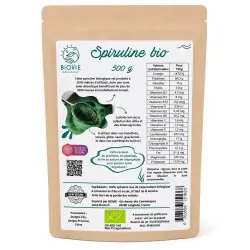
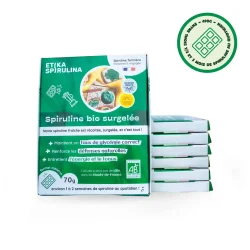
Biovie organic spirulina comes in 4 formats: fresh, grown in a greenhouse by Etika; frozen fresh, produced in northern France by Etika Spirulina; powder, from organic aquaculture; and phycocyanin, the concentrated extract of the blue pigment, almost tasteless but intensely colorful. To start a regular routine, powder is the most economical and the easiest to dose; for freshness, choose fresh or frozen spirulina of French origin, closer to the harvest. Phycocyanin suits anyone looking for a concentrated extract with a discreet taste, to add to a preparation without changing its flavor., 4
products
Edible seaweed or seaweed capsules: what is the difference?
This is a question I find essential to address, because the market is full of products sold as "seaweed" that in reality have little to do with the edible seaweeds we offer.
"Draining" fucus capsules, "bladderwrack" capsules, supermarket "slimming seaweed" formulas: these products use isolated, standardised extracts, often dried at high temperature, and formulated solely for a very targeted marketing benefit. Their bioavailability is very different from that of a whole seaweed, and their nutritional profile bears no resemblance to that of a living food seaweed.
The approach we have championed at Biovie since 2007 is seaweed as a whole food. A seaweed dried at low temperature, certified organic and Ecocert certified, which preserves its complete nutritional matrix: vitamins, minerals, amino acids, pigments, fibre, polysaccharides. Extracts cannot reproduce that matrix. It is the same difference as between an industrial fruit juice and a whole fruit you bite into. This overall nutritional richness, close to that of seaweeds and microalgae in general, explains why we favour the whole food.
"These products are essential to my health and my daily vitality." - Panyi Christ'Aile, Biovie customer (Trustpilot ★★★★★)
How do Japanese women experience menopause differently?
This is the angle that fascinates me most on this subject, because it is based on very telling observational data.
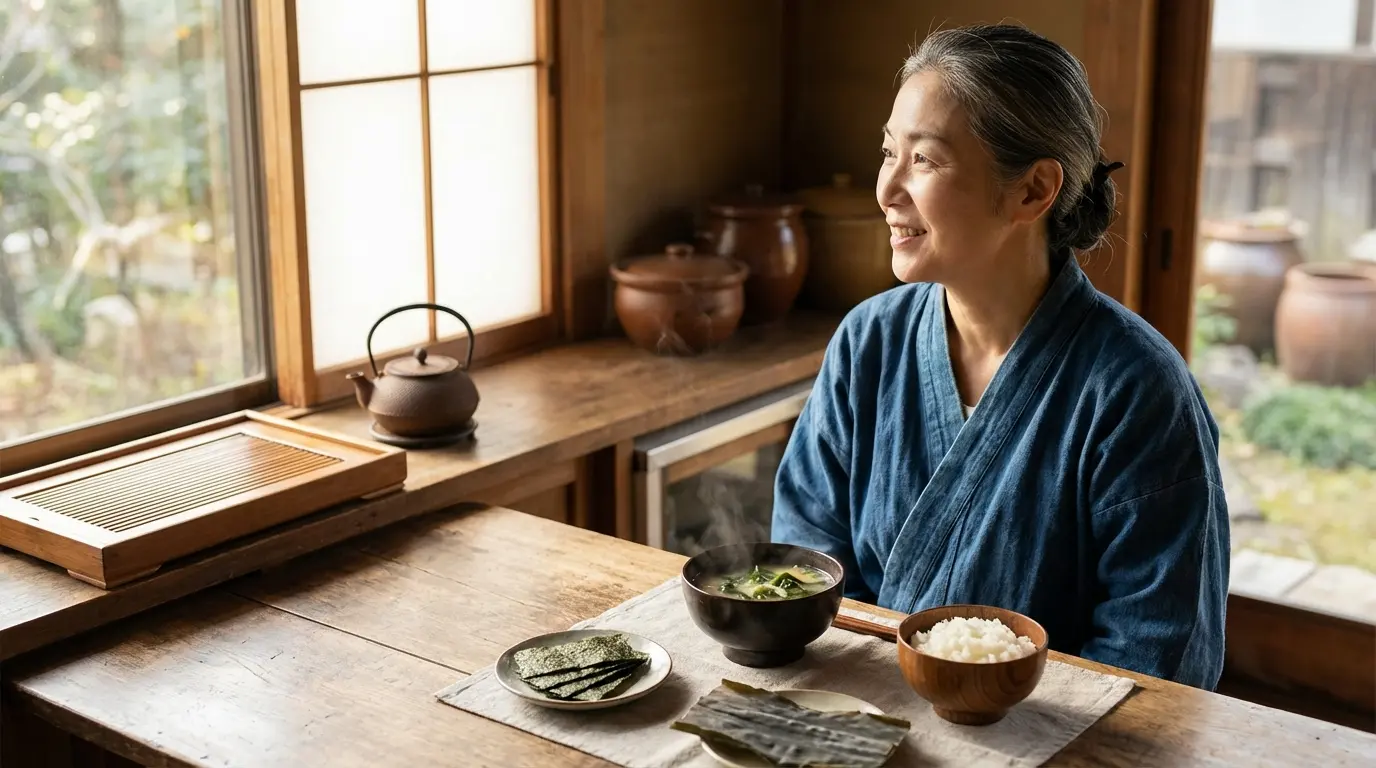
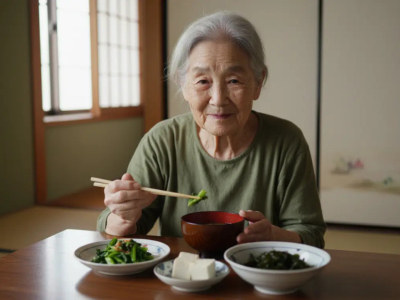
Japanese women eat on average 5 to 7 grams of seaweed a day. Wakame in the morning miso soup, kombu in the lunchtime broth, nori wrapped around the evening rice. For them it is not a food supplement: it has been everyday food for generations.
Comparative epidemiological studies observe that these women report 2 to 3 times fewer hot flushes than Western women, without being able to isolate the share of seaweed in a very different lifestyle (5). The Okinawa diet, women and longevity, which underpins the eating pattern of Japanese centenarians, relies precisely on this daily consumption of seaweed, combined with fermented soya, varied vegetables and very few ultra-processed products. Discover the dietary secret of Okinawa's centenarians in our dedicated article.
This rare nutritional combination provides natural phytoestrogens, iodine (which contributes to the normal function of the thyroid), calcium (maintenance of normal bones) and fucoidan, a marine polysaccharide that is simply not found in typical Western diets.
In concrete terms, when I worked with Aurélie on our book « Algues au quotidien » (Gallimard, 2024), we were struck by the consistency between all this epidemiological data on Japan and what we observe every day with our customers in France. This parallel deserves to be highlighted.
Seaweed and the thyroid at menopause: what you really need to know
I want to address this subject head-on, because it is often the first objection I hear: "But I can't eat seaweed, I have thyroid problems."
Spirulina contains no iodine. It is therefore entirely compatible with thyroid treatment, including levothyroxine. If you want to start with an iodine-free seaweed, spirulina is a good starting point.
Iodine-rich seaweeds (wakame, kombu, nori) contain bioavailable iodine, which can contribute to the normal function of the thyroid. This is a nutritional asset, provided you follow the golden rule: go gradually. Start with once a week in the first week, then two to three times a week in the following weeks.
If you are taking levothyroxine, simply check with your doctor before adding iodine-rich seaweed. Caution costs nothing, and your prescriber is best placed to make adjustments if necessary.
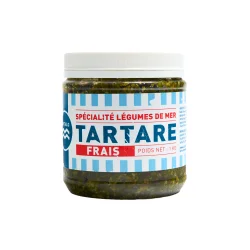
"The seaweed tartare... so important for the thyroid. An exceptional nutritional contribution." - Marinella C., Biovie customer (Trustpilot ★★★★★)
How to include seaweed in your diet at menopause: the Biovie protocol
The mistake I see most often is wanting to change everything at once in your menopause diet. You buy five different seaweeds, don't know what to do with them, and they end up at the back of a cupboard. The key, as with any dietary change, is to go gradually.
Week 1, a gentle start:
Monday: 1 teaspoon of spirulina for menopause in your morning smoothie (banana + plant milk, possibly a spoonful of cocoa, and you won't taste the seaweed at all, it is almost undetectable)
Wednesday: a bowl of miso with wakame at lunchtime: comforting, warm, calcium and iodine in one simple step
Friday: a dulse and beetroot salad, to introduce it gradually into your range of flavours
From week 2:
Spirulina: 3 to 5 g a day (1 teaspoon) as a course of at least 3 weeks
Wakame: 2 to 3 times a week in cooking or in hot miso
Chlorella for menopause: 1 to 3 g a day, in addition to spirulina
Three express recipes (5 minutes flat):
Spirulina and banana smoothie: 1 banana, 1 teaspoon of spirulina powder, 200 ml of plant milk (almond or oat), 1 tablespoon of hemp seeds. Blend. There you go: protein and iron, which contributes to the reduction of tiredness and fatigue, all in two minutes.
Lunchtime miso and wakame bowl: dissolve a spoonful of unpasteurised organic miso in 300 ml of hot water at 45°C maximum (not boiling, to preserve the enzymes), add 5 g of wakame flakes. Three minutes and it's ready. Calcium, iodine, natural probiotics.
Dulse as a seasoning: crumble dulse flakes directly over your evening salad. No cooking, no preparation. Five seconds.
Frequently asked questions about seaweed and menopause
Which seaweeds to choose if you have hot flushes at menopause?
No seaweed treats hot flushes, but spirulina and chlorella are the two microalgae most often chosen during this period. Spirulina provides protein, iron and tryptophan. Chlorella is rich in chlorophyll, protein and B vitamins. Research on seaweed and menopause focuses mainly on the phytoestrogens of certain seaweeds, studied mainly in the laboratory. If hot flushes bother you, talk to your doctor.
Is seaweed dangerous for the thyroid at menopause?
No, provided you proceed gradually. Spirulina contains no iodine and is compatible with thyroid treatments. Iodine-rich seaweeds (wakame, kombu, nori) provide iodine, which contributes to the normal function of the thyroid, but it is advisable to introduce them gradually: once a week in the first week, then two to three times a week. If you are taking levothyroxine, consult your doctor before adding iodine-rich seaweed.
How can you include seaweed in your diet at menopause without eating it morning, noon and night?
Three simple steps are enough: 1 teaspoon of spirulina in your morning smoothie (undetectable in a banana and cocoa blend), hot wakame miso at lunch two to three times a week, and dulse flakes sprinkled over your salads or eggs. That takes less than 5 minutes a day and already provides calcium, iron and a variety of minerals.
Does wakame really contain more calcium than milk?
Yes. Dried wakame contains 1,000 to 1,300 mg of calcium per 100 g, compared with 125 mg for whole milk. It is one of the most concentrated plant sources of calcium, valuable for contributing to the maintenance of normal bones at menopause.
Why do Japanese women seem to suffer less from menopause?
Epidemiological studies observe that Japanese women report two to three times fewer hot flushes, without being able to isolate the role of diet. Their diet is rich in daily seaweed (wakame, kombu, nori) providing phytoestrogens, iodine, calcium and fucoidan, a combination that is rare in Western diets.
Can you take spirulina and chlorella together at menopause?
Yes, spirulina and chlorella are complementary and can be taken at the same time. Spirulina provides complete protein, iron and phytoestrogens. Chlorella complements it with its chlorophyll, fibre and B vitamin content. A common protocol: 2 to 3 g of spirulina in the morning and 1 to 2 g of chlorella with a meal. Start gradually to let your body adapt.
Bibliography
ANSES (2017) - Opinion on the risk of excessive iodine intake linked to seaweed consumption. anses.fr (institutional opinion)
Revue IAA / Seaweed polyphenols - Phytoestrogens from certain seaweeds may induce physiological responses via oestrogen receptors. (observational study)
CEVA (Centre d'Étude et de Valorisation des Algues) - Nutritional composition of French edible seaweeds. ceva.fr (institutional reference)
Comparative epidemiological studies Japan / West - Frequency of hot flushes and a seaweed-rich diet. (observational studies)
INSERM - Osteoporosis: 1 woman in 3 after 50. inserm.fr (institutional data)
* A varied and balanced diet and a healthy lifestyle are important. The beneficial effect of seaweed is obtained as part of regular and balanced consumption.
Would you like to get started with Biovie seaweed? Explore our full range of Ecocert certified organic seaweed: spirulina, chlorella, wakame, kombu, nori and dulse, dried at low temperature to preserve their entire nutritional matrix.
And if you would like to go further in understanding seaweed, how to cook it and how to use it, our book « Algues au quotidien » (Gallimard, 2024) brings together 18 years of research and dozens of recipes tested in our kitchen.