

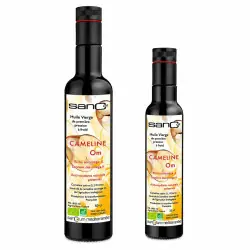

Organic camelina oil
Exceptional cold-pressed oil
Certified organic farming
Bottle of 25cl or 50cl
Origin and processing in France
For culinary and cosmetic uses
No queries yet, leave the first!
Price:
€15.00
Tax included


Organic camelina oil images


100% pure Camelina oil from French organic farming
Organic camelina oil is a cold-pressed vegetable oil extracted from Camelina sativa seeds grown in France, and one of the most concentrated plant sources of omega 3: 39 g of alpha-linolenic acid per 100 ml. It is used exclusively raw, as a dressing. Half a tablespoon - about 5 ml - provides the 2 g of ALA set by European regulations as the daily reference intake. At Biovie, we offer it in 25 cl or 50 cl bottles, in violet-tinted glass.
Camelina (Camelina sativa), also known as "false flax" or "German sesame", is one of the oldest known oilseed plants. Native to Northern Europe and Central Asia, camelina has been grown for more than 3000 years for its vegetable oil and as a source of food for people and animals.
As early as the Iron Age, its seeds, combined with flax seeds and other grains, were used to make bread. From the Roman Empire until the discovery of gas and electricity, camelina oil was a favoured fuel for oil lamps and an everyday consumer product (food, soap making, paints...). Recent discoveries about its exceptional agronomic and nutritional qualities present camelina growing as a fitting response to today's ecological challenges and a key player in the food of tomorrow.
Frankly, it's a plant we had almost forgotten. It disappeared from French fields during the 20th century, replaced by higher-yielding crops. And now it's coming back - for good reasons.
🌿 The "Cameline om" used for this oil is an annual or biennial plant from the Brassicaceae family (mustard, broccoli, cabbage, rapeseed...). Derived from a wild camelina, it was adapted by our supplier, after several consecutive years of organic farming production, to the terroir of southern France for its development across the Mediterranean and Europe.
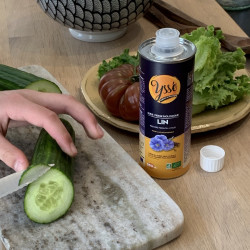
🌿 The taste. With its typical plant flavour, mild and fresh, this camelina oil has a fluid, clear and glossy appearance and a lovely golden yellow colour. Remarkably versatile, it can be elegantly incorporated into a wide range of culinary preparations. For example, you can drizzle it over raw vegetables or add it to your plant-based pâtés or seaweed tartares, for a refined touch and a truly unique finish.
It is often compared with flaxseed oil. In reality, it is noticeably milder: where flaxseed quickly turns bitter and a little fishy, camelina keeps a note of hazelnut and raw asparagus that goes down much better with children. In fact, that's the first thing people tell us when they try it after giving up on flaxseed.
🌿 How to use it? Raw, only. Omega 3 fatty acids are fragile: heat degrades them and alters both the taste and the nutritional value of the oil. In practice, it works very well on:
- the raw vegetables and salads - grated carrot, raw beetroot, young shoots;
- the seaweed tartares and plant-based pâtés, where its mildness lets the iodine notes of wakame or dulse come through;
- the purées and soups, added at the last moment on the plate;
- the green smoothies and plant-based yoghurts - a drizzle of oil is enough, you can barely taste it.
🌿 How much? One tablespoon is about 10 ml. Personally, I pour the equivalent of half a tablespoon - 5 ml - over my lunch plate, and that's it for the day. The easiest way, at first, is to measure once with a spoon: after three or four meals, the gesture is set and you no longer think about it.
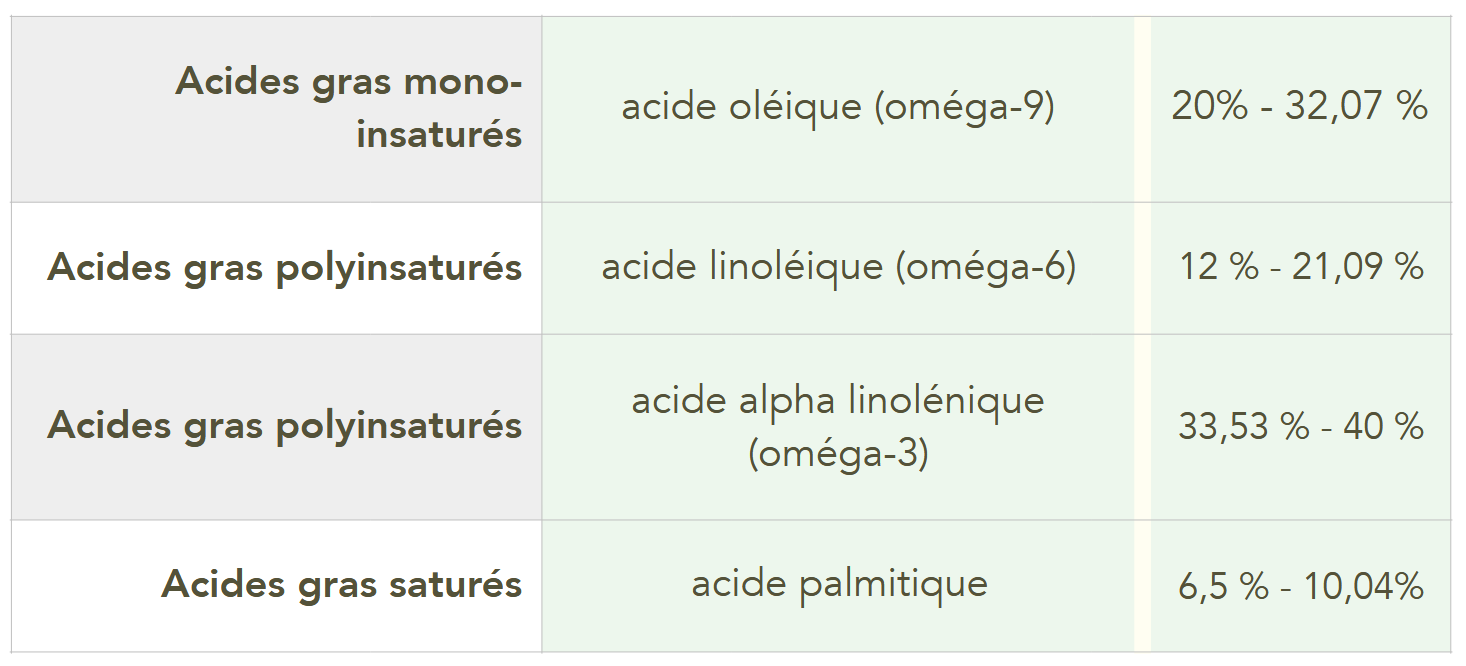
🌿The fatty acid profile: this is where it all comes down to. The camelina seeds used by our supplier contain more than 40% oil, made up of around 90% unsaturated fatty acids. Per 100 ml, this oil provides 39.09 g of alpha-linolenic acid (ALA), the plant-based omega 3, 17.4 g of linoleic acid (omega 6) and 15.9 g of oleic acid. Saturated fatty acids, meanwhile, top out at 9.7 g.
In other words, it has an omega 6 / omega 3 ratio of about 1 to 2 - in favour of omega 3. That's rare. Most common oils show the opposite, often by a very wide margin: sunflower oil is above 100 to 1 in favour of omega 6.
Alpha-linolenic acid contributes to the maintenance of normal blood cholesterol levels. The beneficial effect is obtained with a daily intake of 2 g of alpha-linolenic acid, as part of a varied and balanced diet and a healthy lifestyle. Let's make that concrete: with 39.09 g of ALA per 100 ml, about 5 ml of this oil - half a tablespoon - is enough to reach those 2 g. A 25 cl bottle therefore covers around fifty days.
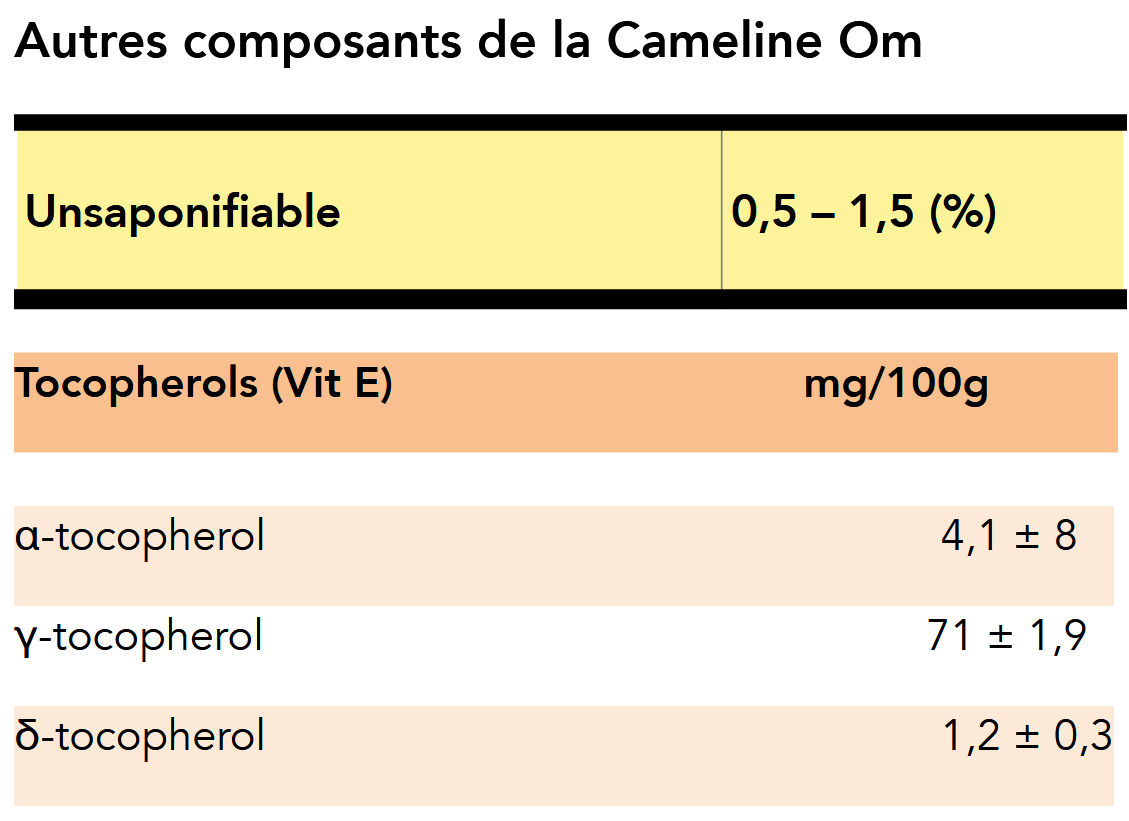
🌿 Vitamin E: 7 mg per 100 ml. That is more than half of the reference intakes, which allows this oil to be considered a source of vitamin E within the meaning of European regulations. Vitamin E contributes to the protection of cells from oxidative stress - always as part of a varied and balanced diet. These tocopherols also play a dual role: they contribute to the stability of the oil itself.
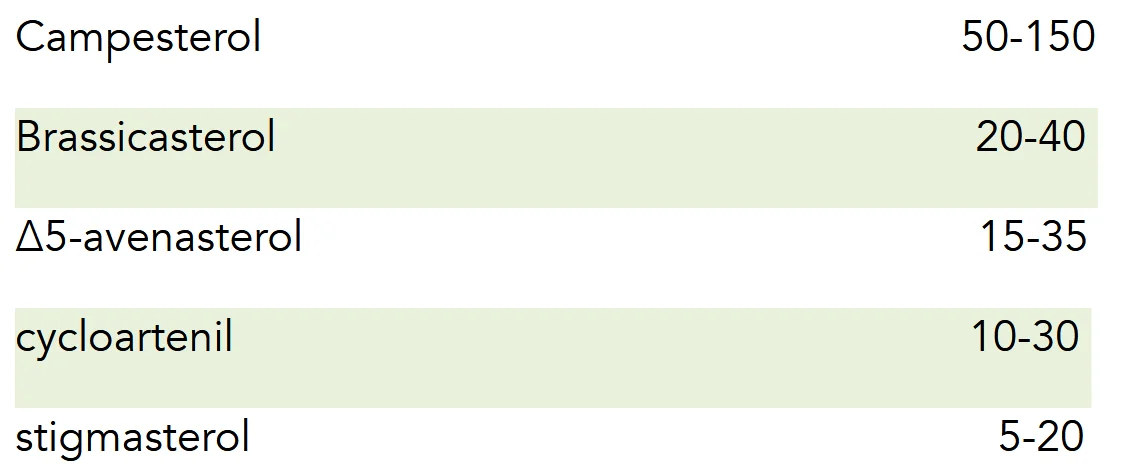
🌿 Tocopherols, phytosterols and storage. Camelina oil also contains phytosterols and polyphenolic compounds. Together with the tocopherols, they give it good resistance to oxidative rancidity - which is precisely what clearly sets it apart from flaxseed oil, known to be fragile and often disappointing a few weeks after opening. An oil with 39 g of ALA per 100 ml that holds up over time is not that common.
A point of honesty, because it seems important to me. A lot is written about omega 3 and health, and some of those claims go well beyond what European regulations allow us to write. So we stick to what is established and verifiable: the oil's analytical profile, and the two authorised claims above. For the rest, the composition speaks for itself.
🌿 On the skin: A dry oil, it absorbs quickly without leaving a greasy feel on the skin. Aurélie uses it at the end of the day on her hands and forearms, after a day in the garden. A few drops are enough.
Also worth reading on the Biovie blog:
- Camelina oil vs flaxseed oil: which one to choose? - the full comparison, taste, stability and contents.
- Why should you vary your oils? - why a single oil is never enough.
sanCoil
The 'om' camelina oil produced and distributed by sanCtum méditerranée, thanks to its polyunsaturated fatty acid profile, omega 3 and omega 6, has remarkable qualities and a unique taste. Committed to defending biodiversity, the sanCoil brand is part of sanCtum méditerranée's mission to create lasting value in new supply chains and to contribute to better food for people and animals and to preserving the planet. It is the strategic subsidiary for the local development of raw materials, processing and the associated know-how.
Why we chose this producer. Three reasons, in order. First, the varietal selection: Cameline om is not a seed bought from a catalogue, it was adapted over several successive growing seasons to the terroir of southern France. Second, the pressing, carried out cold below 35 °C, with the modest yield that implies. Finally, the location of the crops - Gard, South-West, Dijon area. A camelina oil that travels 8,000 km before reaching your kitchen doesn't make much sense.
Cameline om itself has a high content of tocopherols, phytosterols and polyphenols, which makes its oil more resistant to oxidative rancidity. The vitamin E content (tocopherols, 7 mg per 100 ml) also provides great stability and a longer shelf life.
Ecology : From the multiplication and supply of seeds and seedlings through to the finished product, the sanCoil brand is committed to an ethical approach to promote fairer and ecologically sustainable organic farming. Its activities and investments focus on developing perfume, aromatic, medicinal and food plants (PPAMA) and on collective development around useful plants (green manures, organic treatments...) for agro-biodiversity research.
A supply chain for the future : Recent research has shown that camelina (Camelina sativa L. Crantz) has exceptional agronomic characteristics. With very low requirements in terms of soil preparation (ploughing) and "weed" control (allelopathic effects), camelina adapts easily to any type of soil and climate, with increased resistance to drought, disease and pest attacks. Growing it is therefore in line with the goals of reducing energy consumption and chemical treatments (pesticides, insecticides, chemical fertilisers), and it protects soils against erosion. The agro-biological qualities of camelina growing open up new prospects for sustainable development and ecology.
Its pale yellow flowering, very attractive to bees, lasts about three weeks. That's not a minor detail: in a cereal rotation, a plant that feeds pollinators in spring and needs neither irrigation nor treatment is exactly the kind of crop Mediterranean soils need. That is why we talk about a supply chain for the future, and not just one more oil in the catalogue.
Best before: 31/10/2027
Packaging: 25cl or 50cl bottle
- violet-tinted glass bottles, well able to protect light-sensitive products from the harmful effects of light on quality
Origin of the seeds : Grown in Gard , South-West, Dijon France
Cold pressing < 35° which brings out all the nutritional qualities of the oil (yield: about 30/35%)
Optimal shelf life : 24 months in the original sealed packaging
How to store : Camelina oil should be stored in a closed place, away from light and air, at a stable, moderate temperature (5 to 15°C). Once the bottle is opened, the fridge remains the best place - omega 3 likes neither heat nor light. Do not keep it near a hob or on a windowsill.
Recommended use : raw only, as a dressing and finishing oil. One tablespoon is about 10 ml; half a tablespoon, about 5 ml, provides 2 g of alpha-linolenic acid.
A word about the last drops in the bottle: a vegetable oil should never be poured down the sink. We have written an article on recycling cooking oils if the subject interests you.
- Product identity card :
| Characteristic | Value |
| Botanical species | Camelina sativa - "Cameline om" variety |
| Family | Brassicaceae (cabbage, mustard, rapeseed) |
| Origin of the seeds | France - Gard, South-West, Dijon |
| Farming method | Certified organic farming |
| Extraction | Cold pressed < 35 °C (yield 30 to 35%) |
| Omega 3 (ALA) | 39.09 g / 100 ml |
| Omega 6 / omega 3 ratio | About 1 : 2 |
| Vitamin E | 7 mg / 100 ml |
| Taste profile | Mild and fresh, notes of hazelnut and raw asparagus |
| Formats | 25 cl violet glass bottle - 50 cl violet glass bottle |
| Storage | 24 months, original sealed packaging |
- Type of fatty acids and percentage :
 |
|

- Average nutritional values :
| Average nutritional values | 100 ml |
| Energy value
Energy |
900 kcal
3700 kJ |
| Fat | 100 g |
| Saturated fatty acids | 9.7 g |
| Monounsaturated fatty acids | 30.5 g |
| of which oleic | 15.9 g |
| Polyunsaturated fatty acids | 56.4 g |
| Linoleic acid | 17.4 g |
| Alpha-linolenic acid | 39.09 g |
| Carbohydrates | 0 g |
| Fibre | 0 g |
| Protein | 0 g |
| Salt | 0 g |
| Vitamin E | 7 mg |
What is camelina oil?
Camelina oil is a vegetable oil extracted from the seeds of Camelina sativa, a plant from the Brassicaceae family grown in Europe for more than 3,000 years. It is also called "false flax" or "German sesame". What sets it apart is its omega 3 content: 39.09 g of alpha-linolenic acid per 100 ml, one of the highest concentrations among edible oils. It is consumed exclusively raw.
How much camelina oil per day?
About 5 ml, or half a tablespoon. That is the amount providing the 2 g of alpha-linolenic acid set by European regulations as the daily reference intake for this claim. A full tablespoon is about 10 ml, a teaspoon about 5 ml. The easiest thing is to measure once with a teaspoon to get a feel for it, then pour straight onto the plate.
Can you cook with camelina oil?
No, and that's really the point to remember. Omega 3 fatty acids are fragile: heat degrades them and the oil loses both its taste and its nutritional value. Keep it for raw use - dressings, finishing, a drizzle over dishes already served - and keep an olive oil or another more stable oil for cooking.
Camelina oil or flaxseed oil: which one to choose?
Both have a high alpha-linolenic acid content (39.09 g per 100 ml for camelina). The difference lies in two areas: taste and stability. Camelina is noticeably milder, with hazelnut notes, where flaxseed quickly turns bitter. And its natural content of tocopherols, phytosterols and polyphenols makes it more resistant to oxidative rancidity. For daily family use, camelina generally goes down better. The detailed comparison is in this blog article.
What does camelina oil taste like?
A mild, fresh plant flavour, with notes of hazelnut and raw asparagus. The oil is fluid, clear and glossy, with a lovely golden yellow colour. It doesn't dominate dishes: it accompanies them. That is precisely what makes it easy to use every day, including with people who never took to flaxseed oil.
Why is the bottle made of violet-tinted glass?
Because light is the enemy of unsaturated fatty acids. Violet glass filters out a large part of the visible spectrum and protects the oil far better than clear glass or even classic green glass. For an oil made up of around 90% unsaturated fatty acids, this is not a packaging detail: it is what preserves the oil's profile between bottling and your plate.
How long does camelina oil keep once opened?
The optimal shelf life stated by the producer - 24 months - applies to the original sealed packaging. Once the bottle is opened, keep it in the fridge and use it without waiting too long. The 25 cl format is designed precisely for that: at 5 ml a day, it is finished in around fifty days, well before oxidation becomes an issue.
Is camelina really grown in France?
Yes. The seeds come from crops located in the Gard, the South-West and the Dijon area, grown under certified organic farming. The "Cameline om" variety was adapted to the terroir of southern France by our supplier, sanCoil (sanCtum méditerranée), after several successive seasons of organic production.
Can camelina oil be used on the skin?
It is a dry oil: it absorbs quickly and leaves no greasy feel. Many people use it for hand or body care, a few drops at a time. That said, it is first and foremost an edible oil - it is in the kitchen that it gives its best.
Is camelina oil suitable for a vegan diet?
Yes. It is a pure vegetable oil, obtained simply by cold pressing the seeds, with no ingredient or processing aid of animal origin. It is also certified organic. For people following a 100% plant-based diet, it is even one of the oils most concentrated in ALA (39.09 g per 100 ml) to have on the table - I come back to it often after thirty-four years of vegan practice.
Updated: August 2026. Product sheet validated by Éric Viard, founder of Biovie and ISTOMengineer, co-author of "Algues au quotidien" (Gallimard, 2024) - Best cookbook in the world, Gourmand Cookbook Awards 2025, and Best cookbook in France, Académie Nationale de Cuisine 2025.
Disclaimer: the information presented on this product sheet is provided for information purposes only and does not constitute medical advice. Consult a qualified health professional before making any changes to your diet or supplementation. As part of a varied and balanced diet and a healthy lifestyle.
Wondering… ?
Everything you need to know before ordering.
Be the first to ask a question about this product!
Question about the product
Ask a question