Here is an article that was very close to my heart! Aurélie and I have been eating wakame for years, and honestly, it is one of the easiest seaweeds to include in everyday meals. You may already know it: it is the tender green seaweed you find in miso soup at Japanese restaurants. But did you know that the benefits of wakame go far beyond being a simple soup garnish?
Between its exceptional calcium content (between 8 and 11 times more than milk, weight for weight), the research conducted on its fucoxanthin and fat metabolism, and its remarkable natural iodine content, this wakame seaweed really deserves a closer look. In practical terms, I will explain why this seaweed has become a cornerstone of our diet, how to choose it, how to prepare it, and above all how to enjoy all its benefits safely.
What is wakame?
Wakame (Undaria pinnatifida) is an edible brown seaweed native to the cold seas of Asia. Don't be fooled by its scientific classification as a "brown" seaweed: once on the plate, it shows a beautiful green colour, tender and slightly translucent. That is precisely what makes it so visually appealing.
In Japan, this wakame seaweed has been eaten for more than 1,300 years. The first writings mentioning its use date back to the Nara period (710-794), when it was already considered a precious food, reserved for the nobility and offered as tribute to the emperor. Today, Japan is still the world's largest consumer of wakame, where it holds a central place in the daily diet.
What is fascinating is that the inhabitants of Okinawa (one of the famous "blue zones" with an exceptional concentration of centenarians) traditionally eat seaweed, including wakame, almost every day. Of course, longevity cannot be explained by a single food, but this observation has prompted a great deal of research into the benefits of wakame and of seaweed in general.
In Europe, and particularly in Brittany, wakame cultivation has developed since the 1980s. The cold, nutrient-rich waters of the Breton coast offer ideal conditions for producing quality wakame, with the advantage of rigorous traceability and health controls. To find out more about the different edible seaweeds available, we have written a complete guide.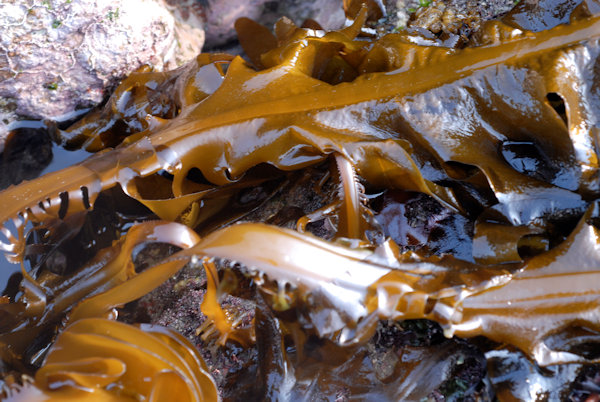
The 7 nutritional strengths of wakame
1. Natural iodine, which contributes to normal thyroid function
Wakame is naturally rich in iodine, a trace element that contributes to the normal function of the thyroid. The thyroid regulates our metabolism, our energy, our body temperature and many other vital functions. According to data from the Ciqual Table (ANSES), dried wakame contains about 1,800 µg of iodine per 100g, making it one of the most concentrated natural sources.
In France, mild iodine deficiencies remain common, particularly among women of childbearing age. Moderate, regular consumption of wakame can help cover daily requirements (150 µg for an adult according to EFSA), provided the recommended quantities are respected.
2. Calcium, needed for the maintenance of normal bones
Here is a figure that particularly struck me: wakame contains between 8 and 11 times more calcium than milk, weight for weight. In concrete terms, 100g of dried wakame provides 1,000 to 1,300 mg of calcium, compared with 120 mg for cow's milk. Of course, nobody eats 100g of wakame in one go: a 5g serving provides about 65 mg, to be added to the other sources of the day. And calcium is needed for the maintenance of normal bones.
This calcium comes with magnesium and vitamin K, two nutrients that also contribute to the maintenance of normal bones. This is what we call nutritional synergy, and it is what gives whole foods their strength compared with isolated supplements.
3. Wakame and cardiovascular health: avenues of research
The link between wakame and cardiovascular health is the subject of research. This work remains preliminary and does not allow any effect on the heart to be attributed to wakame.
Wakame also contains specific peptides and polysaccharides studied for their effects on blood pressure. Fucans, in particular, are soluble fibres specific to brown seaweeds that are the subject of active research.
4. Antioxidant compounds under study
Fucoxanthin, the pigment that gives wakame its characteristic colour, is studied for its antioxidant activity, observed mainly in the laboratory. Unlike conventional antioxidants such as vitamin C or E, fucoxanthin has a unique chemical structure that allows it to act on several cellular mechanisms at the same time.
Wakame also contains polyphenols and chlorophyll, which complete this profile. In the laboratory, these compounds show an ability to neutralise free radicals.
5. Unusual fibres: alginates and fucans
Wakame's fibres, notably alginates and fucans, have a special feature: they form a gel on contact with water. Studies are looking at their role in intestinal transit and as food for the bacteria of the microbiota, a very active field of research.
Studies have also looked at the ability of these soluble fibres to slow down the absorption of sugars during a meal. To explore this subject further, also discover kombu, another brown seaweed with comparable fibres.
6. A source of quality plant protein
With about 15 to 20% protein (on a dry matter basis), wakame is an interesting source of plant amino acids. Its protein profile is relatively complete, which is rare in the plant kingdom. For people reducing their intake of animal protein, it is a valuable addition, to be combined with other sources such as pulses or spirulina.
7. Alginates that bind to certain metals
The alginates in wakame have a fascinating ability: studies, carried out mainly in the laboratory, have observed that they can bind to certain metals. All the more reason to choose quality seaweed from unpolluted areas: a seaweed harvested in contaminated water accumulates these metals itself!
Wakame and weight: what the studies really say
Let's talk frankly about a subject that interests a lot of people: wakame and weight, what do we really know?
Fucoxanthin, wakame's famous pigment, has been the subject of many studies in recent years, most of them carried out on animals. In humans, trials remain few and their results are mixed: they do not allow any effect on weight to be attributed to wakame.
What mechanism? In rodents, fucoxanthin has been observed activating a protein called UCP1, found in adipose tissue, which increases thermogenesis, in other words the body's production of heat. Researchers put forward this mechanism to explain the 24% increase in resting energy expenditure reported in other studies, but it still needs to be confirmed in humans.
Important: These results remain preliminary and wakame is not a miracle pill. Weight management relies on an overall approach: a balanced diet, regular physical activity, good-quality sleep. Think of wakame as a good food on that plate, not as a solution.
Also interesting are wakame's fibres: they swell on contact with water, and their effect on satiety is the subject of studies. Add to that a very low calorie density (about 45 kcal per 100g rehydrated) and you will understand why wakame easily finds its place in a balanced diet.
Photo taken from our book "Cuisiner les algues"
Detailed nutritional composition
Here are the nutritional data for dried wakame, according to the ANSES Ciqual Table (per 100g):
Macronutrients
- Energy: 306 kcal (but you only eat 5-10g at most)
- Protein: 16.7 g
- Carbohydrates: 39.6 g (of which fibre: 32.7 g)
- Fat: 2.6 g (of which omega-3: 0.9 g)
Minerals (wakame's stars)
- Calcium: 1,000 to 1,300 mg (125 to 162% of the RDA)
- Magnesium: 770 mg (205% of the RDA)
- Iron: 13.6 mg (97% of the RDA)
- Iodine: 1,800 µg (1,200% of the RDA, hence the importance of moderation)
- Potassium: 6,100 mg
Vitamins
- Vitamin A: 360 µg
- Vitamin K: 66 µg
- B vitamins: B1, B2, B9 (folate)
Specific bioactive compounds
- Fucoxanthin: a carotenoid pigment studied for its role in fat metabolism (mainly in animals)
- Fucans: sulphated polysaccharides studied in the laboratory
- Alginates: gelling fibres, able to bind to certain metals
These figures are impressive, but remember that a realistic serving of wakame is 5 to 10g of dried product. It is nonetheless a remarkable nutritional concentrate, comparable to other superfoods such as dulse or nori.
How to eat wakame every day
Dried wakame: the most practical
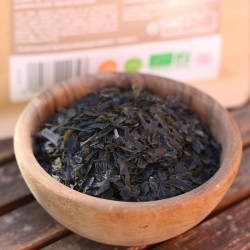
This is the most common form and the easiest to store. Dehydrated wakame comes in flakes. To prepare it:
- Pour the desired amount into a bowl (allow 5g per person)
- Cover with cold or lukewarm water
- Leave to rehydrate for 5 to 10 minutes: the wakame will triple in volume
- Drain well and squeeze lightly to remove excess water
- It's ready! Add it to your dishes
Storage: Dried wakame keeps for several months (even more than a year) in an airtight container, away from light and moisture. Once rehydrated, eat it within 2-3 days, kept in the refrigerator.