Organic frozen fresh spirulina - 420g
Frozen fresh spirulina
Certified organic
Made in France
6 x 70g blocks, i.e. 420g
SHIPPED EVERY THURSDAY VIA CHRONOFRESH IF ORDERED BEFORE TUESDAY 18:00 (SHIPPING WITHIN FRANCE ONLY)
ON SALE THROUGHOUT OCTOBER UNTIL 27/10 18:00)
No queries yet, leave the first!
Price:
€64.00
Product availability:
In stock
Tax included
- Certified organic


Organic frozen fresh spirulina - 420g images


Ultra-fresh organic spirulina
(6 x 70 g blocks to thaw)
Frozen fresh spirulina is living spirulina simply pressed and then frozen straight after harvest, never dried : 6 x 70 g blocks (420 g in total) grown and harvested in the north of France, at a rate of 6 to 12 g per day - that is, half a block to one block. No drying, no heating: the excess water is removed, it is weighed, then frozen straight away to lock in its freshness. The result: a melting texture once thawed, a neutral taste, and 16.9 mg of iron per 100 g.
Have you tried spirulina powder but its taste really isn't for you? Would you like to work it into your diet more easily? We have the solution!
Fresh spirulina, made in the north of France, really is a game-changer in the kitchen.
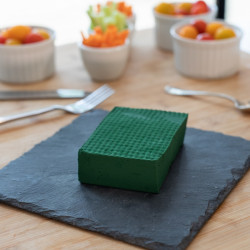
Grown and harvested with the greatest care, this micro-alga is gently pressed to remove excess water and simply concentrate the spirulina in its purest form.Weighed, then cut into blocks in strict compliance with hygiene standards and the cold chain. You get a smooth, creamy block (a little like tofu) that you can very easily cut with a knife, spread, or mix into your sweet and savoury preparations.
Its taste is neutral, so you can slip it into any of your everyday meals.
Jamy explains it all in his report from Xavier, our producer:
🟩What makes it different from other spirulinas?
We were won over by how easy it is to use and its soft texture, and really surprised by its neutral taste: spirulina acts as a flavour enhancer, bringing an "umami" note to your preparations while its own flavour is very mild, imperceptible. It is ideal for giving a magnificent green colour to your savoury and sweet dishes without altering their taste. On the contrary, your cooking will be all the better for it.
In practice, the difference comes down to a few words: nothing has been removed, nothing has been heated. Whereas spirulina powder goes through a drying stage, the fresh block stays just as it comes out of the pond, give or take the water. It therefore keeps its natural enzyme activity and its creamy texture. Spirulina in its fresh form is a raw, unprocessed food that you cook with - and that is precisely what changes everything day to day.
🟩 How to use it?
- Prepared with olive oil or honey (natural preservatives), you can keep it for up to 15-20 days in the fridge.
Add creaminess to your morning toast or tapenade toasts for aperitifs, deepen the green of your guacamole, liven up your vinaigrettes, make original dessert creams, a surprising tiramisu...
- We recommend pairing it with a squeeze of lemon or with citrus fruit, which go very well with its neutral taste.
- Do not heat spirulina.
- Day to day: take a block (or half a block) out of the freezer and let it thaw for 2 minutes at room temperature - it gives a smooth green liquid that is easy to stir into a glass or a preparation. The recommended amount is 6 to 12 g of frozen fresh spirulina per day, that is, half a block to one block. Never refreeze a block that has already been thawed.
A kitchen tip from our daily practice: add a squeeze of lemon to the thawed block before stirring it in. If the taste of algae still puts you off, our 12 tips for masking the taste of spirulina also work very well with the fresh version.
🟩 Why eat fresh spirulina
Eating spirulina as a food or condiment in its own right, in your everyday meals - isn't that more enjoyable than swallowing it mechanically every morning without even tasting it? Fresh spirulina is slowly becoming more widely available and regaining all the nobility of its pure form in our kitchens. Besides its very pleasant texture and its umami side, unprocessed, it arrives just as it comes out of the pond, a bit like an apple you bite into after picking it from the tree - that is when it is at its best!
It contains on average 5695 mg of phycocyanin per 100 g of fresh spirulina. Phycocyanin is the characteristic blue pigment of spirulina - we have written a complete guide about it on the blog.
🟩 What European regulations say
A 20 g serving of fresh spirulina provides 3.4 mg of iron, or 24% of the nutrient reference values. As such, the health claims authorised by Regulation (EU) No 432/2012 for iron apply:
- Iron contributes to the reduction of tiredness and fatigue.
- Iron contributes to the normal function of the immune system.
- Iron contributes to normal oxygen transport in the body.
- Iron contributes to normal formation of red blood cells and haemoglobin.
- Iron contributes to normal energy-yielding metabolism.
Of course, as part of a varied and balanced diet and a healthy lifestyle.
🟩 Delivery
Price includes shipping by Chronofresh
Shipped every Thursday just after harvest if ordered before Tuesday 18:00
Delivery in FRANCE only
🟩 To find out more about using spirulina, read our blog articles:
How to eat spirulina?
Spirulina and microcystins: check the quality!
12 effective tips for masking the taste of spirulina
How much does spirulina cost? (price per kilo and per 100 g)
Blue spirulina: what is it and why is everyone talking about it?
🟩 And to hear from the people who work with algae every day, there is also our podcast: Algues au quotidien, the Biovie podcast.
Eating it fresh means receiving it just as it comes out of the pond - no drying, no heating, no intermediate processing. Its average nutritional values per 100 g are shown in the table in the Practical info tab.
High in iron : with 16.9 mg of iron per 100 g, or around 120% of the nutrient reference values, our fresh block is high in iron within the meaning of European regulations - and iron contributes to the reduction of tiredness and fatigue and to normal oxygen transport in the body, as part of a varied and balanced diet and a healthy lifestyle.
Protein : in its fresh form, as the water has not been removed, the block provides 17.6 g of protein per 100 g (see the nutritional values table in the Practical info tab). Our article on complete plant proteins details the amino acid profile.
Pigments : spirulina naturally contains several pigments - mainly its phycocyanin (the blue pigment, 5695 mg per 100 g here) and beta-carotene (70 mg per 100 g). These molecules are sensitive to heat and light: as the fresh form has been neither dried nor heated, it reaches you without having gone through those stages.
To go further, with no beating about the bush: phycocyanin: is there any danger?
Chlorophyll : this is what gives spirulina its deep green colour. And then there is a point that is often forgotten - the quality of a spirulina depends first of all on the medium it is grown in. That is why it is essential to know where it comes from. Our producer works in closed ponds, under certified organic farming, in the north of France. That is why we insist so much on traceability and microcystin testing.
Who is it for? For everyone, or almost: fresh spirulina can fit into anyone's daily routine, as part of a varied and balanced diet.
For sportspeople, the main argument remains the iron (16.9 mg per 100 g) - iron contributes to normal oxygen transport in the body and to normal formation of red blood cells - plus a protein content (17.6 g per 100 g). It is concrete, measurable, and there is nothing magical about it.
For precautions for use, see the question "Who should be careful with spirulina?" in the Practical info tab.
This cyanobacterium also does the planet some good, since it photosynthesises. Yes, it captures CO2 from the atmosphere and releases oxygen throughout its growth. Grown in ponds, with no arable land, no ploughing and no long-distance transport: a way to produce protein with a very low carbon footprint ;)
🟩 To find out more, also read our blog articles:
How much does spirulina cost?
How to eat spirulina?
Spirulina and microcystins: check the quality!
Blue spirulina: what is it and why is everyone talking about it?
12 effective tips for masking the taste of spirulina
ETIKA SPIRULINA
Shilhi runs the NGO Etika Spirulina Philippines, which sets up low-tech, sustainable spirulina micro-farms and trains local people to make this food accessible to all.
Producing ecologically in the north of France: Xavier, for his part, the son of organic farmers, has always wanted to commit to a sustainable food transition and to organic farming brought back into the heart of our cities. On his return to France, he experimented with low-tech ponds of this green cyanobacterium on his parents' farm before joining an urban farm in Roubaix to launch larger-scale production and perfect their techniques: they managed to extend the use-by date of fresh spirulina from 2 days to 10 days, 100% naturally, thanks to strict production hygiene. A small revolution for the sale of this precious green paste!
Passing on know-how: Having successfully produced quality spirulina in the north of France, sustainably and ecologically, Xavier launched his own urban spirulina farm through a community build, and went even further: he built an educational farm to pass on all this know-how. Cooking workshops, harvesting workshops, but also training in low-tech family-scale cultivation - everything is done to share the secrets of this micro-alga with as many people as possible.
🟩 A local urban micro-farm - what does that involve?
Waste management (everything is designed to be recycled or reused), a smaller energy footprint by choosing low-consumption equipment, solar panels, compost, timber construction, eco-friendly packaging (compostable or reusable), natural cleaning products, bicycle delivery across the Lille metropolitan area…
🟩 Etika Spirulina has also formed partnerships with local artisans to bring spirulina where you least expect it: soap, honey, beer and even spirulina mochi! A real democratisation of spirulina as an everyday food is under way.
🟩 Frankly, this is exactly the kind of supply chain we have been looking for at Biovie since 2007: short, traceable, certified organic, and driven by people we know and go to visit on site. A micro-alga produced in Roubaix and delivered to your door in a few days is also a very concrete answer to the question of transport and freshness. And if the subject of algae supply chains interests you, we talk about it at length in our podcast Algues au quotidien.
Packaging : recyclable vacuum-sealed bag, 6 x 70 g blocks.
Ingredients : 100% raw frozen fresh spirulina (Arthrospira platensis), certified organic. Grown, harvested, frozen and packed in France.
Best before : 24 months after harvest.
Storage : in the freezer at -18°C (do not refreeze after thawing).
Recommended serving : 6 to 12 g per day, that is, half a block to one block.
Delivery : shipped by Chronofresh 1 time a week from the production site (separate parcel from your Biovie order); you will receive your spirulina at home on Saturday morning.
Average nutritional values per 100g:
| Nutrient | Per 100 g |
| Energy | 402 kJ / 95 kcal |
| Fat | 1.5 g |
| of which saturates | 0.8 g |
| Carbohydrate | 2.8 g |
| of which sugars | Traces |
| Protein | 17.6 g |
| Salt | 0.51 g |
| Iron | 16.9 mg |
| Magnesium | 51 mg |
| Beta-carotene | 70 mg |
| Phycocyanin | 5 695 mg |
🟩 Frequently asked questions about frozen fresh spirulina
How much frozen fresh spirulina should you take per day?
The recommended serving is 6 to 12 g per day, that is, half a block to one 70 g block. This amount provides around 1 to 2 mg of iron, or 7 to 15% of the nutrient reference values. If you are just starting, begin at the lower end of the range for a week, then increase gradually - everyone at their own pace.
What is the difference between fresh spirulina and spirulina powder?
Fresh spirulina is simply pressed to remove excess water, with no drying or heating stage, then frozen straight away to lock in its freshness: it keeps its enzyme activity and a neutral taste. Spirulina powder, on the other hand, is dehydrated, so much more concentrated for the same weight (60 to 70% protein versus 17.6 g per 100 g fresh) and stronger in taste. In practice, you don't use the two in the same way: the thawed block is cooked with like a food, the powder is measured out like an ingredient.
Does fresh spirulina really have a neutral taste?
Yes, and that is what surprises people most. The thawed block does not have the pronounced iodised taste associated with spirulina powder: it brings a very mild, almost imperceptible umami note that behaves like a flavour enhancer in both savoury and sweet preparations. That is in fact the number 1 reason why people put off by the powder switch to the fresh version.
How long does frozen fresh spirulina keep, and how do you thaw it?
In the freezer, the best-before date is 24 months after harvest : keep the blocks at -18°C. To use it, take a block (or half a block) out of the freezer: it thaws in 2 minutes at room temperature and gives a smooth green liquid that is easy to stir into your preparations. Never refreeze a block that has already been thawed.
Can you cook fresh spirulina?
No, it is best to avoid heating it. Spirulina's pigments and enzymes are sensitive to heat, so stir it in at the end of preparation, cold or onto a warm dish. Toast, guacamole, vinaigrettes, hummus, dessert creams, tiramisu: it slips in anywhere, as long as it stays out of the saucepan.
What goes well with fresh spirulina?
A simple squeeze of lemon, orange or kiwi on your thawed block goes very well with its neutral taste - and as a bonus, it lightens the texture even further.
Who should be careful with spirulina?
Spirulina is not recommended for people with haemochromatosis or phenylketonuria, and particular care is needed if you are on anticoagulant treatment, have an autoimmune disease or kidney problems, or during pregnancy and breastfeeding. In all these cases, ask your doctor for advice before starting. For everyone, it is better to choose a spirulina whose origin and test results are known: that is the point of our article on microcystin testing.
How can a fresh product be delivered to your home?
Frozen fresh spirulina is shipped every Thursday, just after harvest, by Chronofresh (refrigerated transport), for delivery on Saturday morning. So you need to order before Tuesday 18:00. The parcel is shipped directly from the production site, separately from the rest of your Biovie order, and shipping costs are already included in the price. Delivery in France only.
Disclaimer: The information presented on this page is provided for information purposes only and does not constitute medical advice. Consult a qualified health professional before making any change to your diet or supplementation. As part of a varied and balanced diet and a healthy lifestyle.
Updated: September 2026. Article approved by Éric Viard, founder of Biovie and ISTOMengineer, co-author of Algues au quotidien (Gallimard, 2024) - Best Cookbook in the World, Gourmand Cookbook Awards 2025, and Best Cookbook in France, Académie Nationale de Cuisine 2025.
The documents that back up what we write about this product. Every document is dated; we remove those that are no longer valid.
Biovie organic certificate
Valid until 31/03/2027Etika Spirulina (Nutraleos) organic certificate
Valid until 31/03/2027Wondering… ?
Everything you need to know before ordering.
Be the first to ask a question about this product!
Question about the product
Ask a question