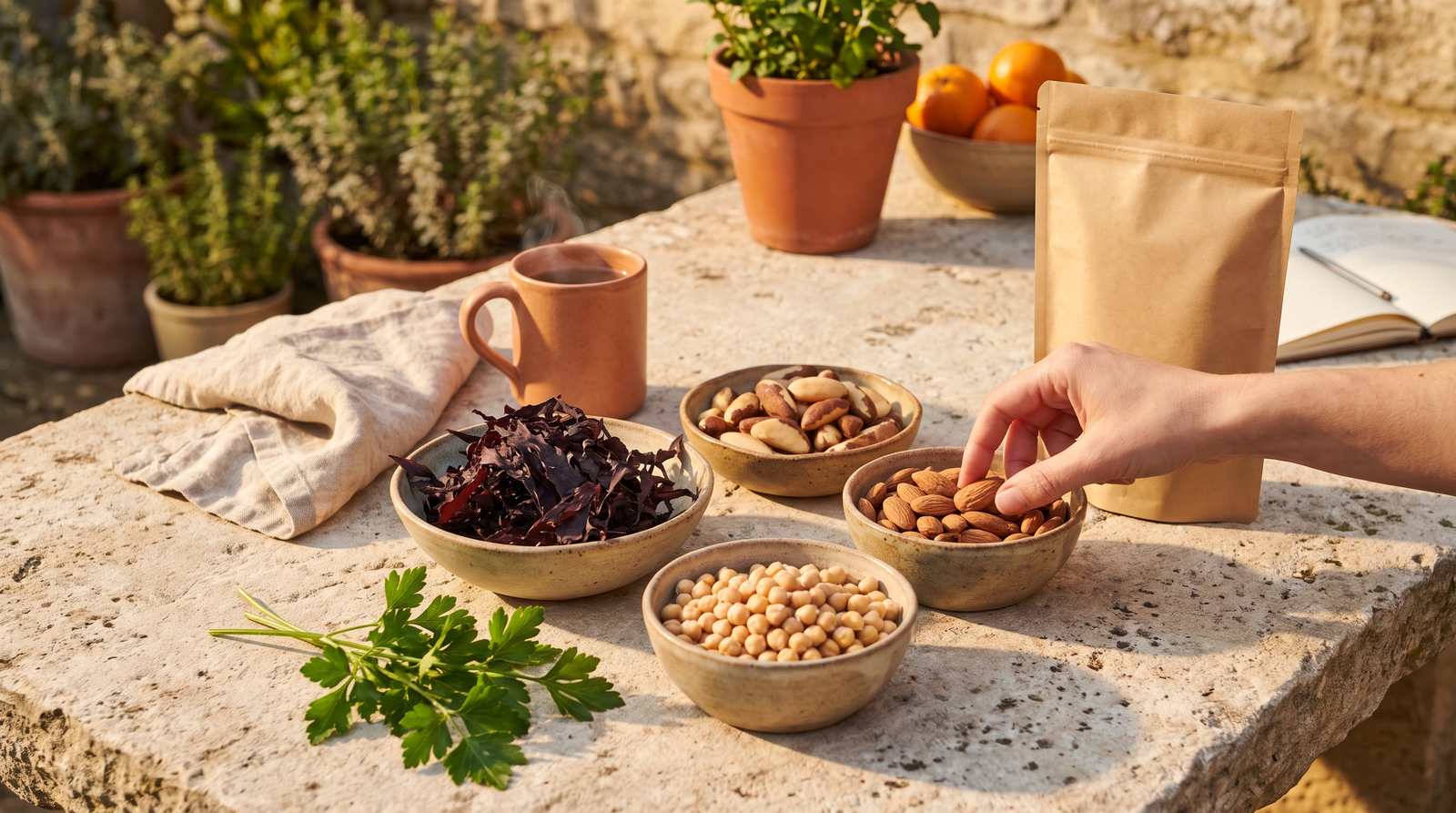
Ask a search engine and you'll get lists, almost never quantities. The foods highest in minerals are seaweeds, very concentrated but eaten by the few grams, followed by nuts, seeds, legumes and leafy greens, which cover the most needs per real serving, provided their minerals are well absorbed. And behind every marine source, there is seawater itself, the most complete reserve of minerals and trace elements on the planet. At Biovie, we redid this ranking per serving, using the reference values from ANSES.
The Foods Highest in Minerals, in Brief
What foods are highest in minerals? Seaweeds come first for iodine and potassium; next come seeds and nuts (magnesium, selenium), legumes and whole grains (iron and zinc), then leafy greens. And above this list, seawater, where seaweeds get theirs.
- Seaweeds, for iodine (the brown ones especially).
- Nuts and seeds, for magnesium.
- Sunflower seeds and soaked legumes, for zinc.
- Legumes and whole grains, for iron, provided you prepare them well.
- Leafy greens, spinach and chard first, for magnesium too.
- Seawater for magnesium and trace elements.
But "rich" is not enough. You still have to eat a useful amount, then absorb what you ate. As an ISTOM engineer and a vegan since 1992, I was already sprouting seeds as a teenager at my parents' house. More than thirty years later, the question that occupies me hasn't changed: what does the body really keep of what we give it?
Why are "per 100 g" rankings misleading?
A pinch of sea salt is, gram for gram, far more mineral-rich than a bowl of soup. Do we eat it by the spoonful because of that? Obviously not. Yet that is the logic of most lists: they rank by weight, as if everyone ate the same amount of everything. A "per 100 g" ranking measures a concentration, whereas your body receives a serving, and all that matters is the share of your needs it covers.
Take seaweeds. A review of European edible seaweeds (Circuncisão et al., 2018) gives figures that make your head spin: their ash content, that is their minerals, reaches up to 40% of dry weight, against about 20% for spinach, and their mineral contents would be 10 to 100 times those of land vegetables. Out of 10 g of dried seaweed, up to 4 g can therefore be minerals. Only, a serving of seaweed is counted in grams, not in platefuls.
And then there is the opposite case, which is trickier. Six Brazil nuts, about 28 g, provide 544 µg of selenium according to the Linus Pauling Institute, while the adult upper limit is 400 µg per day. Six nuts is the hollow of a hand, a snack you nibble without thinking. Here, "rich" means "too much".
Of course, these tables are not wrong: they simply answer a different question from the one you ask yourself in front of your cupboard. To build a list of the foods highest in minerals that is really useful, you have to cross the content, the serving actually eaten and your need for the day. It is the only honest way to rank the foods highest in minerals, and the only way to get a mineral rich foods list you can actually use.
The mineral-by-mineral ranking, set against your needs
Adult needs according to ANSES (2021), contents per serving from the US tables compiled by the Linus Pauling Institute (servings converted into grams or millilitres) and the 2018 seaweed review: here is what it looks like, mineral by mineral.
| Mineral | Adult need (ANSES) | Star food | Amount per serving | Source |
|---|---|---|---|---|
| Magnesium | 380 mg/day (men), 300 mg/day (women) | Brazil nuts, cashews, almonds, spinach, chard | 107 mg (Brazil nuts), 83 mg (cashews), 77 mg (almonds, i.e. 23) per 28 g; 78 mg (cooked frozen spinach) and 75 mg (cooked chard) per about 120 ml | Linus Pauling Institute |
| Zinc | 9.4 to 14.0 mg/day (men), 7.5 to 11.0 mg/day (women), depending on phytate intake | Sunflower seeds, chickpeas, soaked legumes | 1.5 mg (28 g of dried sunflower seeds); 1.2 mg (about 120 ml of cooked chickpeas) | Linus Pauling Institute |
| Selenium | 70 µg/day | Brazil nuts, sunflower seeds | 544 µg (28 g, i.e. 6 nuts); 18.6 µg (about 60 ml of dried sunflower seeds) | Linus Pauling Institute |
| Iodine | 150 µg/day | Kelps (brown seaweeds) | 6,685 to 10,239 mg/kg dry weight (Laminaria hyperborea); 8,122 to 9,014 mg/kg dry weight (L. digitata), depending on the season | Circuncisão et al., 2018 |
| Potassium | 3,500 mg/day | Dulse (Palmaria palmata) | 95 g/kg dry weight (Maine sample) | Circuncisão et al., 2018 |
| Minerals and trace elements, all together | Varies by element | Seawater | About 35 g of salts per kilo (salinity 35), including 1,280 mg of magnesium, 410 mg of calcium and 400 mg of potassium; almost all other elements as traces | Millero et al., 2008 |
As part of a varied and balanced diet and a healthy lifestyle, none of these foods is eaten in large amounts: they add up.
Magnesium
Per serving, the Brazil nut comes first for magnesium, ahead of the cashew and the almond. Absorption is another matter: you absorb 30 to 40% of the magnesium you swallow, depending on the amount and the food matrix (Linus Pauling Institute). Out of 100 mg swallowed, your gut keeps thirty to forty.
Zinc and selenium
For zinc, no food stands far above the others: sunflower seeds provide 1.5 mg per 28 g and cooked chickpeas 1.2 mg per about 120 ml, against a need of 7.5 to 14 mg per day. Zinc is therefore not won on content, but on preparation. This is precisely where soaking legumes makes complete sense, and I come back to it below. Seawater provides some too, like dozens of other elements, as traces.
For selenium, the Brazil nut beats everything, with a significant nuance: its content depends on the soil where the tree grew, more than 100 µg per nut on rich soil, ten times less on poor soil (Linus Pauling Institute). Two nuts from different origins can therefore have almost nothing in common. The agronomist in me isn't surprised: a tree cannot put into its seed what the earth hasn't given it.
Calcium and iron
Two big absentees from this table, and it's not an oversight. ANSES sets calcium at 950 mg per day from age 25 (1,000 mg from 18 to 24) and iron at 11 mg, or 16 mg in case of heavy menstrual losses. For calcium, I refer you to calcium-rich foods without dairy, which have their own ranking, one I won't comment on, being vegan.
Seawater, the most complete source
People look in their cupboards for what foods are rich in minerals, and forget the most complete reserve on the planet, the one that covers 70% of its surface. One kilo of seawater of salinity 35 contains about 35 g of dissolved salts, including 1,280 mg of magnesium, 410 mg of calcium and 400 mg of potassium (Millero et al., 2008). Alongside these big ones, almost all the other natural elements are present as traces: iodine, zinc, selenium, manganese, copper, boron, lithium.
Compare that with a seed. In the seed, the mineral is locked inside a plant matrix, often behind a phytate, and we'll see below what it takes to get it out. In seawater, it is already dissociated, as an ion, in a liquid. There is nothing to unlock. That is, by the way, the whole explanation for seaweeds: they don't go looking for their minerals, they live in them.
One obvious point has to be made: seawater is salty, and it is its sodium that limits the amount. The WHO recommends staying under 2 g of sodium per day, about 5 g of salt. That is the whole point of diluted forms: the isotonic one, one third seawater to two thirds spring water, brings the concentration down to that of the body's internal environment, whereas the hypertonic one remains seawater. I have detailed what separates isotonic from hypertonic and the origin and composition of Quinton water. If you follow a low-salt diet, or are under kidney or heart supervision, the question is first one for your doctor.
At Biovie, the seawater we offer is a hypertonic marine plasma in a 0.75-litre glass bottle, harvested at open sea off Ibiza by our exclusive supplier, then cold-filtered. Hypertonic simply means it is seawater as it is, and that it is diluted before drinking. For regular culinary use, the same plasma comes in a 3-litre Bag-in-Box. The amounts, the timing and the way to take it, I have detailed in a separate article.
The rest is a matter of cooking. At home, we use seawater as a brine for lacto-fermentation: the sea invented brine long before we did. And the simplest gesture remains salt: an unrefined sea salt keeps the magnesium and the traces that refining removes from white salt. As part of a varied and balanced diet and a healthy lifestyle, it is a detail that costs nothing and is repeated three times a day.
At the beginning of the 20th century, the biologist René Quinton popularised this diluted seawater and opened marine dispensaries that left their mark on their time. The story is fascinating, and I treat it for what it is: a story. What counts today is the composition, and it has no equivalent in a cupboard.
Seaweeds: the champions of concentration
Why would a seaweed be more mineral-rich than a spinach leaf? Because spinach looks for its minerals in the soil, whereas seaweed bathes in seawater all its life and draws its minerals straight from it, like a sponge that is never wrung out. Its colour gives a trend: greens lean towards magnesium and iron, reds towards manganese, browns towards iodine (Circuncisão et al., 2018).
Contents nonetheless vary from one species and one season to another. As co-author of "Algues au quotidien", I keep one rule: a figure from a review describes a trend, and what's in a bag always depends on its batch.
On iodine, kelps reach several thousand micrograms per gram of dry weight, for an adult need of 150 µg per day. A pinch is therefore more than enough. That is the only reserve to keep in mind: small amounts, regularly.
In the kitchen, at home, we avoid cooking them: raw or rehydrated, with the flakes added off the heat. The one exception is broth, where a piece of kombu infuses under the boil. No pan-frying, no wok.
I devoted an article to the place of seaweeds in the Japanese diet.
Seeds, nuts, legumes: rich, but to be "unlocked"
A seed is a strongbox of reserves, closed with a padlock. Logical: these reserves are meant for the future sprout, not for you. That padlock is phytic acid: it makes up 1 to 5% of the weight of cereals, legumes, oilseeds and nuts, and it binds to iron and zinc, which we then absorb poorly, for lack of phytase, the enzyme able to cut it up (Gupta et al., 2015).
The zinc need itself depends on it: EFSA puts it between 9.4 and 16.3 mg per day for men and between 7.5 and 12.7 mg for women, depending on phytate intake (300 to 1,200 mg per day); ANSES stops at 900 mg of phytates, hence its ceiling of 14.0 mg for men. For vegetarians who live mostly on cereals, the need can be up to 50% higher (Linus Pauling Institute). Put simply, the same plate of legumes won't leave you the same zinc depending on how it is prepared.
Good news: the padlock opens. According to the studies compiled by Gupta and colleagues:
- soaking: from 47.4 to 55.71% fewer phytates for chickpeas between 2 and 12 hours, 16 to 21% for sorghum flour in 24 hours;
- sprouting, up to 40%;
- malting of millet, 23.9% in 72 hours and 45.3% in 96 hours;
- sprouting then fermenting pearl millet: 88.3%, the best score of the series;
- sourdough, finally: the zinc of a leavened wholemeal bread is better absorbed than that of an unleavened one (Linus Pauling Institute).
Let's be honest: these figures measure a drop in phytates, and the review does not show, for every process, an absorption gain in humans. But the direction is clear, and it matches a sentence I often repeat: you are not what you eat, but what you absorb. Soaking, sprouting, fermenting is like delivering planks already sawn to the workshop rather than logs: part of the work is done in the jar.
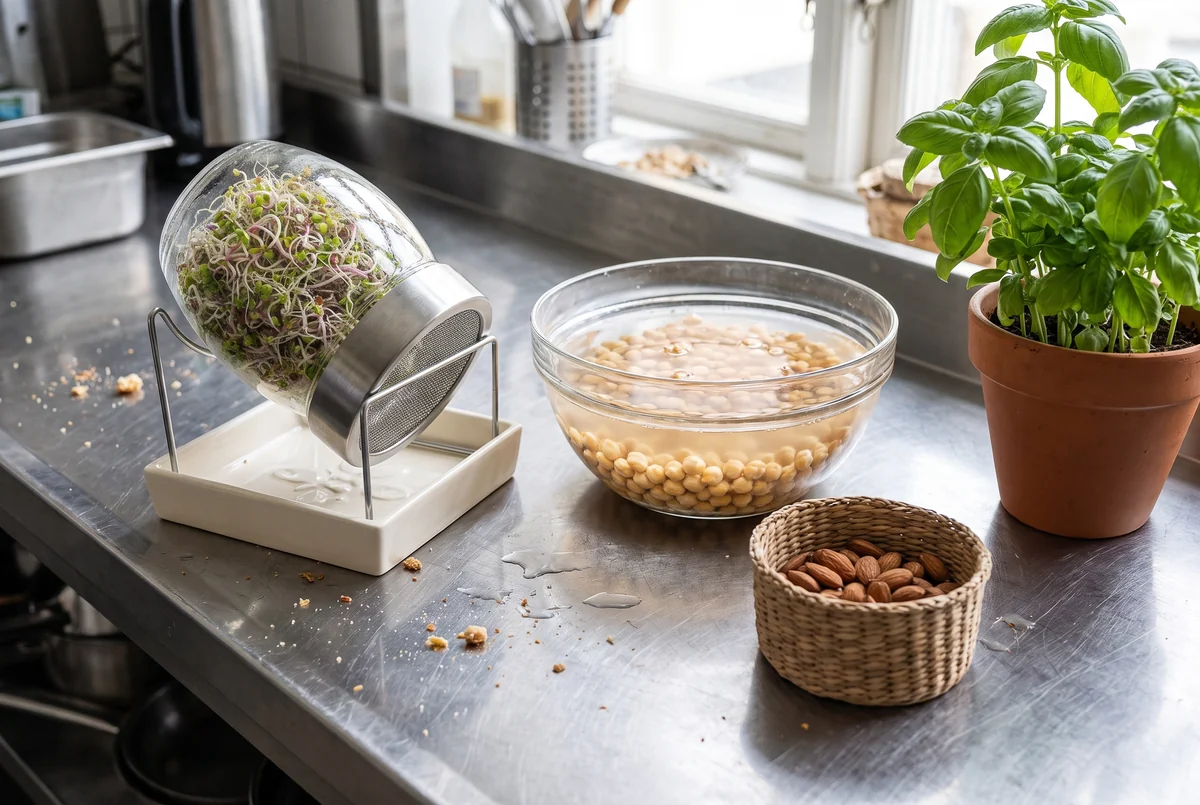
At home, this takes the form of an enormous basin of almonds. One night of soaking, two rinses, 24 hours of sprouting, then dehydrating and jarring under vacuum: enough to last several months. We didn't spend the whole weekend on it, but we did spend some time. Same thing with buckwheat, for crackers and muesli.
Soaking is not the only way to improve nutrient absorption, and fermented foods are another. For spinach, the brake is not called phytate but oxalate, which limits the absorption of its calcium: here is what we really know about oxalates.
How do you put together a mineral-rich day?
The first step is a low one: one or two Brazil nuts, added to what you already eat. And for once, there is a real study in humans. In a randomised trial run in New Zealand on 59 adults over 12 weeks, two nuts a day (53 µg of selenium on average) raised plasma selenium by 64.2%, as much as 100 µg of selenomethionine (61.0%), against 7.6% on placebo (Thomson et al., 2008). Two nuts, a one-second gesture.
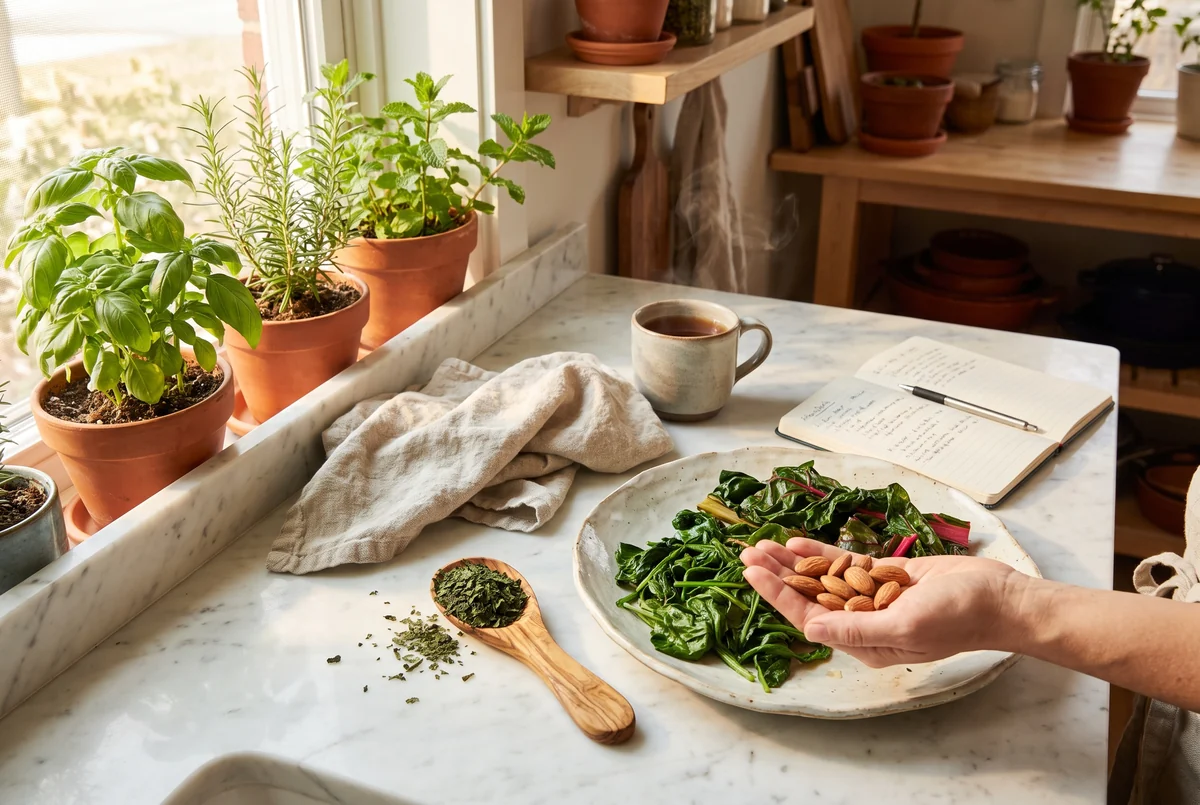
The rest comes at everyone's own pace: a handful of almonds, legumes soaked the night before (a short gesture, but you have to remember it), seaweed flakes off the heat, leafy greens. We add, we remove nothing. As part of a varied and balanced diet and a healthy lifestyle, these additions already put the foods highest in minerals on your plate, with no supplement at all.
For rushed evenings, the organic raw superfood broth serves as the base for a broth that doesn't cook.