



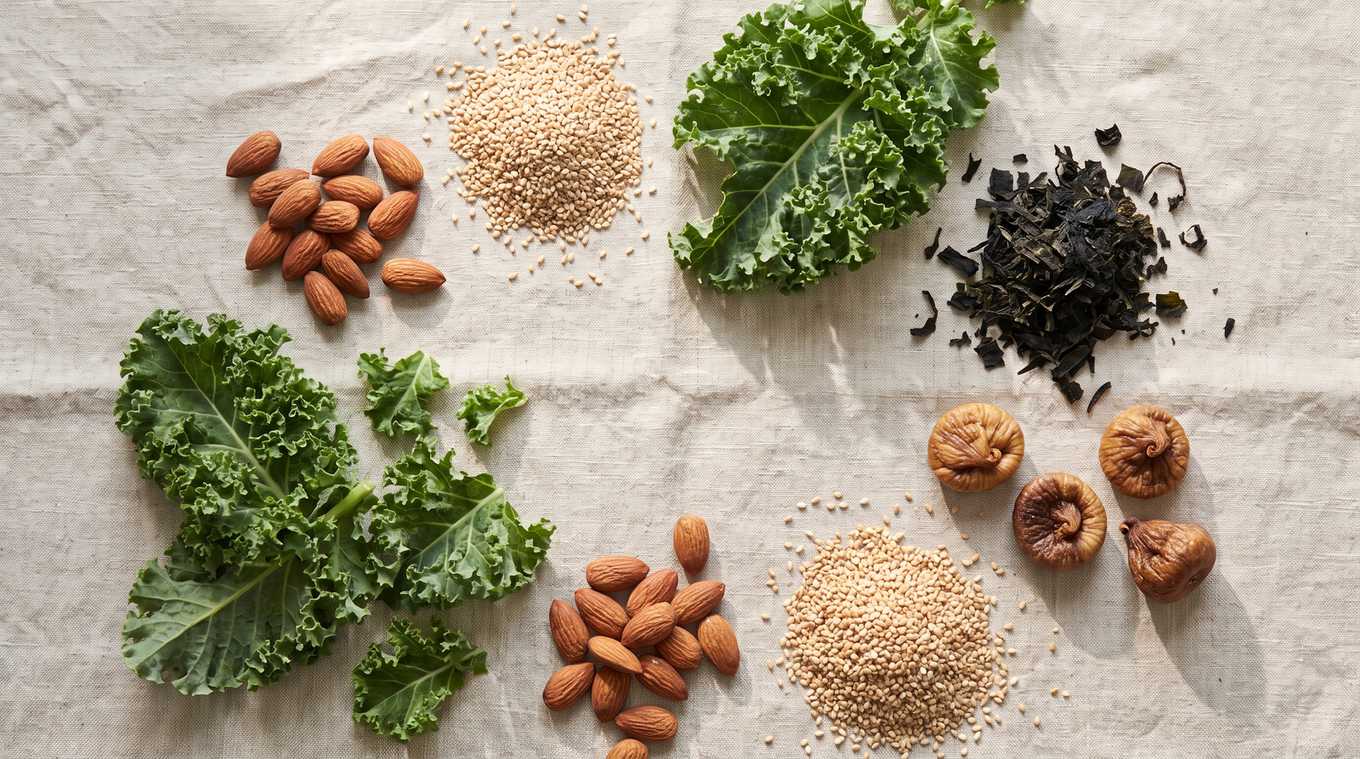
The richest non-dairy calcium sources are, weight for weight, dried seaweed and whole sesame seeds (962 mg per 100 g); but at real serving sizes, kale, white beans, tofu and almonds fill the plate best, while the calcium in spinach is very poorly absorbed. All the amounts quoted come from the Anses Ciqual table, and the absorption rates from human trials using labelled calcium.
"No milk, no calcium." As the son of a baker father who was a Meilleur Ouvrier de France, I grew up on bread and milk. I have been vegan since 1992.
Yet 100 g of whole sesame seeds contain 962 mg of calcium, almost eight times more than 100 g of semi-skimmed milk. Weight for weight, a spoonful of sesame is worth almost eight spoonfuls of milk. There is one big catch, though: containing is not providing, and providing is not absorbing. So plant foods are ranked here three times: weight for weight, per real serving, then by the calcium the intestine actually retains.
Ranking by equal weight: the table of non-dairy calcium sources
Among plants, the ten most calcium-rich foods in the Ciqual table are bladderwrack, sea lettuce, whole sesame, sea spaghetti, Atlantic wakame, chia, dulse, nori, tahini and almonds: all of them contain more than double the calcium of semi-skimmed milk.
| Food | Calcium (mg per 100 g) | Ciqual code |
|---|---|---|
| Dried bladderwrack | 1,410 | 20994 |
| Dried sea lettuce (Ulva) | 1,130 | 20985 |
| Sesame, whole seed | 962 | 15010 |
| Dried sea spaghetti (haricot de mer) | 803 | 20992 |
| Dried Atlantic wakame (Alaria esculenta) | 771 | 20999 |
| Chia, dried seed | 631 | 15047 |
| Dried dulse | 577 | 20988 |
| Dried nori | 440 | 20987 |
| Tahini (sesame paste) | 284 | 15203 |
| Almonds with skin, unsalted | 260 | 15000 |
| Raw kale | 254 | 20346 |
| Dried white beans | 240 | 20501 |
| Dried figs | 167 | 13013 |
| Semi-skimmed UHT milk (benchmark) | 121 | 19041 |
| Plain tofu | 100 | 20904 |
| Raw spinach | 99 | 20059 |
| Boiled broccoli | 43 | 20303 |
Ciqual is the public food composition table of Anses, the French food safety agency: it compiles French analyses and grades each value from A to D according to its reliability. "Per 100 g" means we compare identical quantities, whatever the real use of the food. It is the most honest way to draw up a list of calcium-rich foods. But this way of counting mechanically favours dry foods: remove the water from a seaweed or a seed and everything left is concentrated, like a raisin compared with a fresh grape.
Two lines are surprising. Whole sesame shows 962 mg per 100 g, hulled sesame only 60: the calcium sits in the seed's husk, the one removed to get a smooth white sesame. Another trap with white beans: 240 mg dried, 120 mg once boiled, because the cooking water dilutes their content without making the calcium disappear.
Finally, the calcium content of seaweed varies from one batch to another: for Atlantic wakame, Ciqual gives 771 mg, but measurements range from 183 to 1,730 mg.
On the plate: the ranking changes with the serving
Nobody eats 100 g of dried seaweed at lunch. In practice, a serving of sea lettuce flakes weighs about 5 g, while a kale salad weighs 80. Counted by what we really put on the plate, the ranking flips like a pancake.
The plant foods rich in calcium that matter day to day are therefore not always the ones that lead weight for weight. Here is how each family behaves per serving, according to the same Anses Ciqual table.
Seaweed: very rich, eaten in small amounts
With 1,130 mg per 100 g, sea lettuce remains a champion, but 5 g of flakes provide only 57 mg; 5 g of dulse, 29 mg. That is little, and it is normal: brown seaweeds such as bladderwrack or wakame also concentrate iodine, hence servings of a few grams. Enjoy them raw, rehydrated, as flakes or added off the heat, never pan-fried or sautéed. A whole article covers wakame and how to use it in the kitchen.
Seeds and nuts: the spoonful that counts
Here, the gesture is tiny. A tablespoon of whole sesame (10 g, barely enough to sprinkle on a salad) provides 96 mg, a little less than 100 g of milk, and 10 g of chia give 63. Tahini, less concentrated than the whole seed, provides 43 mg for 15 g. And then there are almonds: a small handful of 30 g is 78 mg.
Green vegetables, legumes, tofu: volume makes the difference
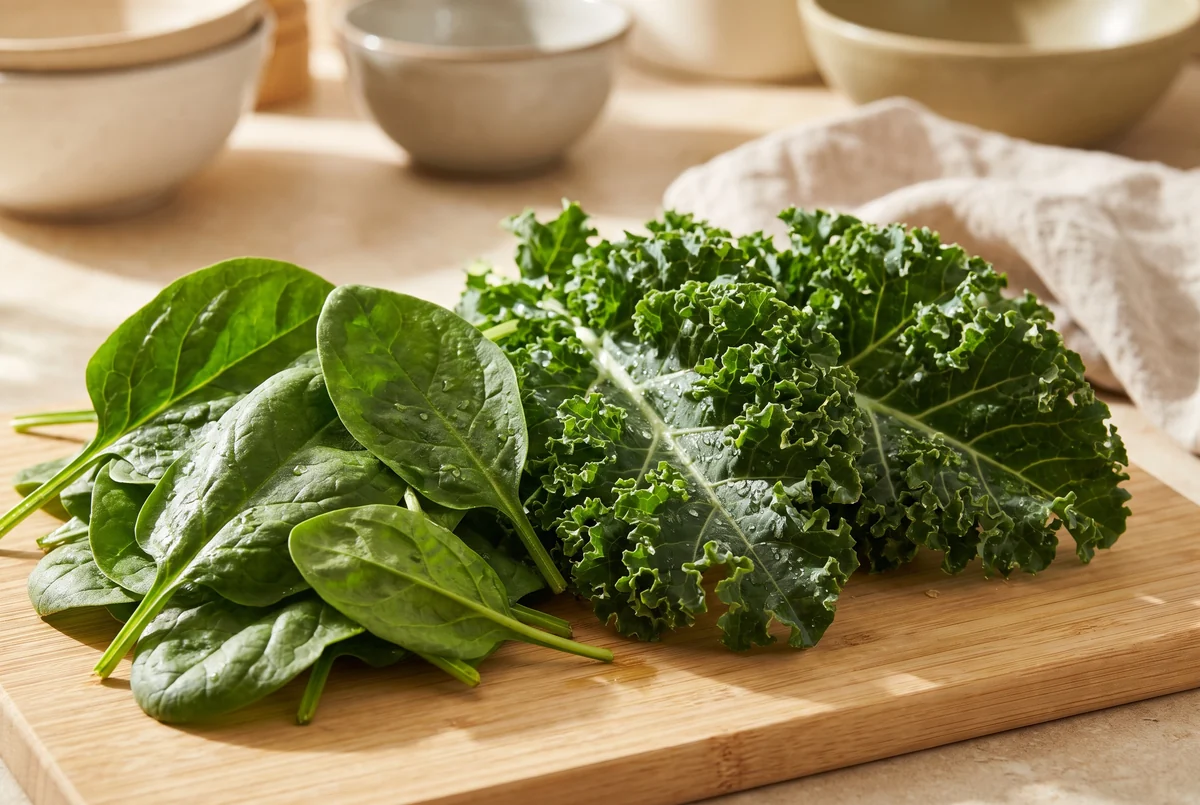
This is where everything tips. Raw kale contains only 254 mg per 100 g, almost four times less than whole sesame, but an 80 g salad provides 203, more than any serving of seaweed or seeds. A 150 g plate of cooked white beans gives 180 mg, and 100 g of plain tofu, 100 mg. For reference, a 200 g glass of semi-skimmed milk provides 242: the kale salad and the plate of beans, together, do clearly better.
Calcium without dairy is therefore built mostly from foods we eat in volume, as part of a varied and balanced diet and a healthy lifestyle.
Calcium contained, calcium absorbed: why do spinach leaves disappoint?
Raw spinach contains 99 mg of calcium per 100 g, a little less than milk, and yet the intestine retains almost none of it. In reality, it all comes down to oxalate, a molecule abundant in the leaf. Picture the calcium handcuffed to the oxalate: it travels through the intestine under escort, never able to cross the door. This is what we call bioavailability: the share of a nutrient that the body really absorbs.
In a randomised crossover trial in 13 adults, only 5.1% of the calcium in spinach was absorbed, against 27.6% for the calcium in milk (Heaney et al., 1988). Crossover means that each participant tests both foods, one after the other, and serves as their own point of comparison. The calcium was labelled, that is, made traceable by an isotope, which makes it possible to follow the share that truly crosses the intestinal wall instead of estimating it.
Two years later, the same team tested kale, which contains few oxalates, in 11 women: 40.9% of calcium absorbed, against 32.1% for milk (Heaney and Weaver, 1990). The sample is small, but the gap is striking. As an order of magnitude, 100 g of raw spinach lets through about 5 mg of calcium, an 80 g kale salad about 83 mg. Kale wins hands down.
You are not what you eat, but what you assimilate.
So, should we shun spinach? Of course not. It remains a good vegetable; for calcium, it is simply better to rely on others. To understand what oxalates really are, without giving in to fear, read the article we devoted to them.
To find where to get calcium outside dairy products, look at the content, then at the absorption: that is where the plant calcium of kale makes the difference.
Almonds: 260 mg per 100 g, and what does soaking change?
Almonds with skin contain 260 mg of calcium per 100 g, more than double semi-skimmed milk. They are among the non-dairy calcium sources that we nibble without thinking. Almonds are a source of calcium. Calcium is needed for the maintenance of normal bones, as part of a varied and balanced diet and a healthy lifestyle.
Soaking, for its part, wakes the seed up: in contact with water, the almond restarts its enzymes, which begin to transform its reserves. It is a form of pre-digestion, the very principle of living food. It does not change the calcium content: the mineral is in the almond, and it stays there. Dried afterwards at low temperature, soaked almonds also become crunchier, with a milder taste. That is the whole point of our whole organic Tuono activated almonds.