With Aurélie, we consume some fermented foods daily for years, and frankly, it's one of the dietary changes that has most transformed our digestive comfort. I wanted to share this comprehensive guide with you.
Do you feel like varying your plates with tangy, living flavors? This craving can find its answer in foods that our ancestors naturally consumed: fermented foods.
Specifically, in this article, I present to you the 15 fermented foods to know, with practical tips for easily incorporating them into your daily routine
What is a fermented food ?
Before diving into the heart of the matter, let's take a moment to understand what really happens in a fermented food. It's fascinating, and it will help you make the right choices.
Lactic fermentation explained simply
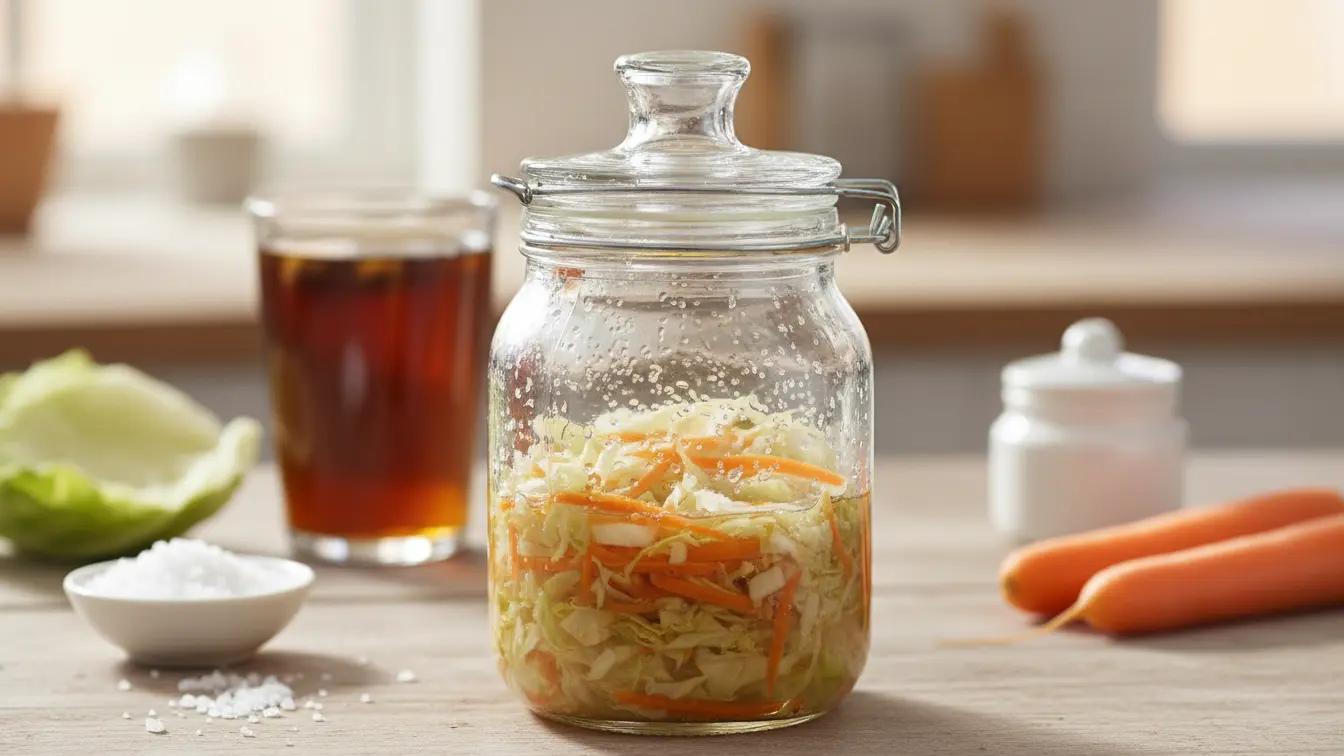
The Lactic fermentation is a natural process as old as the world. Bacteria or yeasts transform the sugars present in a food into lactic acid, alcohol, or carbon dioxide. This is what gives yogurt its acidity, to the raw sauerkraut its characteristic crunch, and kombucha its small bubbles.
Our ancestors used fermentation to preserve their food long before the invention of the refrigerator.
The process is simple: you take a food item (cabbage, milk, tea), create favorable conditions for the development of good bacteria, and let the magic happen. In a few days or weeks, the food transforms, develops new flavors, and most importantly, becomes rich in living microorganisms. This is the principle of homemade lactic fermentation, accessible to everyone.
The five types of fermentation, explained simply
"Fermented" covers very different processes, and knowing which one is at work helps you understand what you're eating:
Lactic fermentation (or lacto-fermentation): lactic acid bacteria turn sugars into lactic acid. This is sauerkraut, kimchi, pickles, kefir and kombucha, and the only one we're really interested in here.
Alcoholic fermentation: yeasts convert sugars into alcohol and carbon dioxide. This is wine, beer, and the first stage of some ferments.
Acetic fermentation: acetic acid bacteria turn alcohol into acetic acid. This is vinegar, including unpasteurised cider vinegar.
Malolactic fermentation: malic acid becomes lactic acid, which softens acidity. Found in winemaking and cheesemaking.
Sourdough fermentation: wild yeasts and lactic bacteria work together to make a dough rise. This is sourdough bread, made with a long fermentation.
Live or pasteurized foods ?
A point that many people overlook: not all fermented foods are alive.
A pasteurized fermented food, like canned sauerkraut from the supermarket, has lost its live bacteria. Pasteurization, which heats the food to preserve it longer, unfortunately destroys the microorganisms. That's why I always recommend opting for raw, unpasteurized versions, or better yet, making your own. lacto-fermented foods at home.
At Biovie, we offer kefir grains and lactic ferments precisely to allow you to create your own living fermented foods.
The complete list of the 15 best fermented foods
Let's now move to the heart of the matter. I have selected these 15 foods based on their accessibility and their culinary interest. This list of fermented foods covers all categories so that everyone can find something for themselves.
Fermented drinks
1. Milk kefir
It's my favorite, by far. Milk kefir is fermented by many different strains of bacteria and yeasts.
The taste is slightly acidic and sparkling. You can consume it plain, add it to your smoothies, or use it as a base for your sauces. We offer kefir grains on the Biovie store so that you can prepare it yourself, indefinitely, from a single purchase.
2. Water kefir (or fruit kefir)
For those who do not consume dairy products, the water kefir is an excellent alternative. Prepared with water, sugar, and fruits, it offers a sparkling and refreshing drink, dairy-free.
It is also an alternative to sodas for children. With Aurélie, we regularly prepare it in the summer. If you want to get started, check out our guide. how to make 100% homemade fruit kefir.
This fermented tea-based drink is experiencing growing popularity in France. The market for kombucha and kefir has reached 15 million euros in 2021, which is a doubling compared to 2020. This is not a coincidence.
Kombucha is fermented from tea thanks to the SCOBY (the "mother" of kombucha) and offers a unique slightly vinegary flavor. However, be careful: prioritize unpasteurized versions, and avoid those that contain too much added sugar.
To prepare your own, you can get a kombucha mother on our store.
4. Kvass
Less known in France, kvass is a traditional Eastern European beverage made from fermented rye bread. Its taste is unique, but it deserves to be discovered for its ease of homemade preparation, a fermented food. easy to do for adventurers.
Lacto-fermented vegetables
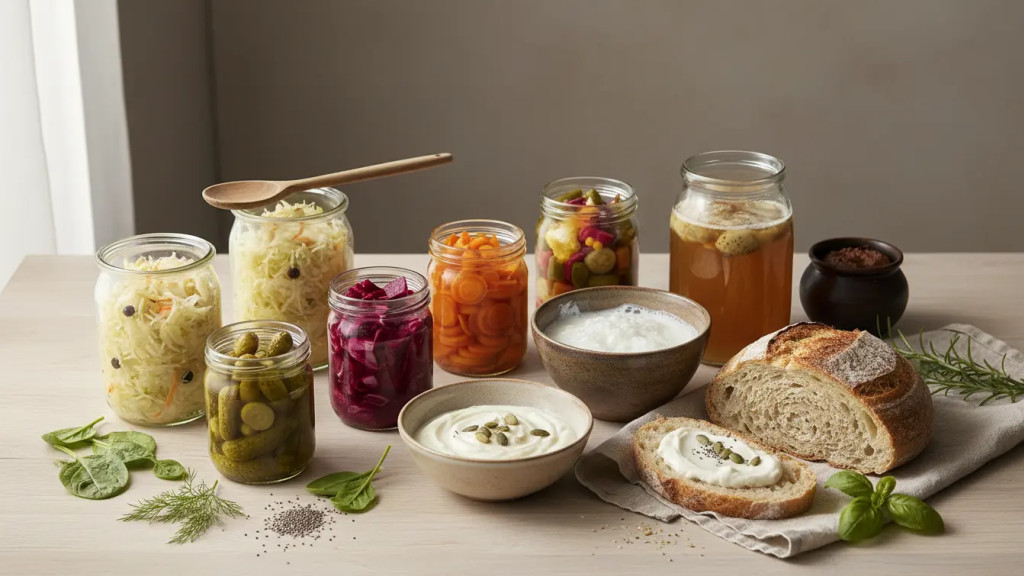
5. Raw sauerkraut
The raw sauerkraut is probably the most ingrained fermented food in our French culture. But be careful: only raw, unpasteurized sauerkraut retains its live cultures.
It naturally contains lactic acid bacteria, notably Lactobacillus plantarum and Lactobacillus brevis.
6. Kimchi
Kimchi is the Korean cousin of sauerkraut, but in a spicy version. It is made with Chinese cabbage, radish, chili pepper, garlic, and ginger. It is fermented notably by Lactobacillus kimchii.
7. Lacto-fermented pickles and gherkins
Be careful not to confuse them with pickles in vinegar! True lacto-fermented pickles are prepared in a brine (water + salt) and naturally ferment thanks to lactic bacteria.
You can ferment almost any vegetable this way: cucumbers, carrots, radishes, green beans, beets... The homemade lactic fermentation is within everyone's reach.
8. Fermented beetroot
Lacto-fermented beetroot is a root vegetable whose vibrant color comes from betalains, pigments. Its vibrant color brightens up dishes, and its slightly tangy taste pairs perfectly with salads.
Fruit kefir grains and kombucha mothers, all organic and unpasteurised, are produced in Strasbourg by Orisae, a young company founded in 2020 by Axel and Cléo. Biovie's complete kits include everything needed to start a first fermentation without buying anything elsewhere. For a first try, fruit kefir produces a fizzy result in 24 to 48 hours, a short time frame that lets you quickly see whether the practice suits you; kombucha takes 7 to 14 days but in return offers more aromatic complexity., 4
products
Probably the easiest fermented vegetable to prepare for beginners. The taste remains close to fresh carrot, with a very pleasant tangy note. It's an excellent entry point into the world of homemade fermentation, a fermented food. easy to do to start.
Fermented soybeans
10. Miso
Fermented soybean paste, the misoIs a pillar of Japanese cuisine. The secret: never boil it, as that would destroy its valuable microorganisms.
Add it at the end of cooking in your soups, or use it as a base for marinades and dressings.
11. Tempeh
Originally from Indonesia, the Tempeh is obtained by fermenting soybeans with the fungus Rhizopus oligosporus. Its firm texture and nutty taste make it an excellent substitute for meat, with 19g of protein per 100g. It is the ideal option for those who are looking for fermented plant proteins.
It is one of the few fermented foods that are eaten cooked.
12. Natto
Natto is a Japanese food that divides opinions: its slimy texture and strong smell do not appeal to everyone. However, it is a traditional Japanese food known for its vitamin K2 content.
If you are adventurous, try it on hot rice with a bit of soy sauce and Japanese mustard.
Other fermented foods
13. Sourdough bread
Even if we do not consume it, I note for the record that true sourdough bread, made with natural sourdough starter and not with industrial yeast, stands out from regular bread through its long fermentation.
Certainly, cooking destroys live ferments, but fermentation has already transformed the taste and texture of the bread.
Honorable mentions
I could also mention unpasteurized apple cider vinegar (with its visible "mother"), olives in natural brine, and naturally fermented soy sauce (tamari). All these foods have their place in a diet rich in fermented foods.
How to incorporate fermented foods into your daily routine
It's all well and good to know these 15 foods, but concretely, how can you integrate them without completely disrupting your habits? Here is the protocol I recommend for introducing fermented foods gradually, based on our experience.
The protocol for starting gently
Week 1-2: Discovery
Start slowly. One serving per day of a mild fermented food like plain yogurt or milk kefir. It is better to go gradually.
Week 3-4: Diversification
Add a second type of fermented food. For example, a bit of raw sauerkraut at lunch as a side dish. You are now at 2 servings per day.
Week 5-8: The ramp-up
Gradually increase to 4-6 servings per day, varying the sources.
Beyond: The Maintenance
Once your body has adapted, maintain a regular intake of 3 to 6 servings daily, varying the foods.
The recommended quantities
A "serving" of fermented food corresponds approximately to:
Start with what you can easily incorporate, even one serving per day.
Possible side effects at the start
I prefer to be transparent with you: some people experience temporary digestive discomfort when they start consuming fermented foods. Bloating, gas, or accelerated transit may occur in the first few days.
It's normal. These symptoms usually disappear within a few days to two weeks. If you increase the quantities too quickly, these effects may be more pronounced. Hence the importance of the gradual protocol.
If the symptoms persist beyond two weeks or are very uncomfortable, reduce the quantities and consult a healthcare professional.
A complete menu, start to finish
For those who'd rather try it all at once than in small touches, here is a simple meal where every course brings its own ferment.
Starter: raw sauerkraut salad
Mix two cups of raw sauerkraut, a diced green apple, a handful of raisins and crushed walnuts. Dress with a mustard, honey and cider vinegar vinaigrette, then let it rest for fifteen minutes: the flavours need that time to come together.
Main: plant-based wrap with fermented vegetables
For the wrap, mix a cup of almond flour, a cup of coconut flour, a cup of water and a pinch of salt, then spread thinly into four rounds. Fill with avocado, grated carrot, cucumber sticks and fermented cabbage (sauerkraut or kimchi), drizzle with a tahini-lemon sauce, roll tightly and serve right away.
Drink: a glass of fruit kefir or kombucha
To round off the meal without weighing it down: half a glass is enough, especially if you're just starting out. The idea isn't to stack up ferments, but to have one at every meal, as part of a varied and balanced diet and a healthy lifestyle.
Mistakes to avoid with fermented foods
After 18 years in the field of raw food at Biovie, I have seen many common mistakes. Here are the main ones.
Confuse pasteurized and non-pasteurized
This is the number one mistake to keep in mind. Really. A pasteurized fermented food has lost its live probiotics. It retains some nutritional qualities, but not the essential ones: the beneficial microorganisms.
Check the labels, especially for sauerkraut. The terms "unpasteurized," "raw," "live," or "with active cultures" are good indicators. If in doubt, the refrigerated section is generally more reliable than the ambient temperature grocery section.
Relying on industrial products
Many industrial products labeled as "fermented" are actually poor imitations. Cow's milk yogurts with ultra-sweetened fruits, pasteurized kombuchas then artificially carbonated, or canned pseudo-sauerkrauts cooked and recooked have little to do with genuine raw and healthy fermented foods.
The best solution? Prepare your own fermented foods. It's simpler than you might think and much more economical in the long run. At Biovie, we offer everything you need to get started: kefir grains, lactic ferments, and kombucha mother.
Neglect the quality of basic ingredients
Fermentation amplifies the qualities of the starting food. If you ferment vegetables full of pesticides or low-quality milk, you will not obtain an optimal product.
Prioritize organic ingredients, local if possible, and seasonal. The difference is noticeable in the taste.
Forget the contraindications
Fermented foods are not suitable for everyone. People with histamine intolerance, SIBO (small intestinal bacterial overgrowth), or those undergoing immunosuppressive treatment should be cautious and consult their doctor before consuming them regularly.
Similarly, during pregnancy, certain non-pasteurized fermented foods are not recommended. Discuss this with your healthcare professional.
Frequently Asked Questions
What are the main fermented foods ?
The fermented foods The most common ones are yogurt, milk kefir, water kefir, raw sauerkraut, kimchi, kombucha, miso, tempeh, natto, lacto-fermented vegetables (carrots, beets, pickles), sourdough bread, and unpasteurized apple cider vinegar. Each has a different taste, which is why it's beneficial to vary them.
Is it good to eat fermented foods every day ?
Yes, you can consume fermented foods every day, varying the sources. Start gradually if you are not used to it.
How much fermented food should be consumed per day ?
Ideally, aim for 3 to 6 servings daily once your body has adapted. One serving is approximately 150 ml of kefir, 2-3 tablespoons of sauerkraut, or 100 ml of kombucha. Start with one serving per day and gradually increase over several weeks.
Can fermented foods be consumed without lactose ?
Absolutely! Many fermented foods are naturally lactose-free : water kefir, kombucha, sauerkraut, kimchi, lacto-fermented vegetables, miso, tempeh, natto... These are excellent dairy-free options.
Do fermented foods present any risks ?
For the vast majority of people, fermented foods are perfectly safe. However, some individuals need to be cautious: those with histamine intolerance, SIBO, or on immunosuppressive treatment. Mild side effects (bloating, gas) at the start are normal and usually disappear within a few days. If in doubt, consult a healthcare professional.
Conclusion
The fermented foods are not a passing trend. They are ancestral foods, found in traditional cuisines around the world.
Specifically, you can start as early as tomorrow. A simple plain yogurt for breakfast, a few spoonfuls of raw sauerkraut at lunch, a glass of kefir for a snack. Gradually, your palate will get used to these tangy flavors.
At Biovie, we have been supporting this approach since 2007. We offer kefir grains, a kombucha mother and lactic ferments to help you easily incorporate fermented foods into your daily routine. Feel free to browse our store and contact us if you have any questions.
Here it is, this list is of course not exhaustive, and I encourage you to explore, test, and prepare your own fermentations. To try it is to adopt it !