How to take plasma orally: dosage, posology & the 20-second rule
Here is an article that has been close to my heart for a long time. Because it answers the question I hear repeatedly, week after week: "how to take marine plasma, practically, without making a mistake."
The answer fits in three lines. 20 to 30 ml per day, preferably on an empty stomach (morning is ideal), while retaining the liquid 20 seconds in the mouth under the tongue before swallowing. The classic treatment lasts 21 days. The isotonic is suitable for daily maintenance and sensitive individuals; the hypertonic is reserved for athletes and highly demineralized conditions.
This is what I recommend today to everyone who is starting out. For the choice between the two forms, I have written a Comparative guide isotonic/hypertonic. The detail of the hypertonic dosage is in the dosage grid above, and its lesser-known uses - nasal spray, lacto-fermentation - are covered further down in this article. For the rest - timing, sublingual absorption, storage, mistakes to avoid - the full details are in the following.
How much marine plasma should be taken per day ?
The first thing to know is that "more" does not mean "better." Marine plasma works through ions - sodium, magnesium, potassium, calcium, and nearly 78 minerals and trace elements - and the body absorbs a limited amount per intake. Exceeding 50 ml per day does not provide any additional benefit. At best, you waste an excellent product, and at worst, you may experience slight digestive discomfort (the hypertonic solution can have a mild laxative effect in some people).
The dosage grid according to your profile
Here are the guidelines I have always used, to be adapted to your situation:
Adult in daily maintenance : 20 to 30 ml of isotonic solution. Hypertonic solution is not recommended for daily long-term use.
Adult in an attack treatment : 30 to 50 ml of isotonic, or 15 to 30 ml of hypertonic for a maximum of 21 days.
Athlete in recovery : 30 ml after exercise. In case of intense or prolonged effort, 15 to 30 ml of hypertonic.
Sensitive person or in recovery : 20 ml of isotonic per day, with a gradual start. Hypertonic is not recommended without professional advice.
Adolescent aged 12 and over : half adult dose (10 to 15 ml of isotonic). Hypertonic not recommended.
Child under 12 years old : only on the advice of a healthcare professional.
Pregnant or breastfeeding woman : only on the advice of the gynecologist or midwife.
How to dose when starting out (progressive method)
For my part, I always advise starting slowly, even for people in good shape. Not because it's dangerous - it's not - but because your body isn't used to such an ionic mineral intake. It's better to proceed gradually:
Day 1 to 3 : 10 ml of isotonic solution in the morning. You test the tolerance and see how your body reacts.
Day 4 to 7 : 20 ml per day.
Week 2 and 3 : 25 to 30 ml per day.
Start low, listen to your body, adjust. It is this approach that yields the best results over time.
The classic error of overdosing
"More = better" is the most common intuition, and it's wrong. Ionic absorption is limited by the mucous membranes. Beyond 50 ml per day, the body eliminates the excess - and may experience temporary digestive discomfort with hypertonic solutions. It's better to have a correct, regular dose over 21 days than a one-time overdose.
Practical equivalents for measuring without a measuring cup
I am often asked the question. Here are the guidelines:
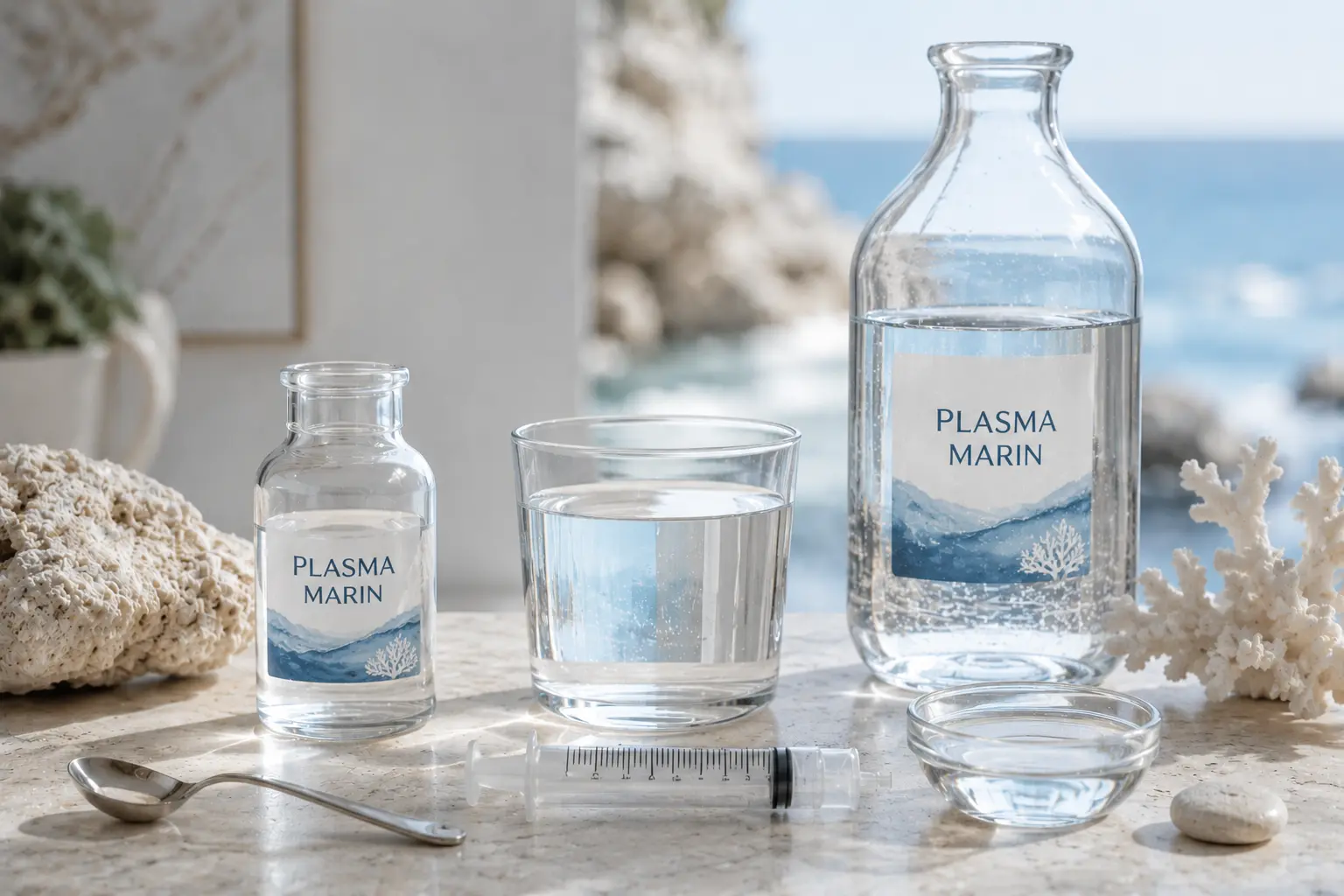
1 level teaspoon ≈ 5 ml
1 level tablespoon ≈ 15 ml
1 measuring cap from the 750 ml bottle ≈ 30 ml (according to packaging)
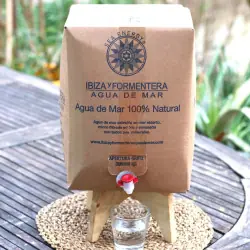
At Biovie, we offer hypertonic marine plasma in 750 ml glass bottle, , 3 liters and 11 liters - cold bottled, never heated, with ultra-filtration at 0.01 micron. To prepare your homemade isotonic solution, mix 1 volume of marine plasma with 3 volumes of low-mineralized spring water: you return to the saline concentration of blood plasma (about 9 g/L).
At what time of the day should marine plasma be taken ?
The morning on an empty stomach: the reference time
Upon waking, even before your glass of lemon water, before coffee, before anything else - this is the ideal moment. The stomach is empty, the mucous membranes are receptive, and ionic assimilation is optimal. Then wait 15 to 20 minutes before your breakfast.
This applies to the hypertonic (which has a small, very appreciable stimulating effect in the morning) as well as to the isotonic for maintenance treatment.
Between meals (20 to 30 minutes before, or 2 hours after)
This is the second interesting window for those who jump in the morning or who want to split their intake - two small doses rather than one large one. The idea remains the same: to avoid gastric dilution when the stomach is full.
The evening: only with isotonic, if needed
Having a hypertonic drink in the evening is rarely a good idea. Its slightly stimulating effect can interfere with falling asleep in sensitive individuals. However, after a late sporting effort, an isotonic drink can be well integrated - or a diluted hypertonic drink, depending on the needs.
Moments to absolutely avoid
Just after a heavy meal (poor assimilation)
At the same time as a coffee or strong tea (tannins can interfere with the absorption of certain minerals)
Within the two hours surrounding the intake of a medication (consult your pharmacist, particularly for diuretics, antihypertensives, lithium, and thyroid treatments)
The 20-second rule: why sublingual absorption changes everything
Here it is. If you were to remember only one thing from this article, it's this: the 20-second rule is the action that distinguishes an informed use of Quinton® plasma from a mere mechanical reflex. And frankly, it's the mistake I've seen most often over the past 18 years.
The gesture, in 4 simple steps
Pour 20 to 30 ml marine plasma in your mouth (according to your daily dose).
Keep the liquid under the tongue - not on top, underneath.
Count mentally up to 20. Minimum. Ideally until 30.
Swallow slowly.
That's it. It takes less time than brushing one tooth.
Why 20 seconds - the science behind the gesture
Under the tongue, there is a dense network of small blood capillaries (the sublingual vein). Mineral ions - sodium, potassium, magnesium, calcium - pass through this mucous membrane in a matter of seconds and enter directly into the bloodstream. Without passing through the stomach, without enzymatic degradation, without first-pass hepatic transit.
This is not a peculiarity of marine plasma; it is a physiological principle known in medicine since the 19th century. The most illustrative analogy: the sublingual nitroglycerin used in emergency cardiology. It's exactly the same mechanism. If it works for a fast-acting cardiac medication, it also works for the ionic transfer of marine plasma.
The 20-30 second range: minimum effective vs optimal
In reality, there is a real difference between the durations:
20 seconds : the effective minimum, the easy-to-remember practical rule.
30 seconds : the optimal recommended by naturopathy practitioners to maximize ionic passage.
Beyond a minute : no additional measurable gain.
Swallow directly without a pause : you lose the main benefit of sublingual absorption. The ions end up in the stomach rather than in the circulation.
A mnemonic formula: 20 seconds in the mouth is the minimum requirement. It's short. It's free. And it changes everything.
What I have observed in the field since 2007
Dozens of questions reach us every month in the form of "why does marine plasma do nothing for me?" In 8 out of 10 cases, the person swallows it directly, like a shot. They pay for an excellent product only for it to end up in their stomach rather than in their bloodstream. When I advise the 20-second rule-in the store, during consultations, in training-it's invariably the moment when their eyes light up.
This is the reference, the one I recommend to 90% of people who are starting out. 21 days, 25 to 30 ml of isotonic each morning on an empty stomach. Why 21 days? It is the time needed for ionic minerals to settle in the cellular reserves and for the first foundational effects to be observed. The full effects, however, take several months to establish - the turnover of red blood cells is about 120 days.
The short cure (SOS occasional fatigue): 7 to 10 days
Temporary fatigue, post-flu, post-intense effort: no need to commit to 3 weeks. A short course is often enough. Typically 30 ml of isotonic in the morning + 15 ml of hypertonic in the middle of the morning, over 7 to 10 days.
The long-term treatment: 2 to 3 months in stages
For demineralized conditions (long convalescence, post-chronic stress), a long treatment can be considered. 20 ml of isotonic solution per day, with a one-week break every 3 weeks. For this type of prolonged treatment, I always recommend seeking professional advice.
When to renew: 2 to 3 courses per year
The season plays its part. Autumn, at the start of the school year, to prepare for winter. Spring, to support the seasonal transition. And as needed in case of stress or sustained effort. Personally, I systematically do a treatment at the beginning of September and at the end of February - for almost 15 years now.
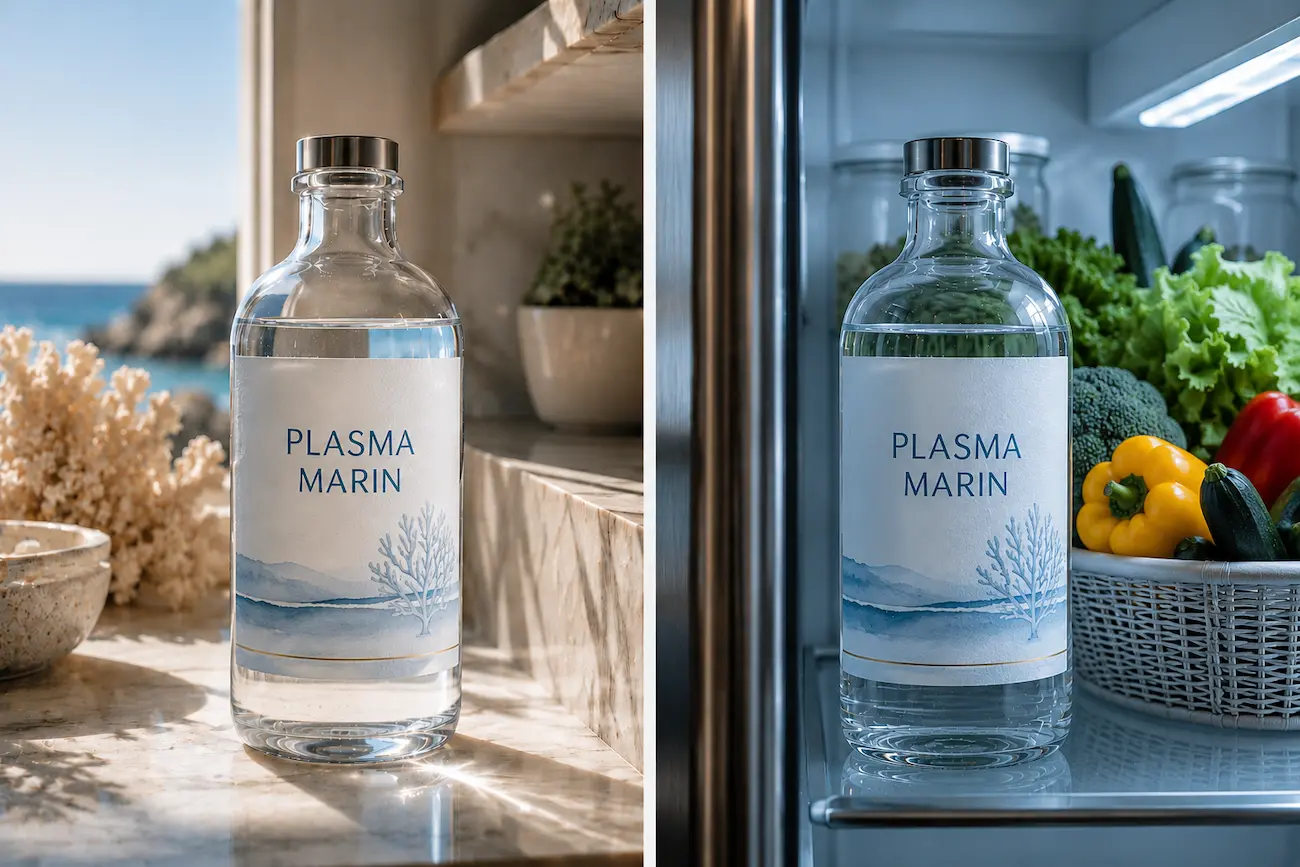
At room temperature, away from direct light. No need for refrigeration. Follow the best before date indicated on the label.
After opening
In the refrigerator, consume within the 30 days. For the bottles 3 L and 11 L, a little tip: transfer a portion into a smaller glass bottle to limit the openings of the large bottle. This prolongs the quality of the product.
Marine plasma has a Alkaline pH (8.1 to 8.4) and a saline concentration that naturally inhibits bacterial growth - but adhering to the 30-day period remains a good precaution.
Visual inspection before each use
The appearance should be clear, transparent, and very slightly tinted. A slight sedimentation of fine crystals at the bottom is normal: gently shake before pouring. Persistent cloudiness, abnormal sediment, or an unusual odor: do not consume.
Why glass + cold ultra-filtration is important
The marine plasma that we bottle at Biovie is Ultra-filtered to 0.01 micron and never heated. This process preserves all trace elements in their bioavailable ionic structure - no thermal pasteurization that would degrade certain marine organic compounds. Glass ensures the complete absence of plasticizer migration into a product that is, let's remember, a highly mineralized water and therefore potentially reactive.
This section is important. I always take the time to explain it in detail during consultations because marine plasma is not a trivial product - in the sense that it provides a significant amount of ionized minerals, and certain situations require medical advice.
Uncontrolled high blood pressure
The hypertonic solution provides sodium. In cases of uncontrolled hypertension, it is not recommended without medical advice. The isotonic solution remains feasible in most cases, but again, professional advice is recommended.
Strict low-sodium diet
If it has been medically prescribed (heart failure, kidney failure), always consult your doctor before taking it.
Kidney failure
Mandatory medical consultation before any intake.
Pregnancy and breastfeeding
Consultation with a gynecologist or midwife is recommended. In common practice, only isotonic is considered, in moderate doses.
Ongoing medication treatment
Separate the intake by at least 2 hours from any medication. Seek advice from your doctor or pharmacist - particularly for diuretics, antihypertensives, lithium, thyroid treatments.
Children
Before 12 years: only on professional advice. Adolescents: half adult dose of isotonic only.
⚠️ The information presented in this article is provided for informational purposes only and does not constitute medical advice. Consult a qualified healthcare professional before making any changes to your diet or supplementation. As part of a varied and balanced diet and a healthy lifestyle.
Specifically, here are the 7 mistakes I see most often - along with the correct action to take for each one.
1. Swallow directly without sublingual absorption. Consequence: you lose the main immediate benefit, the ions end up in the stomach. Good gesture: the 20-second rule, detailed above.
2. Confusing isotonic and hypertonic. Consequence: hyperactivity in a sensitive person = possible digestive discomfort; isotonic drinks for a very dehydrated athlete = limited benefit. Good gesture: a small decision-making test in 5 questions, in my ISO / Hyper Guide.
3. Take the hypertonic in the evening. Consequence: stimulating effect that may hinder falling asleep. Good gesture: Hyper in the morning, iso in the evening if needed.
4. Give up before the 10th day. Consequence: The first signs often appear between day 7 and day 14, sometimes on day 21. Stopping before then means missing them. Good gesture: hold for at least 21 days before judging.
5. Buy without traceability. Consequence: Plasma potentially heated, over-filtered, or sourced from polluted coastal areas. Good gesture: search for cold ultra-filtered plasma, bottled in glass, sourced from certified planktonic zones. See my article on where to buy seawater with confidence.
6. Take just after a heavy meal. Consequence: dilution in the food bolus, significantly reduced ionic assimilation. Good gesture: On an empty stomach, or at least 2 hours after a meal.
7. Do not adjust the dose to your condition. Consequence: Under-dosage in athletes (disappointing result) or over-dosage in sedentary individuals (discomfort). Good gesture: the grid by profile (see above).
Two uses of hypertonic marine plasma that people often forget
We almost always think of taking it orally. Yet hypertonic seawater has two other perfectly well-documented uses, one in the bathroom, the other in the kitchen.
As a nasal spray: the step almost no one does correctly
This is probably the use with the most solid data behind it. Nasal washing with hypertonic seawater has been used for decades to clear the airways, and systematic reviews devoted to saline nasal irrigation converge on the respiratory comfort it brings during congestion. The mechanism is nothing mysterious: a solution more concentrated than plasma draws water out of the mucous membranes by osmosis, which thins secretions and helps clear them.
The technique matters as much as the product:
Use a spray bottle specifically designed for nasal use
Two to three sprays per nostril, two to three times a day
Blow your nose gently after each application - without forcing, or you risk further irritation
Do not use for more than seven to ten days in a row; for maintenance, once or twice a day is enough
A slight stinging sensation the first time is common and temporary. If it really bothers you, switch to the isotonic form, which is better tolerated by sensitive mucous membranes and just as useful for maintenance.
In the kitchen: in place of salt in your lacto-fermentations
This is a use that Aurélie and I explored at length while writing « Algues au quotidien »: hypertonic seawater replaces salt in a lacto-fermentation - jarred vegetables, homemade sauerkraut, kimchi. It supplies the sodium the ferments need to work safely, but comes with the full range of minerals and trace elements from seawater, whereas white salt provides only sodium chloride.
The result shows in the taste: a slightly rounder acidity, a different aromatic complexity. Use the same amount of brining liquid as in your usual recipe, and as always, check that the vegetables stay submerged under the brine.
FAQ: Your Most Frequently Asked Questions
Can marine plasma be taken every day ?
Yes, isotonic is suitable for daily intake over the long term as part of a balanced diet. Hypertonic, on the other hand, is designed for courses of up to 21 days, followed by a one-week break. The most commonly used form daily here: 20 to 30 ml of isotonic in the morning on an empty stomach.
How long before feeling the first effects ?
The initial effects are generally perceived between 7 and 15 days of regular treatment. Customer feedback varies: more stable energy during the day, better recovery during exertion, and an overall sense of well-being. The underlying effects settle in over 21 days and more. To discover the 10 documented benefits of marine plasma.
Can it be taken with coffee or tea ?
It is better to separate by at least 30 minutes. The tannins in tea and coffee can interfere with the absorption of certain minerals. If you take your marine plasma in the morning on an empty stomach, wait 15 to 20 minutes before having your coffee - this sequence yields the best results.
Does marine plasma have an unpleasant taste ?
It is frankly marine and salty, more pronounced for the hypertonic than for the isotonic. Most people get used to it within a few days. If the taste is really bothersome at first, the isotonic can be diluted in half a glass of water-without losing the sublingual effect if you follow the 20-second rule with the first sip.
Can the treatment be continued in case of flu or gastroenteritis ?
In the case of gastroenteritis, temporarily suspend oral intake - the digestive tract needs calm. In the case of the flu, isotonic drinks can be maintained at a moderate dose, as they help support the body. Resume normal intake once the acute episode has passed.
Should it be stored in the refrigerator ?
Before opening: store at room temperature, away from light. After opening: refrigerate and consume within 30 days. Biovie marine plasma in a glass bottle preserves very well due to its alkaline pH (8.1-8.4) and natural saline concentration.
What to do if you miss a dose ?
No worries. Simply resume the next dose normally, without doubling it. Consistency over 21 days matters more than daily perfection. Missing one dose does not undermine the overall benefit of the treatment.
Does marine plasma exist in injection form ?
Historically, yes - René Quinton used the injectable form in his medical practice at the beginning of the 20th century. Today, the injectable form is no longer marketed in France without strict medical supervision. At Biovie, we only sell the form drinkable in glass bottle - largely sufficient for regular use in a remineralization treatment.
In practice
Scientific heritage, not miracle. Marine plasma as we know it today is rooted in the work of René Quinton, a French physiologist who documented the use of marine plasma starting in 1897. More than a century later, we have cold ultra-filtration processes that fully preserve the ionic structure of this medium. The action itself remains remarkably simple: a little liquid, 20 seconds under the tongue, and you let your physiology do the rest.
If you are a beginner, the easiest way is to start with our Hypertonic marine plasma in a 750 ml glass bottle - the one we have been using every morning with Aurélie for almost two decades. For long or family treatments, the formats 3 L and 11 L are available.
What is marine plasma ?
So-called hypertonic marine plasma is simply seawater harvested and filtered under very specific conditions.
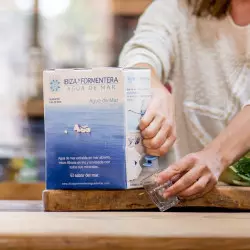
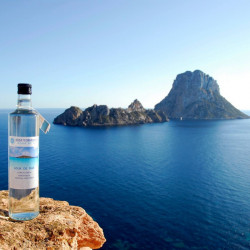
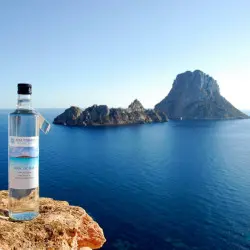
Our supplier Ibiza Agua de Mar collects sea water from a depth of 25 meters off the coast of Ibiza in a UNESCO listed area.
Concerning the harvest, here are the different physico-chemical parameters measured during the search for an optimal place for the harvest of hypertonic marine plasma, first on the radar with reading of the currents and according to the marine weather (wind, swell, rain. ..) and then by local measurement of these different parameters: taste of seawater, dissolved O2 level, PH level, redox level (ORP), salinity level (TDS), conductivity level ( PSU), alkalimetric title (TA), Pressure. It is the empirical practice of the harvesters and the reading of the various measuring instruments that makes it possible to decide on the best complex combination of these measures together to decide whether the harvest is triggered on the site or whether another location is sought.
Where does marine plasma come from ?
The marine plasma is collected in the high seas, off the coast of Ibiza, in a specific area classified as UNESCO with high planktonic activity and with a presence of tens of square kilometers of Posidonia. It is indeed in this specific area that lives the largest living organism listed on Earth, a posidonia herbarium of 80,000 to 200,000 years extending over 15 kilometers in length.
Source: Sophie Arnaud-Haond, Carlos M. Duarte, Elena Diaz-Almela, Núria Marbà, Tomas Sintes, Ester A. Serrão: Implications of Extreme Life Span in Clonal Organisms: Millenary Clones in Meadows of the Threatened Seagrass Posidonia oceanica
When is it best to take marine plasma ?
The ideal is to consume marine plasma, which contains, let's remember, all the elements that make up Mendeleev's periodic table, in the morning when you get up, on an empty stomach. take 1/4 of hypertonic marine plasma to mix 3/4 of spring water or filtered water.
What are the benefits of marine plasma ?
Minerals are the "fuel" used primarily by our body, which is necessary for our cells to perform their functions optimally. They are also essential for the absorption of vitamins and are responsible for enzymatic processes in cells. Cells perform all their functions with maximum vitality and the precise capacity for organic, bioavailable, alkaline cellular nutrition. Thus, sea water becomes the best mineral drink since it contains all the elements of Mendeleev's periodic table.
Another of the great benefits of seawater is its pH. As Otto Warbürg, father of cellular respiration and two-time Nobel laureate, said, “all diseases are acidic and where there is oxygen and alkalinity there can be no disease”. Due to the quality of our raw material, the hyper-oxygenated waters of Posidonia meadows (recognized by UNESCO as a World Heritage Site in 1999) and sea currents providing purity and clarity: Ibiza and Formentera Agua de Mar have an alkaline pH , between 8.1 and 8.4, which will help the body maintain a neutral pH through homeostasis. The ingestion of sea water is advised to control and maintain our PH, as well as an exceptional supplement for alkaline diets.
The antioxidant and anti-acidity power produced by seawater is due to the alkalinity provided by the minerals.
Drinking filtered seawater in a direct and controlled way is very beneficial for your health, because seawater is an excellent nutrient, containing most of the minerals of the periodic table and all of them dissolved in the best universal solvent available: l 'water.
Seawater contains all the minerals of the periodic table of elements in a bioavailable way. It is thanks to this that foods cooked in seawater are rehydrated and remineralized to make foods with high nutritional power. The problem today is that our intake of minerals through food has dropped dramatically and what is causing this? The answer is very simple: pollution, soil depletion due to intensive agricultural production and our stressful pace of life have considerably reduced the quality of food and its mineral intake, drastically reducing the minimum contribution necessary for the proper functioning of the body.
Seawater also helps us stay young, for a simple reason: the body regularly and cyclically regenerates all its cells, because their lifespan is limited in time. As we age, one of the first faculties the cell loses is the ability to hydrate. We know that the older we get, the less we drink, so drinking and ingesting seawater can help us "wake up" this ability to hydrate ourselves., 4
products
Ionic composition and pH of Biovie marine plasma - internal technical sheet, Ibiza & Formentera Laboratory, ultra-filtration 0.01 µm.
Editorial note: The pharmacokinetic information on sublingual absorption mentioned in this article is based on a well-established medical consensus (the sublingual route has been documented in pharmacology since the 19th century, with clinical analogs such as sublingual nitroglycerin). No specific PubMed reference for marine plasma is cited: robust clinical studies on oral marine plasma remain scarce to date, which I prefer to state clearly rather than cite approximate sources.
Warning: The information presented in this article is provided for informational purposes only and does not constitute medical advice. Consult a qualified healthcare professional before making any changes to your diet or supplementation. As part of a varied and balanced diet and a healthy lifestyle.