Sea Moss for Energy? Fatigue, “Demineralization” and How to Remineralize Naturally with Seaweed
“I'm wiped out, I must be demineralized.” If you're wondering about sea moss for energy, or how to remineralize naturally, the honest answer comes in two steps: first check what is actually missing with a blood test, then vary your plate, where seaweeds bring a lot of minerals in small amounts, while keeping an eye on iodine. At Biovie, this page draws on seven scientific and institutional sources, from EFSA to ANSES.
Everyone has said that sentence or heard it, on a gray evening, at the end of a week that was too long. The word “demineralization” is oddly reassuring: it puts a name on a fatigue that has none, and it suggests that all you need to do is “put the minerals back” to get going again. A tempting idea, but a rather short one. The word matches no diagnosis, and seaweeds, much as I love them, are no substitute for a checkup, sea moss for energy included.
I'm an ISTOM engineer, vegan since 1992, and I co-wrote a book on seaweeds with Aurélie. I've also spent time, for the big seaweed articles on this blog, looking for the studies that really hold up. What I take from them fits in one sentence: seaweeds are among the most mineral-dense foods, but fatigue has plenty of other causes than the plate.
“Demineralization”: what this word really covers
The word is everywhere, but no doctor writes it on a prescription. Fatigue has a host of possible causes (sleep, stress, illness, deficiency), and among deficiencies, iron shortage is the one that has been studied best.
Yet the symptoms of a lack of minerals don't tell you much. A fatigue linked to a deficiency looks like every other fatigue, and only a blood test can tell you what is really missing.
A randomized trial run in France (Vaucher et al., 2012), which I find very telling, followed 198 tired women aged 18 to 53 with normal hemoglobin (above 12.0 g/dL) but ferritin below 50 µg/L. For 12 weeks, some of them received 80 mg of elemental iron a day, the others a placebo. The result: the fatigue score dropped by 47.7% on iron, versus 28.8% on placebo, a gap of 18.9 points (p = 0.02).
In other words, everybody felt a bit better. But clearly more on iron.
Ferritin is the body's iron stock, like the pile of logs stacked against the house for winter: the fire is still burning (normal hemoglobin) while the reserve is running down. The placebo soothes too: being followed, feeling taken seriously, already changes how you feel. As for the famous p = 0.02, it means that a gap like that would show up by chance only about 2 times in 100 if iron had no effect.
This trial is about iron at a medical dose, prescribed and monitored. It says nothing about seaweeds, let's be clear about that from the start.
Before looking into how to remineralize naturally, it's better to know whether the reserve is empty: the blood test is what tells you. For everything else, here are our simple tips against fatigue.
Why seaweeds are so dense in minerals
A seaweed has no roots: it takes what it needs straight from the seawater. Think of a sponge forgotten for months in water loaded with mineral salts: it ends up soaked with them.
And the figures follow. According to a review published in Marine Drugs (Circuncisão et al., 2018), the ash of a seaweed, that is, what is left once the seaweed has been burned, so its mineral part, reaches up to 40% of its dry weight, versus 20% for spinach. Popeye's spinach does half as well, then. I won't hide my pleasure.
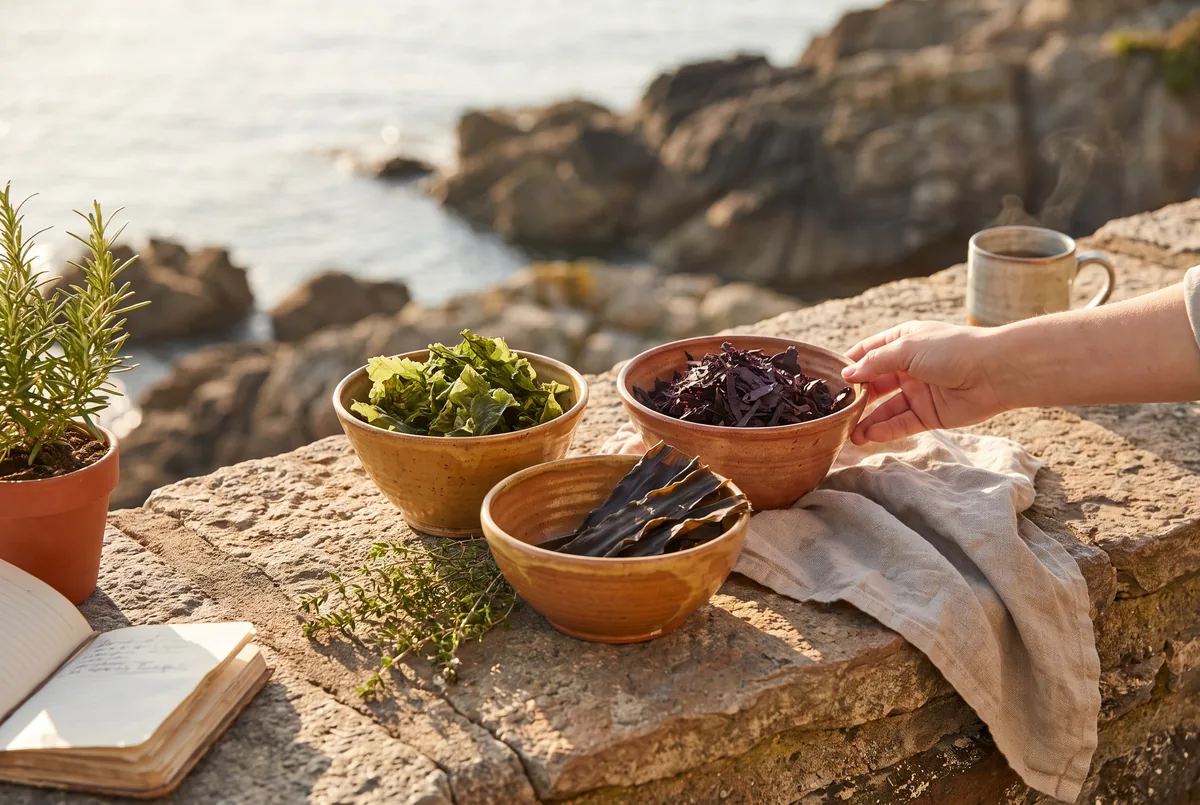
The review distinguishes three main families, and each has its specialty: in the green ones such as sea lettuce, magnesium and above all iron stand out; the red ones (dulse, nori) are notable for manganese, and the brown ones such as kombu for iodine.
Family
Examples
Minerals that stand out
Green seaweeds
Sea lettuce (Ulva)
Magnesium, and above all iron
Red seaweeds
Dulse, nori
Manganese
Brown seaweeds
Kombu
Iodine
Where it's harvested matters too: the review cites a Norwegian dulse at about 260 mg of iodine per kilo of dry weight, versus 5 to 7 mg/kg for dulses from Iceland and Denmark. The same species can therefore contain several dozen times more iodine depending on where it grew. That is the whole difference between a pinch of salt and a saltshaker tipped over the table.
Among the so-called “remineralizing foods,” seaweeds are among the densest, with a content that depends on the species and the harvest location. As part of a varied and balanced diet and a healthy lifestyle, a few grams are enough to invite them to the table.
Sea moss for energy: can seaweeds help with fatigue?
Now for the awkward question: is sea moss good for energy, or seaweed in general? None of the studies gathered here measures the effect of a portion of seaweed on fatigue. Looking for sea moss for energy still makes sense, as long as you know what seaweeds really bring: minerals, iron included, which the body uses more or less well.
Iron from seaweeds: well released, especially with vitamin C
Because a mineral on the plate is not yet a mineral in the body: the body still has to be able to use it, which is what we call bioavailability. According to the review published in Marine Drugs in 2018, the iron in dulse and sea lettuce (Ulva lactuca) is more bioavailable than the iron in spinach in the lab (in vitro), and vitamin C improves it further, whereas phytates and polyphenols reduce it.
You are not what you eat, but what you absorb. The European register acknowledges as much, for the nutrient itself: vitamin C increases iron absorption (Regulation (EU) No 432/2012). So the squeeze of lemon on your seaweed is not just a matter of presentation.
These in vitro results, obtained in a test tube and not in people, remain a lead, with no claim validated by EFSA. To go further: seaweed iron in detail.
What about spirulina?
If you want a serious opinion on spirulina for fatigue, start from a randomized, double-blind, placebo-controlled trial (Johnson et al., 2016).
Healthy men took 3 g of spirulina a day or a placebo, without either they or the researchers knowing who was taking what: that's double-blind, which keeps enthusiasm from coloring the results. After one week, their performance during exercise had increased slightly, in a statistically significant way. They also did better on a mental arithmetic test and reported less fatigue, 4 hours after the first dose and again at 8 weeks.
One caveat, just one: the trial is short and covers only a small group of men. These observations describe what the participants measured and felt, and remain a research lead with no claim validated by EFSA. For women, see fatigue at menopause and seaweeds.
To bring dulse and sea lettuce to your table, the organic Gourmet Seaweed Mix combines these two seaweeds with nori, ready to sprinkle raw.
How to remineralize naturally with seaweeds every day
To remineralize naturally, start by varying vegetables, legumes, oilseeds and whole grains. Seaweeds add a high mineral density in small amounts, ideally with a little vitamin C (lemon, parsley). And lasting fatigue is checked with a blood test.
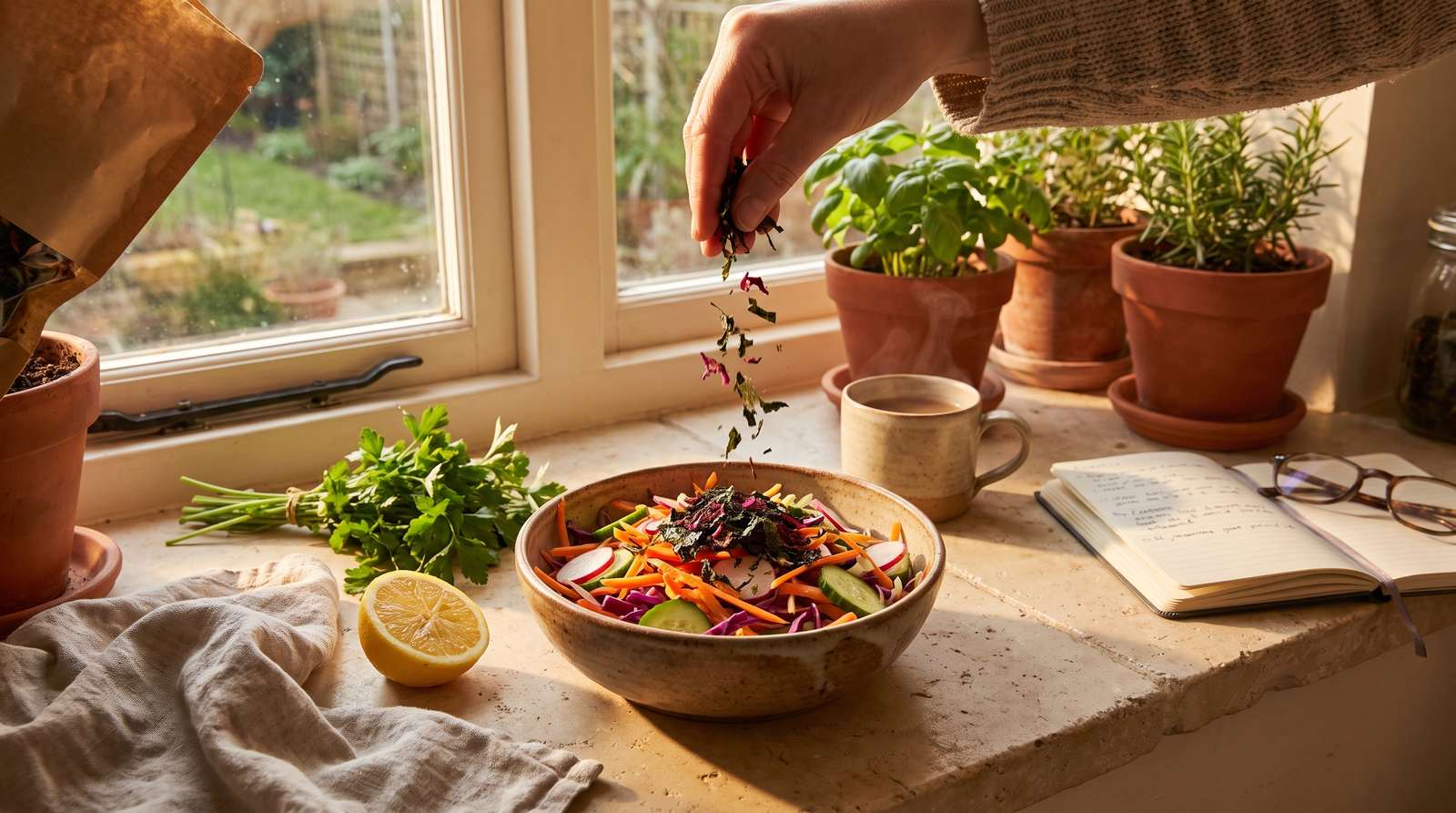
And in real life? It all happens without cooking. Flakes are sprinkled over a salad or a mash, off the heat, just before serving. Fresh seaweeds are eaten in salads.
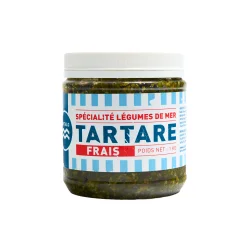
Kombu gets its own handling: let it steep in a hot broth, below the boil, then take it out, a bit like a tea bag you don't leave hanging around in the cup. At our place, an avocado with seaweed tartare, and there you go, a quick meal: that suits me fine. I'm not asking you to do the same, everyone finds their own shortcuts.
Pairing seaweeds with a little vitamin C, a squeeze of lemon or a handful of parsley, is the right reflex, as part of a varied and balanced diet and a healthy lifestyle.
Dried seaweeds mostly fear humidity. At Biovie, we recommend vacuum sealing in a glass jar with the BocUp kit: a bell and a small hand pump, with no electricity and no plastic bag, which keeps seaweeds safe from humidity and moths. The kit works with your glass jars with “shoulders” and a 65 or 84 mm lid: nothing else to buy, it's pure reuse, low tech the way I like it.
For fresh products, the manufacturer claims storage up to 5 times longer (8 to 10 days for a vegetable soup instead of 2). Vacuum sealing replaces neither the fridge nor the freezer, and it does not sterilize. For fresh seaweeds, see storing fresh seaweeds, and for the principle, the benefits of vacuum sealing.
At Biovie, our dried seaweed is dried at a low temperature (40 °C) to preserve its nutrients, and it goes straight into a dish without any long soaking: wakame (iodine, calcium), nori (protein, B12, perfect for sushi), kombu (potassium, fucoidan), dulse (iron, potassium) and sea lettuce (iron, calcium). To get started, nori sheets are the easiest to use; to season your everyday dishes, the dehydrated gourmet mix combines several varieties in one box; curly wakame is ideal for travel thanks to its light, compact format. Between wakame, dulse and sea lettuce, it is best to start with wakame or sea lettuce, both mild in taste, before moving on to dulse, which has a stronger, more iodine-rich flavour., 10
products
Iodine: aim for the right dose rather than the highest
Iodine is the flip side of this mineral density. EFSA sets the adequate intake of an adult at 150 µg a day, and at 200 µg during pregnancy and breastfeeding (EFSA, 2014). These are millionths of a gram, an amount invisible to the naked eye.
An EFSA scientific report covering 19 countries and 468 consumers found, among people who eat kombu and nori (“laver” in the report), average iodine intakes above 20 µg per kilo of body weight per day (EFSA, 2023). The math is quick. For a 60 kg person, that means more than 1,200 µg a day, or more than 8 times the adequate intake.
Back to our Norwegian dulse (Circuncisão et al., 2018): about 260 mg of iodine per dry kilo, versus 5 to 7 mg/kg in Iceland and Denmark. At 260 mg/kg, a single gram of this Norwegian dulse already exceeds a day's adequate intake. One gram is barely a pinch.
ANSES, in its opinion of 25 June 2018, advises against seaweed-based foods and supplements for pregnant or breastfeeding women without medical advice (ANSES, 2018). During pregnancy or breastfeeding, ask your doctor's advice before putting seaweeds on the menu. For the thyroid, the data are gathered in seaweeds and the thyroid.
Should we steer clear of seaweeds, then? I don't think so. Salt is a problem too when you tip over the saltshaker, and nobody goes without it: it's all a question of dose. Brown seaweeds such as kombu are best kept to small amounts, while red and green ones suit everyday use better.
When fatigue lasts: the right order of things
A fatigue that sets in deserves more than a bag of seaweed, sea moss for energy included, and the order of things matters:
See a doctor and ask for a blood workup, ferritin included.
If a deficiency shows up, correct it with the doctor: in the 2012 French trial, it took 12 weeks of iron at a medical dose.
As part of a varied and balanced diet and a healthy lifestyle, then make room for seaweeds on your plate.
On this point, European law is clear, and I find that rather healthy. Regulation (EU) No 432/2012 authorizes the claims “iron contributes to a reduction of tiredness and fatigue” and “magnesium contributes to a reduction of tiredness and fatigue,” for foods that provide enough of them. These claims concern the nutrients themselves and cannot be applied to seaweeds in general. A seaweed is therefore not “anti-fatigue” by principle, and that's perfectly fine.
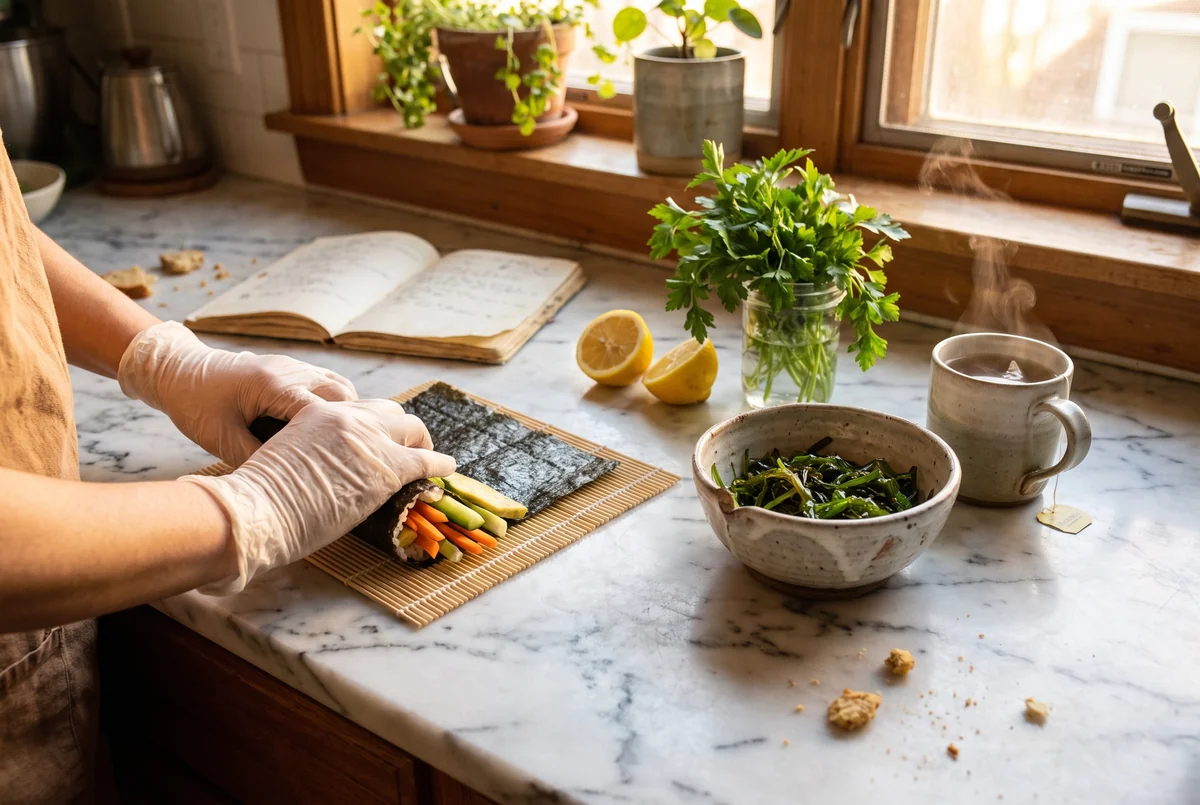
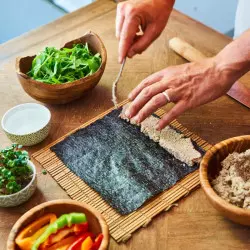
For a first step, a raw-grade nori sheet rolled around a few raw vegetables is ready in a moment. The book Algues au quotidien, written with Aurélie, then takes over.
I hope that one day we'll talk less about “demineralization” and more about ferritin and variety on the plate, and that seaweeds will find their rightful place there: that of an everyday food, dosed with common sense. And if you have a way of your own to slip them into your meals, write to me!
Frequently asked questions
What are remineralizing foods?
Green vegetables, legumes, oilseeds and whole grains bring minerals every day. Seaweeds are among the densest foods: their ash, that is, their mineral part, reaches up to 40% of dry weight, versus 20% for spinach, according to a review published in Marine Drugs in 2018.
What is the best remineralizer?
No single food plays that role alone: it's the variety of the plate that counts. Seaweeds have the advantage of bringing a lot of minerals in a small amount, but their content depends on the species and the harvest location, and iodine calls for moderation, especially with brown seaweeds such as kombu.
What are the symptoms of a lack of minerals in the body?
The most common is a nonspecific fatigue that looks like every other fatigue, which is where the difficulty lies. Only a blood test can settle it, for example a ferritin measurement, the body's iron stock. In a French trial from 2012, tired women had low ferritin despite normal hemoglobin.
Can you raise your calcium quickly with food?
No, not reliably: a low blood calcium is a medical matter, to be discussed with your doctor. Seaweeds contain calcium, but they do not quickly correct a deficit. As part of a varied and balanced diet and a healthy lifestyle, they complement the plate without replacing medical follow-up.
Is spirulina effective against fatigue?
A randomized, double-blind trial published in 2016 observed small effects in men taking 3 g of spirulina a day: a bit more performance during exercise, better mental arithmetic and less perceived fatigue. The trial is short, the group small, and it is not a claim validated by EFSA.
Which seaweeds should you choose against fatigue?
Dulse and sea lettuce are the two seaweeds cited for iron: in the lab, their iron is released better than the iron in spinach, especially with vitamin C. Kombu is eaten in moderation, because brown seaweeds concentrate iodine, for which the adequate intake is only 150 µg a day for an adult.
The information presented in this article is provided for informational purposes only and does not constitute medical advice. Consult a healthcare professional before changing your diet or supplementation.