How much seaweed is safe to eat daily? Realistic portions by seaweed and iodine benchmarks
Online, the answers to the question "how much seaweed is safe to eat daily?" run from 0.2 g to 60 g, and they can all be right depending on the seaweed. Around 0.06 g of dried kombu, 1 g of wakame, 2 g of dulse or 4 g of nori cover the 150 µg of iodine recommended for an adult, with a limit of 600 µg. These portions are calculated from the benchmarks of EFSA and Anses and from published analyses.
"How much can I eat?" It is the question Biovie's customer service gets right before someone buys seaweed. The sites that answer it say 0.2 g a day, then 1 g dried, then 5 to 10 g, and up to 30 to 60 g of fresh seaweed. It is enough to leave anyone puzzled, spoon in hand.
As the founder of Biovie since 2007, an ISTOM engineer and co-author of "Algues au quotidien" (Gallimard, 2024), I would rather show you where this gap comes from than add one more number to the pile. It all comes down to one word.
Iodine.
Why do recommended amounts of seaweed range from 0.2 g to 60 g?
Iodine content depends first on the species, then on the form (dried, fresh or salted), the origin and the harvest. It is iodine that sets the dose, well before taste or texture. The same spoonful can therefore bring very little iodine, or a lot.
An analysis of 12 species, mixing products from American shops and samples from harvesters, measured anything from 16 µg of iodine per gram for nori to more than 8,165 µg/g for a kelp granule sold as a salt substitute (Teas et al., 2004). In practice, a pinch of one can bring more iodine than a whole plate of the other.
Same finding in Norway, where a team analysed 96 products from the local market: a portion of whole seaweed there provides from 128 to 62,400 µg of iodine, and for 54 of these products, one portion or one dose exceeds the upper limit (Aakre et al., 2021). More than half the products, then, on a single portion. This study measures products on the shelf; it says nothing about what people actually eat or about their iodine status.
So, who is right, 0.2 g or 60 g? Everyone, or nearly. Each of these numbers can be true for one seaweed and false for another, and that is why you cannot answer "how much seaweed is safe to eat daily" without naming the seaweed.
The official benchmarks: 150 µg a day, 600 µg at most
Two numbers are enough. EFSA sets the adequate intake of iodine at 150 µg a day for an adult, and at 200 µg during pregnancy and breastfeeding (EFSA NDA Panel, 2014). The tolerable upper limit is 600 µg a day for adults, adjusted for each age group, and it is the reference Anses uses (2018).
The upper limit works like a seat belt: you buckle it and never try to test it. Aiming for around 150 µg and staying well away from 600 µg is the whole game.
You will also come across the figure of 1,100 µg a day, cited by Teas and colleagues and repeated by English-language websites. In reality, it is the American limit, set by a different agency from EFSA; in Europe and in France, the figure to keep is 600 µg.
Another useful benchmark: in France, food supplements are capped at 150 µg of iodine a day (Anses, 2018), which by itself equals the recommended intake.
Iodine contributes to the normal function of the thyroid, as part of a varied and balanced diet and a healthy lifestyle. Anses nevertheless considers that seaweed is not a good way to correct an iodine deficiency, because its content is too variable. Monitoring a deficiency is a job for your doctor.
How much seaweed is safe to eat daily, species by species
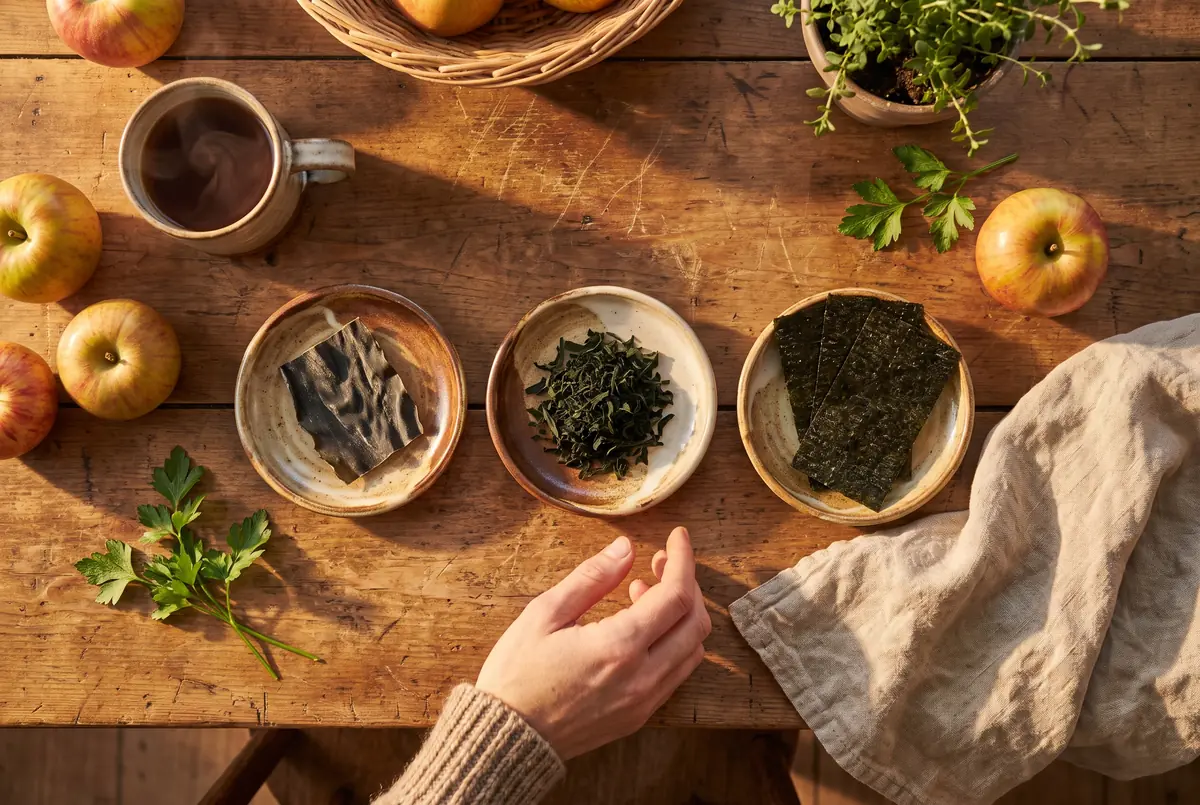
To work out how much seaweed is safe to eat daily, divide 150 µg (recommended intake) or 600 µg (adult limit) by the average iodine content of the seaweed. The result: a few hundredths of a gram for kombu, about one gram of wakame, two of dulse and four of nori, dried.
Seaweed
Average iodine (µg/g dry)
For 150 µg (recommended intake)
For 600 µg (adult limit)
Kombu
2,524 (from 241 to 4,921)
about 0.06 g
about 0.24 g
Wakame
140 (from 94 to 185)
about 1.1 g
about 4.3 g
Nori
37 (from 29 to 46)
about 4 g
about 16 g
Dulse
not measured in this analysis (calculated from Roleda et al., 2018)
about 2.1 g
about 8.6 g
These amounts are simple calculations on averages: dried shop-bought products analysed in Taiwan (Yeh et al., 2014) and, for dulse, wild and cultivated North Atlantic biomass (Roleda et al., 2018). A fresh seaweed contains a lot of water: weight for weight, it provides less iodine than the same seaweed dried.
Kombu: a condiment, not a vegetable
With kombu, you count in tenths of a gram, at most. For the kelp Saccharina, 32 mg of dry matter is enough to cover the recommended intake of most adults (Roleda et al., 2018). Thirty-two milligrams is a crumb, roughly what a grain of rice weighs. Well, dosing kombu the way you dose salt is just common sense.
Iodine dissolves in cooking water (Teas et al., 2004): in a kombu broth infused below boiling point, part of the iodine passes into the liquid, and since you drink the broth, you get it back in the cup. Soaking in lukewarm fresh water, at 32 °C, reduces the iodine in Saccharina latissima, but it also loses minerals and other compounds, and the same team estimates that eating this seaweed every day leads to excessive iodine intakes (Stévant et al., 2018). Kombu is therefore kept for broth, never pan-fried or sautéed.
Wakame: around one dry gram, more when fresh
The shop-bought wakame analysed in Taiwan contains 140 µg of iodine per dry gram on average, or about 1.1 g for the recommended intake (Yeh et al., 2014). For Alaria esculenta, the Atlantic wakame, 283 mg dry is enough (Roleda et al., 2018). Close species, different waters: that is where the gap comes from.
How much wakame a day, then? Around one dry gram, more when fresh since water dilutes the iodine. It is eaten raw in salads, after desalting for the fresh wakame and rehydrating for the dehydrated wakame. For flavour pairings, see the guide to the taste of seaweed.
Nori: the mildest seaweed in iodine
Nori shows 37 µg/g on average in the Taiwanese analysis, and 16 µg/g in the American one: origin and analysis method explain the gap. With about 4 g for the recommended intake and 16 g to reach the limit, a few grams of nori a day stay far from 600 µg. If you are wondering how much nori per day, think in grams rather than in sheets.
Dulse
As for dulse (Palmaria palmata), it sits in between: 2,149 mg dry cover the recommended intake (Roleda et al., 2018), or about 2.1 g for 150 µg and 8.6 g for 600 µg. A seaweed moderate in iodine, then, halfway between nori and wakame.
Fresh seaweed tartare: one spoonful, like a condiment
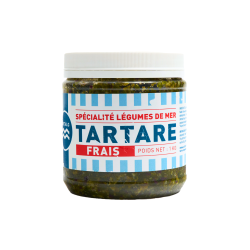
According to its product page, Biovie's fresh seaweed tartare combines fresh sea lettuce (30%), dried kombu and dulse (2.8%), gherkins, olive and walnut oils, onions and capers. Its iodine content has not been measured. The presence of kombu is enough to handle it as a condiment.
Our benchmark, shown on the product page and given by customer service, is one level teaspoon a day, or about 5 ml. It is a house precaution. No official standard sets this figure, and honestly, that is already a lot of flavour, to put on a slice of bread or in a salad, always off the heat, as part of a varied and balanced diet and a healthy lifestyle.
Every day? Vary your seaweeds rather than stacking them
You can eat seaweed every day, provided you choose species that are moderate in iodine and portions suited to each. Kombu, for its part, waits for its broth.
The main risk of too much iodine from seaweed comes from accumulation: seaweed at the table, plus food supplements made from seaweed (Anses, 2018). According to Anses, a regular excess of iodine can disturb the function of the thyroid and affect the heart or the kidneys. There you go, in plain terms, the side effects of eating too much seaweed: they come down to dose and accumulation.
Working from the table, and with no other figure, a workable week could look like this:
nori or fresh seaweed tartare most days, in a few grams or a level spoonful;
wakame in a salad, a few times;
dulse alternating with nori, sprinkled on a salad or a bowl of warm vegetables;
an infused kombu broth, from time to time.
Varying the species remains the simplest approach, as part of a varied and balanced diet and a healthy lifestyle. Everyone at their own pace: you add a seaweed to the menu rather than forcing the dose of a single one. If the place of seaweed in Japan interests you, I talk about it in the article on seaweed in the Japanese diet.
Anses also recommends favouring controlled supply channels and would like the iodine content to appear on packaging. I hope we get there, because the day every pack shows its iodine content, the question "how much seaweed is safe to eat daily" will be settled at a glance.
Who should ask for medical advice before eating it?
Anses advises against seaweed, unless a doctor says otherwise, for several groups:
people who have thyroid problems;
heart disease or kidney failure: same advice;
anyone taking medication that contains iodine or lithium;
pregnant or breastfeeding women.
For young children, Anses recommends caution, for lack of sufficient data. During pregnancy, the need for iodine rises to 200 µg a day (EFSA NDA Panel, 2014), which does not mean you can cover it with seaweed without having talked to your doctor. Nothing dramatic in all this.
Once you have the medical advice, you will know what place to give seaweed in your meals. To go further, I have gathered the research on seaweed, iodine and the thyroid, and another article goes into the iodine in wakame.
A 1 kg jar, one spoonful at a time: portioning and storing
Unopened, the jar of fresh seaweed tartare keeps for 3 months in the refrigerator; once opened, it is eaten within 15 days, and it can be frozen (product page). At one level spoonful a day, a 1 kg jar lasts much longer than 15 days. The trick is simple. Portion it as soon as you open it into small glass jars, keep one in the fridge and put the others in the freezer.
For the opened jar as for dried seaweed, vacuum sealing helps. The BocUp kit pulls the vacuum with a bell and a small manual pump, without electricity or plastic bags, on the glass jars you already have at home, provided they have "shoulders" and a 65 or 84 mm lid: nothing else to buy. According to the manufacturer, fresh foods keep up to 5 times longer (a vegetable soup lasts 8 to 10 days instead of 2), and dry foods such as dehydrated wakame or nori stay safe from humidity and moths.
The vacuum replaces neither the fridge nor the freezer, and it does not sterilise: the 15-day rule after opening stays the one on the product page. I talk about it at more length in the article on vacuum sealing at home, and you will find how to store and freeze fresh seaweed in a dedicated guide.
And then, to switch species from one week to the next, the assortment of 4 fresh seaweeds lets you try several flavours of the sea. You can start tomorrow morning, quite simply: one level spoonful of tartare on your breakfast toast, at your own pace.
Yes, provided you choose seaweeds moderate in iodine, such as nori or dulse, or a dosed condiment such as fresh seaweed tartare, and stay under 600 µg of iodine a day, the adult limit Anses uses. Kombu, very rich in iodine, is kept for an occasional broth.
Which seaweed is the richest in iodine?
Kombu, that is to say kelp, is the richest in iodine among the common cooking seaweeds: 2,524 µg per dry gram on average in an analysis of shop-bought products, up to 4,921 µg/g. About 0.06 g is enough to cover the recommended intake of 150 µg. For comparison, see also the iodine in wakame.
What are the side effects of eating too much seaweed?
The danger lies in a regular excess of iodine: according to Anses, it can disturb the function of the thyroid and affect the heart or the kidneys. The risk rises above all when you combine seaweed at the table with food supplements made from seaweed. Varying the species and dosing kombu limits this accumulation.
Is seaweed good for your health?
Seaweeds are foods that provide iodine, fibre and minerals, and iodine contributes to the normal function of the thyroid, as part of a varied and balanced diet and a healthy lifestyle. It all comes down to the dose, suited to each species. For the Japanese context, see seaweed in the Japanese diet.
How many sheets of nori per day?
It is better to think in grams than in sheets: about 4 g of dry nori cover the recommended intake of 150 µg of iodine, and about 16 g are needed to reach the adult limit of 600 µg, based on the average contents measured in shop-bought products. A few grams a day therefore stay well below.
Can you eat seaweed when pregnant?
Not without medical advice: Anses advises against seaweed for pregnant or breastfeeding women unless their doctor says otherwise. The need for iodine does rise to 200 µg a day during pregnancy and breastfeeding according to EFSA, but the content of seaweed varies too much to cover this need reliably. Talk to your doctor or your midwife.
Can young children eat seaweed?
Caution is called for: Anses recommends it for young children, for lack of sufficient data. The safety limits for iodine are, by the way, adjusted for each age group. Before offering any to a young child, ask your paediatrician or your doctor for advice.
The information in this article is provided for information purposes only and does not constitute medical advice. Consult a healthcare professional before making any change to your diet or supplementation.