How to cook with seaweed? By giving each one a role: kombu infused just below boiling point for a broth full of umami, raw dulse flakes for sweetness, crumbled nori for seasoning, wakame and sea lettuce in salads, always added in small amounts and weighed dry. This guide draws on four scientific publications and on my practice with seaweed since I created Biovie in 2007.
At the back of many a cupboard sleeps a packet of seaweed bought out of curiosity and never opened. The Semaine du Goût (Taste Week), whose 37th edition runs from Monday 12 to Sunday 18 October 2026 (CNED, 2026), is a good excuse to finally open it. As the son of a baker who was a Meilleur Ouvrier de France and an ISTOM engineer, I remain convinced that an ingredient is judged first in the mouth. So let's talk flavour.
Where does the taste of seaweed come from? Umami explained
A well-salted soup that "is missing something". A tomato sauce that suddenly turns round after a long reduction. That something has a name: umami, the fifth basic taste, alongside sweet, salty, sour and bitter.
I like to explain it with an image. If salt sets the volume of the music, umami is the bass line: you don't always notice it, but without it the tune sounds hollow.
In 1908, the Japanese chemist Kikunae Ikeda identified glutamate as the active principle behind the taste of kombu, the seaweed that forms the base of Japanese broth (Kurihara, 2015). So it was by tasting a seaweed that we put a word on the fifth taste. Classic dashi combines this glutamate with the inosinate of dried bonito, a fish (Ninomiya, 2015).
Why would a piece of dried seaweed have more flavour than a ripe tomato? Kurihara compiled the glutamate content of several foods, in mg per 100 g (Kurihara, 2015):
- kombu, from 1,200 to 3,400 mg depending on the samples;
- nori, 1,380 mg;
- cheeses, from 300 to 1,680 mg;
- anchovy, from 630 to 1,440 mg;
- tomato, only 150 to 250 mg.
The kombu range is wide because it reflects the variability of the samples compiled: it gives an order of magnitude and describes no particular seaweed. Even at the bottom of that range, kombu contains, weight for weight, several times more glutamate than a tomato. On the plate, it is the impression of a dish that "has body", like grated Parmesan on pasta.
Then there is synergy. In humans, the taste response to a mixture of glutamate and inosinate is about 8 times stronger than to glutamate alone; in rats, the ratio is only 1.7 (Kurihara, 2015). In practice, one and one don't make two: together, two sources of umami give an intensity that neither reaches alone.
And if the taste of the sea still puts you off, read the article if you don't like the taste of seaweed.
How to cook with seaweed: which seaweed for which use?
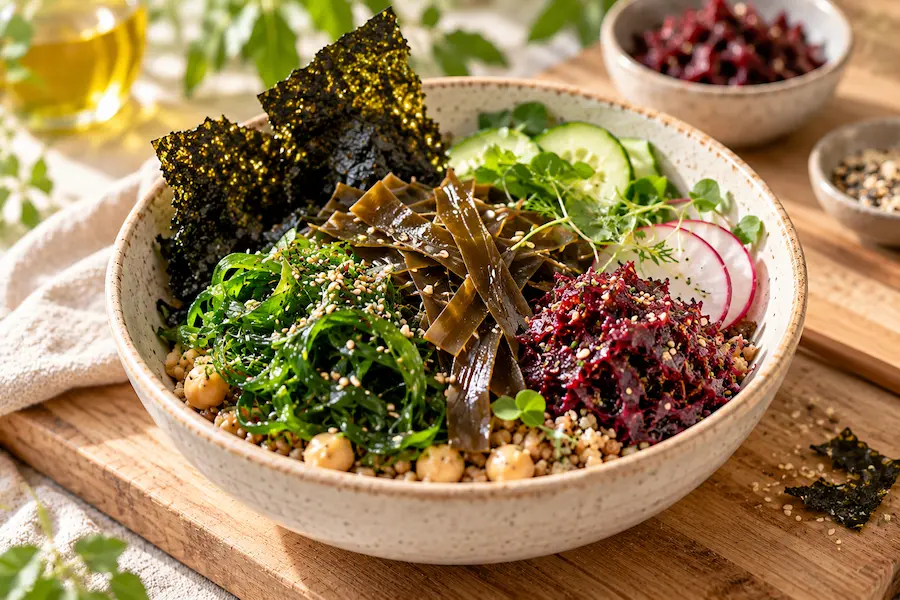
To use seaweed in the kitchen, remember five simple uses:
- in a broth, with a strip of kombu;
- in a salad, with rehydrated wakame or sea lettuce;
- for crunch, with dry dulse or crumbled nori, raw;
- as a seasoning, with flakes;
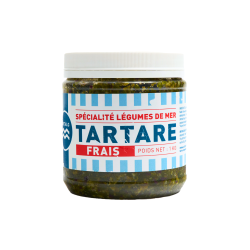
- as a ready-to-spread condiment, with fresh seaweed tartare.
Honestly, forget the idea of "eating seaweed". Think in terms of use instead. Knowing how to cook with seaweed means first asking what role you want this ingredient to play: depth, freshness, crunch or a salty touch. Each seaweed has its function, like each spice in your cupboard.
| Seaweed | Flavour | Use | Starting amount |
|---|---|---|---|
| Kombu | Deep, marine umami | Broth, cooking dried pulses | One strip |
| Dulse | Mild and round, nutty with a slight pepperiness | Raw: flakes, salads | A pinch to a small handful |
| Nori | Marine, with a toasted note | Sheets, crumbled | Half a sheet per plate |
| Sea spaghetti | Discreetly marine, firm texture | Like a vegetable, with pasta | A rehydrated handful |
| Sea lettuce | Herbaceous, fresh | Salad, pesto | A rehydrated handful |
| Wakame | Mild, barely marine | Salad, soup | A rehydrated handful |
| Seaweed tartare | Punchy, already seasoned | Ready-to-use condiment | A small dollop on a slice of bread |
For a broth
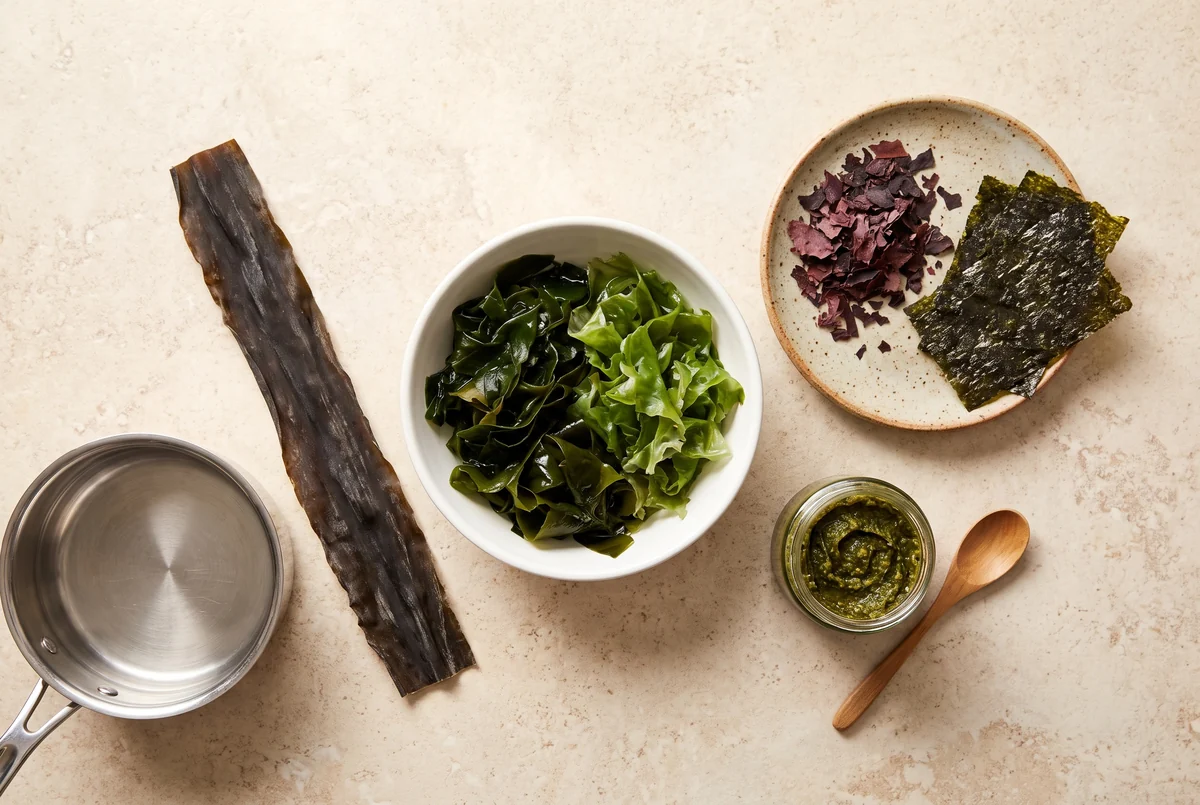
Kombu is the seaweed of broths: it is infused rather than eaten. It is the simplest way to learn how to use kombu and how to cook with dried seaweed. Kombu is also traditionally added when cooking pulses: lentils, chickpeas, beans or broad beans.
For a salad
Wakame and sea lettuce rehydrate in cold water, then join some thinly sliced cucumber and a splash of vinegar. For anyone wondering how to cook wakame seaweed, this is the gentlest way in. It is often the seaweed that wins over people who thought they didn't like seaweed. To compare them: our guide to dulse, wakame and sea spaghetti.
For crunch
Dry dulse can be nibbled as it is or crumbled into flakes over a dish. Crumbled raw nori brings the same discreet crunch; our raw-quality nori sheets suit it very well.
For seasoning
Kombu flakes or crumbled nori lift a dish, and you salt less. Taste before salting: the seaweed brings its own saltiness, and umami gives a fullness that often makes you less tempted to add more salt. It's just common sense, as part of a varied and balanced diet and a healthy lifestyle.
Drawing the umami out of a strip of kombu
The glutamate in kombu is extracted with gentleness and time, like a tea bag forgotten in a hot cup. At the Nordic Food Lab, the researchers worked with 10 g of dry seaweed in 500 ml of water for 45 minutes at a constant temperature, and with a dashi prepared sous vide at 60 °C (Mouritsen et al., 2012). These are culinary laboratory analyses, with no trial on people. At 60 °C, the water barely steams, without a single bubble.
At home, the rule translates simply: infuse below boiling point. Put the strip in cold water over a low heat; take it out at the first small bubbles. That's all.
In reality, not all kombus give the same broth: sweet kombu (Saccharina latissima) gives a more viscous one, with less glutamate (Mouritsen et al., 2012). That is not a flaw, it is another style: more body in the mouth, a coating texture that has its place in a soup or a sauce.
For a more intense broth, the authors suggest pairing the seaweed with dried mushrooms, which bring 5'-nucleotides, the family of molecules that multiplies the perception of glutamate (Kurihara, 2015). A strip of kombu and a few dried mushrooms in the same pan make an entirely plant-based dashi.
And don't throw the strip away: finely sliced, it slips into a salad or in among pulses. The whole dried kombu suits this, and the kombu flakes can be sprinkled straight onto the dish. To go further, here is everything about dried kombu seaweed.
Dulse: mild, round and easy to crunch on
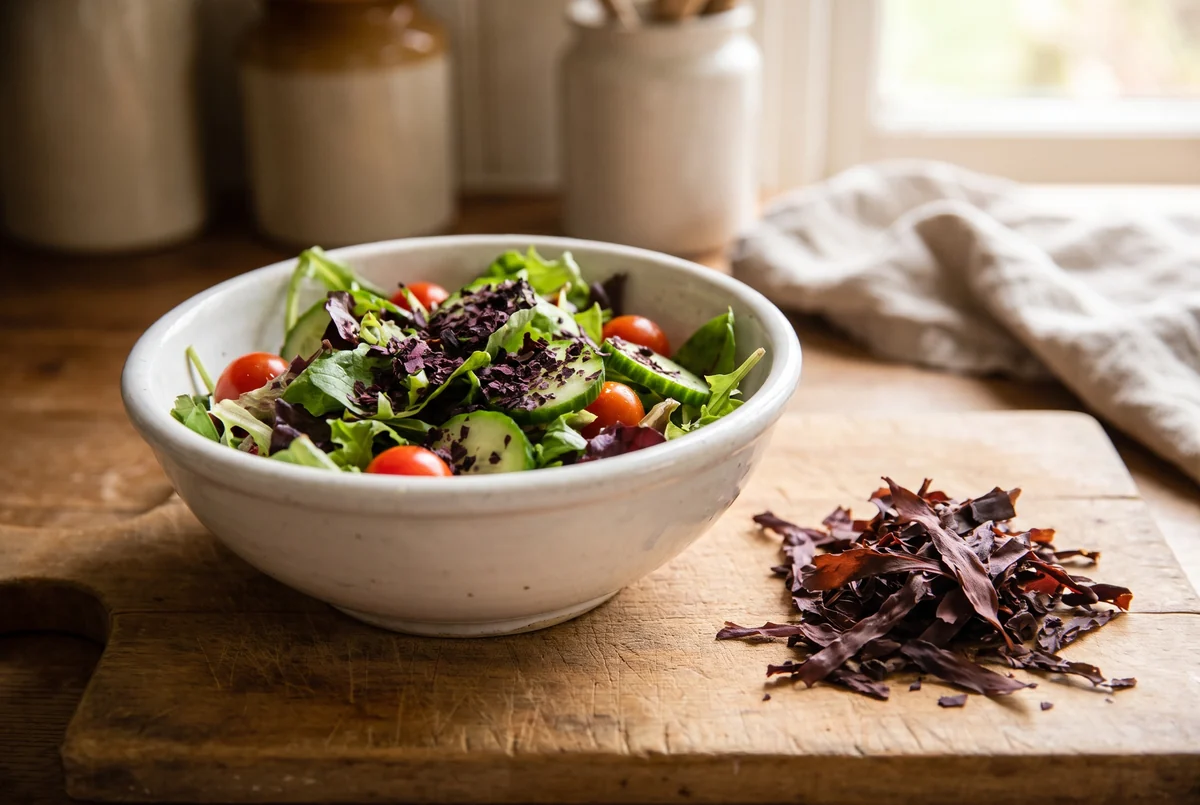
Raw, dulse surprises: it is milder and rounder than kombu, and science explains why: its extract releases more sweet-tasting amino acids (alanine, proline, glycine, serine) and less glutamate (Mouritsen et al., 2012). Less pure umami and more sweetness: enough to make it an easy seaweed to start with.
Dulse has been eaten for centuries in Ireland, Brittany, Iceland and as far as Maine, as a snack and as an ingredient (Mouritsen et al., 2013). Nothing new, then.
How to eat dulse seaweed? No need to cook it. Dry, dulse crumbles into flakes over a salad, a purée or steamed potatoes, with no cooking at all. With fresh dulse, rinse it first to desalt it, pat it dry well, then slice it raw into a salad.
Ready-to-use seaweeds: tartare and sea spaghetti
There's really no hurry. If rehydrating and measuring put you off, two seaweeds let you start with no preparation.
The fresh seaweed tartare is the most direct way to discover how to cook with seaweed, since there is precisely nothing to cook: it is a spreadable condiment, already seasoned, that goes on a slice of bread, steamed potatoes, fish or grilled tofu. A small dollop on a slice of bread is enough to find out whether you like the taste of seaweed.
As for dried sea spaghetti, it is cooked like a vegetable: once rehydrated, its long strands mix into warm pasta or are crunched in a salad with a little garlic. It is the seaweed for people who like green beans: a firm texture, a discreet marine taste.
These two entry points fit seaweed into a gesture you already make, spreading a slice of bread or cooking pasta.