Wakame, Iodine and Thyroid: Content, Recommended Portions and Precautions
Wakame contains about 420 µg of iodine per gram of dehydrated seaweed, or about 280% of the NRV for 1 g. Iodine contributes to the normal production of thyroid hormones and to normal thyroid function. Kombu can contain up to 10 times more iodine: wakame is used in small quantities and fits easily into daily life.
Honestly, when one is interested in thyroid health, one quickly encounters a paradox. On one hand, iodine is absolutely essential for the proper functioning of this small butterfly-shaped gland located at the base of the neck. On the other hand, too much iodine can become problematic. So, which seaweed should be chosen for the thyroid without taking risks? With Aurélie, after years of exploring the Scientific studies on algae and the thyroid, we have a clear answer: wakame.
In this article, I explain why this brown algae has become our daily ally, how to use it practically, and what precautions to take. You'll see, it's much simpler than you might think.
The role of iodine for the thyroid
The role of iodine in the production of T3 and T4 hormones
Iodine is literally the fuel for your thyroid. Without this essential trace element, your thyroid gland simply cannot produce its hormones.
Here's how it works: your thyroid absorbs the iodine present in your blood to synthesize two fundamental hormones, thyroxine (T4) and triiodothyronine (T3). These complex names conceal extraordinary molecules that regulate a multitude of functions in your body. T4 contains four iodine atoms, while T3 contains three. No iodine, no thyroid hormones. It's as simple as that.
ANSES (National Agency for Food, Environmental and Occupational Health & Safety) recommends a daily intake of 150 µg of iodine for adults, and up to 200 µg for pregnant or breastfeeding women. These figures are not arbitrary: they correspond to what your thyroid needs to function normally.
The functions iodine contributes to
Here are the functions for which iodine contributes to normal functioning:
Energy metabolism: iodine contributes to normal energy-yielding metabolism.
Cognitive functions: iodine contributes to normal cognitive function.
Skin: iodine contributes to the maintenance of normal skin.
This is why an adequate intake of natural iodine is so important. And this is why, at Biovie, we pay special attention to seaweeds like wakame, which represent a balanced and natural source of iodine.
Wakame vs other seaweeds: comparison of iodine content
Not all seaweeds are equal in terms of iodine content. This is crucial information that many people are unaware of. Some seaweeds are so concentrated that they can pose a problem if consumed without caution.
Here is a comparison of the main edible seaweeds (data from CEVA, the Center for the Study and Valorization of Seaweeds) (4):
Kombu (Laminaria) : 1,500 to 3,500 µg of iodine per dry gram, or about 1,000 to 2,300% of the NRV with 1 g
Wakame (Undaria pinnatifida) : 350 to 500 µg per dry gram, or about 230 to 330% of the NRV with 1 g
Dulse (Palmaria palmata) : 150 to 300 µg per dry gram, or about 100 to 200% of the NRV with 1 g
Nori (Porphyra) : 30 to 50 µg per dry gram, or about 20 to 33% of the NRV with 1 g
Sea lettuce (Ulva lactuca) : 10 to 30 µg per dry gram, or about 7 to 20% of the NRV with 1 g
You immediately see the problem with kombu: a single small portion can easily exceed the safety limit set by the EFSA at 600 µg per day. Wakame, on the other hand, is in an intermediate zone: its iodine content is high but well below that of kombu.
Why wakame is the most balanced seaweed in iodine
If you are looking for a seaweed whose iodine content stays under control, wakame ticks all the boxes.
Firstly, its dosage is naturally calibrated. With approximately 420 µg of iodine per gram, a daily portion of 1g more than adequately meets your needs without ever reaching the upper safety limit. This is what I call an "iodine-rich seaweed without excess."
Secondly, wakame has a subtle and pleasant taste, quite different from the strong marine flavor of kombu. Many people who "don't like seaweed" are actually pleasantly surprised by the mildness of wakame. It is, in fact, the most consumed seaweed in Japan, particularly in the famous miso soup.
At Biovie, we offer certified organic wakame, responsibly harvested in Roscoff. It's our reference seaweed when asked which seaweed to choose for its iodine intake.
The Kombu Trap: When Too Much Iodine Becomes Problematic
Kombu deserves a moment of attention because it is the typical example of "too much of a good thing can be harmful."
This kombu seaweed very high in iodine is appreciated in cooking for its richness in umami. However, its iodine content, which can reach 3500 µg per gram in certain varieties, can be problematic for very regular use.
A study published in ScienceDirect in 2021 documented cases of thyroid dysfunction related to long-term excessive consumption of highly iodized seaweed (6). The individuals involved regularly consumed kombu-type seaweed without being aware of its exceptional iodine concentration.
Specifically, here is the iodine content of wakame vs kombu: kombu contains on average 8 to 10 times more iodine than wakame. This significant difference explains why wakame can be consumed regularly (3 to 4 times a week) while kombu should be reserved for occasional use and in very small quantities.
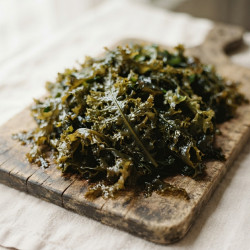
Biovie's fresh seaweed is hand-harvested in Roscoff by Bretalg, France's first historic seaweed harvester (since 1991). Kombu, wakame, nori, dulse, sea lettuce and sea spaghetti are sold as a ready-to-eat tartare or in 500 g to 1 kg packs, with a texture and taste closer to the sea than dried versions. At €16.80 per kilo, our price is among the most competitive on the market for fresh seaweed harvested in France. To try, choose our discovery assortment of 4 organic seaweeds in 4 x 250 g; for regular cooking, the kilo works out much cheaper., 8
products
The confusion is common, so let's clear it up right away. Spirulina is very rich in protein but contains practically no iodine: it will never replace wakame on that front. Chlorella, for its part, stands out for its chlorophyll and its cell wall, but not for its iodine content either.
In other words, these three don't compete for the same role: wakame for iodine and marine minerals, spirulina for protein and iron, chlorella for chlorophyll. Combining them makes sense; pitting them against each other doesn't.
Storage: one of the easiest foods to keep
This is an advantage rarely highlighted: dehydrated wakame keeps for about 18 months (versus just a few days for the fresh version), at room temperature, somewhere dry and away from light. No refrigeration needed.
Once the bag is opened, transfer it into an airtight glass jar kept in a kitchen cupboard. Dry wakame doesn't spoil the way a fresh product does: it slowly loses the little moisture it contains, which if anything concentrates its mineral content. That's what makes it a food you can keep on hand all year round without a second thought.
Iodine deficiency in France: a truly underestimated reality
The alarming figures of the WHO 2024
It is often thought that iodine deficiency is a problem of developing countries. In reality, this is far from being the case.
According to the latest data from the World Health Organization published in 2024, Nearly 2 billion people worldwide have an insufficient iodine intake (7).. And Europe is not spared: the WHO classifies France among the countries with a moderate iodine deficiency.
These figures really caught my attention when I discovered them. How is it possible in a developed country like ours, with access to a varied diet ?
Who are the populations most at risk ?
Certain population groups are particularly at risk of iodine deficiency:
Vegetarians and vegans The main dietary sources of iodine are seaweed, fish, seafood, and dairy products. Without these foods, obtaining natural iodine on a vegan diet becomes problematic if not compensated with seaweed, however, vegans do not necessarily have this habit.
Pregnant and breastfeeding women Their iodine needs are increased by 30 to 50%.
People who limit salt The iodization of table salt is a public health measure, but those who reduce their salt intake for cardiovascular reasons lose this source of iodine.
Inhabitants of regions far from the sea Historically, mountain populations were the most affected by goiter, this enlargement of the thyroid gland linked to iodine deficiency.
People consuming a lot of goitrogenic foods Certain foods like cabbage, broccoli, or soy can interfere with the thyroid's use of iodine if consumed in large quantities.
Why iodized salt is no longer enough
Iodized salt was a major public health advancement in the 20th century. The addition of iodine to table salt significantly reduced cases of goiter and cretinism in Western countries.
But today, this strategy is showing its limitations. Several factors explain why iodized salt is no longer a sufficient natural iodized salt alternative:
Reducing salt consumption Public health recommendations rightly encourage us to reduce our salt intake. Less salt = less iodine.
The use of non-iodized salt : Sea salt, fleur de sel, Himalayan pink salt... These "trendy" alternatives are generally not iodized.
Food transformation : Industrial dishes rarely use iodized salt.
Bioavailability Iodine added to salt can partially volatilize during storage and cooking.
Seaweeds like wakame are one dietary source of iodine among others, and we have been offering them at Biovie for years.
How to use wakame in daily life
Recommended dosages according to your situation
Let's get to the concrete details now. How much wakame per day ?
Here are the dosages we recommend, based on the reference nutritional intakes (3):
General maintenance (adult) : 1g of dehydrated wakame, 3 to 4 times a week. This covers about 280% of the NRV in iodine with each intake.
Increased needs (pregnancy, breastfeeding) : 1 to 1.5g of wakame, 4 times a week. Important: always inform your doctor or midwife.
Strict vegan diet : 1g of wakame, 4 to 5 times a week, to compensate for the absence of animal sources of iodine.
Salt reduction : If you limit iodized salt for health reasons, wakame can become your main source of iodine. Same dosage as general maintenance.
This seaweed iodine dosage may seem low, and that's precisely the point. A teaspoon of wakame flakes or a small portion of rehydrated wakame is more than enough.
Ideal frequency: 3 to 5 times per week
Why 3 to 5 times a week rather than every day ?
Firstly, iodine is stored in the thyroid. Your body maintains a reserve that allows it to cope with variations in intake. Regular but not daily consumption is more than enough to maintain these reserves.
Secondly, this frequency gives you flexibility in your culinary organization. You don't have to eat wakame at every meal. Three, four, or five times a week is easy to incorporate without it becoming a constraint.
Thirdly, as a precautionary measure, this avoids any risk of overload. Even with a balanced seaweed like wakame, it is preferable not to saturate your body with iodine on a daily basis.
Preparation methods: salad, soup, flakes
Wakame lends itself to many preparations. Here are the three simplest ways to incorporate it into your diet:
1. In salad (the classic) Soak 5g of dehydrated wakame in cold water for 5 minutes. It will triple in volume and regain its tender texture. Drain, season with a bit of soy sauce, sesame oil, and rice vinegar. Add sesame seeds. It's the famous "wakame salad" from Japanese restaurants, but fresher and less sweet !
2. In your soups and broths Add a pinch of dehydrated wakame directly into your soup at the end of cooking. It will rehydrate on its own. It's excellent in a miso soup, but also in a classic vegetable broth or a fish soup.
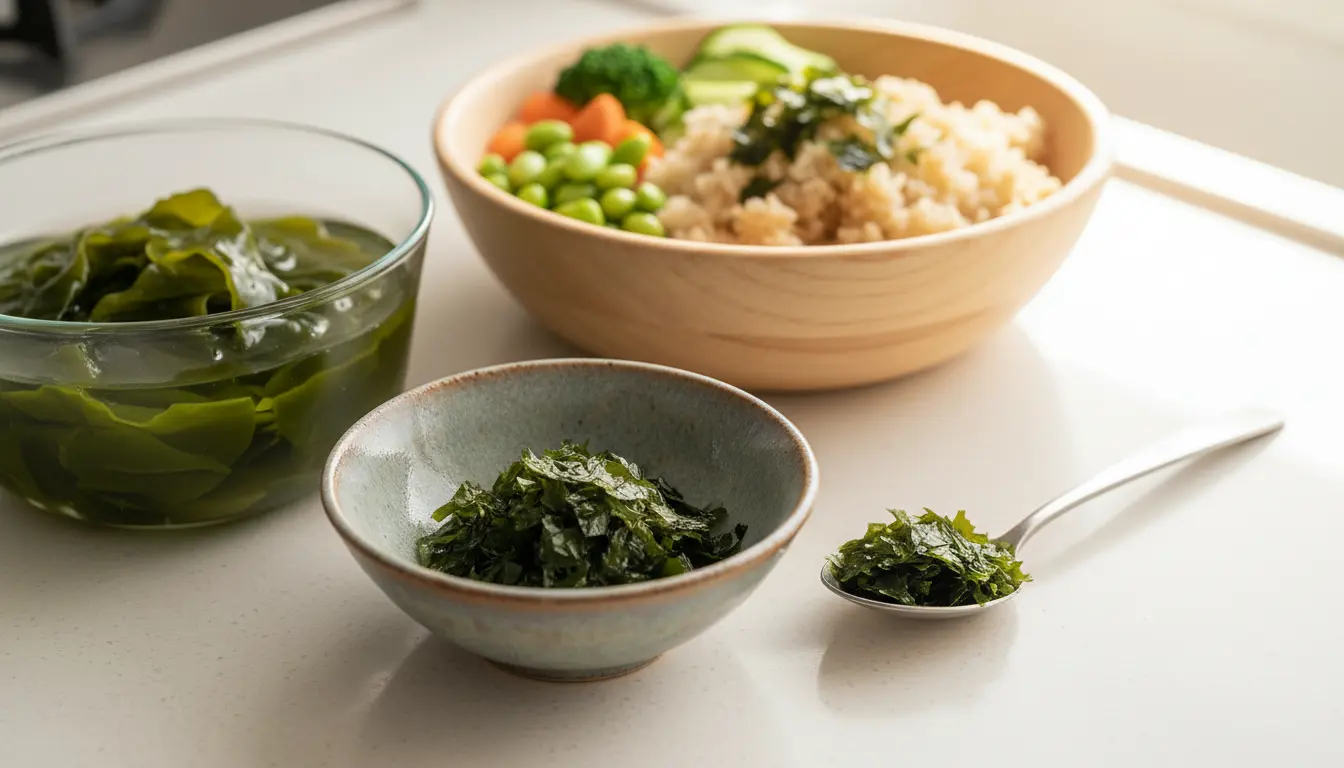
3. In sprinkle glitter (the most practical) It is truly the simplest solution for everyday use. Wakame flakes can be sprinkled on any dish: rice, pasta, vegetables, salads, eggs... The taste is subtle and adds a pleasant umami touch without overpowering the dish.
At Biovie, we offer these different formats so that everyone can find the one that suits them. Personally, I mainly use the flakes daily for their convenience.
Tip: how to adjust iodine content if necessary
Here is a tip that few people know: the soaking water of wakame contains some of the iodine. If you wish to slightly reduce the iodine intake (for example, if you are already consuming other sources of iodine), you can:
Extend the soaking time to 5-10 minutes.
Discard the soaking water rather than using it.
Quickly blanch the wakame in boiling water
Conversely, if you want to maximize iodine intake, use wakame without prior soaking (directly in flakes) or incorporate the soaking water into your preparation.
Important precautions and contraindications
I value this section greatly because transparency is part of our values at Biovie. Regular consumption of wakame is suitable for most people
Hyperthyroidism and autoimmune thyroid diseases
If you suffer from hyperthyroidism (overactive thyroid), the consumption of wakame or any other source of iodine is generally not recommended. Additional iodine intake could worsen the situation.
For autoimmune thyroid diseases such as Hashimoto's thyroiditis or Graves' disease, the issue is more nuanced. Some studies suggest that an excess of iodine could stimulate thyroid autoimmunity in predisposed individuals (6). In these cases, it is imperative to seek the advice of your endocrinologist before any regular consumption of seaweed.
Note: The situation is different for hypothyroidism (underactive thyroid). In case of hypothyroidism, whatever its origin, ask your doctor's advice before regularly consuming seaweed.
Interactions with treatments (Levothyrox®, amiodarone)
Some treatments interact with iodine and require special precautions:
Levothyrox® and other thyroid hormone replacements : If you are undergoing this type of treatment, your iodine intake should remain stable. A sudden increase (for example, starting to regularly consume wakame) might require an adjustment to your treatment. Talk to your doctor about it.
Amiodarone : This treatment used for certain cardiac arrhythmias contains a large amount of iodine itself. The addition of dietary sources of iodine is generally not recommended during this treatment.
Lithium : This treatment used in psychiatry can affect thyroid function. The consumption of seaweed should be discussed with the prescribing doctor.
Pregnancy, breastfeeding, and special cases
Pregnancy and breastfeeding are periods when iodine needs are increased. If you consume it during these times:
Always inform your doctor or midwife about your consumption of seaweed.
Respect the recommended dosages (1 to 1.5g, up to 4 times a week maximum)
Absolutely avoid seaweeds that are very high in iodine, such as kombu.
For children, wakame can be gradually introduced from the age of 3, in small quantities (0.5g, twice a week).
Pre-operative period: why stop 15 days before
Here is a precaution that is often overlooked: if you need to undergo surgery, particularly on the thyroid or parathyroids, it is recommended to stop consuming iodine-rich seaweed at least 15 days before the operation.
Iodine can indeed interfere with certain preoperative examinations (notably scintigraphy) and temporarily alter thyroid function, which complicates the procedure.
Other components of wakame
Wakame is not limited to its iodine content. This seaweed contains other components. For more details, I invite you to consult our Complete guide to edible seaweeds.
Fucoxanthin: the brown pigment of wakame
Wakame contains a unique carotenoid pigment called fucoxanthin.
The calcium in wakame
Wakame contains about 1300 mg of calcium per 100g of dried seaweed.
Of course, we don't eat 100g of wakame per day: with the recommended portions (1 to 2g), the calcium intake remains modest.
Wakame also contains other minerals: magnesium, iron, zinc...
Fucoidans: Polysaccharides
Fucoidans are sulfated polysaccharides found in brown algae such as wakame.
Wakame offers much more than iodine: it is a food that has its place in a varied and balanced diet.
Frequently Asked Questions
Which seaweed to choose for the thyroid ?
Wakame contains about 420 µg of iodine per gram, or about 280% of the NRV for 1 g; iodine contributes to the normal production of thyroid hormones and to normal thyroid function. Kombu can contain up to 10 times more: wakame is used in small quantities.
Does wakame help with weight loss ?
No food makes you lose weight on its own. Wakame is a low-calorie seaweed that fits into a varied diet; I recommend it for its taste and its iodine, not as a slimming product.
Are algae dangerous for the thyroid ?
Seaweed is not dangerous if consumed in moderation and with common sense. The main risk involves excess iodine with highly concentrated seaweeds like kombu. Wakame, with its moderate content, is safe for regular consumption (3-5 times a week) for individuals without pre-existing thyroid issues.
How much wakame per day ?
1 to 2g of dehydrated wakame, 3 to 4 times a week, is enough to meet iodine needs. This amounts to about a teaspoon of flakes or a small portion of wakame salad. There is no need to consume more.
Can iodine from seaweed be dangerous ?
The EFSA (European Food Safety Authority) sets the upper safety limit at 600 µg of iodine per day (5). With 1g of wakame providing about 420 µg, you remain well below this limit. The danger mainly concerns kombu (1500-3500 µg/g) or the overconsumption of concentrated iodine supplements.
How to easily eat wakame ?
Three simple ways: (1) In a classic salad after 5 minutes of rehydration, with a soy-sesame sauce. (2) Added at the end of cooking in your soups and broths. (3) As flakes to sprinkle directly on all your dishes, rice, pasta, vegetables... The flakes are truly the most convenient solution for everyday use.
What is the food richest in iodine ?
Brown laminar algae (kombu) are the richest foods in iodine, with 1500 to 3500 µg per gram. However, this concentration can be excessive for regular use. For a safe and balanced intake, prefer wakame (420 µg/g) or supplement with sea fish and seafood.
In summary
Wakame provides an intermediate amount of iodine, neither too low like nori nor excessive like kombu: this is why we recommend it for regular consumption.
With 1 g of wakame a few times a week, you provide iodine, which contributes to normal thyroid function, without exceeding the EFSA safety limit (600 µg per day).
At Biovie, we offer certified organic wakame, available in different formats to suit all uses: dehydrated for salads, in flakes to sprinkle on your daily dishes. It's truly one of our favorite seaweeds, which we have been using ourselves with Aurélie for years.
Discover our organic wakame →
A varied and balanced diet and a healthy lifestyle are important for your health.
Bibliographic references
(1) CIQUAL, Nutritional Composition Tables of Foods. ANSES, 2024. Available at: https://ciqual.anses.fr/
(2) Zimmermann MB, Boelaert K. Iodine deficiency and thyroid disorders. Lancet Diabetes Endocrinol. 2015;3(4):286-295.
(3) ANSES, Nutritional references for vitamins and minerals. Opinion of the French Agency for Food, Environmental and Occupational Health & Safety, 2021.
(4) CEVA, Center for the Study and Valorization of Algae. Data on the nutritional composition of edible algae, 2023.
(5) EFSA Panel on Dietetic Products, Nutrition and Allergies. Scientific Opinion on Dietary Reference Values for iodine. EFSA Journal. 2014;12(5):3660.
(6) Farebrother J, Zimmermann MB, Andersson M. Excess iodine intake: sources, assessment, and effects on thyroid function. Ann N Y Acad Sci. 2019;1446(1):44-65.
(7) World Health Organization. Iodine Deficiency, Global Status Report 2024. WHO Europe, 2024.
(9) MacArtain P, Gill CI, Brooks M, Campbell R, Rowland IR. Nutritional value of edible seaweeds. Nutr Rev. 2007;65(12 Pt 1):535-543.