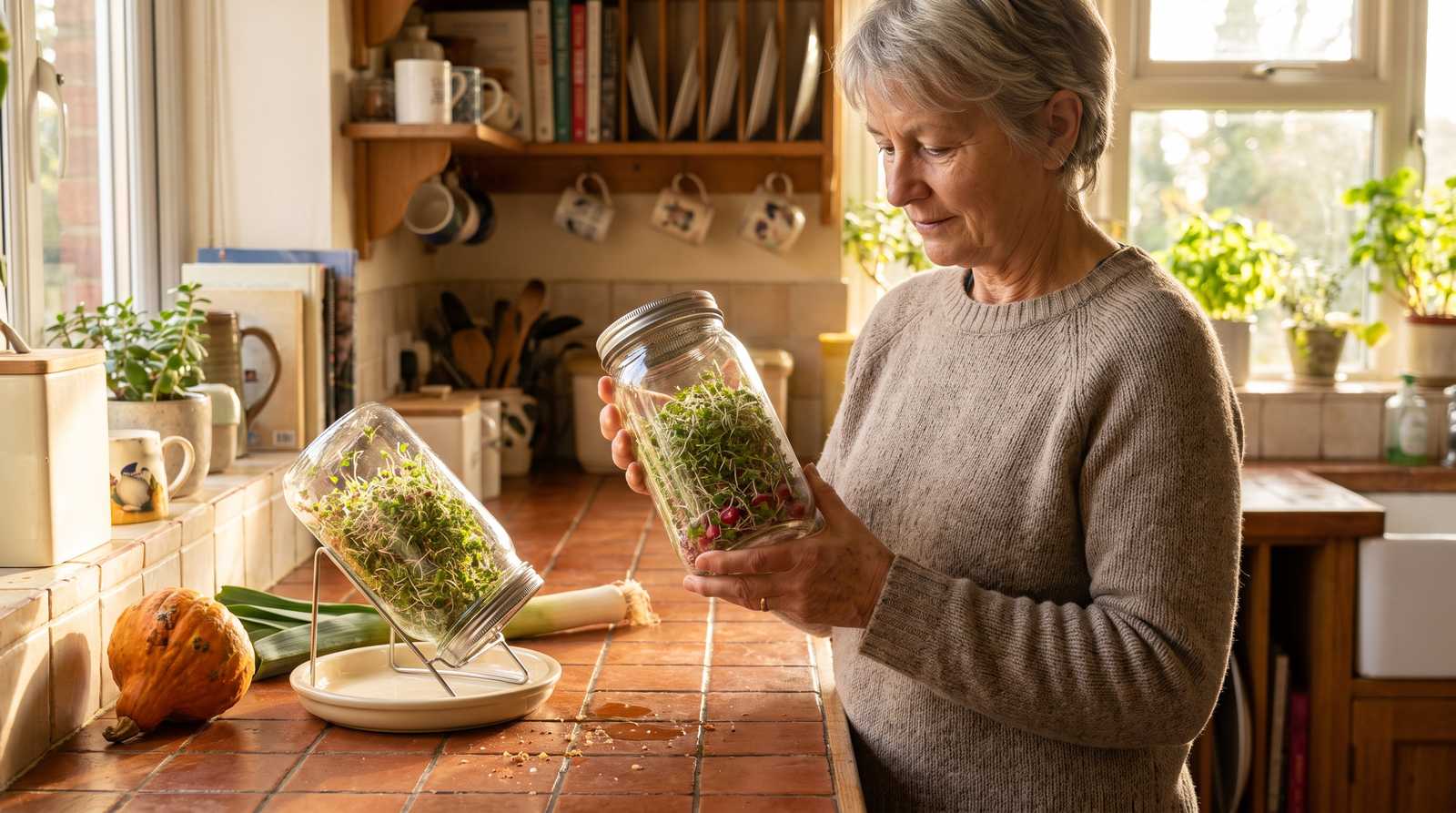
Summer salads have left the table and the kitchen has lost a few degrees: if you want to know how to sprout seeds at home in autumn, and which are the best seeds to sprout, keep your summer routine (soaking, rinsing, draining, waiting away from direct sun) and accept that everything goes more slowly in the cool. Only the spot of the jar and the choice of seeds change, matched to seasonal dishes. At Biovie, we built this guide on a study run at three temperatures and on the opinions of EFSA and ANSES, and I have been sprouting seeds myself since I was a teenager.
How to sprout seeds in autumn: the 4-step method
Good news first: the method doesn't change. Soak the seeds in water, rinse and drain them morning and evening, then let them wait away from direct sunlight, at the temperature of a room where you live. In autumn, sprouting simply slows down: only the patience grows, and the rinses stay regular.
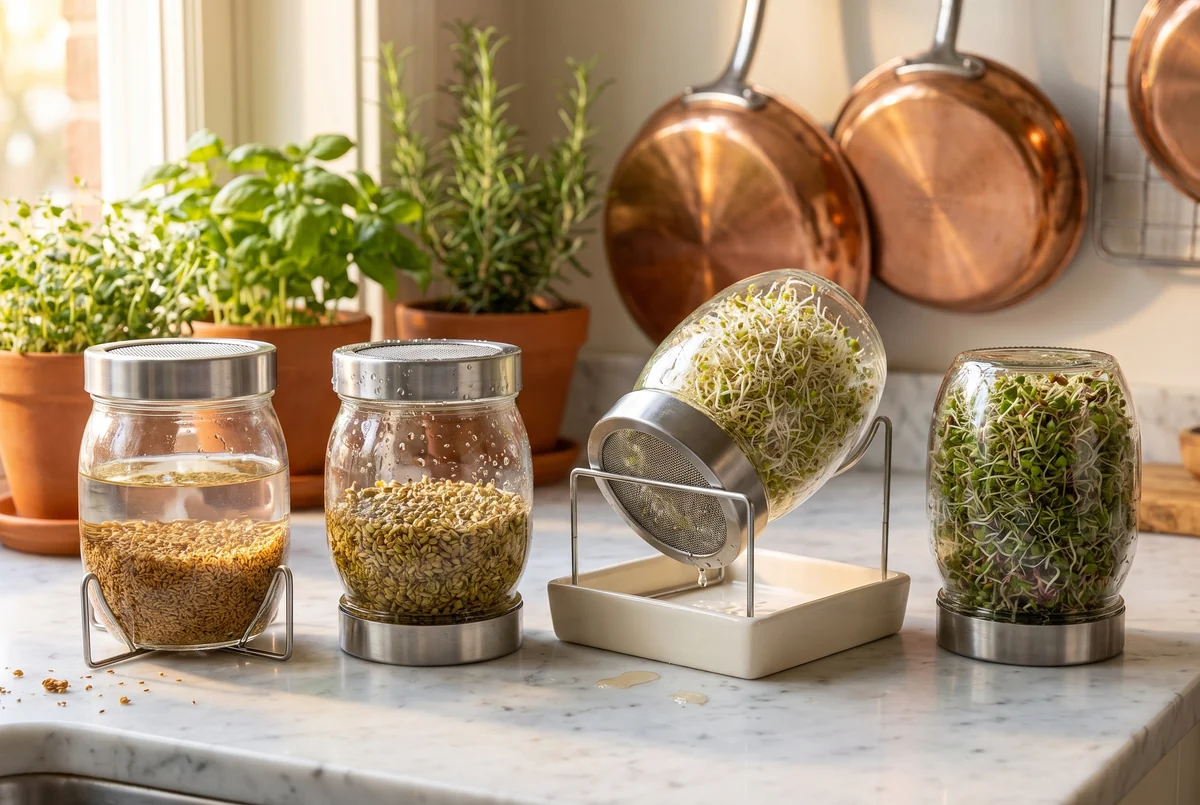
- Soaking, in water that is neither icy nor hot.
- Rinsing with clear water, stirring the seeds a little so the water reaches everywhere.
- Draining, with the jar tilted upside down: a seed sitting in stagnant water ends up smelling bad.
- Waiting, away from direct sunlight.
Cold slows things down, it doesn't stop anything. Researchers wanted to know for sure: they sprouted broccoli and rocket sprouts at 10, 20 and 30 °C, then analysed their composition (Ragusa et al., 2017). In this laboratory study, the vitamin C content of the sprouts rose during sprouting, with no difference between the three temperatures. Even more surprising, the antioxidant capacity measured was highest at 10 °C, especially for rocket, while glucosinolates climbed with warmth.
Ten degrees is roughly the coolness of a cellar, and twenty that of a heated living room. These measurements concern the composition of the sprouts in the laboratory, and no volunteer ate any: they simply show that a cool kitchen doesn't ruin the seed. I point this out because it's easy to make a study say more than it says. As part of a varied and balanced diet and a healthy lifestyle, a handful of sprouts remains a simple way to keep fresh plants on the plate when the seasonal offer shrinks. If you are just starting out, the 10-minute daily routine is plenty, summer or winter.
What if the room drops below 15 °C?
Move the sprouter closer to a room where people live, the kitchen or the living room, and rinse with water that isn't icy. Avoid the windowsill, which is cold at night, and the top of the radiator, which dries out the seeds.
And you don't need a sophisticated setup, I know something about that. During my first year of studies at ISTOM, I lived in a room with no kitchen, without the right to use the shared kitchen, and the university canteen offered nothing vegetarian. Be that as it may, I had to eat fresh food somehow: it was by sprouting seeds intensively that I got something green on my plate. You can start with no means at all, as long as you rinse regularly.
What sprouting changes inside the seed
A dry seed is a pantry locked with a key. Then it drinks, and everything wakes up: its enzymes get back to work, and amylases break starch down into simpler sugars (Benincasa et al., 2019).
I always think of a carpentry workshop. Workers in blue overalls saw the logs into planks before the seed even reaches your plate, so part of the work is done outside. Your body receives planks, not logs. Hence this sentence I often repeat, as a conviction: we are not what we eat, but what we assimilate.
A nuance is needed, though. The same review points out that the composition of sprouts depends on the variety, the cultivation of the mother plant and the sprouting conditions: one sprout is not worth another. Broccoli, for its part, has something to surprise us, since 3-day-old broccoli sprouts contain 10 to 100 times more glucoraphanin than the adult plant (Fahey et al., 1997). In other words, a small handful of sprouts can, on that one compound alone, be worth a full plate of florets.
As part of a varied and balanced diet and a healthy lifestyle, it's a very concentrated way to put broccoli on the menu. We covered sprouted broccoli seeds and sulforaphane in a dedicated article.
The best seeds to sprout from October to December
This calendar of the best seeds to sprout follows seasonal dishes, not a seed season. Indoors, nothing stops you from sprouting radish in November as in May. The seed follows the room temperature and the regularity of the rinses, far more than the date. The idea is simply to match the sprouts to the vegetables at the market.
| Month | Seeds | Use at the table |
|---|---|---|
| October | Alfalfa, radish, Mix Andante, mung bean, azuki | Transition salads, more filling bowls |
| November | Broccoli, red cabbage, kale, mustard, Mix Adagio, leek | On soups and purées, just before serving |
| December | Chinese rose radish, Mix Vivace, sunflower, wheat for wheatgrass | Colourful holiday plates, wheatgrass to cut |
October: the transition
The last tomatoes are still lingering on the stalls, the squashes are arriving, and you no longer quite know whether you feel like a salad or a soup. Fine seeds suit transition salads, larger seeds suit bowls that stick to the ribs. On the fine side: alfalfa, mild, radish for its bite, or Mix Andante, a blend built around mung bean. On the larger side: mung bean and azuki, two legumes always soaked before sprouting (see mung beans and their precautions).
November: crucifers and leek
November is the month of cruciferous vegetables, at the market as in the jar. Broccoli, red cabbage, kale or mustard all lend themselves to it, as does Mix Adagio, built around broccoli. If you are wondering how to sprout broccoli seeds at home, or how to sprout mustard seeds at home, the four steps above apply as they are. And then there is leek as a seed, which we too often forget. Placed on a leek soup just before serving, its fine sprout echoes the dish. The same vegetable twice in the bowl, once cooked, once alive. Have a look at our article on sprouted leek seeds.
December: colour and greenery for the holidays
For end-of-year tables, go for colour with Chinese rose radish or Mix Vivace, made entirely of radish. If you are wondering how to sprout sunflower seeds, start with the unhulled seeds sold for sprouting and rinse them carefully. The wheat for wheatgrass gives, for its part, greenery you cut with scissors.
This calendar is by no means exhaustive, of course: the complete list of seeds to sprout covers many other possibilities. Choose two or three seeds a month rather than the whole catalogue: regularity matters more than variety. It's a seed merchant telling you this, and I own it.
Keeping some raw food when it's cold
Who feels like a plate of icy raw vegetables on a November evening? Not many people, and that's perfectly normal: we want something warm. It all comes down to one gesture: add the sprouts off the heat, just before serving, on a vegetable soup, a purée or a lukewarm dish.
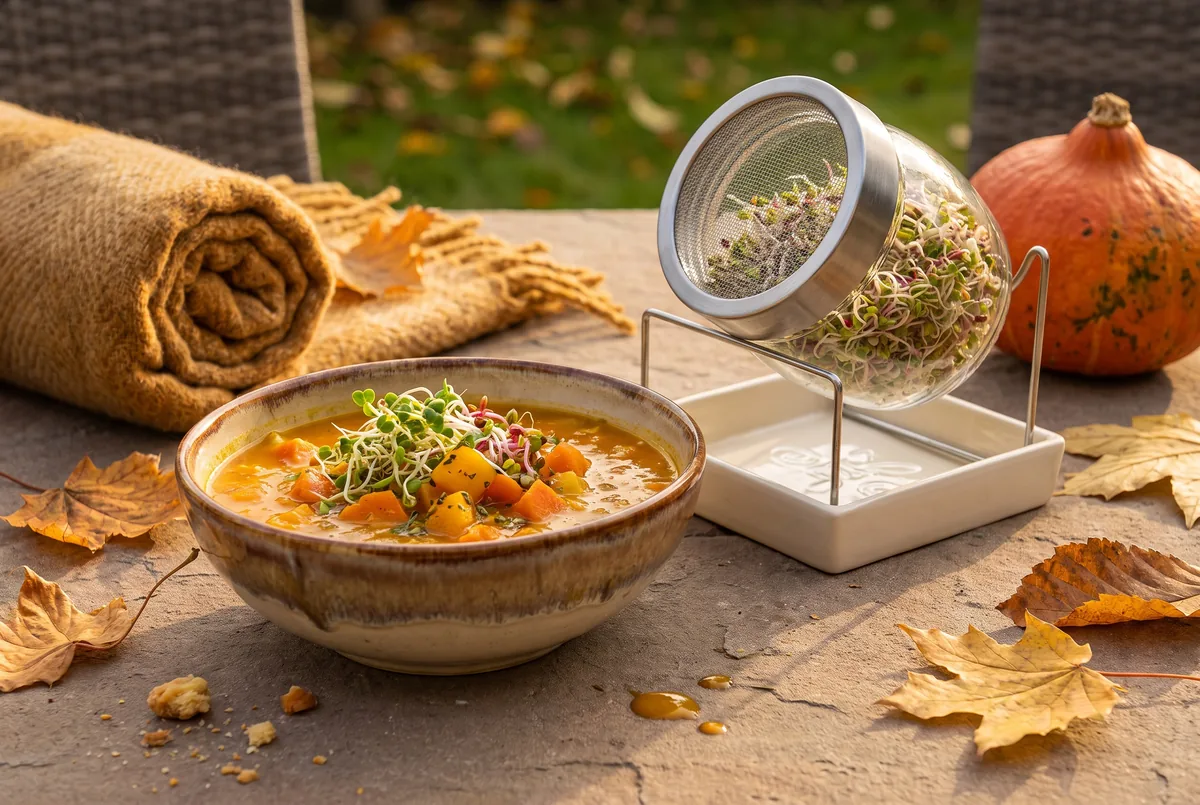
Autumn vegetables also play the game, raw and grated: carrot and beetroot, a handful of radish sprouts on top, next to a hot dish. A “hot + alive” plate, where the raw accompanies the cooked without replacing it. We add, we remove nothing, and everyone moves at their own pace. A spoonful of sprouts on tonight's soup is already a start.
As part of a varied and balanced diet and a healthy lifestyle, these sprouts round out the winter plate without taking anything away from it. One question comes back every year with the seasonal squashes: how do you sprout pumpkin seeds? It's an amusing curiosity to try with the seeds of your own squash, but for regular use, seeds sold for sprouting are much simpler.
Which equipment to choose when the house cools down?
Two manual options, one automatic. First the glass jar, which everyone already has in a cupboard. Then the Universal Sprouting Bag, which you hang after soaking so it drains. Finally the automatic sprouter, which waters the seeds by itself.
To be honest, in autumn the problem isn't the seed, it's us. Rinsing morning and evening with tap water in a cool kitchen, we always end up finding a good reason to skip a round. When rinsing with cold tap water becomes a chore, automatic watering removes the main obstacle of autumn. The Easygreen Light automatic sprouter belongs to this family: it takes care of the watering for you, and the seeds are left in peace even on evenings when you get home late and nobody thinks of the jar. Of course, a well-kept jar does the job just as well. The right tool is the one you will really use every week. To compare sprouters in detail, a whole article is devoted to them.
On cotton wool?
Sprouting seeds on cotton wool is the school method: cress or a lentil on damp cotton wool, and the whole class watches for the root to appear. For an experiment, it's perfect. For eating sprouts every week, the jar or the sprouter are far more practical, because you can rinse in them and harvest in quantity.