








In this article:
At 44 years old, something has changed. You sleep less well. Your cycle is no longer as regular as it was two years ago. You feel a fatigue that you can't explain - not the kind from chronic overwork, no, another kind of fatigue, more diffuse, more dull. Perhaps also some night sweats that surprise you, mood swings that unsettle you, a belly slightly more bloated than before.
It is not menopause. Not yet. It is the premenopause - also called perimenopause - and if you are reading these lines, it is probably because you are looking for answers to what is happening in your body.
Specifically, about 6 million women in France are in perimenopause at any given time (INSERM/INSEE estimate). And yet, the diagnosis is often made with a delay of 2 to 3 years (NAMS, 2023). These changes are attributed to stress, work, children - everything except the hormonal biology which has been quietly progressing for a few years already.
On this subject, I wanted to look into what recent science tells us - particularly a remarkable review published in Nutrients in 2024 (Erdélyi et al.) which confirms that Diet during perimenopause profoundly alters metabolic, bone, and cardiovascular risks. (1). It is not anecdotal. The dietary choices you make today, at 42 or 48 years old, directly influence how you will experience this transition.
This article provides you with the keys to recognize the 12 most common symptoms of perimenopause, understand what is happening in your body, and discover how to seaweed can help navigate this period with more comfort and vitality.
Premenopause, perimenopause: what is the difference and what are we really talking about ?
Let's start by clarifying the vocabulary, as this is often where confusion arises. The two terms refer to the same biological reality. "Premenopause" is the classic medical term, still used by many healthcare professionals. "Perimenopause" is a more recent terminology, preferred by international scientific societies like the NAMS (North American Menopause Society). In practice, the two are synonymous and refer to the hormonal transition period that precedes menopause.
What characterizes this phase is the progressive irregularity in the production of estrogen and progesterone by the ovaries. Your body does not suddenly stop producing these hormones - it does so in an increasingly chaotic manner. It is precisely this fluctuation, and not the total absence of hormones, that is the cause of the symptoms.
Menopause is officially diagnosed after 12 consecutive months without a period. Everything that precedes this point - sometimes over many years - is called perimenopause.
At what age does one start entering premenopause/perimenopause ?
TheAge of perimenopause It can be surprising. It can start as early as 38-40 years old and lasts on average 4 to 8 years. The CMAJ journal (2023) notes that symptoms can appear up to 10 years before menopause (4). On average, the first signs appear around 45-47 years old. But some women enter into early perimenopause well before - as early as 35-38 years old - without always making the connection.
What is interesting, and what I often explain during our Biovie workshops, is that the exact age depends partly on genetic factors, but also on lifestyle and - you guessed it - diet.
How long does perimenopause last ?
On average, perimenopause lasts 4 to 8 years, sometimes up to 10 years for some women. The symptoms are often more intense in the last 2 years before official menopause, when estrogen levels drop most rapidly. Here is a figure that highlights the significance of the issue: Estrogens can decrease by 60 to 80%. between perimenopause and established menopause - source INSERM, CMAJ journal 2023 (4).
Do the rules change during perimenopause ?
Yes, and it is often one of the first signals. In perimenopause, periods frequently become irregular: the Duration of periods in perimenopause can vary considerably - the cycle may lengthen (36 days or more) or shorten (25 days or less), and the periods themselves can be heavier, shorter, or more spaced out. These variations reflect ongoing hormonal fluctuations. This irregularity can last for 2 to 8 years before periods stop permanently. If your periods become very heavy (maximum protection every 2 hours), consult a doctor to rule out other causes such as fibroids or polyps.
.webp)
What are the 12 most common symptoms of perimenopause ?
Here are the 12 most documented premenopause symptoms - those that research on the "35 premenopause symptoms" confirms as the most common. I list them not to alarm you, but because naming them already takes away a good part of their power to cause concern:
- Menstrual irregularities - longer cycles, shorter cycles, more or less heavy periods
- Hot flashes - sudden sensations of intense heat, often on the face and chest
- Night sweats - hot flashes during sleep, sometimes very intense
- Insomnia or fragmented sleep - difficulties falling asleep, frequent nighttime awakenings
- Unexplained fatigue - perimenopause fatigue : persistent exhaustion without obvious cause
- Mood swings and irritability - disproportionate emotional reactions, mild anxiety
- Difficulties concentrating - "brain fog", short-term memory loss
- Decrease in libido - decreased sexual desire, often linked to the drop in estrogen
- Vaginal dryness - discomfort, irritations, pain during intercourse
- Bloating and a swollen belly during perimenopause - water retention, more difficult digestion
- Abdominal weight gain - redistribution of fat to the abdomenlosing weight during perimenopause becomes more difficult)
- Hair modifications - hair loss, decreased density, texture changes
If you recognize several of these symptoms - even 2 or 3 - and you are between 38 and 52 years old, perimenopause is a serious possibility to explore with your doctor.
Visible hormonal signals: cycles, hot flashes, sleep
The symptoms directly related to hormonal fluctuations are generally the first to appear and the most obvious: irregular cycles, hot flashes, night sweats, insomnia. They are the direct consequence of variations in estrogen levels, which no longer follow a stable monthly pattern. These hormonal ups and downs affect the body's temperature regulation (hence the hot flashes), sleep quality, and menstrual cycles.
The lesser-known signals - belly, mood, memory, weight
The less obvious symptoms - and often less attributed to perimenopause - are nonetheless just as real. Brain fog (difficulty concentrating) is one of the most destabilizing. Digestive issues, the bloated abdomen during perimenopause, abdominal weight gain is linked to changes in fat metabolism orchestrated by the drop in estrogen levels. Vaginal dryness is often underreported because it is considered taboo. However, it is part of the documented clinical picture of perimenopause.
Why does diet play a central role from perimenopause onwards ?
This is the key question. And the answer is clearly: because your body is undergoing a profound transformation that changes its nutritional needs. Themenopause nutrition naturopathy is not a gadget - it's a scientifically validated strategy. How to eat during perimenopause is not about a restrictive diet, it's about providing the right fuel for a changing engine.
The decline of estrogen explained simply
Estrogens are not only involved in reproduction. They play a role in:
- Bone health - they slow down bone resorption
- Cardiovascular health - they help maintain a good lipid profile
- Brain health - they modulated your mood and memory
- Metabolic health - they influence fat distribution and insulin sensitivity
When their production becomes irregular and then decreases, all these systems feel the effects. That's why perimenopause is not just about cycles. It's a global metabolic reorganization.
Which nutrients become a priority after 40 years ?
The systematic review published in Archives of Gynecology and Obstetrics (2024) is very clear on this subject: deficiencies in iron, omega-3, and certain vitamins significantly increase morbidity during menopause and perimenopause (2). Here are the priority nutrients from the phase of perimenopause diet :
- Calcium - to protect bone density that estrogens helped to preserve
- Iron - heavier cycles can increase iron loss and the resulting fatigue
- Omega-3 DHA - for the brain, mood, and anti-inflammatory response
- Magnesium - for sleep, stress management, and cramps
- Seaweed phytoestrogens - plant molecules with a structure similar to estrogen, which can modestly interact with hormone receptors
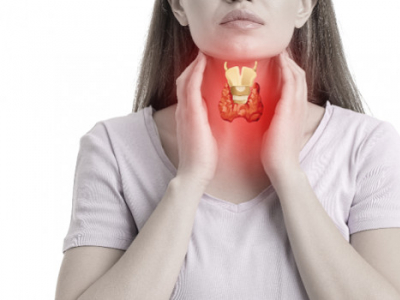
- Iodine - to support the thyroid, which is often weakened during this hormonal transition
Specifically, where can you find all of this on your plate? This is where seaweeds come in - a family of foods that concentrate and make several of these nutrients bioavailable at once.
Seaweed: The Unsung Ally for Women in Perimenopause
I often say it: seaweeds are the most underrated food family of our time. With Aurélie, we have been incorporating them into our daily lives since the creation of Biovie in 2007, and since the publication of our book. Seaweed in everyday life (Gallimard, 2024), we observe every day the growing interest in these marine plants. Edible seaweeds and their benefits could be the subject of an entire book - and that's what we did !
For women in perimenopause, seaweed offers particularly well-documented nutritional benefits. The Algae and female hormones : a subject that science is beginning to explore seriously.
Calcium and bone structure: why wakame outperforms dairy products
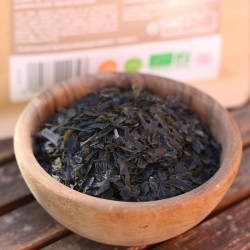
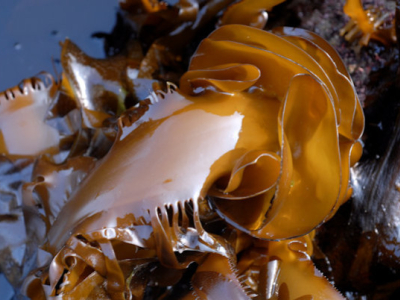
Osteoporosis is one of the major risks associated with the decrease in estrogen. Bone protection primarily involves an adequate intake of calcium. However, the wakame calcium menopause is a particularly favorable equation: Wakame contains approximately 1,300 mg of calcium per 100 g dry. - which is 13 times more than whole milk (source CIQUAL / ANSES 2020) (7). Specifically, a tablespoon of rehydrated wakame already makes a significant contribution to your daily needs.
Wakame contributes to the calcium intake necessary for maintaining normal bone structure*. It is a documented nutritional fact, and it is by far one of the best plant-based sources of calcium available. Wakame: 13 times more calcium than milk.
* A varied and balanced diet and a healthy lifestyle are important for maintaining bone health.