A Olive oil that stings the throat is not a failed oil: it is a sign of a fresh oil rich in phenolic compounds. This tingling sensation has a name, ardence, and it comes from a specific molecule, oleocanthal, identified in 2005 by researchers at the Monell Chemical Senses Center and published in Nature. Professional tasters consider it a positive attribute, not a flaw.
You open a new bottle, you taste it, and two seconds later you cough. The reflex is immediate: this oil must be bad. You put it down, a bit disappointed, wondering if you should throw it away. It's exactly the opposite.
A Olive oil that has a bite is almost always a young and richly endowed oil. I will explain to you where this sensation comes from, why it settles in the throat and never on the tongue, and especially how not to confuse it with the only real flaw that justifies emptying the bottle.
Describe precisely what you feel (it's not about language)
Redo the experiment, but slowly, and observe the timeline. It is always the same.
First, the fruity notes: cut grass, artichoke, green tomato, sometimes almond. Then, on the tongue, a distinct bitterness that settles in as you swallow. And only after - one to two seconds later, when the oil has already passed - a dry tingling at the back of the throat. Clear enough to trigger a cough, sometimes two.
This delay is confusing: you put the oil in your mouth, and the sensation appears elsewhere, later. It is not your imagination, and it is not an anatomical coincidence. We will see below that it cannot happen otherwise.
Above all, remember the distinction, because it is the key to everything else: Bitterness is on the tongue, spiciness is in the throat. Two different sensations, in two different places. The tasters even count the coughs - "one cough," "two coughs" - as an indicator of intensity. It's rudimentary, but it's telling.
A bitter and pungent olive oil is not an oil with a problem: it is an oil that has both attributes, each in its place.
.webp)
A researcher, a sip of oil, and a Nature journal
The story begins with a coincidence.
In 2005, Gary Beauchamp, a researcher at the Monell Chemical Senses Center in Philadelphia, tastes freshly pressed olive oil at a conference in Sicily. He coughs. And he recognizes the sensation: It is exactly the same one he had experienced some time earlier in the laboratory while testing liquid ibuprofen solutions. Same tingling, same location.
His team then isolates the responsible molecule and gives it a completely fabricated name: Oleocanthal. . Oleo for the oil, canth for the spiciness, to the for the aldehyde function. The result is published in the same year in Nature.
What this publication shows, very precisely: Oleocanthal inhibits COX-1 and COX-2 enzymes in vitro, with a profile comparable to that of ibuprofen. The authors also note that the intensity of the tingling sensation of a given oil is directly related to its oleocanthal content.Beauchamp et al., 2005).
And now, the precaution that matters, because it is systematically overlooked elsewhere: These studies describe a mechanism observed in test tube enzymes, not an effect in humans. A study in vitro, This means: outside the organism, on isolated molecules, under conditions that do not replicate digestion, passage into the bloodstream, or the actual doses consumed. Olive oil is not a medicine and does not replace anything. What is true and verifiable is that a molecule present in your bottle intrigued researchers enough to end up in Nature. That's already a lot.
Why does it itch in the throat and nowhere else?
Six years later, the same team answers the question everyone was asking: why does this sensation remain confined to the back of the throat ?
Olive oil stings the throat because of oleocanthal, a phenolic compound it naturally contains. This molecule activates a unique sensory receptor, the TRPA1 channel. However, this receptor is only present in the pharynx within the entire oral cavity. The tongue does not have it, so it perceives nothing.
The works published in 2011 in The Journal of Neuroscience by Catherine Peyrot des Gachons and her colleagues combine three approaches: cultured cells, sensory neurons from rodents, and perception tests in humans.Peyrot des Gachons et al., 2011).
TRPA1 is an ion channel. Think of it as a lock embedded in the membrane of a neuron: oleocanthal is the key. No lock, no signal. Your tongue doesn't have the sensor; your throat does. That's why the sensation arises afterward, downstream, even when you have stopped tasting.
Tasty detail: The same researchers have shown that ibuprofen in solution causes a restricted pharyngeal irritation identical through this same receptor. Two molecules with no obvious chemical relationship that use the same gateway.
Bitterness and spiciness: two molecules, don't confuse them
It is the most common confusion, even in serious articles.
The bitterness of olive oil mainly comes from derivatives of oleuropein, perceived by the bitter taste receptors on the tongue. The spiciness comes from oleocanthal, perceived by TRPA1 in the throat. Distinct molecules, distinct receptors, distinct locations.
Their common point: they all belong to the same family, the biophenols - more commonly known as olive polyphenols.
The International Olive Council recognizes three positive attributes of extra virgin olive oil: fruity, bitter, spicy. A balanced oil presents all three. An oil that has neither bitterness nor spiciness is not necessarily bad, but it tells you something: very ripe olives, aged oil, or deodorizing refining.
These same polyphenols are also of interest to research. A European randomized crossover trial conducted on 200 men in 2006, the EUROLIVE study, observed a dose-response relationship between the polyphenol content of an oil and the protection of blood lipids against oxidative stress. "Randomized crossover" means that each participant received the different oils successively, in a randomly assigned order: each participant thus serves as their own control, which neutralizes differences between individuals. It is this basis that allowed the registration of a claim in the European register by Regulation (EU) No 432/2012, with a strict quantified condition: at least 5 mg of hydroxytyrosol and derivatives per 20 g of oil, measured by chromatography. (Regulation (EU) No 432/2012). As part of a varied and balanced diet and a healthy lifestyle.
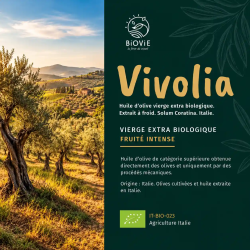
The figure in mg/kg measures the entirety of this family. It says nothing, by itself, about the mouthfeel. If you want to verify for yourself what I am describing, take any monovarietal oil harvested green: the Coratina we have selected is one of them.
Why do some oils sting more than others?
It is neither chance nor price. Four variables, in order of importance.
1. The olive variety
Not all olives produce the same amount of phenolic compounds, and The differences between cultivars are considerable. The Coratina, an indigenous variety from Apulia, is among the most concentrated in the Mediterranean basin. - this is actually why it is often found as a single varietal rather than blended in an assemblage. Curiously, it remains almost unknown in France. Incidentally, note: Table olives are a fermented food., which has nothing to do with oil - but explains why its bitterness disappears in brine.
2. The harvest date
A green olive, picked early, contains significantly more derivatives of tyrosol and hydroxytyrosol - with oleocanthal and oleacein leading - than an olive left to ripen. A metabolomic study using nuclear magnetic resonance published in Chimie Alimentaire In 2021, focusing on Coratina from Apulia, a study compared a November harvest with a January harvest in the same season: The oils from November contained 645 mg/kg of total biophenols compared to 441 mg/kg in January, and 77 mg/kg of oleocanthal compared to 43 mg/kg. (Del Coco et al., 2021A ratio close to double over a two-month difference.
To be read with the necessary caution, and I prefer to say it rather than keep it quiet: One variety, one region, one campaign, and the two harvests were not pressed at the same mill. The trend is clear and consistent with what is observed in the field, but it is not a universal law.
The counterpart is honest in saying: harvesting green means accepting much less oil for the same tonnage of olives. It's more expensive per liter, and there's no miracle in that.
3. The time and temperature at the mill
The longer the olives wait between the tree and the mill, the more they oxidize. And Mixing the dough beyond 35°C increases the yield - thus the liters - while reducing the polyphenols. It is the economic choice behind the term "cold-pressed," which says nothing about the actual malaxing temperature. No one is dishonest in this: it's a margin constraint, and it is rarely communicated because no one asks for it.
4. The age of the bottle
Phenolic compounds decrease over time, with light and oxygen. An oil that is two years old stings much less than when it comes out of the mill. This is not a flaw, it's chemistry - the same principle as for any other minimally processed living food.
To give a concrete order of magnitude: The batch of Coratina we selected was analyzed at 216.67 mg/kg of oleocanthal by an Italian laboratory accredited with ISO/IEC 17025, during the 2025/2026 season. Test report available upon request.
.webp)
Spicy or rancid: the test that prevents wasting good oil
Here is the real question behind your research. The two are very distinct, and you don't need any materials.
- What a spicy oil does: The fruitiness is present on the nose, green, vegetal. The sensation is clear, late, and strictly localized in the throat.
- What rancid oil does: It plays out in the nose, even before tasting. Wet cardboard, dry nut, old paint, sometimes a smell of putty. The fruitiness has disappeared. On the palate, it's flat and oily, without character - and especially without a clear tingling in the throat.
The protocol, in four steps:
- Pour about 15 ml of oil into a small glass.
- Warm it between your palms for about thirty seconds, covering the opening with your other hand. The heat releases the aromas.
- Discover and feel frankly. This is where the rancid reveals itself.
- Sip a small amount while drawing air through your teeth, spread it over your tongue, swallow - and count the seconds before the tingling.
The verdict is simple. It stings in the throat: you keep it, it's actually rather good news. It smells like cardboard: the tingling won't come back, the oil is degraded.
Rancid oil is not toxic. : it has simply lost its aromas and a good portion of its phenolic compounds. Use it elsewhere than at the table, or replace it. There is no reason to worry, only a reason not to waste.
How to get used to it (and why neutral oils end up seeming bland)
It's a taste that is acquired, just like strong coffee or 85% chocolate. No one likes it on the first try, and that's okay. Everyone at their own pace.
Start with a finishing net, on a support that holds: Red lentil soup, homemade chickpea puree, raw fennel, young sprouts. The bitterness is supported by something instead of lingering alone in the mouth.
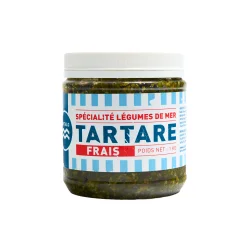
The association we recommend the most, and that you won't read about anywhere else: a drizzle of Coratina on a seaweed tartare, dulse or wakame. The iodine from the seaweed and the green fruitiness of the oil complement each other quite remarkably.
Do not heat it. You pay for thermosensitive aromatic and phenolic compounds; sending them to the pan makes no sense. Keep a more neutral oil for cooking.
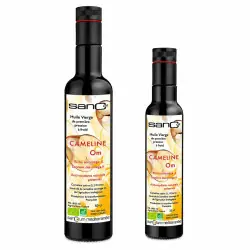
Count three weeks. After this period, a deodorized supermarket oil will seem empty to you. - it is the best indicator that your palate has shifted. And think about diversify the oils in your cooking : olives provide practically no omega-3s, whereas organic camelina oil takes care of it very well. As part of a varied and balanced diet and a healthy lifestyle.
If the Mediterranean context interests you more broadly, we have looked closely at The secrets of the blue zones and what science actually says about a Anti-inflammatory diet.
Our Coratina organic extra virgin olive oil, cold-extracted, lets you taste that peppery sting first-hand.
Frequently Asked Questions
Why does olive oil make my throat itch ?
Because of oleocanthal, a phenolic compound naturally present in extra virgin olive oil. It activates the TRPA1 receptor, located only in the pharynx. Your tongue does not have this receptor, so the sensation appears in the throat one to two seconds after swallowing.
Is it normal for olive oil to be spicy ?
Yes, and it is even sought after. Spiciness is one of the three positive attributes recognized by the International Olive Council, along with fruitiness and bitterness. Its intensity is related to the content of phenolic compounds. An oil without any spiciness is generally low in them.
How to tell if olive oil is good ?
Three sensory markers: a vegetal fruity aroma on the nose, a clear bitterness on the tongue, and a late tingling in the throat. Add two checks on the label: the harvest date and an opaque container that protects from light.
How to tell if olive oil has gone bad ?
First and foremost, the nose. A smell of wet cardboard, dry nuts, or paint indicates rancidity. The fruity aroma has disappeared, and the tingling in the throat is no longer present. On the palate, only a flat, featureless fat remains.
When does olive oil become toxic ?
It does not become so. Rancid oil is degraded in terms of organoleptic properties and has lost a large part of its phenolic compounds, but it does not present toxicity in culinary usage quantities. It is a loss of quality, not a danger.
How to remove the bitter taste from olive oil ?
We don't remove it: the bitterness comes from the polyphenols themselves, they would need to be removed. However, we do use it. Pair the oil with a mild base - legumes, purees, cooked vegetables - and use it sparingly. In three weeks, the bitterness will no longer be an obstacle.
Do all olive oils have to be pungent ?
No. The intensity depends on the variety, the harvest date, and the age of the oil. Some cultivars are naturally mild. However, a fresh extra virgin oil completely devoid of bitterness and spiciness is a signal to question.
References
- Beauchamp, G.K., Keast, R.S.J., Morel, D., Lin, J., Pika, J., Han, Q., Lee, C.-H., Smith, A.B., & Breslin, P.A.S. (2005). "Phytochemistry: Ibuprofen-like activity in extra-virgin olive oil". Nature, 437(7055), 45-46. Scientific letter - chemical characterization and in vitro enzymatic assays.
- Peyrot des Gachons, C., et al. (2011). "Unusual Pungency from Extra-Virgin Olive Oil Is Attributable to Restricted Spatial Expression of the Receptor of Oleocanthal". The Journal of Neuroscience, 31(3), 999-1009. Experimental study - HEK 293 cells, rodent sensory neurons, human psychophysics.
- Covas, M.-I., et al. (2006). "L'effet des polyphénols dans l'huile d'olive sur les facteurs de risque de maladies cardiaques : un essai randomisé". Annals of Internal Medicine, 145(5), 333-341. EUROLIVE - randomized crossover trial, 200 healthy men, 6 centers, 5 European countries.
- Del Coco, L., Girelli, C.R., Angilè, F., et al. (2021). "NMR-based metabolomic study of Apulian Coratina extra virgin olive oil extracted with a combined ultrasound and thermal conditioning process in an industrial setting". Chimie Alimentaire, 345, 128778. Single cultivar, single region, single 2019/2020 campaign.
- European Commission (2012). "Commission Regulation (EU) No 432/2012 - EU Register of authorised health claims"."
Update: August 2026. Article written and validated by Éric Viard, founder of Biovie since 2007 and engineer ISTOM, co-author of " Seaweed in everyday life "(Gallimard, 2024) -" Best cookbook in the world, Gourmand Cookbook Awards 2025, and Best cookbook in France, National Academy of Cuisine 2025.
The information presented in this article is provided for informational purposes and does not constitute medical advice. Consult a healthcare professional before making any changes to your diet or supplementation. As part of a varied and balanced diet and a healthy lifestyle.