


Biovie Vivolia
Organic extra virgin olive oil, cold-extracted, Solum Coratina, Puglia, Italy
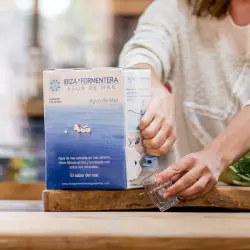
Bag in Box 3 L or 100 ml bottle
Intense fruitiness, bitter and pungent
No queries yet, leave the first!
Price:
€72.90
Product availability:
In stock
Tax included


Biovie Vivolia images


Biovie Vivolia, organic extra virgin olive oil, single-variety Coratina - very high in polyphenols, 100% Italian
This organic extra virgin olive oil is a single-variety Coratina oil: a single olive variety, harvested green in Puglia and cold-extracted less than 4 hours after picking. Batch analysis, 2025/2026 harvest campaign: 434 mg/kg of total biophenols and a free acidity of 0.23%, when European regulations allow up to 0.8% for the extra virgin category.
Its content of hydroxytyrosol and derivatives (more than 5 mg per 20 g of oil) allows it to carry the authorised health claim: "Olive oil polyphenols contribute to the protection of blood lipids from oxidative stress". The beneficial effect is obtained with a daily intake of 20 g of olive oil. This is also the oil that was ranked best Italian extra virgin olive oil in the EVOO World Ranking. We offer it in a 3 litre Bag in Box and in a 100 ml glass bottle.
🌿 Taste comes first. Because it is what strikes you first. Intense green fruitiness, frank bitterness, and above all that pungency that grabs the back of your throat two seconds after tasting. In Italy they call it pizzica - it stings. For a long time, consumers shied away from this sensation and preferred mild, rounded oils with no edge. Professional tasters, on the other hand, now regard it as a positive marker: this pungency is directly linked to the oil's richness in phenolic compounds.
So this is an oil with character, an oil that stands out from a smooth oil you remember nothing about.
🌿 How much per day? Two tablespoons, or about 20 g. This is the reference dose used by European regulations for the olive polyphenol claim, and it is also what fits a realistic daily habit: a drizzle over raw vegetables at lunch, another over the evening vegetables. Nothing extraordinary to set up. One tablespoon is about 10 ml.
🌿 How to use it? Raw, mainly. Heat destroys some of the aromatic and phenolic compounds that are precisely what make this oil worthwhile - so better to keep them. In practice, it works very well on:
- soups and pulses - a drizzle at the last moment over a chickpea or lentil soup, and the dish takes on a new dimension;
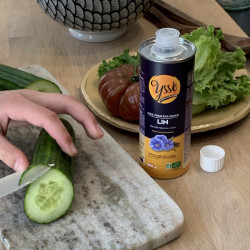
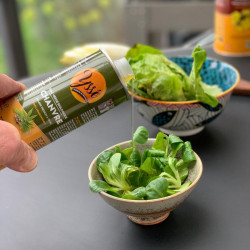
- raw vegetables and mixed salads, where its bitterness balances the sweetness of the vegetables;
- and, more surprisingly, seaweed tartares and vegetable pâtés - the green fruitiness of the Coratina and the iodine note of wakame or dulse really answer each other well.
This is an oil you measure, not an oil you pour. One tablespoon is more than enough for two plates.
🌿 Which format to choose? The 100 ml is a discovery format: enough for about ten dressings and to form your own opinion of this very distinctive taste profile. The 3 litre Bag in Box is the everyday format - and the only one that holds up if you are aiming for 20 g a day. It is not only a question of price per litre: the flexible pouch collapses as the oil is drawn off, the oil never meets the air inside the container, and the carton shields it from light. For an oil rich in compounds sensitive to oxidation, it is one of the most protective containers available. Far more so than a half-empty glass bottle, which lets oxygen do its work between each use.
The two formats are sold separately - the 3 L Bag in Box does not include a serving bottle.
🌿 Olive oil is one of the few foods with officially authorised health claims in Europe. Authorised means: assessed by EFSA, entered in the European register by Regulation (EU) No 432/2012, and subject to precise conditions that must be met. It is not a marketing promise, it is a regulatory text. This oil meets the conditions of the claim on olive oil polyphenols. Here is its exact wording and the figures that support it.
🌿 The authorised claim on olive polyphenols
"Olive oil polyphenols contribute to the protection of blood lipids from oxidative stress."
The condition: the oil must contain at least 5 mg of hydroxytyrosol and its derivatives (e.g. oleuropein complex and tyrosol) per 20 g of olive oil. Measured by chromatography, not estimated.
Test report No 2626133 of September 2026, issued by an Italian laboratory accredited to ISO/IEC 17025, measures for this batch, using the official method of the International Olive Council, 290 mg/kg of hydroxytyrosol and derivatives, which represents 5.8 mg per 20 g of oil - against 5 mg required. The condition is met.
The beneficial effect is obtained with a daily intake of 20 g of olive oil, as part of a varied and balanced diet and a healthy lifestyle.
🌿 The authorised claim on unsaturated fats
"Replacing saturated fats in the diet with unsaturated fats contributes to the maintenance of normal blood cholesterol levels. Oleic acid is an unsaturated fat."
The condition: the food must be high in unsaturated fat, meaning more than 70% of its fatty acids are unsaturated and unsaturated fat provides more than 20% of the energy. This is the case for this olive oil.
The beneficial effect is obtained by replacing saturated fats with unsaturated fats in the diet, as part of a varied and balanced diet and a healthy lifestyle.
🌿 What the analyses of this batch say
Test reports No 2626133 (September 2026, phenolic profile) and No 2616656 (12/06/2026, chemical parameters) - accredited laboratory ISO/IEC 17025 (Italy). Official methods of the International Olive Council.
| Parameter | Result | Regulatory limit |
| Total biophenols | 434 mg/kg | - |
| Hydroxytyrosol and derivatives (total) | 290 mg/kg i.e. 5.8 mg / 20 g |
Claim threshold: 5 mg / 20 g |
| Free acidity (as oleic acid) | 0.23% | 0.80% max. |
| Peroxide value | 7.1 meq O₂/kg | 20.0 max. |
| K232 | 1.92 | 2.50 max. |
| K268 | 0.131 | 0.22 max. |
| Delta-K | -0.0023 | 0.01 max. |
All chemical parameters are declared compliant with Annex I of Delegated Regulation (EU) 2022/2104 for the "extra virgin olive oil" category.
🌿 Why do polyphenols matter so much in an olive oil? They are what give the bitterness and the pungency. They are also what protect the oil from oxidation - a richly endowed oil keeps better than an impoverished one. And it is their content, and only their content, that determines the European health claim. A mild, round olive oil with no edge is almost always an oil low in polyphenols. Bitterness is not a manufacturing defect: it is an indicator of composition.
A detail I find fascinating: one of the phenolic compounds in this oil is oleocanthal. It is precisely what produces the tingling in the throat - it acts on a receptor located at the back of the pharynx, and nowhere else in the mouth. In other words, when you feel this oil sting, you are measuring its phenolic richness live. No laboratory needed.
From this point of view, Coratina is one of the most concentrated cultivars in the Mediterranean basin. This is also why this oil appears in the Top 10 Healthy of the EVOOLEUM competition - a ranking that does not reward taste, but precisely the richness in phenolic compounds.
🌿 What we will not say. You will read elsewhere that olive oil makes you live longer, that it is anti-inflammatory, that it reduces mortality by so many percent. These wordings are not authorised in Europe, and we will not use them - even when studies exist, even when competitors do. A health claim is limited to what the European register allows us to write. The rest is a conversation to have with your doctor, not for a product page. That's all.
🌿 And the overall balance of your oils? Olive oil is an excellent daily base, but it provides practically no omega 3. It pairs very well with an oil rich in alpha-linolenic acid, such as organic camelina oil. One for everyday cooking, the other for the omega 3 intake: it is the duo I recommend most often.
To go further, read our blog article: Why should we diversify our oils?
PUGLIA, THE HOMELAND OF CORATINA
This strip of land in southern Italy, between Barletta and San Ferdinando di Puglia, has produced remarkable oils since Antiquity. Coratina is its emblematic olive: native, robust, highly concentrated in phenolic compounds. It is what built the region's olive-growing reputation, and it is the only variety in this oil.
We selected a family producer established on this land for three generations, now also based in Umbria where he replants abandoned olive groves. His production is certified organic.
The stages of the work - and this is where the final polyphenol content is decided:
- The harvest starts in mid-October and continues until mid-November, on olives that are still green. Harvesting green means accepting a lower oil yield in exchange for a markedly higher phenolic concentration. Hand picking is preferred: slow and costly, but it preserves the integrity of the fruit. A bruised olive oxidises.
- Transport to the mill takes place within 3 hours. There the olives are de-leafed and washed before crushing.
- Crushing is done with a hammer crusher, which breaks the cell walls and releases the juices. This gives the "olive paste".
- Malaxation takes place at around 23 °C. This is the most important technical point, and the most costly. Heating the paste above 35 °C increases the yield - so the litres of oil obtained - but degrades quality and makes polyphenols drop. The opposite choice was made here. Less oil, better oil.
- Extraction is carried out in a decanter and then a centrifugal separator: vegetation water, oil and pomace are separated. Pressing takes place less than 4 hours after harvest.
- Filtration is immediate, to remove natural impurities and sediments that speed up oxidation. The oil is then stored in 18/10 stainless steel tanks, in dark, cool rooms.
Transparency of the analyses: extra virgin olive oil is one of the most fraudulent agri-food products in the world - regarding the origin of the olives, blends, and the declared category. This is why we publish, in the BENEFITS tab, the detail of the test report for the batch you will receive: acidity, peroxides, UV absorbances and full phenolic profile. Not a harvest average, not a rounded brochure figure. The batch.
Ecology: continuous increase in the area under organic management, waste reduction at every processing stage, recovery of abandoned olive groves and planting of new olive trees in the hills of Umbria. Replanting, on Mediterranean land subject to drought, is not a symbolic gesture: it means soil held in place, biodiversity maintained and shade restored.
A RARE INTERNATIONAL TRACK RECORD
Few oils in the world accumulate as many distinctions on as many continents over several successive harvest campaigns. Here are the main ones obtained by this oil:
- Best Italian extra virgin olive oil in the world - EVOO World Ranking (WREVOO), in 2020 and 2024; 2nd place in 2023 with 803 points, 10 points behind the first.
- 4th healthiest olive oil in the world - "Top 10 Healthy" ranking of the EVOOLEUM competition, in 2023 and 2024. This ranking singles out oils for their richness in phenolic compounds.
- EVOOLEUM 2024 World Top 100, with a score of 91/100. EVOOLEUM is the most demanding European competition in the sector.
- Grand Prestige Gold Award and "Best of Italy" prize - Terra Olivo, Israel.
- Double Gold Medal Biologico - Athena International Olive Oil Competition, Greece.
- Gold Biologico - London International Olive Oil Competition, United Kingdom.
- Quality Organic Gold 2024 - Berlin Global Olive Oil Awards, Germany.
- Gold Medal - EVO IOOC, the leading Italian competition.
- Best in Class - Japan Olive Oil Prize, and Gold Medal - Olive Japan.
- Gold Medal - China International Olive Oil Competition.
- Gran Prestigio Oro - Olivinus, the oldest competition in South America.
- Gold Award - Afro-Asian International Olive Oil Competition.
- Gold Quality Standard - Masters of Olive Oil, Monte-Carlo 2024.
- Quality Gold Award - Miami International Extra Virgin Olive Oil Competition.
- Silver Medal - Los Angeles International Extra Virgin Olive Oil Competition.
- Umbria Food Awards 2024, blind tasting by a jury of experts.
A track record never replaces a tasting. But when the same oil wins prizes in Berlin, London, Athens, Tokyo, Beijing, Monte-Carlo, Miami and Los Angeles, over several successive harvest campaigns, it is no longer luck. It is consistency of production.
Packaging: two distinct formats, sold separately
- 3 litre Bag in Box: food-grade flexible pouch in a carton, fitted with a dispensing tap. The pouch collapses as oil is drawn off, the oil is never put back in contact with air, and the carton fully protects it from light. The pouch is made of food-grade low-density polyethylene (LDPE), the tap of polyethylene and polypropylene (PP). The manufacturer certifies that neither phthalates nor bisphenol A (BPA) are intentionally added to the raw materials and additives used in making the pouch and its tap, and that all the materials meet European requirements for food contact. View the pouch manufacturer's certificate (13/11/2014)
- 100 ml glass bottle: discovery format, to taste the Coratina before moving to the larger container. Aluminium cap with an inner polypropylene (PP) insert, paper label, cardboard outer packaging.
Sorting and recycling: the glass bottle is recycled with glass; the aluminium cap, the paper label, the Bag in Box carton and the outer carton go to selective sorting. Remove the plastic insert from the cap before putting the aluminium in the recycling. For the flexible Bag in Box pouch, follow your local sorting instructions.
Legal name: organic extra virgin olive oil - superior category olive oil obtained directly from olives and solely by mechanical means.
Ingredient : extra virgin olive oil* (*from organic farming).
Variety: Coratina - a single olive variety.
Origin of the olives: 100% Italian, Puglia (southern Italy). Certified organic farming.
Organic certification: EU organic logo, "Italy Agriculture" mention, certification body IT-BIO-023.
Net quantity: 100 ml (bottle) or 3 L (Bag in Box), depending on the format chosen.
Extraction: cold extraction in a continuous cycle, less than 4 hours after harvest. Malaxation carried out at about 23 °C.
Olive harvest campaign: 2025/2026.
Free acidity: 0.23% (regulatory limit for the extra virgin category: 0.80%).
Total biophenols: 434 mg/kg, of which 290 mg/kg of hydroxytyrosol and derivatives.
Analysis: test reports No 2626133 (September 2026) and No 2616656 (12/06/2026), accredited laboratory ISO/IEC 17025.
Optimal shelf life: 18 months after packaging, container unopened.
Storage: away from light and heat, ideally between 14 and 18 °C. Do not store near a hob or on a windowsill - light and heat are the two enemies of an oil rich in phenolic compounds.
Recommended use: raw, as a dressing and for finishing. Reference dose: 20 g per day, or about 2 tablespoons. One tablespoon is about 10 ml.
- Product identity card:
| Characteristic | Value |
| Legal name | Organic extra virgin olive oil |
| Cultivar | Coratina (single variety) |
| Origin | Puglia, Italy - 100% Italian |
| Farming method | Certified organic farming (EU organic logo - Italy Agriculture) |
| Free acidity | 0.23% (legal max.: 0.80%) |
| Total biophenols | 434 mg/kg (batch, 2025/2026 harvest campaign) |
| Hydroxytyrosol and derivatives | 290 mg/kg - i.e. 5.8 mg / 20 g |
| Polyphenol health claim | Conditions met (threshold: 5 mg / 20 g) |
| Extraction | Cold, < 4 h after harvest, malaxation ≈ 23 °C |
| Taste profile | Intense green fruitiness, pronounced bitterness, marked pungency |
| Reference dose | 20 g/day (≈ 2 tablespoons) |
| Formats | Bag in Box 3 L - 100 ml glass bottle |
| 100 ml packaging | Glass, aluminium cap (PP insert), paper label, carton |
| Bag in Box 3 L packaging | Food-grade LDPE pouch in a carton, PE/PP tap - phthalates and BPA not intentionally added (manufacturer certificate) |
| Storage | 18 months (unopened container) - away from light and heat |
- Average nutritional values:
| Average nutritional values | 100 ml |
| Energy value
Energy |
821 kcal
3374 kJ |
| Fat | 94 g |
| of which saturates | 14 g |
| Carbohydrate | 0 g |
| of which sugars | 0 g |
| Protein | 0 g |
| Salt | 0 g |
What health claim can this olive oil make?
The European claim on olive polyphenols, entered in the register of Regulation (EU) No 432/2012: "Olive oil polyphenols contribute to the protection of blood lipids from oxidative stress." It requires at least 5 mg of hydroxytyrosol and derivatives (e.g. oleuropein complex and tyrosol) per 20 g of oil; the batch analysis measures 5.8 mg. The beneficial effect is obtained with a daily intake of 20 g of olive oil, as part of a varied and balanced diet and a healthy lifestyle. It can also carry the claim on unsaturated fats: “Replacing saturated fats in the diet with unsaturated fats contributes to the maintenance of normal blood cholesterol levels. Oleic acid is an unsaturated fat.”, as it is high in unsaturated fat.
How much olive oil should you consume per day?
The reference dose used by European regulations is 20 g per day, or about two tablespoons. It is the quantity on which the authorised health claim is based. In practice: a drizzle over raw vegetables at lunch, another over the evening vegetables. If you are not used to such a distinctive oil, start with one spoonful and build up gradually - the bitterness of Coratina surprises you for the first few days, then it reverses: it is the neutral oils that start to seem bland.
Why does this olive oil sting the throat?
Because of oleocanthal, a phenolic compound in this oil. It acts on a receptor located only at the back of the throat - which is why the sensation appears one to two seconds after swallowing, and not on the tongue. It is not a defect: professional tasters see it as a positive attribute, a direct marker of a fresh oil richly endowed with polyphenols. Very mild oils are generally low in them.
How can you tell whether an olive oil is really rich in polyphenols?
Three clues, in order of reliability. The first: the analysis of the batch, not of the harvest - and above all the detail of the phenolic profile, not just the total. The figure that counts under the regulations is the sum of hydroxytyrosol + derivatives, the only basis of the European claim. The second: the taste - bitterness and throat pungency are the direct sensory markers of these compounds; a mild, neutral oil is low in them. The third: the harvest date and the container - polyphenols degrade with light, heat and oxygen. A fresh oil, in an opaque, airtight container, keeps markedly more of them than a clear bottle stored for a year on a shelf.
Is this olive oil really cold-extracted?
Yes, and on this point the detail that matters is not the "cold-pressed" mention - mandatory for any extra virgin oil - but the malaxation temperature, which is almost never disclosed. Here, the olive paste is malaxed at around 23 °C. Heating above 35 °C increases the yield in litres but degrades the aromatic and phenolic compounds. Pressing also takes place less than 4 hours after picking, which limits oxidation of the fruit.
What is a single-variety olive oil?
A single-variety oil is produced from a single olive variety - here, Coratina only. Most oils on the market are blends of several varieties, sometimes from several countries, which smooths out the taste and makes traceability blurrier. A single-variety oil expresses the distinctive character of its variety and allows full traceability, from grove to bottle.
Can you cook with this extra virgin olive oil?
Technically yes, extra virgin olive oil withstands gentle cooking well. But it would be a shame: heat degrades some of the aromatic and phenolic compounds that make a Coratina of this calibre worthwhile. Keep it for raw use - dressings, finishing, drizzles over dishes already served - and use a more neutral oil for cooking.
How do you store a 3 litre Bag in Box?
Very well. The Bag in Box is designed for it: the flexible pouch collapses as the oil is drawn off, practically no air gets into the container, and the carton blocks the light. Storage is therefore very good and there is no notion of "opened" status: no time limit to observe after drawing the first oil. Simply keep the carton away from heat, in a cool, dry place. It is a system far more protective than a half-empty glass bottle. The optimal shelf life is 18 months.
What is the 100 ml format for?
It is a discovery format. Coratina is a very distinctive oil - bitter, pungent, frank - and not everyone takes to it immediately. The 100 ml, in a glass bottle with an aluminium cap, allows about ten dressings, plenty to form your own opinion before moving to the 3 litre Bag in Box. The two formats are sold separately.
What is the price per litre by format?
| Format | Price incl. VAT | Price per litre incl. VAT |
| Bag in Box 3 L | €72.90 | €24.30 |
| 100 ml bottle | €5.90 | €59.00 |
The Bag in Box works out at less than half the price per litre of the 100 ml bottle. The bottle remains the way to taste Coratina before choosing the larger format.
How much does this oil cost compared with Blueprint olive oil?
Per litre, the 3 L Bag in Box works out at €24.30, versus €63.60 for Blueprint's 750 ml bottle (excl. shipping). The 100 ml bottle, a discovery format, is €59.00 per litre.
| This oil | Blueprint extra virgin olive oil (750 ml bottle) | |
| Price per litre, 3 L Bag in Box | €24.30 | €63.60 (excl. shipping) |
| Price per litre, 100 ml bottle | €59.00 | €63.60 (excl. shipping) |
Blueprint price taken from its website on 27/10/2026: €47.70 for the 750 ml pack, one-time purchase (excl. shipping, excl. subscription discount). Prices may change.
Is this olive oil suitable for a vegan diet?
Yes. It is a pure olive juice obtained solely by mechanical means, without any ingredient or processing aid of animal origin. It is also certified as coming from organic farming.
Updated: October 2026. Article written and validated by Éric Viard, founder of Biovie since 2007 and ISTOM engineer, co-author of Algues au quotidien (Gallimard, 2024), Best cookbook in the world, Gourmand Cookbook Awards 2025, and Best cookbook in France, Académie Nationale de Cuisine 2025.
Disclaimer: the information presented on this page is provided for information purposes only and does not constitute medical advice. Consult a qualified healthcare professional before any change to your diet or supplementation. As part of a varied and balanced diet and a healthy lifestyle.
Wondering… ?
Everything you need to know before ordering.
Be the first to ask a question about this product!
Question about the product
Ask a question