Seaweed snacks recipe: 6 plant-based, no-cook bites to serve your friends
Looking for a seaweed snacks recipe that is original and plant-based, among all the vegan appetizer ideas for a party? You can prepare six no-cook bites: seaweed tartare on cucumber, raw nori maki, chickpea spread with dulse, sea lettuce verrines, nuts with seaweed flakes and a board that brings it all together, favoring mild seaweeds over kelps. At Biovie, we base these benchmarks on the Anses opinion and on two analyses of commercial seaweed.
"I'm having friends over on Saturday for appetizers and I'd like to serve something original and plant-based made with seaweed: what can I make?" The question is simple, and so is the answer: plenty of things, and without even turning on the stove. Seaweed comes out of the sea ready to eat. You rinse it or rehydrate it, and that's all.
I've been vegan since 1992, I'm an ISTOM engineer, I founded Biovie in 2007 and co-wrote a seaweed recipe book. But what matters here is something else: when we're invited, Aurélie and I always show up with a raw dish to share, and I can't remember a single dish being badly received. Not one. At a barbecue down south, some guests even ate our raw vegan makis alongside their chop! The original and the familiar go very well together on the same plate.
What to serve at a party with seaweed? 6 no-cook ideas
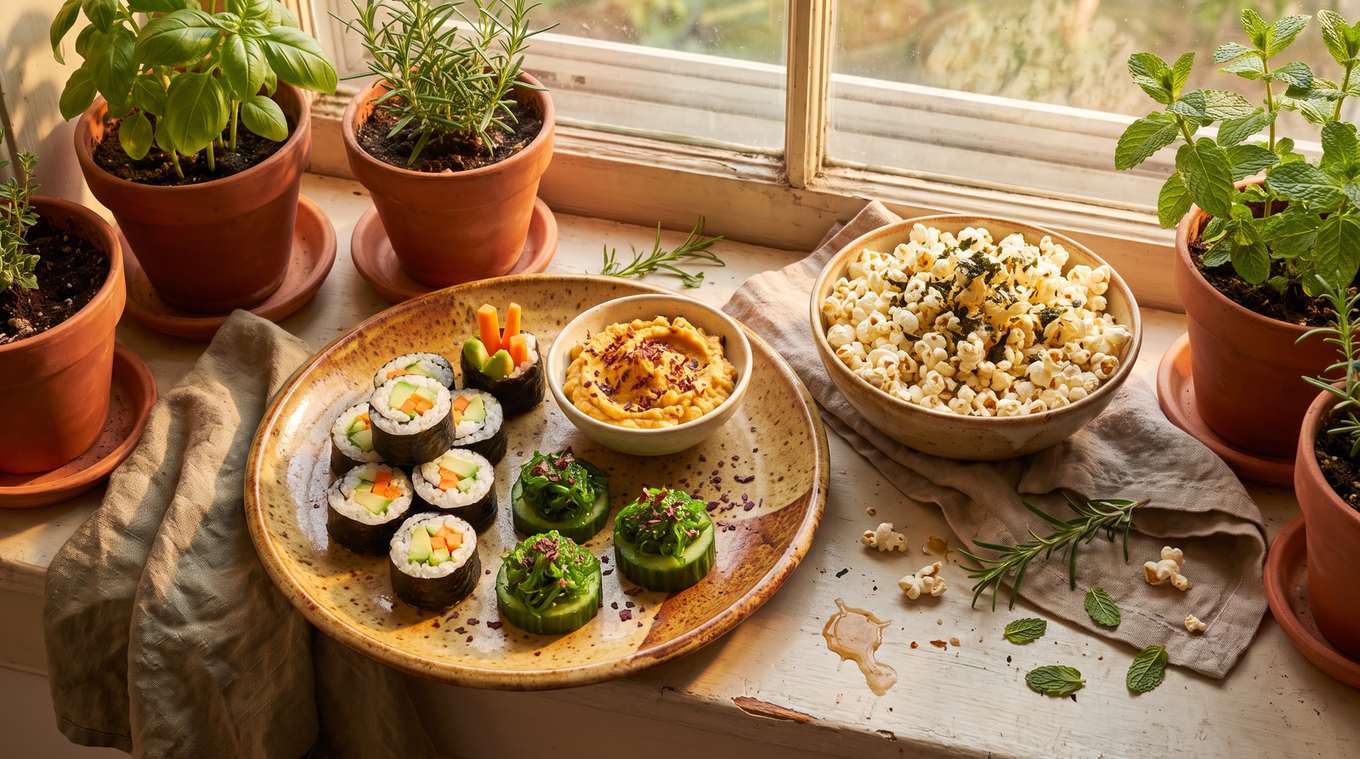
Here are six bites that fit on the same table, all with no cooking of the seaweed:
A seaweed tartare on cucumber slices or buckwheat crackers.
Raw nori maki with vegetables and avocado.
A chickpea spread with dulse.
Verrines of sea lettuce, cucumber and lemon.
Popcorn or nuts seasoned with seaweed flakes, added off the heat, once the corn has popped.
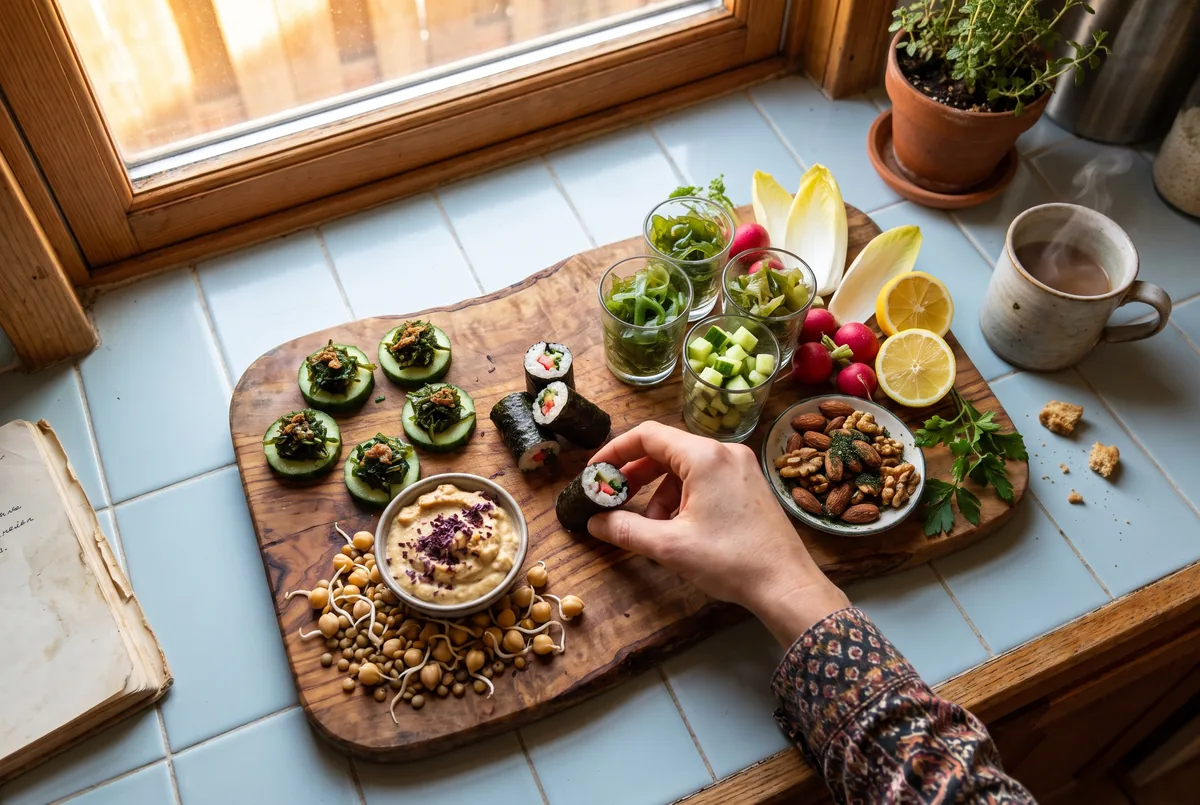
A "sea and garden" party board that brings everything together, with raw vegetables around it.
The principle fits in one sentence, and I stand by it: at Biovie, seaweed is eaten raw, rehydrated or as flakes, never pan-fried or deep-fried. Why on earth heat it, when it comes out of the water tender and full of flavor? Just look at nature: the sea has already done the work.
Each bite has its role. The tartare and the spread are made the day before, the makis at the last moment. The flakes slip a taste of the sea into things your friends already know (popcorn, almonds, cashews), a little bridge between the familiar and the unfamiliar. A successful seaweed snacks recipe is a table where everyone picks, leaves, comes back, without anyone feeling obliged to do anything. As part of a varied and balanced diet and a healthy lifestyle, a few seaweed bites naturally find their place on a festive platter.
Homemade seaweed tartare: the signature seaweed snacks recipe
For an indicative base, count 100 g of drained seaweed from the Organic Fresh 4-Seaweed Assortment, rinsed and desalted according to the label, 1 shallot, about 10 g of capers, the juice of half a lemon and 30 ml of olive oil. Chop the seaweed with a knife, fine enough that it stays on a cucumber slice without sliding off, mince the shallot, mix, taste. These proportions are culinary, not dogma: the lemon and the capers are up to you.
The seaweed tartare is better made the day before. One night in the fridge, and the flavors have had time to blend: the shallot has melted in, the whole thing has taken on a rounder taste. Time does a good part of the recipe.
At home, I sometimes make 3 kilos at once, in an hour and a half to two hours, and freeze half. I don't claim to be a model, and nobody has to do the same (for a Saturday evening, one bowl is more than enough). It simply shows that the tartare handles being made ahead very well.
What to serve it on
Thick cucumber slices remain the freshest base. Around them, radishes cut in half, endive leaves (which make perfect little boats) and buckwheat crackers. A small amount of tartare per base is enough, because it's a powerful condiment, to be placed in small touches.
Raw nori maki and rolls with vegetables
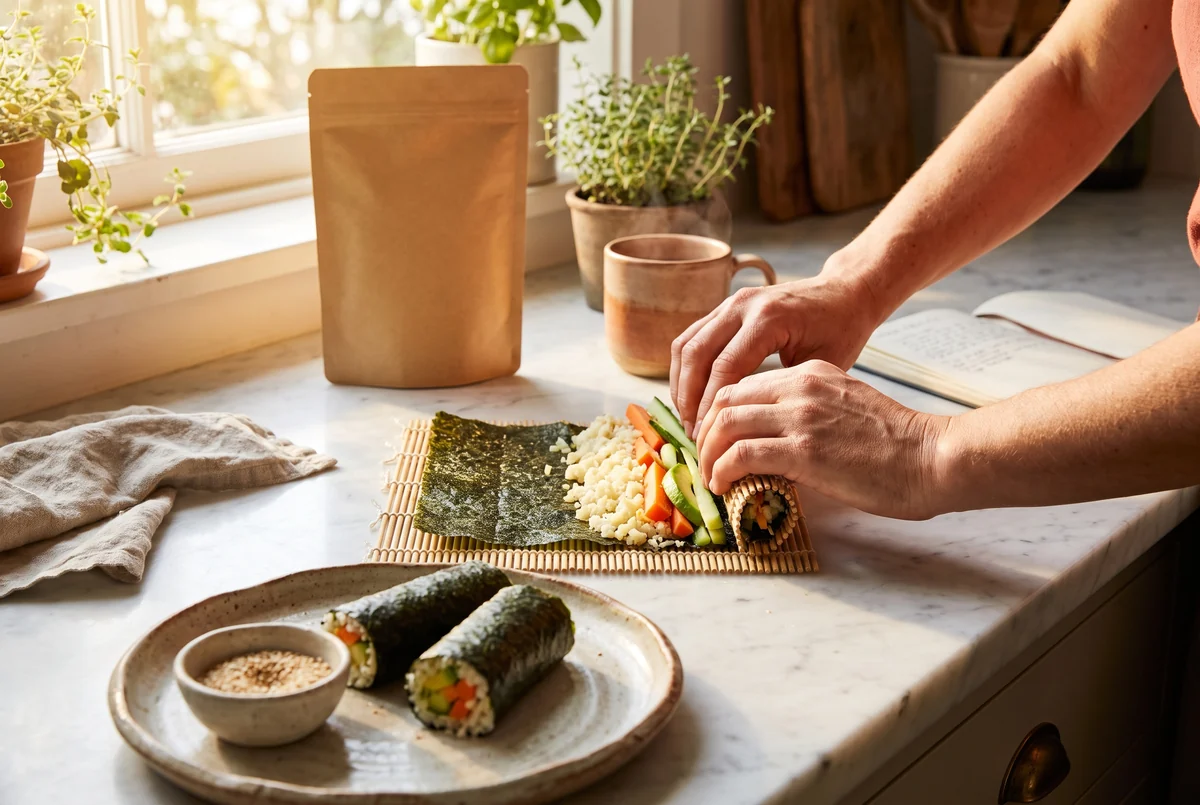
Maki is the bite that always makes a little splash. You need a raw-quality nori sheet, a base (cooled rice, or finely grated cauliflower for an entirely raw version), sticks of carrot, cucumber and avocado, and a pinch of sesame seeds.
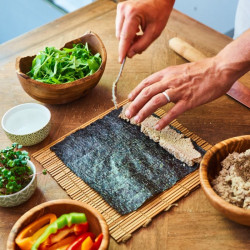
Lay the sheet on a bamboo mat, spread the base in a thin layer leaving a free strip at the top, line up the vegetables, then roll tightly. A wet finger on that strip, it sticks, and the roll is sealed. Nothing complicated.
Roll the makis at the last moment, because nori softens in contact with the moisture of the vegetables. Made too early, they lose their crunch and sag on the platter. In the morning, cut the fillings and keep them in the fridge: in the evening, only the rolling is left.
Another version, without rice: spread the sheet with a layer of chickpea spread with dulse, add a few salad leaves, roll, cut into pieces. This variation holds together better on a platter and is eaten in two bites. In every case, I use raw-quality nori sheets, which roll as they are, with no preparation at all.
Spread, verrines and flakes: seaweed added off the heat, above all!
Here, the seaweed no longer makes the dish, it becomes the seasoning. For the spread, blend cooked chickpeas with a little sesame purée, lemon and water, then fold in crumbled dulse with a fork, or the dehydrated Mix Gourmet (sea lettuce, dulse, nori) crumbled between your fingers. Go light at first, then taste: the seaweed flavor builds fast.
The verrines are assembled in three layers: cucumber in small dice, sea lettuce rehydrated for a few minutes in cold water, then a dash of lemon and olive oil. Three steps, not one more. Which vegan appetizer comes together faster? For easy plant-based appetizers with seaweed, it's the freshest bite on the board.
As for popcorn, pop the corn as usual, take it off the heat, then sprinkle the flakes on with a drizzle of oil so they stick. Same gesture on almonds or cashews. The flakes are always added after cooking, off the heat.
You'll find plenty of recipes for nori chips fried or baked, and I understand the idea: it's crunchy, and it's popular. We make another choice, that of keeping seaweed raw, as it comes out of the sea. As for kombu, it stays in the kitchen. It's a bit like the bouillon cube of the sea, which you infuse in water below the boil and don't crunch on at a party.
Nori, dulse, kombu: which one for the party, and how much?
Let's get to what's easy to forget between two glasses: iodine. As part of a varied and balanced diet and a healthy lifestyle, seaweed provides some, and that's exactly why you need to know the dose. Anses sets an upper limit of 600 µg of iodine per day for an adult, a value established by EFSA (Anses, 2018). To get an idea, two analyses of commercial seaweed, one American (Teas et al., 2004), the other covering 96 products from the Norwegian market (Aakre et al., 2021), give very telling orders of magnitude.
Seaweed
Iodine content
Where the figure comes from
Nori (Porphyra tenera)
About 16 µg/g (± 2)
Analysis of a commercial product, United States (Teas et al., 2004)
Kombu
2,276 µg/g on average
Products from the Norwegian market (Aakre et al., 2021)
Kelps (Laminaria, Saccharina)
The richest in iodine
Anses opinion (2018)
Upper limit for adults
600 µg per day
EFSA value adopted by Anses (2018)
Picture a glass that holds one day's limit. 10 g of dry nori provide about 160 µg of iodine, roughly a quarter of the glass. With 1 g of dry kombu, you reach about 2,276 µg, and the glass overflows nearly four times. A simple pinch of kombu therefore weighs far more in iodine than a whole platter of makis. It's counter-intuitive, and that's why I insist on it.
And these figures aren't carved in stone, they vary from one batch to another. In a single Namibian kelp, the content ranged from 514 µg/g in sun-bleached blades to 6,571 µg/g in young, freshly cut blades. On the Norwegian side, 54 of the 96 products analyzed exceeded the limit in a single serving. One serving.
Iodine does go into the water, that's true. On a kelp (Saccharina latissima) grown in Norway, rinsing followed by boiling removed on average 85% of the iodine, in an experimental processing study (Blikra et al., 2021). But don't conclude that a simple cold soak does the same: this result doesn't transfer, and you can't count on it to lower the content.
Be careful too for some of your guests, even though these figures should be put in perspective, since French institutions are much more timid than Asian institutions, and there is far more iodine deficiency in the world than iodine excess. Anses advises against seaweed for people with thyroid, heart or kidney disorders, or on medication containing iodine or lithium, as well as for pregnant or breastfeeding women without medical advice. For the details: how much seaweed per day, serving by serving.
As for dulse, our sources give no figure, so I dose it by the pinch. As part of a varied and balanced diet and a healthy lifestyle, my rule at a party stays simple: nori in sheets, dulse in flakes, and kombu in the cupboard for the next broth.
Biovie has been selling organic seaweed online since 2007: fresh or dried sea algae, hand-harvested in Roscoff with Bretalg, and freshwater microalgae (spirulina, chlorella, klamath) grown under controlled conditions. We are one of the few companies in France offering fresh seaweed in generous quantities, alongside dried formats that are easier to store and to dose day to day. To get started, go for dried seaweed, easy to add to everyday dishes in small amounts; for regular cooking and an unmatched taste, fresh seaweed in 1 kg packs works out cheaper per kilo. Discover the full range here, from kombu flakes to fresh spirulina in block form., 26
products
Hosting without stress: prepare the day before and store the leftovers
Hosting means, first of all, not spending the evening in the kitchen while everyone else clinks glasses. A seaweed snacks recipe is therefore often won the day before. Everything is prepared ahead, except the makis. Here is the schedule I suggest:
The day before: tartare and spread, in the fridge.
The same day: the verrines, and the vegetables cut for the makis.
At the last moment: rolling the makis, then the flakes on the still-warm popcorn, so they stick well.
To store the tartare and the spread, before the evening as well as for the leftovers, I use glass jars vacuum-sealed with the BocUp kit. It's pure low tech, and the engineer in me is delighted. A bell and a small hand pump are enough, with no electricity and no plastic bag. It works with the jars you already have, if they have "shoulders" and a 65 or 84 mm lid. Nothing else to buy.
According to the manufacturer, fresh food keeps up to 5 times longer this way: a vegetable soup lasts 8 to 10 days instead of 2. On Sunday morning, you tidy the kitchen without wondering what will end up in the bin. Vacuum does not replace the fridge or the freezer, and it does not sterilize, but it extends the optimal storage time. So the jars go in the refrigerator, like everything else.
Nobody has to like it, and I won't make a fuss about it. The iodine taste divides people, and part of this aversion could even be genetic: I dug into the question in an article on the taste of seaweed, a question of genes.
With the hesitant ones, start with the mild seaweeds, the nori in the makis and the dulse flakes. Go light in the spread, and let the seaweed popcorn make the first move, because it's often the most familiar bite on the board.We add a flavor, we impose nothing: everyone at their own pace, even at a party.
And if you feel like going further, there are books: Algues au quotidien, which we wrote with Aurélie (she's the one who came up with all the recipes), and Cuisiner les algues. On Saturday evening, simply put the board in the middle of the table, and watch what goes first. Then tell me about it, write to me!
Frequently asked questions
What can I make that is original and plant-based with seaweed for a party?
Six no-cook seaweed bites make an original, plant-based party spread: a seaweed tartare on cucumber, raw nori maki with vegetables, a chickpea spread with dulse, sea lettuce verrines, popcorn with flakes added off the heat and a board that brings it all together.
What to eat seaweed snacks with at a party?
Serve the seaweed bites with crunchy raw vegetables: cucumber slices, radishes cut in half, endive leaves. Buckwheat crackers and a chickpea spread round out the platter well. Count a small amount per base, because seaweed tartare is a condiment with a strong taste.
What is the difference between nori and other seaweeds?
Nori is a red seaweed sold as dried sheets, mild in taste and much lower in iodine: about 16 µg per gram according to an American analysis, versus 2,276 µg/g on average for kombu analyzed in Norway. It therefore suits makis, whereas kombu stays reserved for broth.
Can you make maki with seaweed snacks?
Better to use raw-quality nori sheets for rolling makis. Store-bought seaweed snacks are already seasoned and brittle: they break when rolled and bring a salty taste that overpowers the vegetables. A plain nori sheet stays supple, sticks with a damp finger and is rolled at the last moment.
Is seaweed a better option than chips at a party?
The two can't be compared on health grounds, but their preparation differs: raw seaweed bites are made without an oil bath, unlike fried chips. For seaweed, keep in mind the upper limit of 600 µg of iodine per day adopted by Anses for an adult, and favor nori.
The information presented in this article is provided for information purposes only and does not constitute medical advice. Consult a healthcare professional before making any change to your diet or supplementation.