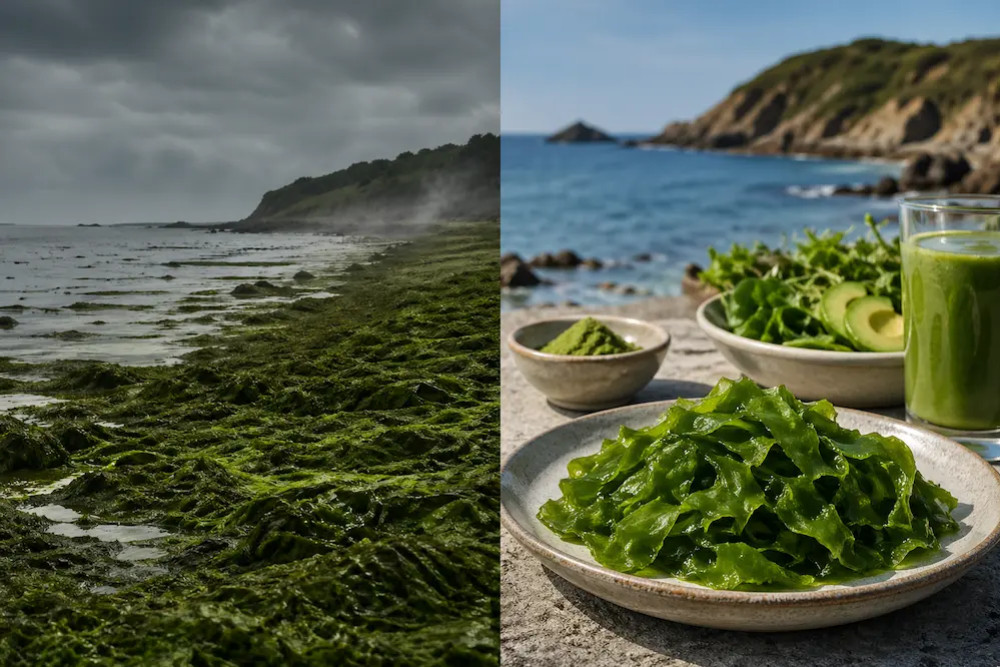
The edible sea lettuce that we sell at Biovie and the green algae serial killer in the Bay of Saint-Brieuc are exactly the same species: Ulva armoricana. What changes everything is the harvesting environment. Harvested alive in clean water in Roscoff, it is one of the best sources of marine minerals that exist. Stranded by hundreds of tons in a bay saturated with agricultural nitrates, it rots and releases a deadly gas that has already killed three people since 1989, even though these facts are controversial as the film "Green Algae" clearly shows. For years, I have been working with Breton edible seaweed and have seen the general public confuse these two realities. This article is here to clear up this misunderstanding once and for all. - and to explain why this confusion suits many people, except the Bretons and the consumers.
The same algae, two destinies: understanding the paradox ofUlva
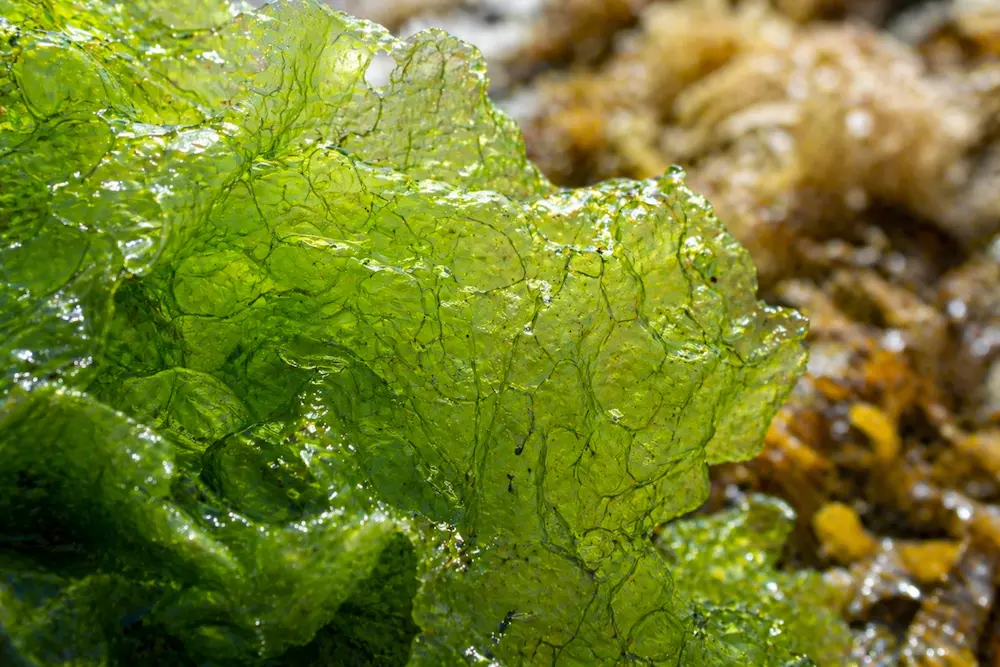
Frankly, we need to start by saying things simply. Ulva armoricana, in the north of Brittany. Ulva rotundata, rather in the south. These two ulvas - commonly referred to as "ulvas" or "sea lettuce" because their tender green thallus resembles a lettuce leaf - are the same algae than those that are marketed dried or fresh in the organic food sector. Not a distant cousin. Not a distant species. The same one.
I know it's counterintuitive. When we read "green tide" in the press for the past twenty years, we imagine a harmful, strange, exotic species. The reality is quite different.
The most surprising thing is that the Brittany prefecture itself acknowledges the edibility of green algae in its official communications. Here is the exact passage, as found on the prefecture's website: " Green algae are part of the Breton marine ecosystem. They are commonly called 'sea lettuce' due to their appearance resembling a large salad and because they are edible. " »
There you go. A public institution, which has been monitoring the phenomenon for thirty years, states clearly that this algae is edible. And yet, the image that prevails in the public's mind is that of the deadly beach. This confusion is not neutral. It protects those who should be accountable for the real problem - which is not the algae, but the environment in which it proliferates.
How a green tide is born: three conditions, never the algae alone
The CEVA (Center for the Study and Promotion of Algae) has been working on these green tides for four decades. Their conclusion is clear: it is necessary to three factors combined simultaneously for a green tide to be triggered. If even one is missing, nothing happens.
Specifically, here are the three legs of the stool:
Low hydrodynamics - few currents to disperse the biomass.
Clear waters that let light reach the bottom.
Without this type of configuration, the ulva has nowhere to accumulate nor anything to photosynthesize massively. This factor cannot be changed - it's the nature of the coasts.
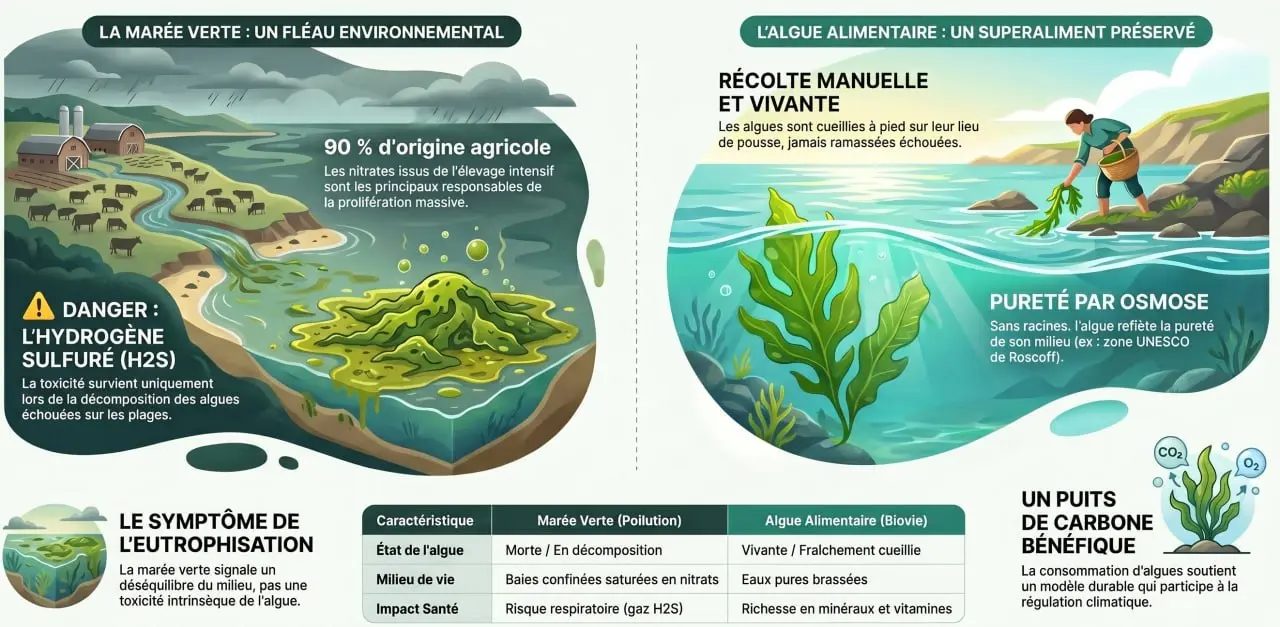
Agricultural nitrates: more than 90% of the cause according to the Court of Auditors
This is where we get to the heart of the problem. A massive excess of nitrogen, in the form of nitrates, is being discharged into the bay via the coastal rivers. According to the report of the Court of Auditors from July 2021, more than 90% of these nitrates are of agricultural origin. It is the only real lever of action.
And then there is a figure that I find, personally, staggering. In certain areas of Penthièvre, in Côtes-d'Armor, the pig density reaches 3,700 pigs per square kilometer, compared to 500 in the year 2000. Multiplied by seven in twenty-five years. That's where the nitrates that flow into the sea come from. France has been condemned twice by the Court of Justice of the European Union, in 2002 and 2013, for non-compliance with the Nitrates Directive. Twice. And the phenomenon continues.
Ulva, the opportunist who proliferates
Ulva armoricana in the north, Ulva rotundata in the south. These algae have a characteristic: they can grow very quickly when nitrogen is available. Give them nitrates, and they respond promptly.
When you look at the map of green tides, it stands out: eight Breton bays alone concentrate 88% of strandings. Saint-Brieuc, Saint-Michel-en-Grève, the bay of Douarnenez, the cove of Horn-Guillec... Always the same ones. Why? Because these are the bays where the three factors accumulate. And the cost for the taxpayer is heavy: the Court of Auditors estimated the first PLAV 1 action plan (2010-2015) at 117 million euros, followed by a PLAV 2 (2017-2021) at 60 million over five years. It is public money that repairs what the agro-industry does not pay for. It's always the same: polluters rely on taxpayers to solve the problems they create.
Why the algae itself is not toxic: it's its decomposition that kills
Here is a point that the media constantly confuses, and yet it is crucial: The ulva, in itself, is absolutely not toxic.. Neither for humans nor for animals. It is not it that kills. It is its decomposition.
The mechanism of H2S: 24 to 48 hours under a crust that traps
When hundreds of tons of sea lettuce wash up on a beach, here's what happens. The top layers in contact with the air dry out and form a yellowish, sometimes whitish, almost airtight crust, like a giant lid. Under this crust, in the lower layers, the algae begin to ferment. Without oxygen. This is anaerobic fermentation, and it releases several gases, including thehydrogen sulfide (H2S).
H2S is that characteristic rotten egg smell. At low concentrations, it is unpleasant. At high concentrations, it is deadly - within a few inhalations. The alert threshold set by the High Council of Public Health in 2021 is1 ppm. . Air Breizh, which monitors the Breton sites, recorded exceedances of this threshold at three Breton sites in 2023.
The trap is that the dry crust conceals the danger. You walk on it, press it down, and suddenly release the gas trapped underneath. This is exactly what happened to the jogger who died in 2016 in the Bay of Saint-Brieuc, and to the oyster farmer in 2019.
Human and animal toll: three deaths, around forty animals, since 1989
Let's state the numbers as they are. Since 1989, in Brittany, the green tides have claimed the lives of three people and at about forty animals (horses, wild boars, dogs). The annual volume of stranded seaweed fluctuates between 70,000 m³ and 150,000 tonnes, according to the years and sources of Brittany-environment. One hundred forty-one coastal sites have been affected at least once since 2002.
These are not isolated incidents. It is a pattern repeated year after year.
June 2025: The State partially recognized as responsible for a death
And here is the hot news. In June 2025, the court recognized the French state partially responsible the death of Jean-René Auffray, who was found lifeless in 2016 on a beach covered with green algae. The World covered the case on June 24, 2025. It is a major legal first.
Personally, I find it scandalous that it took until 2025 - thirty-six years after the first documented death - for a court to recognize this responsibility. Thirty-six years during which reports piled up, European condemnations were issued, and the bays continued to turn green. We cannot simply explain the biological mechanism without addressing the accompanying political question.
Edible sea lettuce: an edible green algae with exceptional qualities
Good. Now that we've set the context, let's talk about the other side. The one that the Japanese understood long before us, the one that our Breton grandmothers discreetly used in soups, and the one that has been marketed by Biovie for nearly two decades.
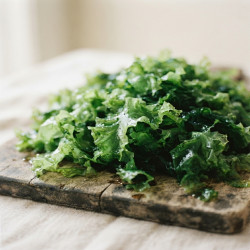
Fresh sea lettuce, harvested live by hand in clean water, has a remarkable nutritional composition. It provides iron, calcium, magnesium, iodine, B vitamins, all in a plant-based form that is easily incorporated into daily life.
The Iron contributes to the normal functioning of the immune system and the normal formation of red blood cells.. The Calcium contributes to the normal functioning of muscles and the maintenance of normal bones.. TheIodine contributes to the normal production of thyroid hormones and the normal functioning of the nervous system.. All these claims, in accordance with the EFSA register, apply within the context of a varied and balanced diet and a healthy lifestyle.
With Aurélie, in Seaweed in everyday life (Gallimard, 2024), we dedicated an entire chapter to sea lettuce because it seems to us the most accessible of the Breton seaweeds for someone who is just starting out. Mild taste, fine texture, versatile in cooking. It's the entry-level seaweed, in the best sense of the term.
How to consume it: tartare, salad, condiment
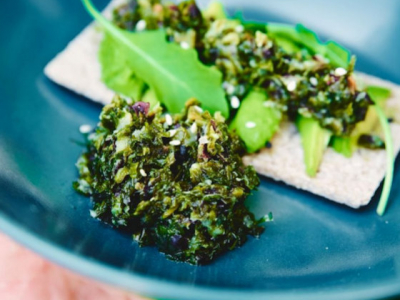
In practice, sea lettuce can be used in several ways. A tablespoon of dried flakes rehydrated in a little water makes a salad topping. A teaspoon of seaweed tartare on a slice of sourdough bread is a classic homemade appetizer. A few pinches in a broth, in a dahl, in a vinaigrette. Nothing complicated.
As for me, I often start the day with an omelet with sea lettuce flakes - it has become a ritual. You will find my seaweed tartare recipe on the blog. To delve deeper into culinary uses, the Complete guide to fresh Breton seaweed tartare Detail all the variants we tested with Aurélie.
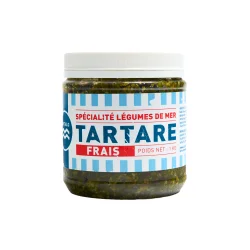
Discover our fresh Breton seaweed tartare - the condiment we use at home all year round.
The French organic sector: Roscoff, BretAlg, hand harvesting
The food harvest has absolutely nothing to do with what happens in eutrophicated bays. The organic harvesters in Brittany work On foot, at low tide, only on live seaweed, never on stranded seaweed. The harvesting areas are concentrated around Roscoff - classified by UNESCO for the richness of its marine biodiversity - and more broadly on the north-west of Brittany, outside of the enclosed bays prone to green tides.
Our historical partner, BretAlg, is the oldest organic seaweed harvester in France. We have been working with them since 2017. The seaweeds are harvested manually, washed in filtered seawater, and then dried at low temperatures (maximum 40 °C) to preserve heat-sensitive enzymes and vitamins. Each batch undergoes bacteriological controls and measurements of heavy metal content. Since 2020, French regulations have imposed a maximum threshold of 0.35 mg of cadmium per kilogram of dry matter for edible seaweedReferral ANSES 2017-SA-0070) - it is almost ten times stricter than the European threshold for dietary supplements (3 mg/kg).
Twenty-five species of algae have been approved for food consumption in France since 1990, with the list updated in 2014 by the CSAVM. Sea lettuce is one of them. It is the reference edible green algae. The comprehensive overview of edible seaweeds details the diversity of this sector that is still largely underdeveloped in our country.
The biological argument that no one explains to you: algae grow by osmosis
Here is a fundamental educational point, and yet it is rarely explained. Understanding this means understanding everything else.
Algae do not neither root, nor leaf, nor flower. These are plant organisms of radical simplicity. They absorb their nutrients - nitrogen, phosphorus, minerals, trace elements - directly through the entire surface of their thallus, by osmosis, from the liquid environment that surrounds them.
Three major consequences, and that's where it gets interesting.
Firstly: an alga instantly reflects the quality of its environment. Harvested in a bay saturated with nitrates, it is saturated with nitrates. Harvested in Roscoff in pristine waters, it is nutritionally excellent, clean, and balanced. This is why edible seaweed is never harvested in eutrophicated bays - it's a basic rule of the industry.
Secondly: an alga does not bioaccumulate like shellfish or large fish. Oysters and mussels filter water and concentrate pollutants in their tissues for months. Tuna and swordfish accumulate mercury throughout the food chain. Seaweed, on the other hand, is an instant reflection of its environment. If the water is clean today, the seaweed is clean today. It's mechanical.
Thirdly - and this is precisely the mechanism of green tides - a detached and tossed seaweed in nutrient-rich water continues to grow. The sea lettuce torn away by currents or the tide drifts in the bay as long as nitrates are abundant. They reproduce, proliferate, and increase in biomass until they reach levels visible from surveillance planes.
This is why the solution is not found in the sea. It is found in the watersheds, in agricultural practices, in the relationship between the nitrogen spread on the fields and the soil's absorption capacity. As long as the upstream cause is not addressed, the algae will continue to respond - by millions of tons - to what is offered to it.
How to distinguish a healthy green algae from an algae that is proliferating
In practice, in the field, how do we tell the difference? Here are three simple tests that I teach everyone who accompanies me on a Breton coast.
The visual test: living algae vs stranded algae
The eye does not lie, provided you know what you're looking at.
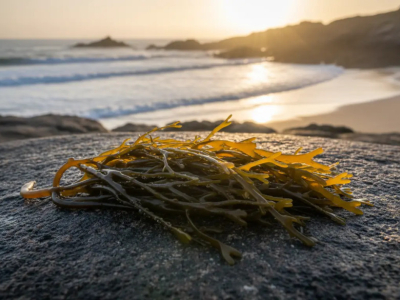
A living seaweed (harvested by hand) is bright green, its structure is intact, the thallus is whole and flexible, it is still attached to a support or floats just below the surface. Uniform color, salad green. A stranded algae (green tide), on the other hand, features yellowish patches, a dry crust on top, and a compact mass underneath. The green shifts towards brown, yellow, or white depending on the stage of decomposition.
The olfactory test: "mild iodine" vs "rotten egg"
The nose never lies.
Living algae: Iodine scent, fresh, marine. Like an oyster opened on the port quay.
Decaying stranded seaweed: The smell of rotten eggs, of sulfur. It's the H2S being released. If you smell this odor, you step back. Without hesitation.
During a visit to BretAlg, I had the opportunity to walk on two neighboring beaches on the same day: one with an ongoing harvest of fresh sea lettuce in open water, and the other further away on another beach where a few cubic meters of seaweed had been stranded for three or four days. The olfactory difference is striking. From five meters away, you instinctively know which one you would eat.
The golden rule: never pick up stranded seaweed
I will say it again because it's important. No edible seaweed is collected washed up on the beach., even if it appears fresh. The organic sector absolutely prohibits it. Harvesting is done on live seaweed, by hand, at low tide, and only in areas authorized and controlled by certification bodies. If you find sea lettuce on a beach and are tempted to cook it - don't. It's a simple rule: if it no longer moves, you no longer touch it.
In summary, here are the criteria that distinguish the two situations:
Appearance: Bright green and intact structure for the living algae; yellowish patches, crust, and compact mass for the stranded algae.
Smell: Iodine-like, sweet, and fresh for the living seaweed; rotten egg and sulfur for the stranded seaweed.
Composition: Assimilable minerals and vitamins for the living algae; H2S, ammonia, putrefactive microorganisms for the stranded algae.
Usage: Food safety after checks for live algae; no health risk for stranded algae.
Authorized harvest: Yes (certified organic sector) for live algae; no, never, for stranded algae.
What to do when faced with a deposit of green algae on a beach ?
Here are the concrete recommendations, validated by the Breton health authorities.
First, do not walk on the dry crusts. It is beneath them that H2S is concentrated. If you see a beach where yellowish patches have formed, give them a wide berth. Do not let children or animals approach them.
Then, rely on municipal and prefectural signage. In the event of a peak concentration, certain beaches are temporarily closed to swimming and visitation. Air Breizh monitors H2S concentrations at the most exposed sites and publishes its data.
Finally, if you experience a sudden headache, nausea, eye or respiratory irritation in the presence of a sulfur odor, move away immediately and consult a healthcare professional. The first signs of H2S poisoning appear quickly, and the severity can escalate within minutes.
Eating organic Breton seaweed, a coherent act against green tides
Here is what I want to say in conclusion, and I will put it simply. Choosing a sea lettuce from the Breton organic sector means choosing the exact opposite of the system that produces green tides.
On one side, you have mass intensive agriculture, excessive spraying, nitrate runoff, and at the end of the chain, beaches covered with toxic decay and a state condemned by European and French justice.
On the other hand, you have an artisanal sector, harvesters on foot who know their areas by heart, bacteriological controls by batch, cadmium thresholds ten times stricter than the European average, and an algae that, in addition to being nutritionally valuable, helps maintain the ecosystem of the foreshore. The Japanese of Okinawa have understood this for centuries - their regular consumption of algae is part of the longevity of Japanese people who consume seaweed on a daily basis.
It is the same plant. But it is not the same relationship with the living.
And then there is an aspect that is often forgotten: algae, as marine photosynthetic organisms, are part of coastal carbon sinks. Supporting an organic sector that values them without degrading the resource is also a coherent gesture for the health of coastlines. Alongside sea lettuce, there are also algae in the same sector such as the Breton wakame or theBreton sea bean, all harvested according to the same principles. This diversity is part of the superfoods from the sea that we have at our fingertips, provided we know where to look for them.
If you are discovering edible seaweed, here is how I would suggest you proceed.
Start with the fresh Breton seaweed tartare. It is the most immediate, the most user-friendly use, and the one that converts the fastest. A teaspoon on bread, and you understand.
Continue with some dried sea lettuce flakes. Practical, economical, to sprinkle on everything. One tablespoon per day is more than enough.
Then, expand the palette. Wakame, dulse, sea beans, nori. Each has its own character.
To go further, Seaweed in everyday life (Gallimard, 2024), which we co-wrote with Aurélie, offers more than a hundred everyday recipes-from appetizers to desserts. It's the book I would have wanted to read when I started, thirty years ago.
Three factors combined: a geography of shallow sandy bays, a massive excess of nitrogen (nitrates) discharged by coastal rivers, over 90% of which is of agricultural origin according to the Court of Auditors (2021), and the presence of an opportunistic species of green algae, Ulva armoricana. Without the combination of these three conditions, there is no green tide.
Is edible sea lettuce really the same algae as green tides ?
Yes. They are mainly the same species of ulva. Ulva armoricana. The prefecture of Brittany itself officially recognizes this edibility. What changes everything is the environment and the method of harvesting: living seaweed in clean water for the food industry, stranded and rotting seaweed for green tides.
Are green algae toxic to humans ?
The algae itself is not toxic. It is its decomposition that poses a problem. When large quantities wash ashore and ferment without oxygen under a dry crust, they release hydrogen sulfide (H2S), a deadly gas at high concentrations. Three people have died from it in Brittany since 1989.
Can you eat seaweed washed up on the beach ?
No, never. No edible seaweed is collected when washed ashore, even if it appears fresh. The French organic sector strictly prohibits it. Edible seaweed is harvested by hand, at low tide, from living seaweed, in authorized and controlled areas. Washed-up seaweed is in the early stages of decay and poses a health risk.
How does Biovie ensure that its Breton algae are healthy ?
Our seaweed comes from Bret'Alg, the oldest organic seaweed harvester in France, and has been a partner of Biovie since 2017. It is hand-harvested on foot in preserved areas (Roscoff, north-west Brittany, outside of eutrophicated bays), dried at low temperatures (40 °C), undergoes bacteriological controls by batch, is organically certified, and complies with ANSES thresholds for heavy metals (a maximum of 0.35 mg/kg of cadmium in dry matter).
What is the difference between seaweed harvested in Roscoff and seaweed from a polluted bay ?
Everything. Algae grow by osmosis and absorb their nutrients directly from the surrounding environment. Algae harvested from clean water are nutritionally excellent. Algae from an eutrophicated bay concentrate nitrates and other imbalances from the environment. This is why the organic food industry only harvests from preserved and certified areas.
Why was the State condemned in 2025 in a green algae case ?
In June 2025, a court found the French state partially responsible for the death of Jean-René Auffray, who was found in 2016 on a beach covered with decomposing algae. This is the first time a court has legally recognized public responsibility in a tragedy related to green tides, despite two previous European convictions (2002 and 2013) for non-compliance with the Nitrates Directive.
Chevassus-au-Louis B., Andral B., Bouvier M., Féménias A. (March 2012). "Assessment of Scientific Knowledge on the Causes of Green Macroalgae Proliferation - Application to the Situation in Brittany and Proposals". CGEDD/CGAAER.
High Council of Public Health (2021). "Notice regarding intervention thresholds and management measures to prevent health effects on populations exposed to hydrogen sulfide from green algae stranded on the coasts".
Warning: The information presented in this article is provided for informational purposes only and does not constitute medical advice. Consult a qualified healthcare professional before making any changes to your diet or supplementation. As part of a varied and balanced diet and a healthy lifestyle.