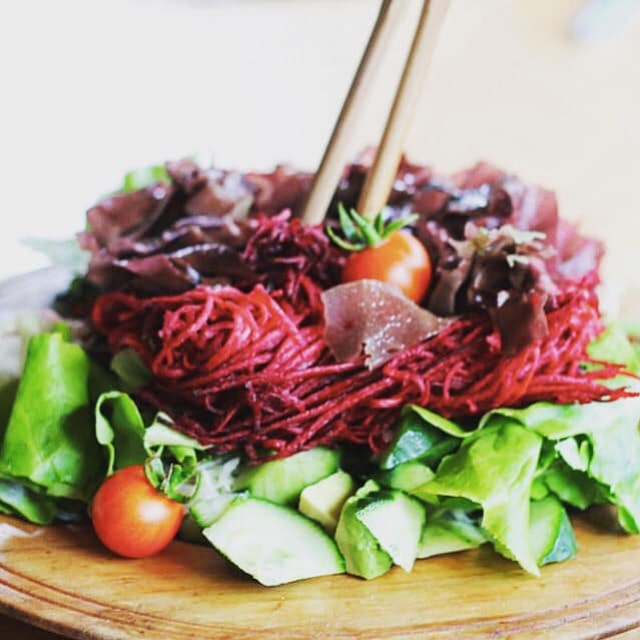
Raw dulse and beetroot salad: the living recipe with two reds
Sea red and earth red, iodine and nitrates, red seaweed and blood-red root: the dulse beetroot salad is one of the most delightful pairings in living food. In fifteen minutes, with no cooking, you put on the table a raw dish that combines the marine taste of Palmaria palmata with the sweet, earthy mildness of freshly grated beetroot. In this guide, I share the recipe we have been serving at home for nearly twenty years, some pointers on the ingredients of this signature dish, the essential iodine precautions before increasing your seaweed intake, and the variations to enjoy this living base all year round.
Why combine dulse and beetroot in a raw salad?
The dulse + beetroot pairing is based on a contrast of flavours, marine on one side, earthy on the other. Dulse (Palmaria palmata) is a red seaweed of the European coastline. According to the work of Galland-Irmouli published in the Journal of Nutritional Biochemistry, its protein content ranges from 11.9% to 21.9% of dry matter depending on the season (PubMed 15539310). It also contains 35 to 50 mg of iron per 100 g of dry matter, as well as marine iodine.
Raw red beetroot, for its part, provides dietary nitrates (~150 mg/100 g according to the Ciqual ANSES table), betalains (red pigments).
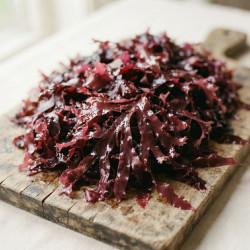
For this salad, you have two options. Fresh dulse in brine is the holy grail: fleshy fronds, a clean sea flavour, a melting texture. Simply rinse it briefly in clean water to remove excess salt, then chop it finely. Allow 30 to 40 g for two people. Otherwise, dried organic dulse in leaves does the job perfectly: 5 to 6 g dry is equivalent to 30 g fresh. It rehydrates in 5 to 10 minutes in a bowl of lukewarm water, then is drained and chopped like fresh dulse. At Biovie, we sell both formats, sourced exclusively from the Bretalg supply chain in Roscoff, the oldest organic seaweed harvester in France, dried at a low temperature of 40 °C to preserve heat-sensitive minerals.
To discover the rest of the range, see our Fresh Seaweed collection.
Choose an organic red beetroot that is firm and not wrinkled. Peel it with a vegetable peeler, then grate it into thin tagliatelle (coarse grater) or julienne. Raw beetroot keeps all its colour: betalains, red pigments, are largely destroyed by cooking. Allow one small beetroot (120 to 150 g) for two people. Avoid the vacuum-packed cooked beetroot sold in shops: it is convenient but lacks the crunch of raw beetroot.
The other ingredients: freshness and seasonality
Complete it with whatever the season offers: half a cucumber, diced, a handful of cherry tomatoes cut in half, a few leaves of young lettuce or lamb's lettuce, a little chopped chives. For the dressing, keep it simple: two tablespoons of extra virgin olive oil, the juice of half a lemon, a pinch of Guérande salt, a twist of the pepper mill, and (this is the secret) a second pinch of peppered dried dulse sprinkled on top as a finish. For a touch of the exotic, you can add a few slices of freeze-dried organic durian for an unexpected tropical fruity note.
Step-by-step preparation (15 minutes)
This raw recipe requires neither cooking nor special equipment. Here are the steps:
Rehydrate the dulse (if dried): soak 5 to 6 g of dry leaves in a bowl of lukewarm water for 5 to 10 minutes, until they become soft and fleshy. Drain well, press lightly, then chop finely. If using fresh dulse in brine: rinse briefly under clean water, drain and chop.
Grate the raw beetroot into thin tagliatelle with a coarse grater. Place in a salad bowl.
Prepare the fresh vegetables: cut the cucumber into small cubes and the cherry tomatoes in half. Chop the chives. Add to the beetroot with the chopped dulse.
Assemble the plate: arrange on a bed of young lettuce. Spread the beetroot, dulse and vegetable mixture generously in the centre.
Season: in a small bowl, whisk together olive oil, lemon juice, salt and pepper. Pour over the salad. Finish with a pinch of peppered dried dulse and a few toasted sesame seeds.
Chef's tip: let the salad marinate for 10 to 15 minutes in the fridge before serving. The beetroot nitrates and the iodine compounds of the dulse soak up the vinaigrette, and the flavours develop. This is a tip Aurélie and I noted in Algues au Quotidien (Gallimard) after many tests: a little patience multiplies the pleasure of eating.
"I have been ordering my fresh seaweed from Biovie for years to make my seaweed tartare, as well as nori sheets and many other products. Always excellent quality." - Florence, Biovie customer.
Pointers on the ingredients
Betalains: the pigments of beetroot
Raw beetroot has long been a great classic of living food Betalains (betanin, vulgaxanthin) are the pigments that give beetroot its red colour. Dulse, for its part, provides chlorophyll and marine pigments.
Plant iron: composition pointers
Dulse contains 35 to 50 mg of iron per 100 g of dry matter. A 5 g portion of dried dulse in the salad provides about 1.7 to 2.5 mg of non-haem iron, or about 12 to 18% of the NRV. To go further, I invite you to read our feature on plant iron from seaweed and spirulina.
Marine iodine and normal thyroid function
Dulse is a natural source of iodine (150 to 200 µg/g of dry matter), and according to the health claims authorised by EFSA, iodine contributes to normal thyroid function and to the normal production of thyroid hormones. A portion of 2 to 3 g of dried dulse is already enough to exceed the reference intakes for iodine: see the precautions below.
Beetroot nitrates
Raw beetroot contains dietary nitrates (~150 mg/100 g). Note: prolonged cooking destroys some of the nitrates, another reason to prefer raw beetroot.
Precautions: iodine, thyroid, pregnancy and kidney problems
This is the section too often forgotten on the web, and I deliberately give it prominence. Dulse is a powerful seaweed, and it should be eaten in moderation.
Iodine and thyroid. ANSES, in its opinion NUT-2017-SA-0086, recommends not exceeding 600 µg of iodine per day for adults (tolerable upper intake level, UL), and warns of the risk linked to excessive seaweed consumption. A 2020 study (PubMed 32803579) confirms the need for vigilance. If you have a thyroid condition (Hashimoto's, Graves' disease, nodules, goitre) or take a treatment such as Levothyrox, ask your doctor's advice before adding dulse to your diet. For a full analysis, see our feature on the relationship between seaweed, iodine and the thyroid.
Pregnancy and breastfeeding. Iodine requirements increase (200 to 250 µg/day according to the WHO), but the margin before the UL narrows. Limit yourself to 1 to 2 g of dried dulse per week during this period, and favour small regular amounts rather than a single large intake.
Kidney problems and oxalates. Raw beetroot contains oxalates. If you have recurrent calcium oxalate kidney stones, limit portions and ask your doctor or dietitian for advice.
Urine colouring. Raw beetroot can turn urine pink-red (beeturia) for 24 to 48 hours in about 15% of the population: this is a harmless phenomenon with no consequences.
Allergies. Allergic reactions to seaweed proteins are rare but documented. If you are allergic to seafood or iodine, try a very small amount first.
Variations and serving tips
This dulse and beetroot base can be varied endlessly according to the seasons and your cravings.
Winter citrus variation. Replace the cherry tomatoes with blood orange or pink grapefruit segments. The palette of reds becomes spectacular on the plate.
Walnut and chicory variation. In winter, swap the lettuce for sliced chicory (endive) leaves and add a handful of crushed walnut halves. The bitter, iodised and rich trio is wonderfully tasty.
Sprouted seed variation. A generous handful of alfalfa, radish or fenugreek sprouts turns the salad into a complete dish. This is the version we serve at the Biovie workshop during our living food training courses.
"I am always satisfied with all the products I order. The seaweed tartare recipe has become a household staple." - Mickael, Biovie customer.
Where to buy dulse and which Biovie products to choose
At Biovie, we have been working for more than fifteen years with the Bretalg cooperative in Roscoff, the oldest organic seaweed supply chain in France. Our seaweed is hand-harvested in Brittany and dried at low temperature (40 °C) to preserve its heat-sensitive minerals. For this recipe, two products are perfectly suited: fresh organic dulse in brine (chilled delivery, long shelf life in the fridge) and dried organic dulse in leaves (cupboard format, ready to rehydrate). To go further in cooking with seaweed, the book Algues au Quotidien (Éditions Gallimard, 2024) offers 80 recipes by Aurélie and Éric Viard, organised by seaweed and by season.
FAQ: everything about the dulse beetroot salad
Can you eat dulse raw?
Yes, dulse can be eaten perfectly well raw, simply rinsed (if fresh in brine) or rehydrated for 5 to 10 minutes in lukewarm water (if dried). Finely chopped, it works just as well in a salad, a tartare or a green smoothie. Allow 2 to 5 g dry per adult portion.
What does dulse seaweed contain?
Dulse (Palmaria palmata) provides protein (11 to 22% of dry matter depending on the season), iron (35 to 50 mg/100 g dry matter), marine iodine which contributes to normal thyroid function, and small amounts of omega-3s. Its composition has been documented since 1999 by the work of Galland-Irmouli.
How much dulse should you eat per day?
ANSES recommends not exceeding 600 µg of iodine per day for adults. For dulse, this corresponds to a maximum of about 3 to 5 g of dried leaves per day, and preferably 2 to 3 g spread over the week for regular use. People with thyroid conditions, and pregnant or breastfeeding women, should ask their doctor's advice before any regular consumption and limit themselves to 1 to 2 g per week.
Is raw beetroot better than cooked?
Yes, nutritionally speaking. Raw beetroot keeps its betalains, red pigments, and its dietary nitrates (~150 mg/100 g), which are partly destroyed by prolonged cooking. Simple grating or a quick marinade in lemon is enough to make it tender. People with a sensitive digestive system can cut it more finely and let it marinate for 15 minutes in the vinaigrette.
How do you prepare dried dulse?
Soak the dulse leaves in a bowl of lukewarm water for 5 to 10 minutes. They double in volume and become soft and fleshy. Drain them, press lightly to remove excess water, then chop them finely. Allow 5 to 6 g of dry dulse to obtain the equivalent of 30 g of fresh dulse. The soaking water can be kept to flavour a miso soup or a vegetable broth, as it concentrates minerals and sea flavour.
Is the dulse beetroot salad suitable during pregnancy?
In very small, occasional amounts, yes. Dulse provides iodine that is useful during pregnancy (requirement of 200 to 250 µg/day according to the WHO), but the margin before the safety limit of 600 µg/day is narrow. Limit yourself to 1 to 2 g of dried dulse per week and favour small regular amounts. If you have a pre-existing thyroid condition or any doubt, ask your midwife or doctor for advice before eating it.
Biovie's fresh seaweed is hand-harvested in Roscoff by Bretalg, France's first historic seaweed harvester (since 1991). Kombu, wakame, nori, dulse, sea lettuce and sea spaghetti are sold as a ready-to-eat tartare or in 500 g to 1 kg packs, with a texture and taste closer to the sea than dried versions. At €16.80 per kilo, our price is among the most competitive on the market for fresh seaweed harvested in France. To try, choose our discovery assortment of 4 organic seaweeds in 4 x 250 g; for regular cooking, the kilo works out much cheaper., 8
products
In practice: the view of Eric Viard, ISTOM engineer
"I first served this dulse and beetroot salad at home nearly twenty years ago, when Aurélie was testing ideas for what would become Algues au Quotidien. Since then, it has become our signature spring dish. What moves me about this recipe is that it brings together everything I have championed since my years as an ISTOM engineer (tropical agronomy): raw food, the plant and marine combination, and above all the immediate pleasure of red colours that catch the eye. A salad that nourishes and delights the eyes at the same time is rare. But I always repeat it to our trainees: dulse is precious, not ordinary. A good handful per week, no more, and you get the best out of it." - Eric Viard, founder of Biovie.
Disclaimer: The information in this article is provided for information purposes only and does not constitute medical advice. Consult a qualified health professional before making any significant change to your diet or supplementation. As part of a varied and balanced diet and a healthy lifestyle.
Find all our organic ingredients for living food at www.biovie.fr