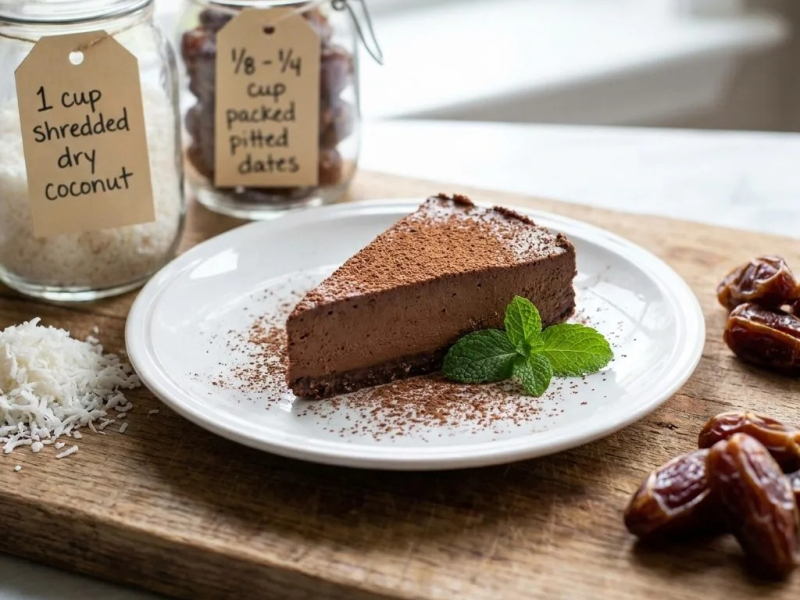
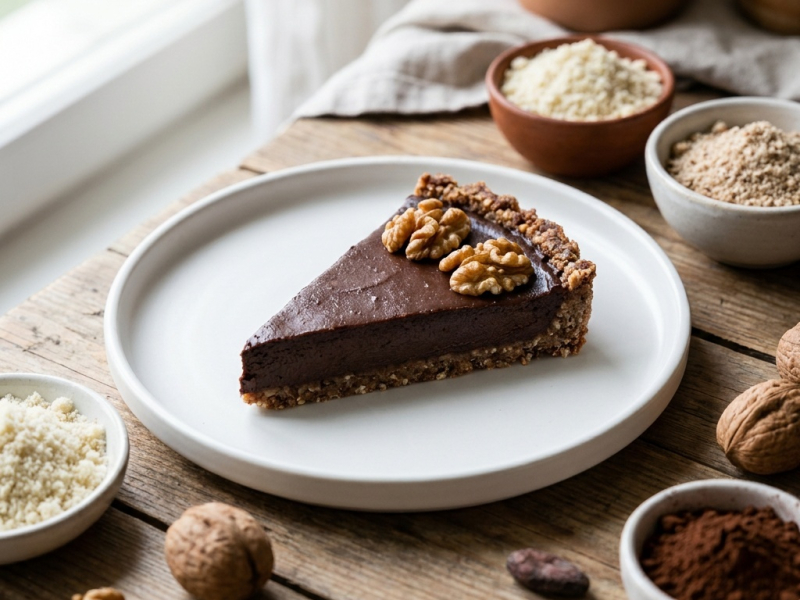
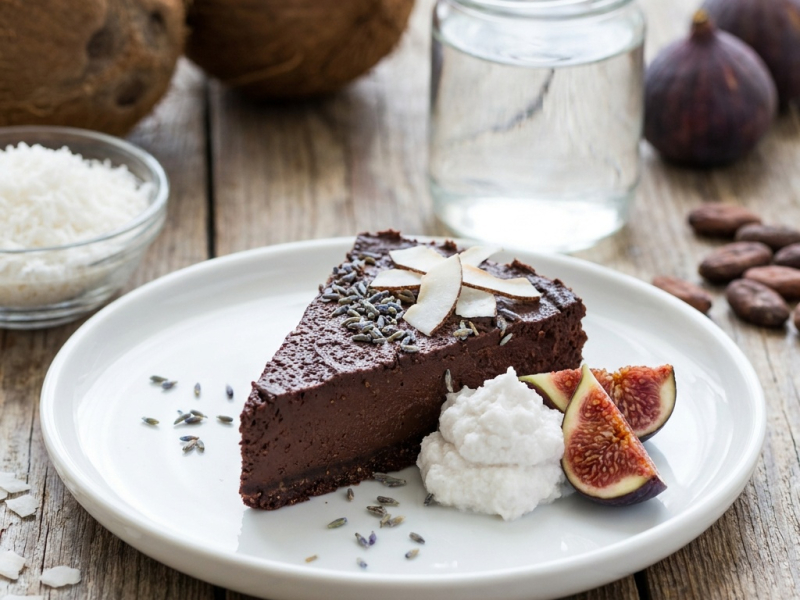
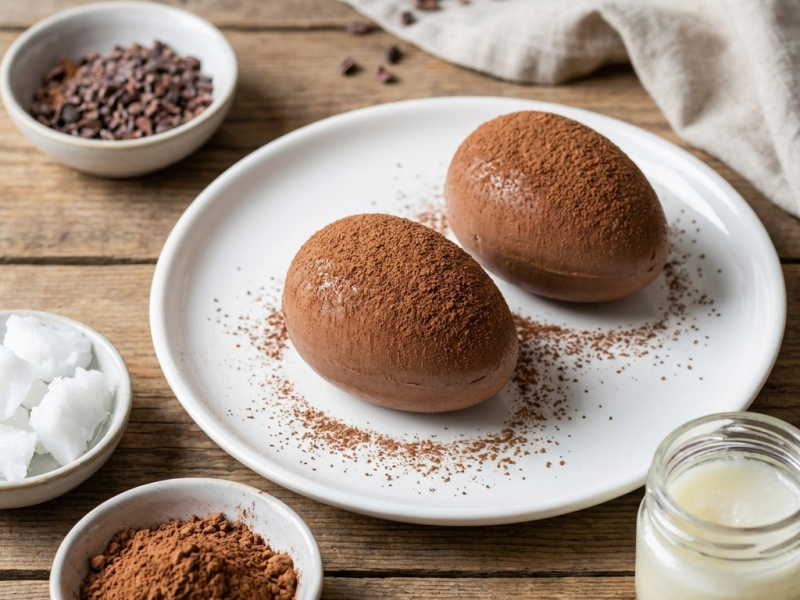
Ripe persimmon and chocolate make a surprisingly harmonious pair, the honeyed sweetness of the fruit softening the depth of the cacao. This tart is built in several patient steps - a dehydrated tart base, a smooth cashew cream and persimmons marinated in honey with vanilla - but each layer can be prepared ahead. The result is spectacular, perfect for closing an autumn meal in style. The persimmon thus joins the long list of exotic fruits that lend themselves well to raw pastry.

Chocolate and persimmon tart with young coconut cream
Share this article
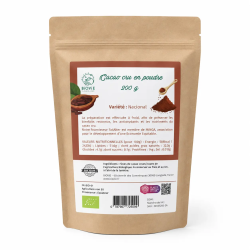
Organic raw cacao powder (Nacional variety)
€9.90 Out-of-Stock
Ingredients
For the chocolate tart base
- 120 g sprouted oat flour
- 130 g almond flour
- 120 ml honey
- 32.8 g raw cacao powder
- 65 g raw almond butter
- 35 g date paste
- 30 ml filtered and hydrogenated purified water
- 1 tablespoon vanilla (optional)
For the chocolate cream
- 150 g young Thai coconut flesh
- 120 g cashews (soaked for at least 4 hours)
- 120 ml young Thai coconut water (or purified water)
- 120 ml coconut oil
- 120 ml raw honey
- 5 tablespoons raw cacao powder
For the vanilla persimmons
- ripe persimmons
- honey with a few drops of vanilla added
Method
- Sift the dry ingredients for the tart base together.
- Add the almond butter and mix well.
- In another bowl, mix the date paste, the water and the vanilla.
- Stir this liquid mixture into the oat preparation.
- Line a tart tin with cling film and press the dough into it evenly.
- Dehydrate for 2 hours, turn out, remove the film and continue drying for 6 to 8 hours.
- For the cream, blend all the ingredients in a high-speed blender until smooth and creamy. Leave to set for a few hours in the fridge.
- Slice the persimmons, drizzle them with vanilla honey and leave them to marinate for 2 to 3 hours.
- Spread the chocolate cream over the tart base, cover with cling film and refrigerate for about 8 hours or overnight.
- Arrange the marinated persimmon slices on top and sprinkle with crushed pistachios.
Tip
To make your own date paste: pit some dates, soak them for an hour in water, then blend them in a food processor, adding a little of the soaking water if needed.
A closer look at raw cacao
Raw cacao (unroasted) retains more magnesium and antioxidant polyphenols than classic roasted cocoa - up to two and a half times more, according to analyses. Two teaspoons of raw cacao powder already provide around 20% of the recommended daily intake of magnesium. To find out how to fit it into your daily routine, our article explains how to use raw cacao powder.
The full range Cacao
Biovie raw cacao comes from Ecuador, Nacional variety, bought directly from a cooperative under the SPP label (Symbol of Peasant Producers), with partner Rrraw Cacao Factory. Unlike conventional cacao, it is never roasted: the beans ferment, then dry in the sun at under 42 °C, which preserves its nutrients better than high-temperature roasting. It comes as whole beans, cacao nibs, powder or melting paste. To get started, try the nibs, which are easy to add to a yogurt or smoothie without any preparation., 11 products
Online only
Raw cacao powder is part of our Raw Cacao range.
FAQ: your questions about persimmon
Can you eat persimmon with the skin?
It depends on the variety. The apple persimmon, or fuyu, is eaten firm and crunchy like an apple, and its thin skin can be eaten without any problem once the fruit is well washed. The traditional persimmon, which must be soft right through to lose its astringency, has a thicker and often bitter skin: there, it is better to cut it in half and eat it with a spoon. For this tart, where clean slices are wanted, the firm variety is more practical - and you can keep the skin.
When should you not eat persimmon?
When it is not ripe, quite simply. An astringent persimmon bitten into too early leaves a rough, cottony feeling in the mouth, caused by the tannins, and can be genuinely unpleasant to digest in quantity. That is in fact where its reputation as a constipating fruit comes from. The rule is simple: the traditional persimmon should give under the finger like a very ripe tomato, almost translucent. If it is still firm, let it ripen at room temperature for a few days, next to an apple if you want to speed things up.
How many persimmons is it advisable to eat per day?
One to two a day is a reasonable amount for an adult. The persimmon is one of the sweetest fruits of autumn - around 16 g of carbohydrates per 100 g - and it easily weighs 150 to 200 g apiece, which is a good reason not to eat five in a row. Two known caveats: eaten in large quantities and not ripe enough, the tannins can form clumps in the stomach in people with slow digestion. And as with any sweet fruit, the amount is worth discussing in the case of diabetes.
Share this article
Related articles