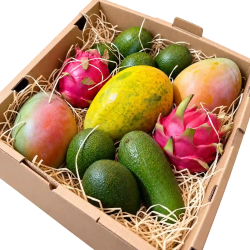
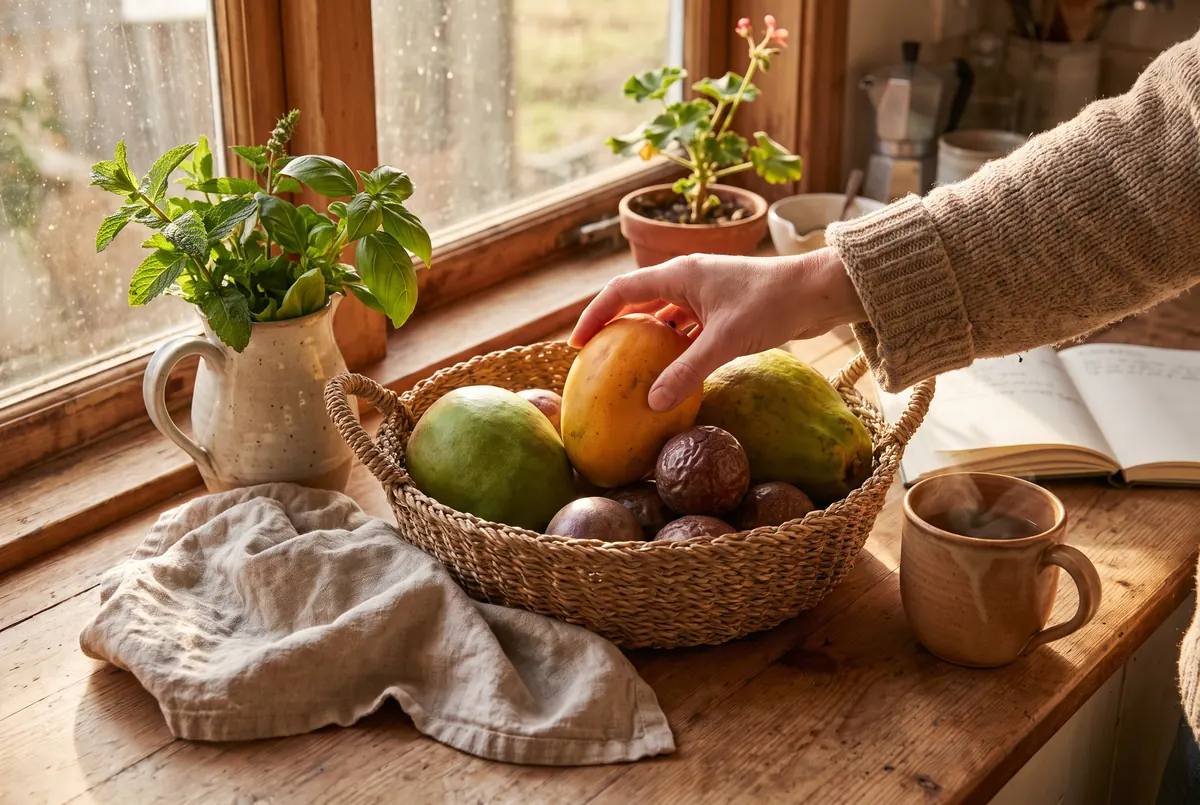
Exotic fruits are fruits that come from a different climate than the one where they are eaten, most often tropical or subtropical: avocado, mango, papaya and pineapple lead the way, the four major tropical fruits according to the FAO, which counts about 2,700 species of tropical fruits. This list comes from Biovie, a fruit importer, and its founder Eric, backed by FAO and USDA figures.
A papaya cut in half on the table, its black seeds packed tight like caviar, and that slightly musky scent spreading through the whole kitchen. For many people, that is exactly what "exotic" means. But what makes a fruit exotic, really? Its color, its price, the journey it made to reach you?
The question isn't new for me. It has followed me since my engineering studies at ISTOM, where we learned to grow crops in the tropics (a long way from our apple orchards), and it comes back to the table every time Biovie, which I founded in 2007, lists a new fruit. So here is our list, updated in November 2026 with official figures and a few simple pointers for choosing and storing these fruits.
What Is an Exotic Fruit?
An exotic fruit is a fruit eaten far from where it is grown, most often in a tropical or subtropical zone. The word is relative: it all depends on the country of the person eating. The four major tropical fruits in world trade are avocado, mango, papaya and pineapple (FAO).
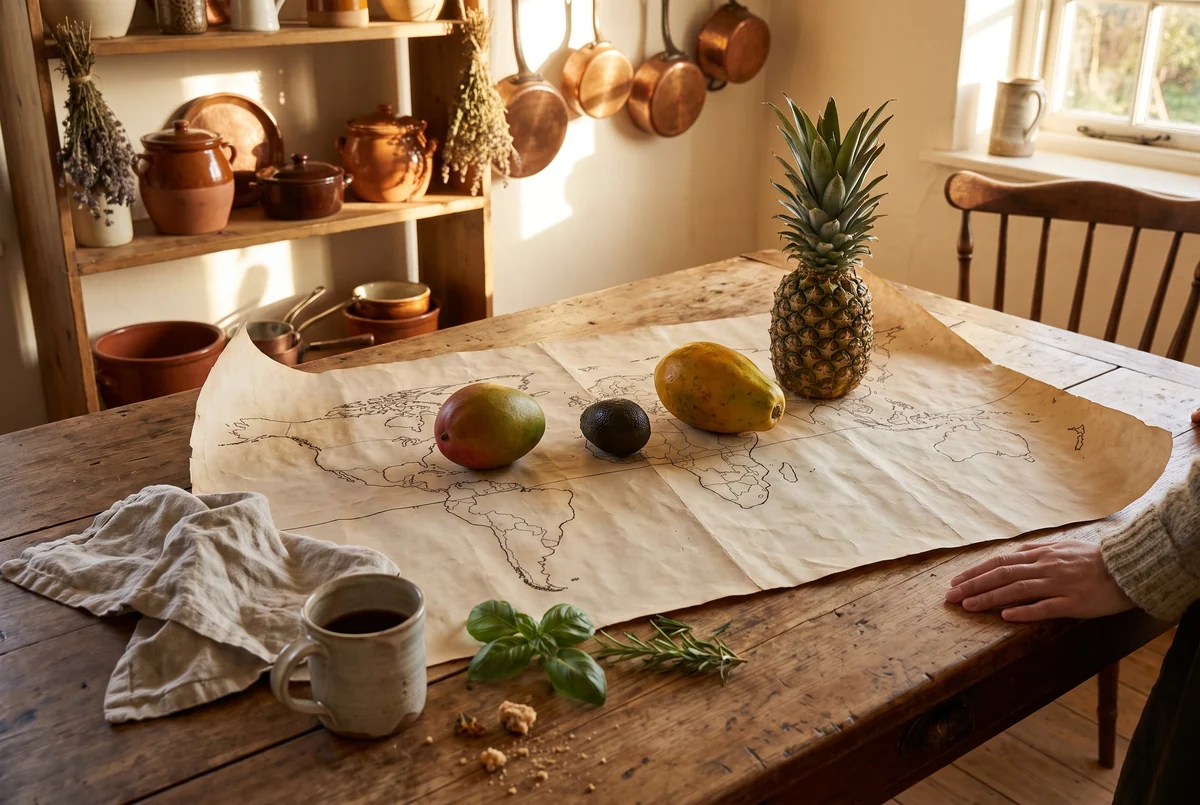
Take a pineapple in Costa Rica: there, it is a local fruit, bought the way we buy our apples. The same pineapple at a market in Nîmes becomes an exotic fruit, without having changed by a single gram. "Tropical", on the other hand, doesn't shift with the person eating. It refers to a climate zone, that warm band on either side of the equator, between the two tropics. A fruit can therefore be exotic in France and perfectly local somewhere else, and that is the whole point of the word.
And here, the numbers are dizzying. The FAO counts about 2,700 species of tropical fruits, and our market stalls show only a handful of them. Even tasting a new fruit every week, a whole lifetime wouldn't be enough! Another surprise: about 99% of this production comes from developing countries, often from small farms of less than 5 hectares, a few football pitches. That is a long way from the endless plantations we imagine from Europe.
Still, most of these fruits never leave their country. Exports of the major tropical fruits come close to 11 million tonnes in 2023, according to an FAO estimate. That sounds huge, and yet it is only 5% of the production of the four major fruits: out of twenty mangoes, avocados, papayas or pineapples harvested, just one goes abroad. All the others are eaten on the spot. Tropical fruits also account for 3% of world exports of agricultural food products.
I don't see anything sad in that: a fruit eaten where it grows is the normal situation. If anything, it is the opposite that should make us think. My studies left me with a conviction I won't let go of: the maximum added value should stay in the producing country, and not only with those who, like us, import and resell.
The List of Exotic Fruits, from the Best Known to the Rarest
This list starts with the four fruits that dominate world trade, moves on to the ones you already come across at the market, then ventures toward fruits that few Europeans have tasted fresh.
The Four Major Tropical Fruits
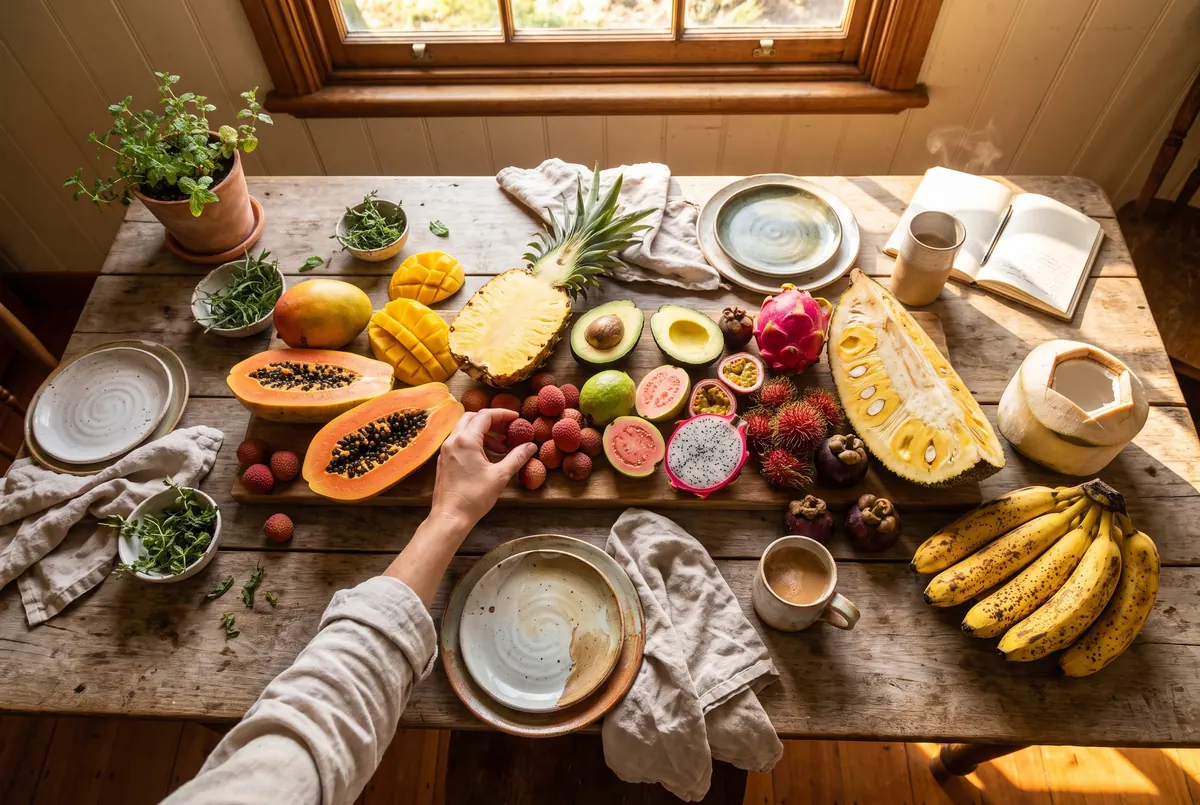
Yes, pineapple is an exotic fruit in France, and the FAO even ranks it among the four major tropical fruits, along with avocado, mango and papaya. Originally from South America, it contains bromelain, an enzyme that keeps a jelly from setting if the pineapple is raw (anyone who has watched a dessert stay liquid will understand). Avocado, from Central America, is the fruit we forget to count as a fruit, since we eat it so often in salads.
Mango, originally from India, is often nicknamed the queen of tropical fruits, and the title is well earned. To judge its ripeness, trust the softness under your fingers, not the color: a mango that is still green can be perfectly ripe. As for papaya, from Central and South America, don't throw away its black seeds: they are edible, with a slightly peppery taste, and add a kick to a vinaigrette.
The Best-Known Exotic Fruits
Next come the fruits that everyone has already met. Banana, originally from Southeast Asia, is at its best well spotted with brown, at the very moment many people throw it away. Coconut is both eaten and drunk: you bite into its flesh, drink its water, and coconut milk is made by pressing the grated flesh. Lychee, originally from China, hides a translucent pulp under its red shell, and a skin that turns brown says nothing about the state of the flesh.
When ripe, guava from Central America gives off a powerful scent that doesn't go unnoticed in a room. Passion fruit, or maracuja, is a fruit you watch for wrinkles, which isn't so common: the more wrinkled its skin, the more ready it is. Pitaya, or dragon fruit, hides white or red flesh under its bright pink skin, dotted with tiny black seeds.
Rare Exotic Fruits
Some fruits stay rare outside their home region, simply because they are hard to grow or keep very poorly. Mangosteen, from Indonesia and Malaysia, comes from a tree that is slow to bear fruit. Jaboticaba, in Brazil, grows directly on the trunk of the tree and keeps for so little time after picking that it isn't exported fresh. Rambutan, from Thailand, covered in soft hairs, hides juicy white flesh, a cousin of the lychee's.
And then there is the sweet berry (Synsepalum dulcificum). It sounds like a fairy tale, but it promises nothing more than a sleight of hand on the tongue: this small red fruit from West Africa contains miraculin, which changes the perception of taste for a while, and after it, a lemon seems sweet. Santol, from Southeast Asia, offers soft, tangy flesh under a thick skin.
That leaves durian and jackfruit, the two giants of Southeast Asia, which both travel poorly when fresh. The first divides the dinner table: its powerful smell, you either love it or run from it. The second, enormous, also grows on the trunk. That is why we offer, among others, freeze-dried jackfruit, light and crunchy; for precise ideas, here is how to use freeze-dried lychee, jackfruit or durian every day.
The Other Exotic Fruits, from A to Z
This exotic fruits list is of course not exhaustive (given the number of species, it couldn't be), but here, from A to Z, are the other tropical and exotic fruits you may come across, with their Latin name, their origin and, when it is marked, their season in France.
- Açaí (Euterpe oleracea), Amazon, mostly sold frozen.
- Acerola (Malpighia emarginata), West Indian cherry (April to November).
- Annona, soursop, cherimoya (Annona muricata, A. cherimola), tropical America (October to February).
- Awara (Astrocaryum vulgare), Amazon, orange flesh (summer, autumn).
- Breadfruit (Artocarpus altilis), Asia and Oceania (June to October).
- Carambola or starfruit (Averrhoa carambola), Southeast Asia (August to February).
- Ceriman (Monstera deliciosa), taste between pineapple and banana (summer).
- Citron (Citrus medica), tangy citrus fruit (October to January).
- Date (Phoenix dactylifera), Middle East and North Africa (summer, autumn).
- Kiwi (Actinidia deliciosa), China (November to May).
- Kumquat (Citrus japonica), small citrus fruit eaten with its skin (December to March).
- Lime (Citrus aurantifolia), warm regions.
- Longan or dragon's eye (Dimocarpus longan), cousin of the lychee (July to September).
- Lucuma (Pouteria lucuma), South America, caramel taste (January to April).
- Marula (Sclerocarya birrea), southern Africa (January to March).
- Persimmon (Diospyros kaki), also grown around the Mediterranean (October to December).
- Physalis (Physalis peruviana), imported from Colombia and South Africa (December to June).
- Pomegranate (Punica granatum), red flesh (September to January).
- Pomelo (Citrus maxima), Southeast Asia, bittersweet taste (November to March).
- Prickly pear (Opuntia ficus-indica), fruit of a cactus from Mexico (August to October).
- Salak or snake fruit (Salacca zalacca), Indonesia, scaly skin (May to December).
- Sapodilla (Manilkara zapota), Central America (November to March).
- Tamarind (Tamarindus indica), Africa, in dry pods.
Comparison Table: What 100 g of Exotic Fruit Provides
Per 100 g of raw fruit, guava is the exotic fruit richest in vitamin C in this table, with 228 mg, passion fruit the richest in fiber and jackfruit the sweetest. The values come from the official American database FoodData Central (USDA, 2019), which publishes averages by species.
| Fruit (raw, 100 g) | Energy (kcal) | Vitamin C (mg) | Fiber (g) | Potassium (mg) | Sugars (g) |
|---|---|---|---|---|---|
| Guava | 68 | 228 | 5.4 | 417 | 8.92 |
| Lychee | 66 | 71.5 | 1.3 | 171 | 15.2 |
| Papaya | 43 | 60.9 | 1.7 | 182 | 7.82 |
| Mango | 60 | 36.4 | 1.6 | 168 | 13.7 |
| Passion fruit (purple) | 97 | 30.0 | 10.4 | 348 | 11.2 |
| Jackfruit | 95 | 13.7 | 1.5 | 448 | 19.1 |
These are composition figures, nothing more. 228 mg of vitamin C per 100 g of guava: it is the value that surprises most, because this discreet fruit leaves the far more famous mango well behind. Who would have guessed? Passion fruit owes its 10.4 g of fiber to its seeds, which you swallow along with the pulp, and jackfruit, with 19.1 g of sugars, is recognizable right away by its sweetness in the mouth.
These values remain averages: variety, ripeness and origin make them vary from one fruit to the next. Two mangoes of the same name, one picked at the right moment and the other too early, won't necessarily give the same numbers. I am wary of rankings, by the way. Each fruit finds its place as part of a varied and balanced diet and a healthy lifestyle, and it is the rainbow of colors on the plate, far more than any champion fruit, that makes a meal rich.
Exotic Fruits Grown in Europe: The Example of Spain
Yes, some of the so-called exotic fruits do grow in Europe, and that still surprises a lot of people. On the Andalusian coast, between Malaga and Granada, a subtropical climate makes it possible to grow mangoes, avocados or pitayas. That is where the fresh organic fruits we offer come from, from the organic exotic fruit mix from Spain to the organic pitayas from Spain.
It all comes down to distance. The grower on the Malaga coast we work with lets the fruits ripen on the tree, and just two days separate the picking from the customer, with no cold room and no three successive warehouses. Two days is about the time a letter takes to cross France. The fruit arrives with the scent it had on the branch, and that can't be made up for in a warehouse.
About Spanish avocados, you hear a lot of urban legends. At our avocado grower's, an hour from Malaga, a stream one meter wide, coming down from the snowy peaks, runs through the plot: it is a far cry from the giant greenhouses of Almería that we spontaneously think of. Of course, the questions of water and pesticides arise in Spain as elsewhere, they are legitimate and I'm not going to wave them away; to see more clearly, here is what the European omnibus changes for pesticides in fruit.
Should we therefore fill our fruit bowl with fruits from far away all year round? I don't think so. The most precious fruit remains the one that grows near you, and the exotic one keeps all its flavor when it stays a celebration. The short supply chains of southern Spain show that you can eat a tree-ripened mango in France. I hope they set an example, and not only for mangoes.