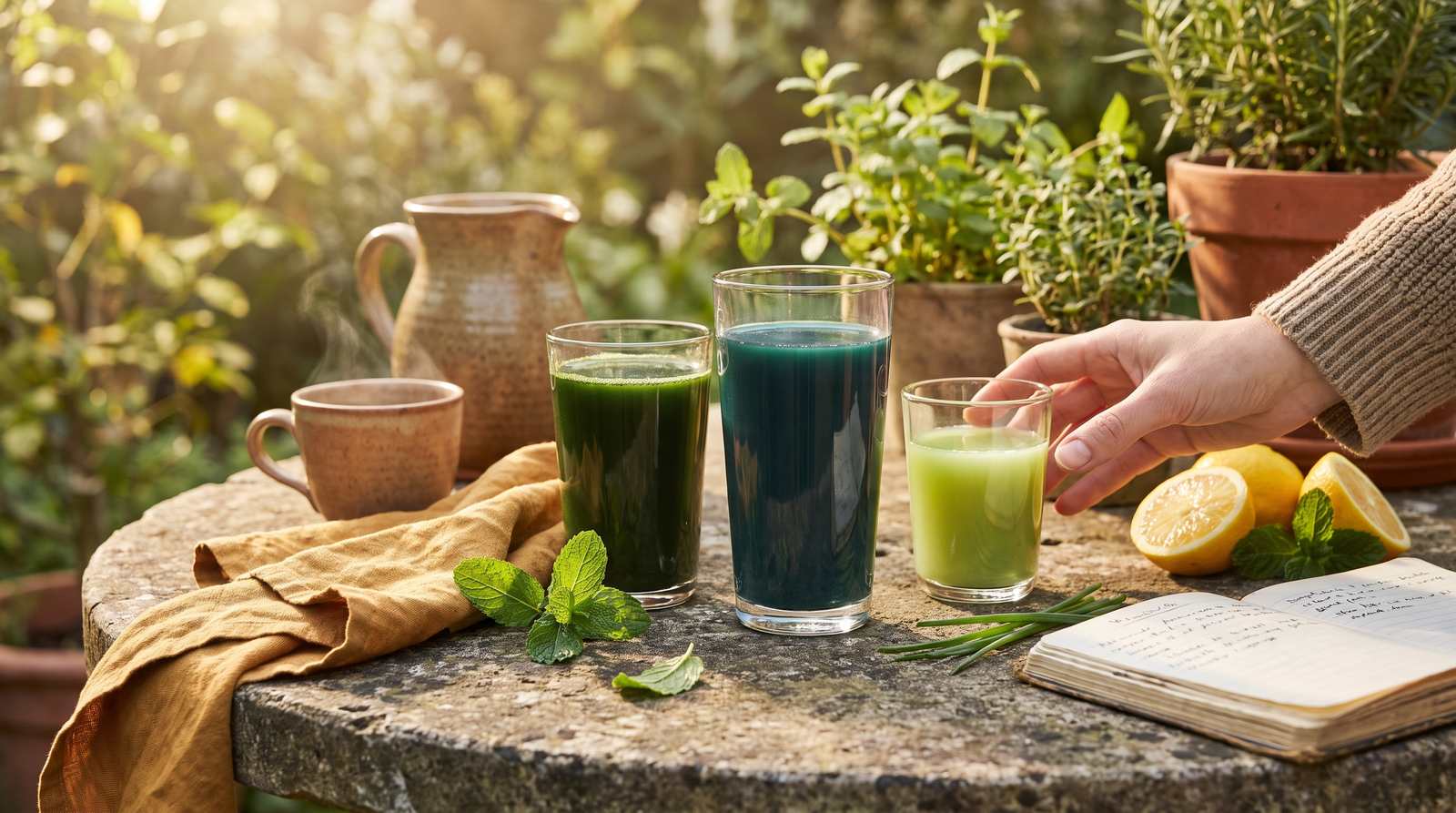
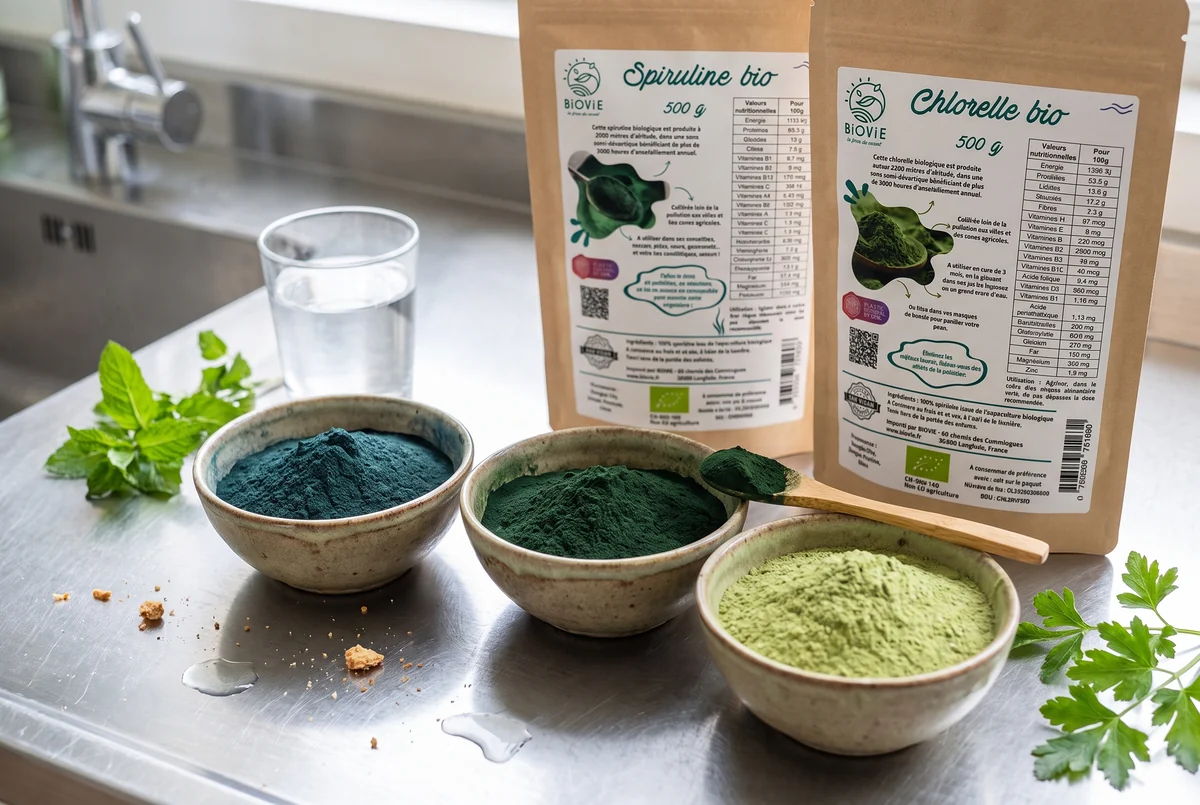
Three powders in almost the same green, three organisms with nothing in common: in the chlorella vs spirulina question, both are micro-organisms containing about 57 to 59 g of protein per 100 g, whereas barley grass is a young cereal shoot, more fibrous, and its juice a milder drink. At Biovie, we built this comparison on the USDA table and on scientific journals, with figures per 100 g to back it up.
In recent weeks, two questions reached customer service back to back: "What's the difference between chlorella and barley grass juice?", then "Can I use my chlorella after the date?" Yet the top-ranking pages on the subject mostly talk about spirulina, and none really compares these powders with one another.
I'm an ISTOM engineer, vegan since 1992, I founded Biovie in 2007, and over the years I've got into the habit of reading a composition table before reading a label. It sells less, but it's more solid. So let's lay out the figures, see why they move, and only then choose according to your use.
Chlorella, spirulina, barley grass: three very different organisms
Put three spoonfuls side by side on the kitchen table: give or take a few shades, the same green. And yet these near-twin powders only share their color, so before settling the chlorella vs spirulina question, it helps to know what we're talking about. Spirulina is a cyanobacterium of the genus Arthrospira, a micro-organism that lives off light like a plant, without being one. Chlorella (Chlorella), for its part, is a true green microalga, made of a single cell.
And that cell has one particularity that changes everything: it is surrounded by a cellulose wall that our body cannot digest when it is intact (Bito et al., 2020). Think of a nut swallowed with its shell. It's all there, but you get nothing out of it as long as the shell stays closed. That is why chlorella is sold as a "broken cell wall" powder, broken mechanically. We are not what we eat but what we absorb, and chlorella is a good example of it.
Barley grass doesn't come out of the water but out of the field: it is the young leaves of barley, harvested before the ear forms. The agronomist in me sees it first as a cereal that was not allowed to go all the way to the grain. Klamath (AFA), another well-known microalga, falls outside the scope of this comparison.
Barley grass powder or barley grass juice?
Barley grass powder is the whole leaves, dried then ground: the fibers all stay. Barley grass juice is first pressed, then dehydrated, which removes a large part of those fibers. And the taste follows. The juice is milder and dissolves far better in a glass of water, whereas the powder, more rustic, finds its place in a smoothie.
What do they really contain? The comparison in figures
Between spirulina and chlorella, the chlorella vs spirulina difference is first of all biological: a cyanobacterium on one side, a green microalga on the other. Their proteins are close (57.5 and about 59 g per 100 g), chlorella provides more fat and fiber, and the B12 in spirulina is mostly an analogue that is inactive in humans.
| Per 100 g of dry powder | Spirulina (USDA) | Chlorella (Bito et al., 2020) | Dried barley grass (Zeng et al., 2018) |
|---|---|---|---|
| Energy | 290 kcal | not reported | not reported |
| Protein | 57.5 g | about 59 g (50 to 72 g depending on the product) | 27.3 g on average (19.9 to 34.1 g) |
| Fat | 7.72 g | about 11 g (7 to 20 g) | not reported |
| Fiber | 3.6 g | carbohydrates about 17 g (5 to 42 g), of which more than 65% fiber | 29.5 g on average (2 to 39.1 g) |
| Iron | 28.5 mg | not reported | 23.3 mg (10 to 41.2 mg) |
| Magnesium | 195 mg | not reported | 183.2 mg (110 to 247.1 mg) |
| Calcium | 120 mg | not reported | 479.4 mg (330 to 819 mg) |
| Potassium | 1,360 mg | not reported | 3,384 mg (2,400 to 4,300 mg) |
| Vitamin B12 | 0 µg (assumed value, not measured) | from less than 0.1 to 400 µg depending on the product | not reported |
One clarification before going further: the barley grass values concern the whole dried grass. For barley grass juice, the reference remains the label on its product page, and I'd rather not give you an approximate figure. On protein, though, spirulina and chlorella are neck and neck: more than half the weight of the powder.
Thing is, nobody eats spirulina by the ladleful. So let's bring these figures down to the spoon: a 3 g portion of spirulina provides about 0.86 mg of iron and 5.9 mg of magnesium, according to the USDA. Those 3 g fit at the bottom of a teaspoon: these powders complete a plate without making up the base of it. As part of a varied and balanced diet and a healthy lifestyle, that is exactly the place I give them, and I'm wary of claims that give them a bigger one.
Why the figures vary from one batch to another
Why do two serious websites show contents that don't look alike? Because a green powder comes from living matter, and living matter doesn't come out of a mold. For the vitamin C in barley grass, Zeng and colleagues report from 19.4 to 548 mg per 100 g: from one batch to another, you go from a trickle to a downpour.
The authors attribute these gaps to growth stage, manufacturing process and variety. Still, a figure displayed on its own, to the milligram and without its range, looks precise while saying very little. It is one of the reasons I devoted a whole article to the quality criteria of a spirulina.
Vitamin B12: the analogue trap
This is the point I most want to dwell on. In a spirulina supplement analyzed in the laboratory, 83% of the purified vitamin B12 was pseudovitamin B12, a form that is inactive in humans, and the usual microbiological assay overestimated the content by 6 to 9 times (Watanabe et al., 1999). Think of a key that goes into the lock without turning it: the test counts it, your body does nothing with it. The USDA, by the way, retains no B12 at all for dried spirulina.
On the chlorella side, the literature reports from less than 0.1 to 400 µg of B12 per 100 g, with some products containing inactive corrinoids (Bito et al., 2020). What's the use of a flattering figure if the body can't make use of it? Neither chlorella nor spirulina replaces a reliable source of vitamin B12 for vegans, and I say so as a long-time vegan.
Chlorophyll: what it is, and what we can say about it
Search for barley grass juice powder benefits and you'll land very quickly on chlorophyll, credited with just about every virtue. Before crowning it, let's start again from what it is. Chlorophyll is the pigment that captures light for photosynthesis, with a magnesium atom at the center of its molecule, like a stone set in the middle of a ring. It is what gives the three powders their color.
For dried barley grass, Zeng and colleagues report an average of 542.9 mg of chlorophyll per 100 g (from 438 to 662 mg), that is a little more than half a gram of pigment in 100 g of leaves. I haven't found an equivalent sourced figure for spirulina and chlorella, and I'd rather leave the box empty. An empty box, at least, fools nobody.
What has been published doesn't allow any health effect to be attributed to chlorophyll. That may disappoint, I know. It is a marker of color and freshness, and that's already a lot. The same pigment colors the young shoots and sprouted seeds on a windowsill: barley grass is, deep down, just a young shoot that was left to grow a little longer.
Taste, preparation, everyday use
Taste often decides whether a powder ends up in the glass or at the back of the cupboard. Personally, I find spirulina pronounced, with a frank marine note. Chlorella is more herbaceous, and barley grass juice recalls fresh grass, only milder, with the advantage of dissolving very well in water. Barley grass powder, more fibrous, is happier in a smoothie.
Preparation, for its part, is nothing complicated. Water, a juice, a smoothie, a sauce or a lukewarm soup to which you add the powder once it's off the heat: anything works. I never cook these powders, it's a rule here as for all seaweeds. For the quantity, follow the portion indicated on the label, as part of a varied and balanced diet and a healthy lifestyle.
And then there are those who are truly put off by the taste of spirulina powder, and I understand them. For them, fresh spirulina in a block or frozen fresh spirulina slips into a sauce or a smoothie, with a taste I find much more discreet; I've also gathered some tips for masking the taste of spirulina.
To settle chlorella vs spirulina when you're starting out, begin with the taste you prefer: a herbaceous note leans toward chlorella, a marine note toward spirulina. The organic chlorella powder below is simply dosed according to its label.