Spirulina: complete guide, composition, uses and precautions
We have been eating spirulina for many years, and honestly, it is a food that is part of our daily life and that we take with us when we travel (along with our sprouting seeds and dried seaweed). This guide presents its composition, the precautions to know about and the origin of our three products.
Source of iron, spirulina provides a mineral that contributes to the reduction of tiredness and fatigue and to the normal function of the immune system; its protein contributes to the maintenance of muscle mass. More than 20 studies published in leading scientific journals such as Clinical Nutrition (2) and Antioxidants (4) have looked at its effects on cholesterol, energy and sports recovery.
What exactly is spirulina?
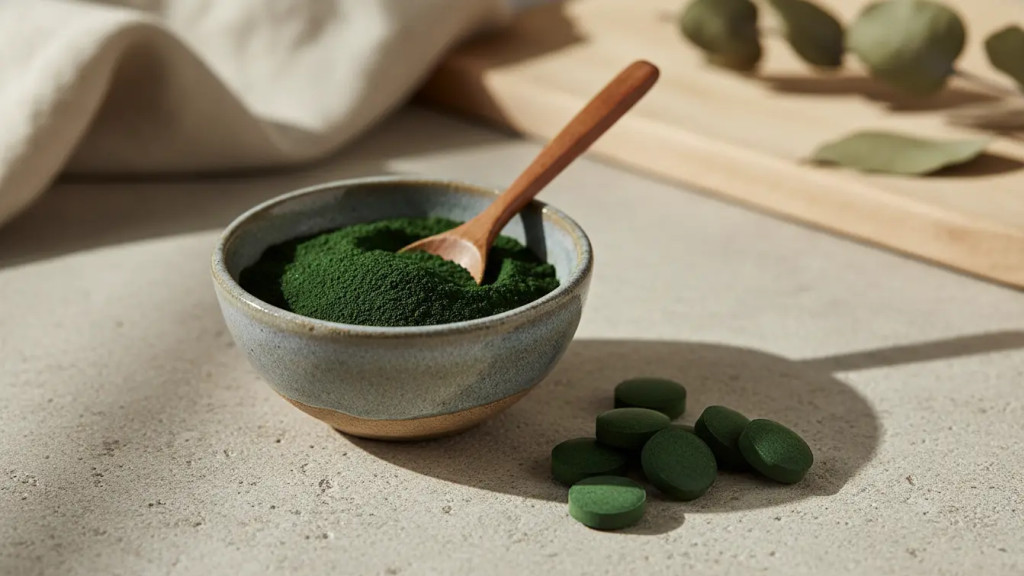
Spirulina, scientifically known as Arthrospira platensis, is not really a seaweed in the classic sense of the term. It is a cyanobacterium, a micro-organism that appeared on Earth more than 3.5 billion years ago. To give you an idea, it is one of the first living organisms to have produced oxygen on our planet.
If you would like to discover the ancient history of spirulina, the Aztecs were already harvesting it from Lake Texcoco in Mexico, where they called it "tecuitlatl". In Africa, the peoples of Lake Chad ate it in the form of dried cakes called "dihé". This blue-green micro-alga has therefore fed humanity long before modern science took an interest in it.
Composition
In practical terms, what makes spirulina so special is its nutrient density. It contains between 60 and 70% protein by dry weight. And this protein is complete, with all 8 essential amino acids present.
Here is what spirulina contains:
Protein: 60-70% of dry weight, complete amino acid profile
B vitamins: B1, B2, B3, B6, B8, B9, and a form of B12 (pseudovitamin)
Fat-soluble vitamins: D, E, K
Beta-carotene : precursor of vitamin A
Iron : 81.4 mg per 100 g of powder, in plant-based ferric form (1)
For the spirulina powder we offer, and for the fresh spirulina from our French producer, here are the measured values in detail, per 100 g and per daily dose (a typical course is between 3 and 5 g per day of powder, 20 g of fresh):
Nutrient
Powder, per 100 g
Powder, 5 g dose
Fresh or frozen, per 100 g
Fresh, 20 g serving
Protein
66.3 g
3.3 g
17.6 g
3.5 g
Iron
81.4 mg
4.1 mg (29% of NRV)
16.9 mg
3.4 mg (24% of NRV)
Carotenoids (including beta-carotene)
242 mg
12.1 mg
not measured on the sheet
-
Chlorophyll (including chlorophyll a: 850 mg)
1.7 g
85 mg
not measured on the sheet
-
Phycocyanin
12.3 g
615 mg
5.7 g
1.1 g
Values taken from the analyses provided by our suppliers and shown on the product pages (September 2026). NRV: nutrient reference values, 14 mg per day for iron. A 5 g dose of powder therefore provides 29% of the NRV for iron, which allows the European claims on iron: it contributes to the reduction of tiredness and fatigue, to normal oxygen transport in the body and to normal formation of red blood cells.
These values are specific to our organic spirulina powder; they vary from one batch and one supplier to another depending on growing and drying conditions, which is why it is worth asking for a real nutrition sheet rather than a generic average.
Phycocyanin, the blue pigment of spirulina
Phycocyanin is the blue pigment that gives spirulina its characteristic colour.
Spirulina also contains gamma-linolenic acid (GLA), an omega-6 that is rare in the diet.
These results are statistically significant (p<0.001) (2). The mechanism of action was clarified by a Japanese study published in the Journal of Nutrition (3): phycocyanin inhibits the intestinal absorption of cholesterol and reduces its biliary reabsorption, thereby increasing its excretion (3).
During pregnancy, ask your doctor or midwife for advice before consuming spirulina.
What ANSES says: risks, contraindications and vitamin B12
I prefer to tackle this subject head-on because it is a legitimate question, and because the honest answer serves our readers better than an awkward silence. Yes, there are risks with spirulina, but they are essentially linked to the quality and origin of the product, not to spirulina itself. That is in fact the heart of the matter: a poorly controlled spirulina can be a problem; a traced and analysed spirulina is quite another thing.
The real risks identified
ANSES (the French Agency for Food, Environmental and Occupational Health and Safety) published a report in 2017 (2) identifying two main risks with poor-quality, non-organic spirulina:
Contamination by microcystins: these toxins come from other cyanobacteria that can contaminate poorly controlled spirulina cultures (2)
Heavy metals: lead, mercury, arsenic depending on the growing medium (2)
Apart from the risk of contamination, ANSES considers that spirulina poses no health risk at usual doses (2). The report recommends favouring the best-controlled supply chains, which is exactly why we detail below the precise origin and the certifications of each of our three products.
The adverse effects actually reported
The ANSES nutrivigilance scheme recorded, up to 2017, 49 reports of adverse effects potentially linked to spirulina-based food supplements (3). Of these 49, only 10 were sufficiently documented to be analysed, and only 4 were judged to be strongly attributable to spirulina (3). The effects reported are mainly digestive, more rarely muscular, hepatic or allergic (3). In other words: the signal exists and deserves to be known, but it remains rare and concerns, in the vast majority of documented cases, products whose quality was not guaranteed.
The real contraindications
Some people should avoid or limit spirulina, or talk to their doctor about it first (2):
Phenylketonuria: spirulina contains phenylalanine, an absolute contraindication
Anticoagulant treatment: presence of vitamin K, which may interfere with the treatment
Autoimmune diseases (multiple sclerosis, lupus, rheumatoid arthritis): as a precaution
Haemochromatosis: spirulina is rich in iron, to be avoided in case of iron overload
Allergic predisposition: as a precaution, in the absence of previous consumption
Apart from these specific cases, spirulina is considered safe by ANSES and the health authorities, provided it is certified and analysed.
What about vitamin B12?
One point on which I want to be transparent, especially for our readers who eat a plant-based diet: spirulina contains a molecule of the B12 family, but it is mainly a pseudo-vitamin B12, which the human body does not absorb like the active form. Studies contradict each other on the truly bioactive share: you therefore cannot rely on spirulina to cover your B12 needs. On a vegan diet, the only reliable option remains a specific supplement, monitored by a blood test. We prefer to say it clearly, even if it does not serve our business.
That is why it is absolutely essential to choose a certified organic spirulina with verifiable batch analyses, as part of a varied and balanced diet and a healthy lifestyle.
Possible mild side effects
Apart from the cases above, the effects reported at the start of a course are generally mild and temporary:
Mild digestive discomfort at the start of a course (bloating, nausea)
Passing headaches
Rare skin reactions
My advice: start with a low dose (1g/day) and gradually increase to the desired dose (3-4g/day). This allows your body to adapt.
Biovie organic spirulina comes in 4 formats: fresh, grown in a greenhouse by Etika; frozen fresh, produced in northern France by Etika Spirulina; powder, from organic aquaculture; and phycocyanin, the concentrated extract of the blue pigment, almost tasteless but intensely colorful. To start a regular routine, powder is the most economical and the easiest to dose; for freshness, choose fresh or frozen spirulina of French origin, closer to the harvest. Phycocyanin suits anyone looking for a concentrated extract with a discreet taste, to add to a preparation without changing its flavor., 4
products
After 18 years of experience at Biovie in the field of living food, I can tell you that quality really makes the difference. Here are the essential criteria:
Selection criteria
Essential criterion: organic certification: guarantees the absence of pesticides and control of growing conditions
Batch monitoring and analyses: checks for heavy metals and microcystins (2)
Full traceability: from the growing pond to the finished product
The price of spirulina per kilo can vary considerably, but remember that a lower-quality product can be dangerous.
Where Biovie spirulina comes from: three origins, three traceability chains
Rather than asking you to take our word for it, here is exactly where our three products come from, and what sets them apart:
The spirulina powder comes from a supplier located in Jiangsu province, China, selected by Éric after in-depth research into certification and traceability. It is certified organic EU, USDA and Canada, produced according to the ISO 22000 quality standard, and dried by spray drying rather than by long convection drying, a method recognised by Ecocert for preserving heat-sensitive nutrients.
The fresh spirulina and the frozen spirulina are produced by Etika Spirulina, at our producer Xavier's farm in northern France. Grown in ponds, it is simply pressed to remove excess water, without drying or heating, and packed in compliance with the cold chain.
In both cases, batch analysis (microcystins, heavy metals) is one of our non-negotiable sourcing criteria, exactly those recommended by ANSES. These analysis reports (microcystins, heavy metals) are available on request from sav@biovie.fr.
Powder, fresh or frozen: which format to choose?
We offer spirulina in three real formats, each with its own use. The table below compares the three on what really matters when choosing: origin, storage, dose, taste and real cost per day.
Same producer as the fresh; frozen immediately after harvest
Several months in the freezer; never refreeze a thawed tablet
6 to 12 g per day (half a tablet to one tablet), thawed for 2 minutes at room temperature
Neutral taste; gives a smooth green liquid that is easy to incorporate
€64.00 for 420 g delivered, i.e. €0.91 to €1.83 per day (35 to 70 days)
Prices including VAT observed on biovie.fr in September 2026, delivery included for fresh and frozen. The cost per day depends on the dose chosen: at equivalent dry weight, a 20 g serving of fresh corresponds roughly to 3 to 4 g of powder, which explains the price difference between a course of powder and a course of fresh.
In practical terms: if you are discovering spirulina or want to dose it precisely in a recipe, go for the powder. If the taste has always put you off or you want to cook it as a food in its own right, try the fresh or frozen. You will find all three products in our spirulina section.
The usual daily dose is 3 to 4 grams of powder (the equivalent of 20 g of fresh spirulina). Always start with a low dose (1g) and increase gradually over 1 to 2 weeks.
Length of a course
Spirulina can also be taken continuously, as Aurélie and I do.
These edible seaweeds can be combined or alternated according to your preferences.
Frequently asked questions about spirulina
Which health claims apply to spirulina?
No health claim is authorised for spirulina itself. The claims authorised in Europe relate to some of its nutrients, such as iron and protein, when they are present in sufficient quantity.
Is it good to take spirulina every day?
Yes, spirulina is a food that can be eaten daily. We have been eating it ourselves every day for more than 15 years.
What are the side effects of spirulina?
Side effects are generally mild: mild digestive discomfort at the start of a course, temporary headaches, rarely skin reactions. The ANSES nutrivigilance scheme recorded 49 reports in France, of which only 4 were judged to be strongly attributable to spirulina (2, 3). They disappear if you start with a low dose and increase gradually.
Who should not take spirulina?
People with phenylketonuria (presence of phenylalanine), those on anticoagulants (vitamin K), people with haemochromatosis (iron overload) or autoimmune diseases (effects on immunity under study) should consult their doctor before taking spirulina (2).
How to introduce spirulina into your diet?
Start with a low dose (1 g per day) and gradually increase to the desired dose.
Does spirulina make you lose weight?
No, spirulina is not a slimming product: it is a food, which we use in cooking in small amounts.
Spirulina and the liver: what do we know?
No food "cleans" the liver, and we do not present spirulina that way.
Is spirulina good for hair?
It provides iron (1), protein and beta-carotene, but no authorised claim links it directly to hair. It can simply be part of a varied and balanced diet.
What is the best form of spirulina?
It mainly depends on how you use it. Powder is the most economical and the most concentrated in nutrients, ideal for precise dosing in a recipe. Fresh or frozen spirulina, produced in France, has a neutral taste and is cooked like a food in its own right, without any drying step. The most important thing is quality: choose a certified organic spirulina whose origin and batch analyses are public (2).
Can you take spirulina during pregnancy?
During pregnancy, ask your doctor or midwife for advice before consuming spirulina.
In brief
The Aztecs and the peoples of Lake Chad were already eating this little blue-green alga.
Spirulina is a food and does not claim to treat anything. But as a quality organic food, whose origin and analyses we publish, it has its place in a varied and balanced diet, and its iron contributes to the reduction of tiredness and fatigue.
My final advice: choose a quality, organic and traceable spirulina, start gradually, and give yourself time to find your rhythm.
Scientific references
Walter A, et al. "Spirulina iron is highly bioavailable in humans." J Agric Food Chem, 2016.
ANSES. "Spirulina: risks of contamination." 2017 report. ANSES
ANSES / Vigil'Anses. "Spirulina-based food supplements: review of nutrivigilance reports." Vigil'Anses no. 4, February 2018. ANSES
A varied and balanced diet and a healthy lifestyle are important.