Spirulina Benefits: What the Science Really Shows (2026)
Spirulina is a cyanobacterium, not an algae in the strict botanical sense - and that is far from a minor detail. On the scientific record, some of its effects are solidly established (the lipid profile, in particular), others remain emerging, and a third category - the one most heavily promoted commercially - simply isn't proven. This guide doesn't revisit the full inventory of benefits; I've already written about that elsewhere. It answers a more practical question, one I've rarely seen addressed seriously: powder, flakes or tablets - how do you choose, and how do you recognize a genuinely high-quality spirulina?
As an engineer, I've had the chance to visit several small-scale artisanal spirulina farms - open-air ponds, filtration, drying. That experience convinced me that you can't judge a spirulina by its price tag or its marketing label: what matters is knowing what actually happens between the pond and the pouch.
What Exactly Is Spirulina?
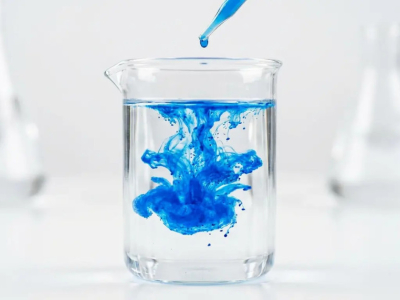
Spirulina is a filamentous cyanobacterium, Arthrospira platensis, cultivated in shallow ponds of alkaline fresh water. It's neither a green algae nor a brown algae like wakame or kombu - it's a micro-organism related to bacteria, capable of photosynthesis, that has existed on Earth for more than three billion years. The name "blue-green algae" often attached to it comes from phycocyanin, the blue-green pigment that gives it its characteristic color once dried.
In practice, it's grown in shallow ponds, harvested by filtration, then dried - at low temperature when the producer does it well, at higher temperature when they don't. That's really the whole subject of this guide: between harvest and pouch, a great many things can change the quality of the final product.
What the Science Actually Establishes
Not all claims made about spirulina carry the same weight - and that's rarely spelled out as clearly as it should be. What we know can be sorted into three levels of evidence, and I'd rather give them to you as they are than flatten them onto the same plane.
Solid level: the lipid profile. A 2023 dose-response meta-analysis, published in Pharmacological Research, pooled 20 clinical trials (23 arms, 1,076 participants in total). The result is clear-cut: spirulina significantly reduces LDL cholesterol, total cholesterol and triglycerides, while raising HDL cholesterol. It's the most robust result available on this ingredient, backed by a solid GRADE level of evidence.
Emerging level: inflammation and oxidative stress. A 2025 meta-analysis (Journal of Functional Foods, 22 studies, 5,385 participants) found a decrease in several inflammatory markers (CRP, IL-6, TNF-α) and an increase in total antioxidant capacity. That's promising, but the body of evidence is younger and more heterogeneous than the one on lipids - so I file it under "emerging," not "established."
Not established: what everyone repeats without checking it. An umbrella review published in early 2026 in Nutrition Research - that is, a synthesis of meta-analyses, the highest tier of scientific evidence - concludes that spirulina's effects are consistent on some parameters but far from uniformly established across the full set of anthropometric and cardiometabolic outcomes often claimed. In plain terms: the most commercially popular promises (immunity, detox, weight loss) rest on a foundation far more fragile than product listings across the market would suggest.
As far as I know, this kind of tiered breakdown of the evidence is something few resources on this topic actually do. I'd rather write an article that's a little less salesy and honest about its limits.
What's Actually in It
Per 100 g of dried spirulina (source USDA FoodData Central, FDC ID 170495): 57.5 g of protein, 28.5 mg of iron, 7.72 g of fat, 23.9 g of carbohydrates including 3.6 g of fiber, for about 290 kcal. It also contains magnesium (195 mg), potassium (1,360 mg) and calcium (120 mg).
Two clarifications matter more than the table itself. First, the ANSES opinion on spirulina (referral 2014-SA-0096) recommends correcting the raw reading of nutrient tables: protein content actually represents 60 to 70% of dry matter, of which 47% are essential amino acids - a rare profile for a plant-based source. Phycocyanin, meanwhile, represents 5 to 15% of dry matter depending on the quality of drying.
Second, on beta-carotene: the USDA tables (342 µg/100 g) are clearly underestimated. ANSES data instead place the content between 140 and 170 mg/100 g. This figure has a direct practical consequence, which I come back to in the consumption section: at 5 g per day, beta-carotene intake approaches or exceeds 7 mg, the estimated daily limit for intake from food supplements. That's not a minor detail, and it's one of the reasons I don't recommend exceeding 5 g/day.
The Truth About Vitamin B12
This is the point where I see the most inaccuracies, even among serious sellers: spirulina is not a good source of vitamin B12 that the body can actually use. The USDA table says so plainly: 0.00 µg of B12 per 100 g. What spirulina actually contains are B12 analogs - molecules that chemically resemble the active vitamin but are, for the most part (around 80% according to ANSES), pseudo-vitamin B12, biologically inactive in humans. In some cases it can even interfere with blood tests for real B12 and create a false impression of adequate status.
In practice, if you follow a plant-based diet and are looking for a reliable source of B12, spirulina isn't the answer - a dedicated supplement remains necessary. I'd rather say this clearly than let the ambiguity work in favor of a sales pitch.
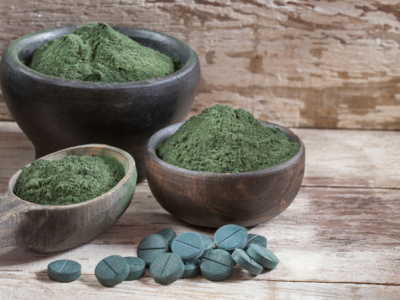
Powder, Flakes or Tablets: Which Should You Choose?
This is the real question behind this guide, and almost no resource addresses it in a genuinely practical way. All three formats exist on the market; they are not equivalent on every criterion.
Powder
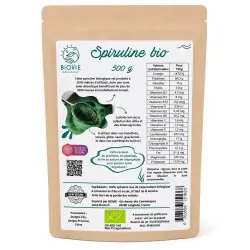
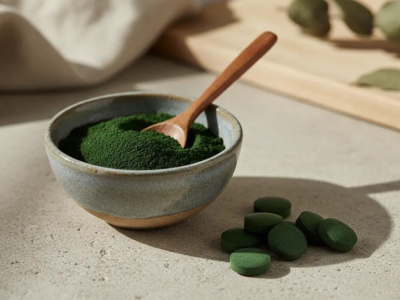
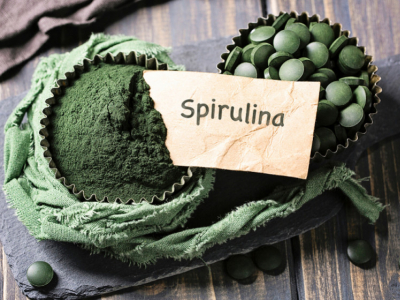
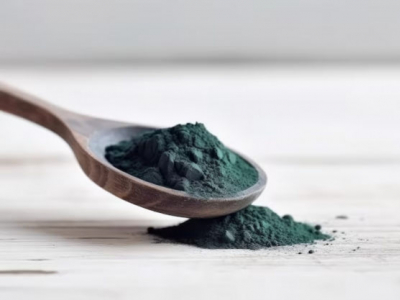
Powder is the most concentrated format and, generally, the least processed after drying - so it's the one that best preserves phycocyanin, which is more sensitive to heat and to storage time in compacted form. It's easy to dose on a scale or with a spoon (with a little practice), and it blends into a smoothie, a sauce, or a spread. Its main drawback: a pronounced, iodine-and-herb-like taste that doesn't appeal to everyone on the first try.
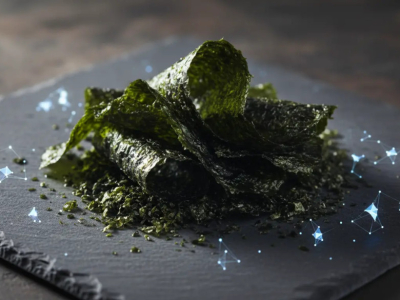
Flakes are produced by a slightly different convective drying process, which yields coarser flakes. They dissolve less easily in a cold liquid, but some users find the taste milder when eaten as they are, sprinkled over a dish rather than mixed in. Nutritionally, at equal production quality, the difference from powder is marginal - the choice mostly comes down to how you plan to use it.
Tablets
Tablets answer a real need: no taste, and easy to carry. But they come with two trade-offs worth knowing before you buy. First, compression usually requires excipients (binding agents), which slightly dilutes the share of pure spirulina in each unit. Second, and this is the most concrete point: the real cost per gram of protein is almost always higher than with powder, because you're also paying for the compression process and individual packaging. For daily use at a target dose (2 to 5 g/day), that quickly adds up to a noticeable budget gap. For a more precise comparison, see the price per kilo of spirulina.
At Biovie, our choice has been powder - not as a matter of principle, but because these are the formats that offer the best control over freshness and actual dosage, gram for gram.
The real risk with spirulina isn't in the molecule itself - it's in contamination. That's one of the central messages of the ANSES opinion, and it's the one that should guide your purchase far more than the price per kilo. Here are the criteria I check, in the order I look at them.
Origin and traceability. An identifiable producer, an address, a farm you can actually locate. This is the first line of defense.
Organic label. It guarantees the absence of chemical inputs in the growing process, but on its own it says nothing about environmental contamination - hence the importance of the next criterion. See also: how to recognize a genuine organic label.
Microcystin testing. Microcystins are cyanotoxins that other cyanobacteria - accidentally present in the growing pond - can produce. There is currently no binding European regulatory threshold; the professional USP reference sets a maximum of 0.5 mg/kg. A serious producer tests every batch.
Heavy metal testing. USP specifications for Arthrospira platensis set precise limits: lead ≤ 1 mg/kg, cadmium ≤ 0.5 mg/kg, mercury ≤ 0.5 mg/kg, arsenic ≤ 1 mg/kg. Ask for the certificate of analysis yourself if the site doesn't provide one on request.
Phycocyanin level. An indirect but useful indicator of freshness and drying quality: the higher it is (within the 5-15% range mentioned above), the better the production process generally is.
ANSES actually states this very clearly in its opinion: it recommends "favoring supply channels that are best controlled by public authorities (compliance with French regulations, traceability, identification of the manufacturer)." That is, word for word, the summary of this guide. To go further: choosing a high-quality organic spirulina.
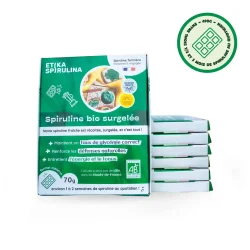
Biovie organic spirulina comes in 4 formats: fresh, grown in a greenhouse by Etika; frozen fresh, produced in northern France by Etika Spirulina; powder, from organic aquaculture; and phycocyanin, the concentrated extract of the blue pigment, almost tasteless but intensely colorful. To start a regular routine, powder is the most economical and the easiest to dose; for freshness, choose fresh or frozen spirulina of French origin, closer to the harvest. Phycocyanin suits anyone looking for a concentrated extract with a discreet taste, to add to a preparation without changing its flavor., 4
products
The most common daily dose falls between 2 and 5 grams per day, to be adjusted according to your digestive tolerance and your goal. A piece of industry advice, which I'm sharing without presenting it as a health-agency recommendation: start with a small dose (half a teaspoon, around 1 g) for a few days, then increase gradually. This gives your digestive system time to adjust - spirulina can cause temporary digestive discomfort if you increase the dose too quickly.
Three simple ways to work it in: in a green smoothie (it pairs well with banana and citrus juice, which mask part of the taste), as a seasoning sprinkled on an already prepared dish (less effective at masking the taste but simpler), or diluted into a morning juice or drink. For more ideas, see six ways to consume it. One recurring point of caution: avoid oat milk as a base - its thick texture tends to accentuate the perceived bitterness - go for a homemade tiger nut milk or a store-bought plant milk (almond, coconut) instead, which are more neutral.
As for timing, there's no strict scientific rule: morning or evening, depending on your routine. Many of our customers take it in the morning, as part of a start-the-day routine.
Precautions, Contraindications and Side Effects
ANSES reviewed available data on doses ranging from 2 to 10 g/day, up to 19 g/day in some clinical studies, over periods reaching 12 months. Its conclusion is measured: "taking 10 g/day of dried spirulina does not appear to cause significant adverse effects in adults," while also stating that "the available clinical data are not sufficient to set an upper limit not to be exceeded." It's this caution that leads me to recommend a practical ceiling of 5 g/day - beyond that, beta-carotene intake reaches the daily limit mentioned earlier.
Certain situations call for particular caution, per ANSES's exact wording:
Phenylketonuria: spirulina contains phenylalanine, which should be avoided in this metabolic condition.
A history of allergies: cases of anaphylaxis and angioedema have been reported, with phycocyanin-C identified as the allergen.
Muscular or hepatic vulnerability: one case of rhabdomyolysis has been reported at a dose of 3 g/day, as well as one case of hepatitis.
On thyroid conditions and pregnancy, I want to be precise: these are not formal ANSES contraindications. As a precautionary principle shared by many health professionals, it's best to talk to your doctor if you are pregnant, breastfeeding, or being followed for a thyroid condition - but this is not an institutional prohibition.
The real risk, again, lies elsewhere: contamination. Microcystins (no European regulatory threshold to date; the tolerable daily intake set by the WHO is 0.04 µg/kg of body weight/day; the USP reference sets a maximum of 0.5 mg/kg), heavy metals, and bacteria in cases of poorly controlled production. By far the most frequently reported adverse effects remain digestive discomfort, followed by headaches - generally linked to increasing the dose too quickly.
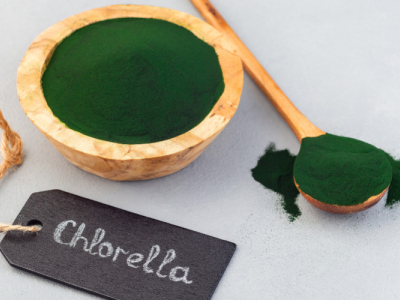
Spirulina or Chlorella?
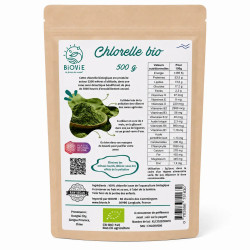
Both are green or blue-green micro-algae, but they're not biologically alike.Chlorella is a single-celled green algae with a rigid cell wall (it requires a "cell-cracking" process to be digestible), while spirulina is a cyanobacterium without that kind of wall. Nutritionally, spirulina is richer in protein and in easily absorbable iron; chlorella stands out for its chlorophyll content and certain specific compounds. In practice, they're not competitors but complements: many of our customers alternate between the two or combine them depending on the period.
On September 26 and 27, 2026, the Fédération des Spiruliniers de France is organizing the 5th edition of the Fête de la Spiruline - simultaneous open days at artisanal farms across France, with an interactive map to find a producer near you. Close to 170 spirulina producers are currently registered in France, according to the Federation.
If you get the chance, it's worth going to see a growing pond with your own eyes - to understand concretely what the quality criteria described above actually look like in practice. See the event's official page.
FAQ
What Are the Benefits of Taking Spirulina?
The most scientifically established effect concerns the lipid profile (lower LDL cholesterol, total cholesterol and triglycerides, higher HDL). Effects on inflammation are promising but still emerging. For the full detail, see our guide to the documented benefits.
Who Shouldn't Take Spirulina?
People with phenylketonuria, those with a known history of allergies (risk identified via phycocyanin-C), and people with pre-existing muscular or hepatic vulnerability. As a precaution, pregnant or breastfeeding women and people being followed for a thyroid condition should talk to their doctor - though this is not a formal ANSES contraindication.
Is It Good to Take Spirulina Every Day?
Yes, at a reasonable dose (2 to 5 g/day), this is the most common use and the one covered by the majority of available clinical data.
Is Spirulina Suitable for People with Diabetes?
Data on glycemic metabolism are less consistent than those on lipids - this is not a solid evidence base at this point. Anyone with diabetes should discuss it with their doctor before adding a new supplement to their diet.
Does Spirulina Help You Lose Weight?
No - or not in any demonstrated way. This is probably the most widespread misconception about this product. The 2026 umbrella review is clear on this point: effects on anthropometric parameters are not uniformly established. If you're buying spirulina mainly for this goal, it's better to know that beforehand.
Spirulina Powder or Tablets: Which Should You Choose?
It mostly depends on how you plan to use it. Powder offers the best value per gram of protein and more precise dosing; tablets offer convenience, at the cost of a generally higher price and compression excipients.
Is Spirulina a Good Source of Vitamin B12?
No. About 80% of the "B12" it contains is actually pseudo-vitamin B12, inactive in humans. Don't rely on spirulina to cover your B12 needs.
Is Spirulina a Good Source of Iron?
Its iron content is real (around 28 mg per 100 g of dried powder), but at the usual daily dose of 3 to 5 g, the actual intake is limited to just over 1 mg - a complement, not a solution to a confirmed deficiency, which needs to be medically monitored.
Sources
ANSES, opinion on the risks associated with the consumption of spirulina-based food supplements, referral No. 2014-SA-0096, 2017. (https://www.anses.fr/fr/system/files/NUT2014SA0096.pdf)
USDA FoodData Central, Spirulina, dried, FDC ID 170495. (https://fdc.nal.usda.gov/food-details/170495/nutrients)
The effect of Spirulina supplementation on lipid profile, GRADE meta-analysis, Pharmacological Research, 2023. (https://pubmed.ncbi.nlm.nih.gov/37263369/)
Spirulina, inflammation and oxidative stress: a meta-analysis of randomized controlled trials, Journal of Functional Foods, 2025.
Spirulina supplementation and human health: an umbrella review of meta-analyses of randomized controlled trials, Nutrition Research, vol. 149, 2026.
European Commission, register of nutrition and health claims (EU Regulation 1924/2006). (https://food.ec.europa.eu/food-safety/labelling-and-nutrition/nutrition-and-health-claims/eu-register-health-claims_en)
Fédération des Spiruliniers de France, Fête de la Spiruline 2026. (https://www.spiruliniersdefrance.fr/fete-spiruline/)
As part of a varied, balanced diet and a healthy lifestyle. The information in this article is provided for informational purposes only and does not constitute medical advice. Consult a healthcare professional before changing your diet or starting any supplementation.