Best water filter for lead removal, PFAS, TFA: what the Ecofiltro retains (and how to check)
Choosing the best water filter for lead removal starts with the lab report: for the Ecofiltro, two filters out of three brought 20 PFAS down from about 205 to about 6 ng/L, and lead went from 18 to less than 5 µg/L. TFA, though, was never tested. Both reports are public: Measurlabs (2024) for PFAS, LABIND (2023) for metals.
Between 11 and 21 September, our customers' questions kept coming: lead, heavy metals, pH, the lifespan of the clay. Then TFA made the news, on 1 October 2026.
Rather than repeat percentages, we opened the reports. I've been the founder of Biovie since 2007 and am an ISTOM engineer, and I spent about ten years at Bio Bourgogne helping farms convert to organic. I kept one reflex from that time, and it applies when someone asks me about the best water filter for lead removal: a number without a protocol doesn't say much. So let's look at them together.
Reading a filter test: three ideas before the numbers
First idea, "spiked" water. The laboratory deliberately adds the pollutant to a water, at a known concentration, then measures what is left after the filter: that is the case for both reports published for the Ecofiltro. Spiked water does measure what the filter is able to retain, but it says nothing about the water that comes out of your tap.
Second idea, the limit of quantification. When a report writes "< 0.005 mg/L" (that is, 5 µg/L), it means "below what the instrument can measure", nothing more. In practice, it's a kitchen scale that displays nothing under 5 g: putting a pinch of salt on it and reading zero doesn't prove the salt has vanished. The "<" sign is a boundary, never a nothing.
Third idea, the one that drives the test. Here it is the manufacturer in both cases, and the manufacturer prepared the samples. That doesn't invalidate anything. Knowing who prepared the water and who paid the laboratory tells you how much trust to give everything else.
The PFAS test was run by Measurlabs, in Helsinki, with analyses entrusted to an ISO/IEC 17025 accredited provider; the report was issued on 5 December 2024. Three new filters soaked for 48 h in 2 L of water, then received 1 L of water spiked with 20 PFAS and 14 medicines; the filtrate was measured after 24 h (Measurlabs, 2024).
On the metals side, over to LABIND, in Guatemala. A "prepared" sample, filtrate measured on day 5, Standard Methods 3113 as the method: the report is dated 2 June 2023 (LABIND, 2023). The accreditation of this second laboratory is not stated, and that is information that matters.
Best water filter for lead removal? Lead and heavy metals in the report
For anyone searching for the best water filter for lead removal, the LABIND report fits in one table. We added the values of the Directive (EU) 2020/2184 on drinking water.
Parameter
Starting water
After the filter (samples 1 and 2)
EU value
Lead
18 µg/L
< 5 and < 5 µg/L
10 µg/L, then 5 µg/L by 12 January 2036 at the latest
Cadmium
11 µg/L
< 1 and < 1 µg/L
5.0 µg/L
Mercury
10 µg/L
< 1 and < 1 µg/L
1.0 µg/L
Arsenic
93 µg/L
34 and 16 µg/L (63% and 83% reduction)
10 µg/L
Total chromium
23 µg/L
31 and 25 µg/L
25 µg/L (50 µg/L until 12 January 2036)
Fluorides
4.2 mg/L
3.1 and 3.6 mg/L (26% and 14% reduction)
1.5 mg/L
Lead: from 18 to less than 5 µg/L
In this test, the lead content fell below the laboratory's detection threshold, 5 µg/L, which happens to be the future European value (by 12 January 2036 at the latest). The report writes "100%". The figure actually demonstrated is a reduction of at least 72% (calculation: 1 minus 5/18). In reality, there may well be much less lead left, but this report doesn't let us say so.
Arsenic, chromium, fluorides: the less favourable results
The starting water was far above the European values: 93 µg/L of arsenic for a value of 10, which is clearly a stress test. After the filter, arsenic drops to 34 and 16 µg/L, a real decrease that nonetheless leaves the water above the European value. Same finding for fluorides. Chromium, for its part, doesn't go down (31 µg/L on one sample).
A water filter that removes heavy metals doesn't therefore work equally well on all of them. If your water comes from a well or a private spring, have it analysed first: with water that is very rich in arsenic or fluorides, a gravity filter is not enough. For compliant mains water, the filter comes as a complement, as part of a varied and balanced diet and a healthy lifestyle.
Well, let's be fair about this too. A manufacturer that publishes its least flattering lines gives its readers the means to judge.
PFAS water filter: the Measurlabs report line by line
Does a water filter remove PFAS? Judging that means counting in nanograms per litre, that is, in billionths of a gram. Measurlabs spiked the water with 20 PFAS at about 10 ng/L each, a sum of about 205 ng/L. That is double the European limit of 100 ng/L set for the sum of PFAS: the filter therefore starts from non-compliant water.
To read these results, we added up the 20 values for each filter, counting as zero those below the limit of quantification (a choice that rounds slightly downwards, since "<" doesn't mean zero). On filters 2 and 3, the sum falls to about 6.4 and 6.3 ng/L, or about 97% reduction. In other words, the water goes in at double the European limit and comes out far below it.
Filter 1 tells a different story. Its sum reaches about 231 ng/L, more than the starting water, with notably PFOS at 157.6 ng/L (against 12.0 at the start) and PFOA at 26.9 ng/L (against 12.9). Honestly, the report gives no explanation, and only an answer from the manufacturer could shed light on this result. One filter out of three, cause not documented.
Then there is PFBA, the shortest PFAS in the test (4 carbon atoms): 8.9 ng/L at the start, then 4.0, 2.3 and 3.5 ng/L, only 55 to 74% reduction. The shorter the molecule, the less this filter retained it in the test.
An independent study, carried out in real conditions in 73 households in North Carolina, helps put these figures in context: reverse osmosis and two-stage under-sink filters removed almost all PFAS there, whereas the other activated carbon filters were variable, around 60 to 70% for long chains and about 40% for short chains (Herkert et al., 2020). For the latter, more than half therefore got through. Clay filters were not part of the study.
How do you filter PFAS out of water?
To filter PFAS out of water, reverse osmosis and two-stage under-sink filters offer the most complete retention. Activated carbon filters give variable results depending on chain length, better on long PFAS. Always ask for the report of the filter you choose.
Published on 1 October 2026, a study commissioned by the Greens/EFA group in the European Parliament covers 110 volunteers from 9 countries: TFA was detected in 100% of them, with a median of 21.2 ng/mL in the blood (franceinfo, 2026). It is a political initiative, separate from the work of a health agency, and its authors acknowledge that they cannot isolate the share of occupational origin. These ng/mL of blood can't be compared with the ng/L of water, and the study does not point to water as the source.
As for TFA in tap water, the national campaign by ANSES (results of 3 December 2025, more than 600 samples of distributed water, 35 PFAS searched for) found TFA in 92% of samples, with a median of 780 ng/L. More than nine samples out of ten, then. TFA is not part of the sum of the 20 regulated PFAS: a test covering those 20 molecules says nothing about it.
The reason comes down to size. TFA has only 2 carbon atoms, against 8 for PFOA and PFOS, and activated carbon works a bit like the rough side of a hook-and-loop strip: long molecules catch on it at many points, very small ones slide over it. A two-carbon molecule, how could it hold on as well as an eight-carbon one? The smaller and more soluble a molecule is, the less activated carbon retains it, a trend already visible with PFBA in the Measurlabs test.
A German study on drinking water treatment confirms this for TFA: granular activated carbon and ozonation are unsuitable, ion exchange removes it in part, and reverse osmosis retains it completely (Scheurer et al., 2017).
No published test covers TFA with the Ecofiltro: nothing can therefore be claimed, in either direction.
There you go, that's why a PFAS water filter shouldn't be chosen on the word "PFAS" alone. For an overview, see how to filter PFAS, pesticides and chlorine from tap water.
Lifespan, flow rate, pH: practical answers
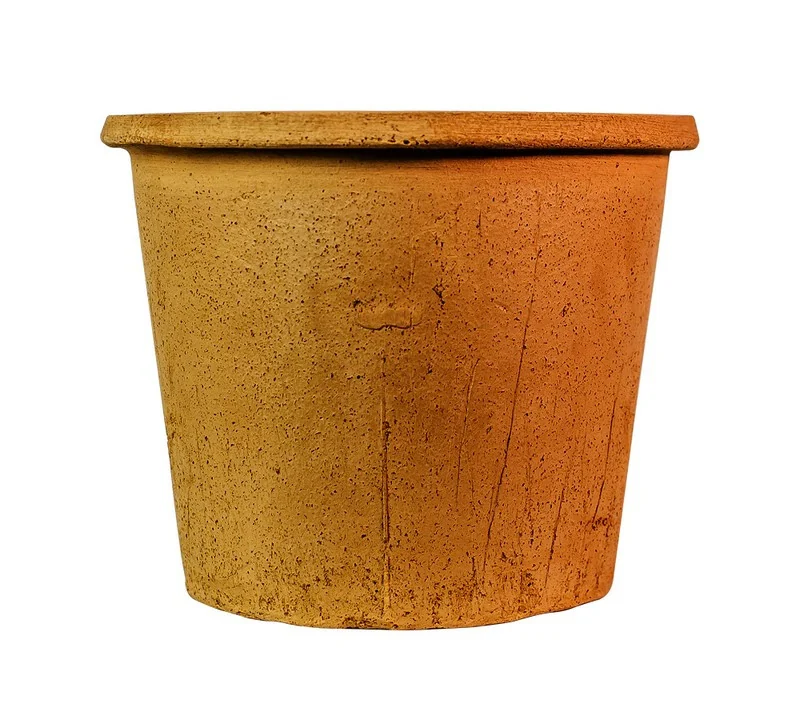
According to the manufacturer, the clay element of an Ecofiltro has a lifespan of 2 years (product sheet data). At the scale of a household, that means a change every two back-to-school seasons. Both reports concern new filters: no published test measures retention at end of life.
For flow rate, count on 1 to 2 glasses per hour at the start, then up to 2 L per hour after about 3 weeks. The first days therefore call for a little patience.
And then there is pH. No pH measurement of the filtered water is published by the manufacturer, and the filter is not designed to change it. The simplest approach is still to measure the pH with test strips, before and after the filter, keeping in mind the range of 6.5 to 9.5 set by the European directive. Knowing your water fits as part of a varied and balanced diet and a healthy lifestyle.
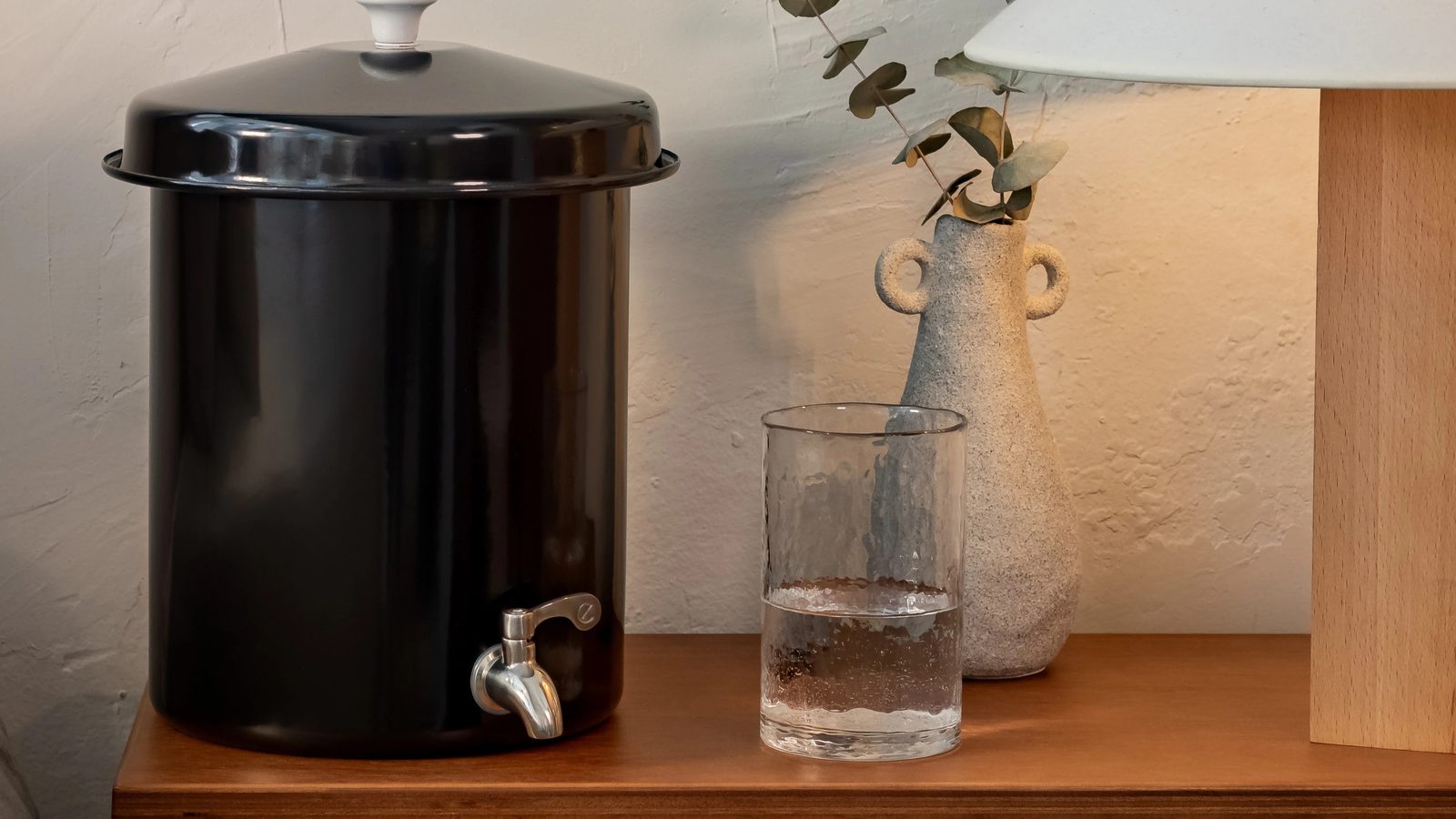
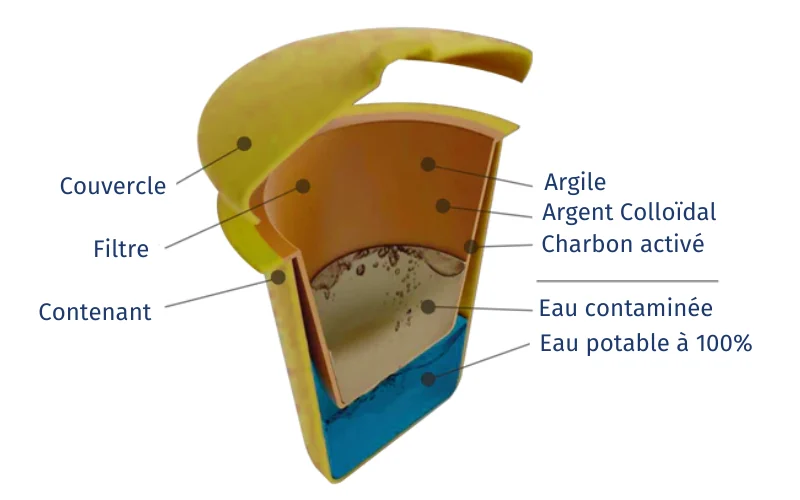
At Biovie, the Ecofiltro water filter filters tap water without electricity or disposable cartridges, thanks to a gravity-fed system of clay, activated carbon and colloidal silver, laboratory tested (99% of PFAS and pharmaceutical residues removed, 100% of polystyrene microplastics). The range also includes the Aquapro shower filter (anti-limescale, anti-chlorine), the Naturalizer tap replacement, and the Water to Go portable filter bottle. Choose the 5 L Ecofiltro for a household of 1 to 2 people, or the 20 L for a family; the clay filter itself only needs replacing every 2 years, without generating electronic waste or disposable plastic cartridges., 19
products
What questions should you ask before buying a filter (Ecofiltro included)?
Before any filter, there is your water. The results of your municipality's health monitoring are public, and looking them up takes a few minutes, with no equipment and no expense. Not knowing is a choice. Starting by knowing your water remains the first step, even before comparing filters.
Then, facing any seller of a PFAS or anti-lead water filter, whether it's the best lead removal water filter for home or the best water filter pitcher for lead removal, these questions sort things out:
Who commissioned the test, and from which accredited laboratory? For the Ecofiltro, the manufacturer in both cases; only Measurlabs mentions an accreditation.
Spiked water or real tap water, at what starting concentration? Both reports use spiked water, often well beyond European values.
New or used filter? New, in both cases.
Are all the tested filters published? The PFAS report shows all three, including the one that disappoints.
What do the "<" and the "100%" mean?
Was TFA measured? For the Ecofiltro, no result is published to date.
One frequent question remains: is it good to drink filtered water? Yes, provided the filter is maintained and replaced in time; mains water remains monitored, and the filter adds to that monitoring without replacing it, as part of a varied and balanced diet and a healthy lifestyle.
I'd like to see the day when every filter sold in Europe comes with its full report, TFA included. On that day, the percentages printed on the boxes won't be worth much anymore, and that will be good news. In the meantime, a lab report can be read in an evening, pencil in hand, and what you learn from it stays with you.
Frequently asked questions
How do you filter PFAS out of water?
Reverse osmosis and two-stage under-sink filters retain almost all PFAS, according to a field study carried out in 73 households in North Carolina. The other activated carbon filters give variable results: about 60 to 70% for long chains, about 40% for short ones. Always check the report of the filter you choose.
What is the list of PFAS?
There is no short list: PFAS group thousands of compounds. The European Directive 2020/2184 targets the sum of 20 PFAS, limited to 0.10 µg/L, and a "total PFAS" limited to 0.50 µg/L. TFA, the smallest of them, is not part of the 20 regulated PFAS.
What is the difference between a reverse osmosis system and a water purifier?
"Purifier" is a broad commercial term, whereas a reverse osmosis system refers to a precise technique: water is pushed under pressure through a very fine membrane, which also retains small molecules like TFA. A gravity filter made of clay and carbon works without pressure or electricity, with performance that varies depending on the pollutant.
Is it good to drink filtered water?
Yes, provided the filter is maintained and replaced in time: mains water remains monitored, and the filter reduces certain substances measured in the tests. It doesn't replace an analysis in the case of well water or very heavily loaded water, because the published test shows that arsenic and fluorides are only partially reduced.
Does the Ecofiltro retain lead?
Yes, in the test published by the manufacturer: the lead content went from 18 µg/L to less than 5 µg/L, the measurement limit of the LABIND laboratory, on two samples of spiked water. The demonstrated reduction is therefore at least 72%, and no end-of-life test is published.
What is the lifespan of an Ecofiltro filter?
Two years for the clay element, according to the manufacturer (product sheet data). The flow rate changes too: 1 to 2 glasses per hour at the start, then up to 2 L per hour after about 3 weeks. The published tests all concern new filters: none measures retention at end of life.
References
Measurlabs (2024). Test report ID 15544, client Ecofiltro Europe SL. Measurlabs, Helsinki, test report issued on 5 December 2024.
LABIND, Laboratorio Biológico Industrial (2023). Resultado de análisis metales pesados, client Ecofiltro S.A. LABIND, Guatemala, report of 2 June 2023.
The information presented in this article is provided for information purposes only and does not constitute medical advice. Consult a healthcare professional before making any change to your diet or supplementation.