



Fresh Seaweed
There are 8 products.
Online only

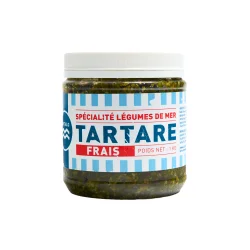
Fresh seaweed tartare
€35.50


Organic Fresh Wakame Seaweed
€17.30

Organic Fresh Nori Seaweed
€10.50


You have seen 8 of 8 products
Questions & answers
All about Fresh Seaweed.
The questions we get asked most often, and our straight answers.
🌊 What edible seaweeds are there?
In 2024, 25 algae are approved for consumption in France, while it is estimated that about 150 species are consumed daily worldwide. The approval processes for a new species in Europe are lengthy and costly.
🌿 Here are the 3 main categories of edible seaweeds:
1. Brown Algae: Ascophyllum nodosum, Fucus vesiculosus, Fucus serratus, Himanthalia elongata, Undaria pinnatifida, Laminaria digitata and Saccharina japonica, Laminaria saccharina, Alaria esculenta
> we offer you Sea Beans (Himanthalia elongata), Wakame (Undaria pinnatifida) and Kombu (Saccharina latissima).
2. Red Algae: Palmaria palmata, Porphyra umbilicalis, Porphyra tenera, Porphyra yezoensis, Porphyra dioica, Porphyra purpurea, Porphyra laciniata, Porphyra leucostica, Chondrus crispus, Gracilaria verrucosa, Lithothamnium calcareum
> we offer you Dulse (Palmaria palmata) and Nori (Porphyra and Pyropia).
3. Green Algae: Ulva, Enteromorpha
> we offer you Sea Lettuce (Ulva Lactuca).
🪸 Only the Wakame algae is cultivated for about half of the quantities sold, the other half comes from wild collections. In the long term, this algae, which proves to be particularly productive, will likely come exclusively from harvests.
🪸 All other algae are freshly harvested by hand and on foot, mainly in the tidal zones where it is possible to harvest algae at low tide, such as in Roscoff, one of the emblematic algae collection areas in Europe.
Here is a video of a visit we made to Roscoff:
🪸 The main economic players are based in Roscoff: BRETALG, the first historical collector in France since 1991 and with whom we have been working since 2017, Bord à Bord, Marinoe, Algoplus...
> The list of edible algae is maintained in Europe by the European Union, and new algae are regularly applied for introduction as edible algae (novel food).
🌊 Where can you find and buy fresh algae? Why is our business different from other online sales sites?
🌿 We are very fortunate to be among the few countries in the world to benefit from a important deposit of wild fresh algae in the region of Roscoff, A major French harvesting site where the majority of French harvesters are located.
> If you feel like it, you can introduce you to seaweed harvesting during a harvesting internship in Brittany ! !
> If you reside on the Breton coast, it will certainly be easy for you to obtain fresh seaweed from local markets ! !
> If you just want to taste and test out of curiosity, you can probably buy a small 150g or 200g container in the fresh section of your usual organic store.
> However, if you wish regularly add seaweed to your plate, enjoy it all year round and prepare your seaweed tartare yourself, we recommend that you buy them in economic format of one kilogram at Biovie ! !
🌿 Since 2014, Biovie has specialized in selling seaweed online in France.. Few of us sell fresh seaweed online, as it requires a Close collaboration with the harvester (in our case, we are working with the first historical harvester of France, BRETALG), suitable refrigerated storage capacities, a certification and a organic traceability throughout the supply chain and a flawless supply chain. This also requires knowing the weather constraints, production, and availability of the harvesters.
🌿 We receive a monthly arrival, after each harvest during the high tides in Brittany. The freshness of our products is therefore optimal.. .
> We have personally and daily consumed seaweed for over 20 years., and we have written two cookbooks on the subject:
🪸 Cooking with seaweed to the Marie Claire Editions, ,
🪸 Algae in everyday life to the Gallimard Editions. .
> We also write numerous blog articles scientifically sourced to help you better understand algae, like this article
🪸 Seaweed and microalgae: benefits, nutrients, culinary uses
🪸 Demystifying the Relationship Between Algae and the Thyroid
🪸 Fucoidan: Unveiling the Benefits of Brown Algae for Inspired Longevity
🪸 Seaweed: The Superfoods of the Sea, Allies for Your Health and the Planet
🪸 Kombu: the seaweed rich in umami that enhances your dishes and supports your vitality
🪸 Wakame: the slimming seaweed that contains 13 times more calcium than milk
🪸 Okinawa diet and seaweed: the longevity secret of Japanese centenarians
🌊 Where do our fresh algae come from?
🌿 Our algae are French and come from Roscoff in Brittany for the following reasons:
> Exceptional marine biodiversity : The Roscoff region, UNESCO-classified, benefits from a large variety of algae species, thanks to its geographical location, its ocean currents, and its climate. The English Channel is particularly nutrient-rich, which favors the growth of a wide variety of algae.
> Historical tradition : The consumption of algae has a long history in Roscoff and the surrounding regions. For centuries, the inhabitants have harvested algae for various uses, from food to agriculture.
> Scientific research : The Roscoff Biological Station, founded in 1872, is a renowned marine biology research center affiliated with the Sorbonne University. It has played a crucial role in algae research and contributed to Roscoff's recognition as a worldwide center of excellence for phycology (the study of algae).
> Algae know-how : Roscoff is the heart of the algae industry in France. The algae harvested in the region are used for a variety of products, from dietary supplements to cosmetics, food, and agricultural products.
> Sustainable practices : The algae harvest in Roscoff is conducted by our partner BRETALG organically and sustainably, respecting the growth cycles of the algae to ensure their renewal and the preservation of the marine ecosystem. BRETALG has been harvesting in this way since 1991.
> Environmental education : Roscoff and its surroundings have also developed tourist activities around algae, such as guided tours of the harvesting areas, workshops, and exhibitions. This has strengthened the region's reputation as a center of expertise for algae. Do not hesitate to visit this extraordinary community!
🪸 To learn more about our algae and their origin, watch our two videos shot on-site with our partner BRETALG. True to our values of transparency and integrity, we wanted to show you the entire industry from harvest to your plate in this report!
🌊 What is the price per kilo for fresh algae?
🪸 At Biovie, our price per kilo for fresh organic algae is certainly the most competitive you can find in France, namely €16.80 per kilo.
In organic stores, you can find algae in 150g or 200g containers to try them out first...
Their price will be around €20 per kilo, as the packages are smaller and organic stores do not work directly with algae collectors like Biovie. In fact, they source their goods through intermediaries.
🌊 What are the benefits of consuming fresh algae?
Fresh edible seaweeds offer a multitude of health benefits due to their rich nutritional profile.
🌿 Some key benefits of consuming fresh seaweeds:
- Rich in minerals and trace elements: Fresh seaweeds are an exceptional source of essential minerals such as iodine, calcium, magnesium, potassium, iron, zinc, and selenium. Additionally, they provide trace elements such as manganese, copper, and boron, which, although needed in small amounts, play a vital role in human health. Iodine, in particular, is crucial for proper thyroid function.
- Vitamins: Fresh seaweeds contain a good amount of vitamins, including vitamins A, C, E, K, and some B vitamins.
- Essential fatty acids: Although their fat content is generally low, some fresh seaweeds are a source of omega-3 fatty acids, beneficial for heart health.
- Dietary fiber: Fresh seaweeds are a good source of fiber, which promotes digestive health, helps regulate blood sugar, and can contribute to satiety.
- Antioxidants: Fresh seaweeds contain antioxidants, such as carotenoids and phycocyanin, which protect cells against damage caused by free radicals.
- Amino acids: Seaweeds are particularly remarkable for their complete amino acid content, essential for building and repairing muscle tissues. Red seaweed species can provide proportional amounts of amino acids comparable to those of animal sources.
- Bioactive compounds: Fresh seaweeds contain bioactive compounds, such as fucoidan, which have shown anti-inflammatory, antiviral, and anticancer properties.
- Digestive health support: Fresh seaweeds contain polysaccharides that can act as prebiotics, nourishing beneficial bacteria in the gastrointestinal tract.
- Detoxification: Fresh seaweeds have the ability to bind and eliminate certain toxins from the body, thus aiding in detoxification.
- Bone health: Thanks to their rich content of highly bioavailable calcium and magnesium, fresh seaweeds contribute to good bone health.
On each of our product pages dedicated to fresh seaweeds, you will find details about their numerous benefits as well as recipe ideas.
🌿 We invite you to check out our scientifically sourced blog articles to help you better understand algae:
Seaweeds and Microalgae: Benefits, Nutrients, Culinary Uses
Demystifying the Relationship Between Algae and the Thyroid
Fucoidan: Unveiling the Benefits of Brown Algae for Inspired Longevity
Algae: The Superfoods of the Sea, Allies for Your Health and the Planet
Fucoxanthin: Can This Brown Algae Really Help with Weight Loss?
Okinawa Diet and Algae: The Longevity Secret of Japanese Centenarians
Algae Proteins: The Complete Alternative to Meat Explained
Plant-Based Iron: Why Algae Outperform Red Meat
🌿 On our YouTube channel, you can also find several videos about the use of algae, including this interview with a naturopath discussing their various nutritional virtues:
🌿 We have also written two books and recipe books about cooking with algae. Feel free to get them to make the most of the exceptional taste qualities and nutritional richness of edible algae!
🪸 Cooking with Algae published by Marie Claire
🪸 Algae in Everyday Life published by Gallimard, Voted Best Cookbook in the World at the Gourmand Awards 2025 (SeaFood category) & Named Best Wellness Cookbook 2025 in France by the National Culinary Academy.