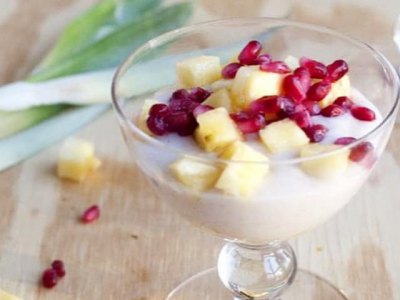
The first time pomegranate really made an impression on me was in Jerusalem, in 2014, visiting my daughter's parents-in-law. On every street corner, vendors sitting next to a sack of pomegranates pressed juice to order, right in front of you, with a big lever press. I later found the same stalls in Tunisia and Morocco. At home, near Nîmes, we have pomegranate trees in the garden, and for at least eight years we have also been selling organic pomegranates from Spain. Here is what I have learned by picking, pressing and shipping them: how to choose them, how to open them without repainting the kitchen, how to make real fresh juice, and what science actually says about this fruit.

Pomegranate: benefits, season, choosing it and fresh juice (by an organic importer)
Share this article
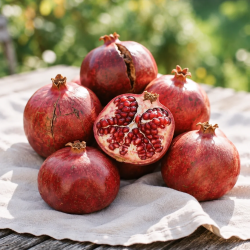
Why we sell pomegranates
The pomegranate (Punica granatum) is a fruit of the Mediterranean basin. In Greece, in the Maghreb countries and in the Near East, you come across it along roads, in courtyards and in gardens. The pomegranate tree tolerates heat and drought, which explains why it also grows very well in the Gard. Ours all bear fruit at the same time, in autumn: it is an abundance you have to know how to manage.
On the shop side, I have worked in the organic sector long enough to know that pomegranate juice is one of the best sellers in organic shops. But it is almost always a pasteurised juice, in a bottle. I wanted to offer the whole fruit, so that everyone can press their own juice.
Our organic pomegranates from Spain come from the same grower as our mangoes and our avocados, on the Costa Tropical in Andalusia. The fruit leaves his farm and goes straight to your address, without passing through a cold store. We offer them in 4 kg boxes: pomegranates keep very well, they are fairly acidic, and a box easily lasts several weeks in a household.
Pomegranate season: from September to early January
The season starts in September and usually ends at the beginning of the new year. So we restart shipments every autumn, as soon as the first fruits are ready.
I find that nature does things well: the pomegranate arrives exactly when we enter autumn and winter, when the summer fruits disappear. It is a transition fruit that takes over from figs and melons.
Out of season, the pomegranates you find come from the southern hemisphere and travel much longer. I prefer to wait for September, as with grapes: a seasonal fruit, picked close to ripeness, tastes better.
How to choose a good pomegranate
A good pomegranate is round, plump, heavy in the hand and of a fairly even colour. The shade varies with the variety, from pink to deep red: it is not the colour that matters, but its evenness.
- Dents or hollows in the skin: the pomegranate has started to dry out. It is older, but still perfectly fine to eat.
- Brown patches on the side: this is often a sign of a damaged part inside.
I have to be honest: I have sometimes opened a pomegranate that looked perfect on the outside and found a damaged part inside. Appearance does not tell you everything. In that case, remove the damaged part and enjoy the rest.
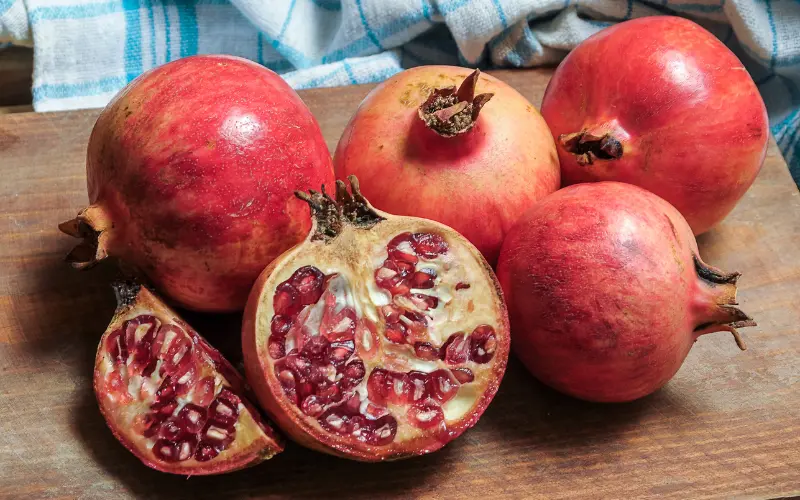
How to open and deseed a pomegranate without making a mess
This is often what puts people off: pomegranate seems like a complicated fruit that stains and fights back. Here is my method, which I also filmed to show that it takes less than 30 seconds:
- Make two crosswise cuts in the skin, around the equator of the fruit, without pushing the blade down to the seeds.
- Pull the four quarters apart with your fingers: the pomegranate opens along its membranes.
- Turn each quarter over, seeds facing down, above a salad bowl, and push the skin upwards.
- Tap the skin lightly from the outside: the seeds fall out on their own.
A few pieces of white membrane remain in the bowl: they are bitter, so pick them out by hand. If you want to make juice, don't even bother, the press takes care of it.
Making pomegranate juice: press or slow juicer, never the blender
This is my favourite way to enjoy pomegranate, and it is what I recommend to anyone bothered by the seeds and pips. Two tools work:
- The manual lever press, the one used by vendors in Jerusalem, Tunisia or Morocco: you place half a pomegranate on a cone, pull down the handle and the juice flows. You find it all around the Mediterranean, less easily in France.
- The slow juicer, with the seeds removed beforehand. At home we use a Hurom juicer, which presses slowly without crushing the pips.
On the other hand, avoid the blender: crushed pips give the juice a really unpleasant taste, bitter and astringent.
The interesting detail is that the lever press crushes the whole half pomegranate, peel included. A study from the University of California published in 2000 showed that juices pressed from the whole fruit contain much more punicalagin, a tannin found mainly in the peel, than juices made from the seeds alone [1]. In the same study, these whole-fruit juices showed an antioxidant activity about three times higher than that of red wine and green tea, measured in the laboratory.
Compared with bottled juice, the main advantage of homemade juice comes down to one word: unpasteurised. The fruit has not been heated at all, the heat-sensitive vitamins and the fruit's enzymes are intact, and the taste is in a different league. To go further on this subject, I have devoted an entire article to pomegranate juice.
How I eat it in season
At the height of the season, I mostly make juice. I also add seeds to salads: they are very colourful, pleasant to look at, and bring a tangy touch that livens up a winter salad.
Pomegranate also has its place in raw desserts: a few seeds on a pudding, a tart or a plant-based yoghurt (you will find ideas in the recipes at the bottom of the page).
Storing pomegranates: three weeks to a month, and juice ice cubes
Whole, a pomegranate easily keeps for three weeks to a month in a cool place. It is one of the fresh fruits that travels and keeps best, hence the box format.
At home, the problem is the opposite: our pomegranate trees all bear fruit at the same time. So we have tried several solutions:
- Freezing the seeds in bags, when there were really too many.
- Making juice ice cubes: press, pour into ice cube trays, unmould and store the cubes in containers in the freezer.
For me, freezing is a much gentler way of preserving food than preserving with heat. And if you have to process the fruit before freezing it, you might as well freeze it in the form you will eat it: as juice, rather than the whole pomegranate, which does not freeze well.
The full range Organic Fresh Fruit
Enjoy a refreshing and nutritious coconut water thanks to these Thai organic green coconuts, proposed with its machete and STAINLESS STEEL straws, 15 products



What does pomegranate contain? What science says
Nutritionally, 100 g of pomegranate seeds provide about 4 g of fibre, 16 µg of vitamin K and 38 µg of folate, according to the USDA database [2]. Pomegranate is therefore a source of fibre, vitamin K and folate (vitamin B9). Vitamin K contributes to normal blood clotting, and folate contributes to the reduction of tiredness and fatigue, as part of a varied and balanced diet and a healthy lifestyle.
What mainly interests researchers are its polyphenols: the anthocyanins, which give the seeds their red colour, and the punicalagins and ellagic acid, concentrated in the peel and membranes. They explain the high antioxidant activity measured in the laboratory [1].
Several clinical trials have studied pomegranate juice in humans. A meta-analysis of randomised trials, published in 2017 in Pharmacological Research, observed an average drop in systolic blood pressure of about 5 mmHg in people who drank it regularly [3]. It is an encouraging result, but it does not make pomegranate juice a treatment: these trials involve a few hundred people, with very variable amounts and durations.
The old version of this article mentioned effects on cancer, diabetes or joints. I removed them: they were based on test-tube or animal studies, which do not allow conclusions for humans. Pomegranate does not need promises to earn its place in your fruit bowl: it is a seasonal fruit, tasty, colourful and nutritionally interesting, as part of a varied and balanced diet and a healthy lifestyle.
The peel, the membranes, the pips… and who should be careful
The pips are edible: they are crunchy and provide most of the fibre. The white membranes are bitter, so set them aside. The peel is not eaten as it is, but the lever press extracts some of its tannins into the juice, as we have seen.
A few common-sense precautions:
- If you are on long-term medication, particularly an anticoagulant, ask your doctor before drinking pomegranate juice every day: pomegranate contains vitamin K, and interactions with certain medicines have been described.
- For young children, choose the juice rather than whole seeds, to avoid choking on the pips.
- Juice is still fruit juice: drink it in small amounts, preferably freshly pressed.
Frequently asked questions about pomegranate
When is pomegranate season?
In Europe, pomegranates are harvested from September to early January. Outside this period, pomegranates come from the southern hemisphere and travel much longer.
How can you tell if a pomegranate is good?
It should be round, heavy and evenly coloured. Dents in the skin indicate an older fruit that is still good; brown patches on the side often signal a damaged part inside.
How long does a pomegranate keep?
Whole, three weeks to a month in a cool place. The seeds and juice freeze very well, in bags or as ice cubes.
Can you make pomegranate juice in a blender?
It is not recommended: crushed pips give a bitter and astringent taste. Use a manual lever press or a slow juicer.
Should you eat pomegranate pips?
Yes, they are edible and rich in fibre. If their texture bothers you, press the pomegranate and drink its juice.
References
[1] Gil M. I., Tomás-Barberán F. A., Hess-Pierce B., Holcroft D. M., Kader A. A. (2000). Antioxidant activity of pomegranate juice and its relationship with phenolic composition and processing. Journal of Agricultural and Food Chemistry, 48(10), 4581-4589.
[2] USDA FoodData Central, "Pomegranates, raw" (values per 100 g).
[3] Sahebkar A., Ferri C., Giorgini P., Bo S., Nachtigal P., Grassi D. (2017). Effects of pomegranate juice on blood pressure: a systematic review and meta-analysis of randomized controlled trials. Pharmacological Research, 115, 149-161.
Further reading
- How to peel a pomegranate in less than 30 seconds
- Pomegranate juice: what the studies say
- Homemade plant-based yoghurt without a yoghurt maker
- Tropical fruits, from the rarest to the best known
Recipes with this product
- Raw rose and pomegranate tart, Persian inspired
- Raw chocolate and flaxseed pudding with pomegranate seeds
- Vegan mandarin cheesecake with a pecan-ginger crust
Updated: October 2026. Article written and validated by Éric Viard, founder of Biovie since 2007 and ISTOM engineer, co-author of "Algues au quotidien" (Gallimard, 2024) - Best Cookbook in the World, Gourmand Cookbook Awards 2025, and Best Cookbook in France, Académie Nationale de Cuisine 2025.
The information in this article is provided for information purposes only and does not constitute medical advice. Consult a qualified health professional before making any change to your diet or supplementation. As part of a varied and balanced diet and a healthy lifestyle.
Share this article