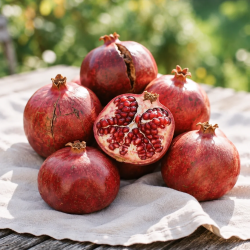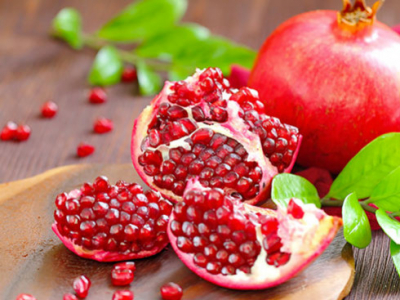





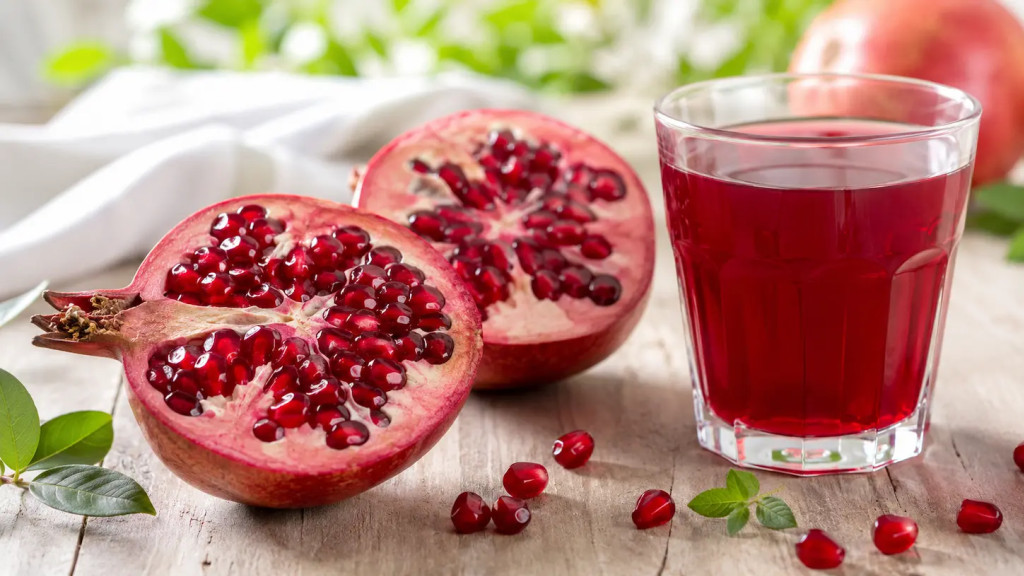

You pick a pomegranate from your garden (I'm lucky enough to have that!), cut it in two, and pour out the juice. That colour, that deep, almost unreal red that stains your fingers and the cutting board - it isn't decoration. It's chemistry you can see. That pigment is the polyphenols, and it's exactly what has made this fruit one of the most studied by researchers for twenty years now.
So, among all the pomegranate juice benefits you read about, which ones actually hold up? The short answer: only one is solidly proven in humans - the effect on blood pressure, backed by several meta-analyses. The others (skin, hormones) are promising but shakier, and I'll tell you honestly where the science stands on each. I'm an agricultural engineer, I've spent thirty-three years looking closely at food, and I'd rather give you an article that's a little less salesy but fair.
So we'll sort it out together: what pomegranate juice does, what it might do, and what it gets wrongly credited for. With the amounts, the best time to drink it, and above all the cautions - because there are real ones. If it's the whole fruit rather than the juice that interests you, I've written a dedicated piece on the 8 benefits of pomegranate.
An antioxidant powerhouse: what's really in the glass
Let's start with the concrete. A glass of 100% pure pomegranate juice is the liquid equivalent of several fruits pressed at once. And what earns it its reputation are two families of compounds: the polyphenols and, above all, a molecule with a slightly barbaric name, punicalagin.
Punicalagin belongs to the ellagitannins. In a study that has become a reference, Seeram and his team showed in 2005 (in the Journal of Nutritional Biochemistry) that on its own it accounts for more than half of the antioxidant activity of whole pomegranate juice. That figure is worth pausing on for a second. More than 50% means most of the work comes from a single type of molecule - the one that concentrates in the rind and the white membranes, not just in the little juicy beads, the arils.
Concretely, what does that change for you? That juice pressed with part of the rind and membranes is richer than juice made from the arils alone. It's also why a "cold-pressed, whole-fruit" juice doesn't have the same profile as a juice reconstituted from concentrate. Living food, once again, is a matter of synergy: it isn't one isolated molecule that acts, but a whole cocktail working together.
A point of honesty, because it comes up all the time: yes, pomegranate juice has a high antioxidant capacity measured in the lab. But an antioxidant score on a bench doesn't tell you what happens once the glass is drunk and digested. That's why we won't stop at the pretty molecules - we're going to look at the trials run on real people.
Heart and blood pressure: the best-proven pomegranate juice benefit
If you only remember one thing, let it be this. On blood pressure, the link between pomegranate juice and your heart rests on the strongest level of evidence, by far. This is where is pomegranate juice good for you gets its clearest "yes".
In 2017, Sahebkar pooled eight controlled clinical trials in Pharmacological Research. The result: among participants who drank pomegranate juice, researchers observed an average drop in systolic pressure of about 4.96 mmHg and in diastolic of about 2.01 mmHg. A more recent meta-analysis, published in 2023 in Phytotherapy Research and gathering fourteen trials on 573 people, points the same way: about 5.02 mmHg less on systolic.
Now, 5 mmHg might sound abstract. Let's translate it. It isn't a spectacular number, but at the scale of a population, a drop of that size sustained over time is the kind of change cardiologists take seriously. What these studies describe is a trend measured in participants followed in an experimental setting - not a promise of results for you personally, and certainly not a substitute for treatment. If you're being treated for high blood pressure, pomegranate juice replaces nothing: it can fit, possibly, within the frame of a varied, balanced diet and a healthy lifestyle.
What about cholesterol?
That's more nuanced. Some trials observed favourable effects on lipid markers and LDL oxidation, others didn't. Let's be clear: the evidence is less consistent than on blood pressure. We're still at "research is exploring", not "it's established". I'd rather tell you.
Circulation
Pomegranate polyphenols are also the subject of work on vessel function - the famous endothelial function, meaning the arteries' ability to dilate properly. The signals are fairly encouraging, but again in modest sample sizes. I'd rather say that than oversell you a "circulation effect" that isn't at the same level of evidence as blood pressure.
Pomegranate juice and skin: antioxidant protection and glow
Let's move to a field a lot of people care about: the pomegranate juice benefits for skin. And here you have to handle your words carefully.
The most interesting study comes from Henning and her team, in 2019. In this controlled trial, people who consumed pomegranate extract or juice showed increased resistance of their skin to the erythema triggered by UVB - in plain terms, the small experimental sunburn took longer to appear. What participants reported falls under internal protection, that famous "shield from within" that dietary antioxidants can support.
More recent work, in vitro this time (2023), observed on cultured cells a boost in collagen and hyaluronic acid production, along with a drop in reactive oxygen species - ROS, the molecules involved in skin ageing. That's promising - but "in vitro" means "in a culture dish", not "on your face". I'll flag it honestly: between a cell in a lab and your real skin, there's a world of difference.
What we can say without overreaching: pomegranate juice provides polyphenols that take part in protecting cells against oxidative stress, within a balanced diet. It's a contribution, not an anti-ageing treatment. No glass will ever replace sleep, water and real sun protection.
Hormones and vitality: what the science (really) says
This is the topic where you read the most nonsense, so we'll be precise. "Pomegranate juice for men", "for women", testosterone, libido… this research is everywhere. What does the literature actually say?
A small 2012 study reported a rise of about 24% in salivary testosterone after regular pomegranate juice intake. The figure is seductive, I get it. But I'm going to do what I always do when a piece of data is too good: I'll qualify it. The sample was small, salivary testosterone is a debatable marker, and other work didn't find the same signal. In other words: interesting, worth watching, but absolutely not proven. Personally, I wouldn't base any decision on it.
On libido and erectile function, the often-cited study (2007) reported an improvement… that didn't reach the threshold of statistical significance (p = 0.058). Plainly: the trend went the right way, but the researchers themselves couldn't conclude. Presenting that as a "proven effect" would be lying.
Here's my position, honestly: pomegranate juice is an excellent antioxidant food, and it doesn't need us inventing hormonal powers for it to deserve its place. The vitality you might feel more likely comes from a diet rich in plants and polyphenols as a whole than from any magic effect on hormones.
How much pomegranate juice per day?
The question that always comes up, and the good news is it has a simple answer. In most of the blood-pressure studies, the amounts were around 150 to 250 ml a day - a glass, not a jug. All the benefits of drinking pomegranate juice were measured at that modest dose.
The best time? Morning works very well: on an empty stomach or at breakfast, your body takes in the polyphenols without the competition of a big meal. But honestly, the "best time" is mostly the one you'll keep up over time. Consistency matters more than the clock.
Three markers to make it useful rather than a gimmick:
- One glass a day is enough. Beyond that, you're mostly adding sugars (more on that in the cautions).
- A three-week run is a reasonable format to give the polyphenols time to settle in, before taking a break.
- Choose a 100% pure juice with no added sugar. "Pomegranate nectar" at 25% fruit and sweetened is another thing entirely - a soda in disguise.
Thirty seconds in the morning, one glass, and it's done. No need to turn it into a complicated ritual: start small, change nothing else the first week, and see how your taste adjusts. Pure pomegranate juice is quite tannic at first.
Making pomegranate juice at home: juicer or centrifuge?
Here I'll talk about what I know best: making your own juice. Because a juice pressed at home is a juice whose every ingredient you know.
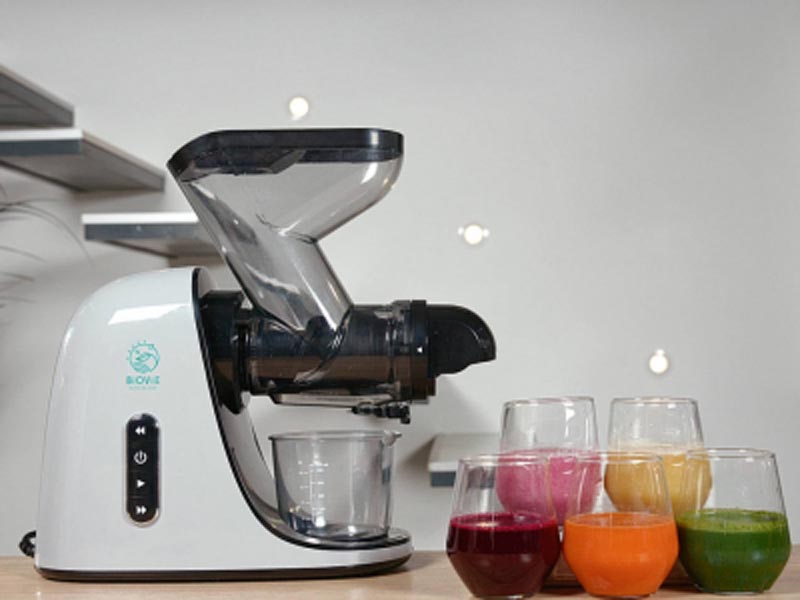
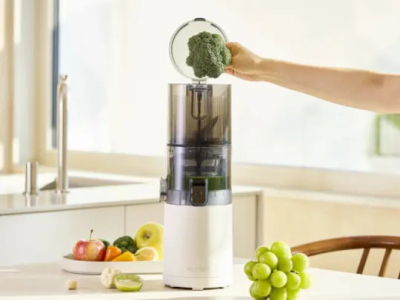
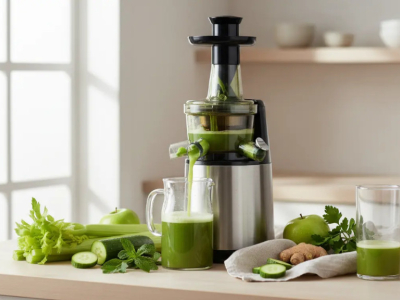
For pomegranate, the slow-turning masticating juicer has a real edge over the centrifugal one: it turns slowly, heats less, and better preserves the fragile compounds. The centrifuge is faster but oxidises more. If you juice regularly, the masticating juicer is the investment that changes everything - and not just for pomegranate: citrus, leafy greens, it all goes through. To understand the difference in detail, I compared the two in an article on the centrifuge versus the masticating juicer, and if you're unsure which model to pick, my 2026 best juicer guide reviews them all.
If you want to test for three weeks what a truly fresh juice changes in your morning routine, this is the one we use at home: Biovie's Juice Me Up masticating juicer, designed for daily use and easy to clean.