How to Tell if a Pomegranate Is Ripe, Pick a Good One and Store It
Skin still cream, arils pale pink, yet a sweet taste: how to tell if a pomegranate is ripe in that case? Trust the weight and a firm skin with no soft spot or split, because color depends on the variety and the fruit does not ripen after picking. At Biovie, we import organic pomegranates from Spain, and this page draws on five verifiable sources, including the specification of a Spanish designation of origin.
On October 20, a customer wrote to us after receiving their 4 kg box of organic pomegranates from Spain. Skin that had stayed white, arils mixing pink and white, and yet a sweet taste. Their question fit on one line: is this normal?
Yes. And most of the time it is a matter of variety, not of ripeness.
I admit this kind of message makes me happy. I founded Biovie in 2007, I trained as an ISTOM engineer, and from being immersed in these subjects I sometimes forget the basic questions, even though they are the most valuable ones to understand: those of someone holding the fruit in their hand and wondering whether they got a fair deal. So here is how to tell if a pomegranate is ripe, how to pick one and how to keep it in good shape.
How to tell if a pomegranate is ripe when it isn't red?
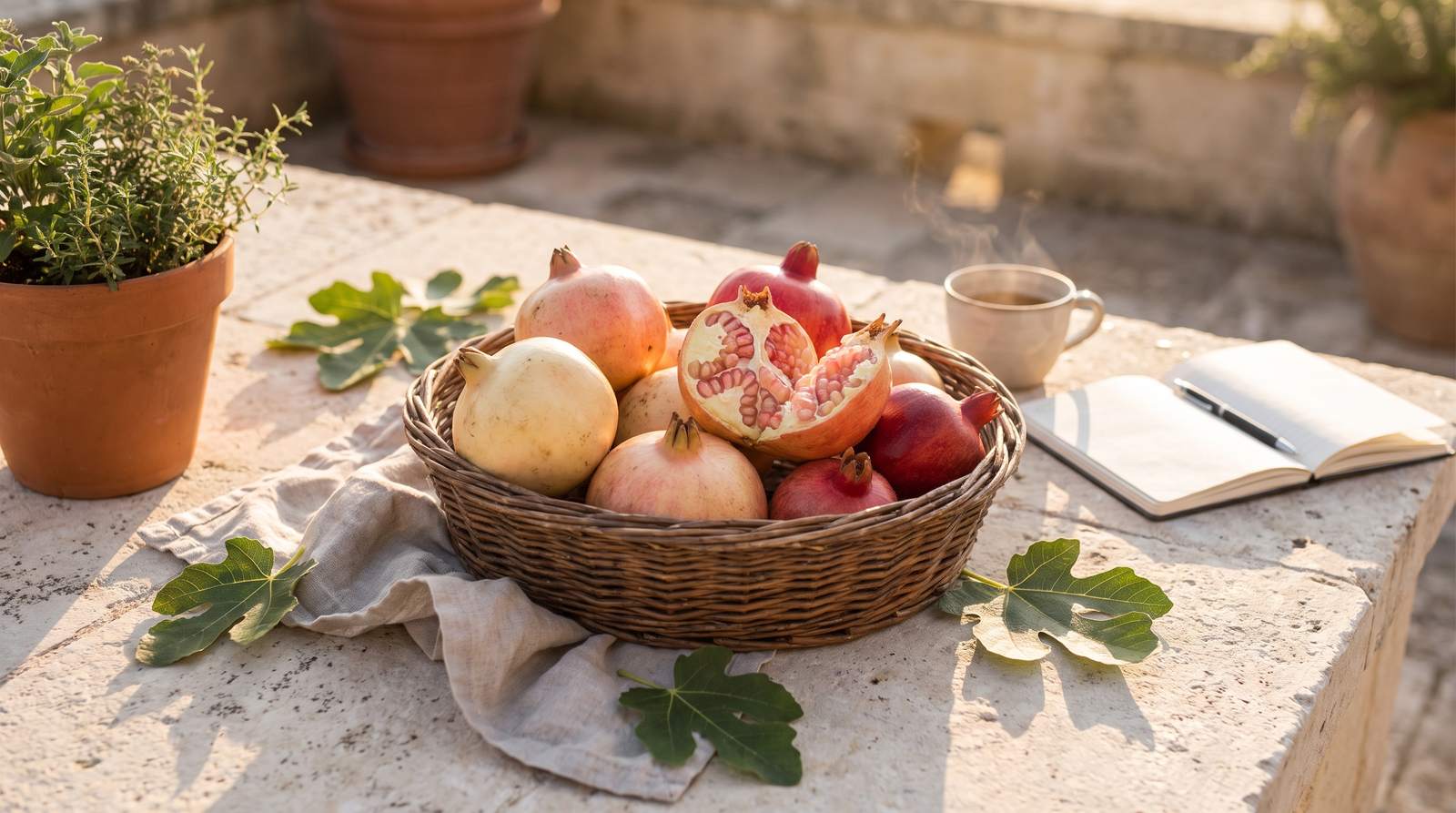
A pomegranate is ripe when it is heavy for its size and its skin is firm, with no soft spot or split. Color, on the other hand, varies from one variety to another, and the fruit does not ripen once picked: it is harvested ripe. We have been trained so well to judge a fruit by its color that a pale pomegranate looks like a mistake. I understand the reflex, the eye buys before the hand does. But here, it is a false lead.
What skin color does (and doesn't) tell you
Take the Mollar de Elche, a Spanish variety protected by a designation of origin, the Granada Mollar de Elche PDO, registered by the European Commission in 2016. The official sheet from ICEX, which sums up its specification, is unambiguous: skin from cream to dark red, arils from dark pink to red. Cream-colored skin therefore falls within the norm for this designation.
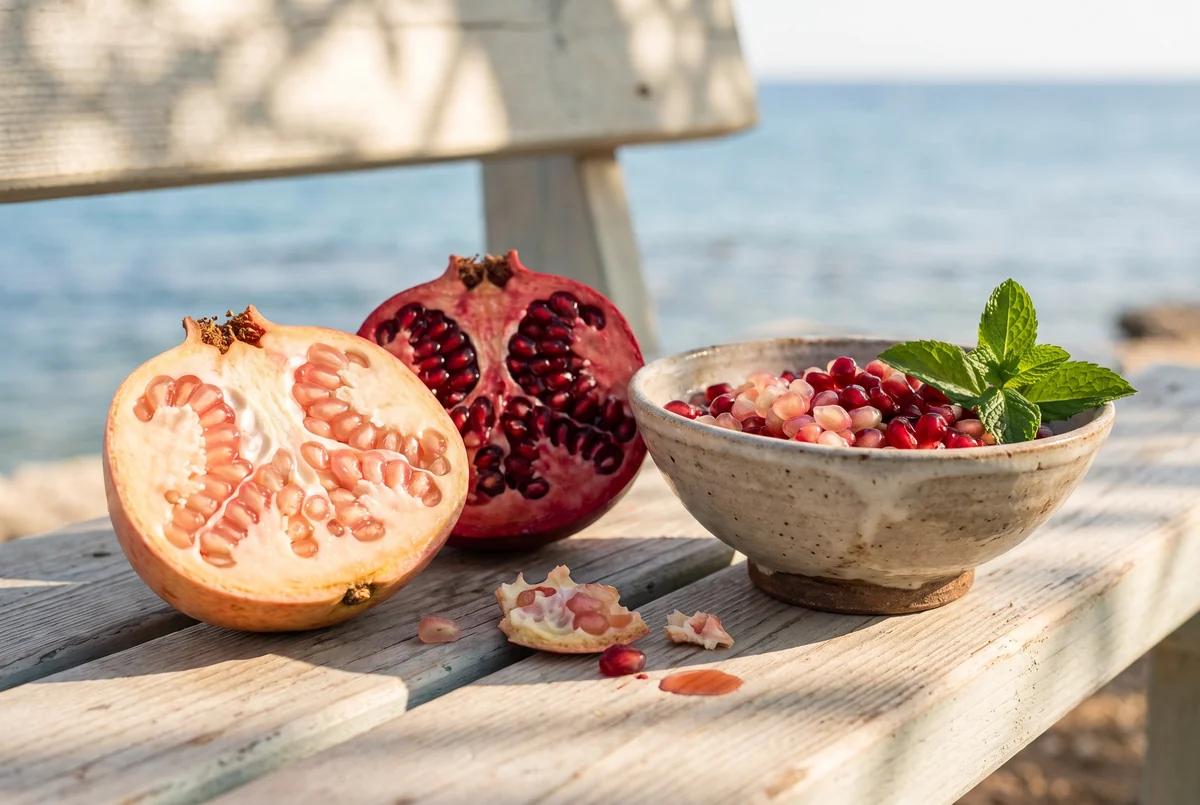
And this paleness has a very simple explanation. The Mollar de Elche contains few anthocyanins, the pigments that turn arils red: its arils therefore stay pale on a fruit that is nevertheless ripe (Serrano and Valero, 2022). This lack of color penalizes it for export, even though it is appreciated for its high sugar, low acidity and tender seeds. Penalized because it isn't red enough, in short. I find that a pity.
It is in any case the spitting image of our customer's pomegranates, which I therefore call here, since I can't state it more firmly than that, Spanish pomegranates of the Mollar type.
What the arils and the taste tell you
The PDO specification sets figures, which the ICEX sheet sums up: at least 14 °Brix, an acidity of 0.18 to 0.24% citric acid and a maturity index of 60 to 90. Put like that, it's a bit dry. Let's translate.
°Brix measures the sugars dissolved in the juice, roughly in grams of sugar per 100 g of juice. At 14 °Brix, about one seventh of the weight of the juice is sugars from the fruit. Acidity, for its part, stays under a quarter of a gram per 100 g. And the maturity index simply divides one by the other.
Picture a two-pan balance, sugar on one side, acid on the other: with an index of 60 to 90, the sugar pan touches the table and the acid pan hangs in the air. That is why a pale pomegranate can taste really sweet. Sugars from the whole fruit, to enjoy as part of a varied and balanced diet and a healthy lifestyle.
Why there's no point waiting for a pomegranate to turn red
So, should you leave a pale pomegranate in the fruit bowl for a few days while it colors up? No. A banana or an avocado, yes: you buy them firm, forget them in the bowl, and both their texture and their taste change. These are so-called climacteric fruits.
The pomegranate isn't part of the club. Storage trials run at the University of California, Davis established it: it is a low-respiration, non-climacteric fruit (Elyatem and Kader, 1984). A pomegranate is picked ripe, and it is on the tree that its taste is decided.
A picked pomegranate is a bit like an account whose deposit window has been closed: nothing goes in anymore, there are only withdrawals. With time, the fruit mainly loses water and acidity; it gains neither sugar nor color (Pareek et al., 2015; Serrano and Valero, 2022). A pale pomegranate will therefore not turn red at your place, and it will not become any sweeter.
Understanding this point already answers half of the question "how to tell if a pomegranate is ripe": everything is read in the fruit as it is, not in what it will become. If it is pale and sweet, enjoy it as it is; if it is sour, waiting won't change a thing.
How to pick a pomegranate at the store: 5 checkpoints
To know how to pick a pomegranate well, first forget about color and take the fruit in your hand. Weigh it. A good pomegranate is heavy for its size, because a heavy fruit is a fruit that has kept its water. Here are my five checkpoints, backed by sources.
Checkpoint
Good sign
Warning sign
Why
Weight
Heavy for its size
Light, hard and dry rind
Water loss hardens the rind and browns the skin and arils (Pareek et al., 2015)
Skin
Firm, smooth or a little rough
Soft or brown areas
Chilling injury after long storage at 5 °C or lower (Elyatem and Kader, 1984), or the start of rot (Pareek et al., 2015)
Splits
None
Open split
Splitting is a known disorder of the fruit: eat it quickly
Size
125 g or more
Very small fruit
The Spanish PDO excludes fruit under 125 g, barely the hollow of a hand: a size grade, not a taste indicator (ICEX)
Color
From cream to dark red depending on the variety
Judging by it alone
It depends first on the variety (Serrano and Valero, 2022; ICEX)
If you are looking for how to pick a pomegranate that is sweet, the answer comes down first to the variety: a low-acid pomegranate of the Mollar type, nicely heavy and firm, will be sweet even when pale. Knowing how to pick a ripe pomegranate comes down, in the end, to trusting your hands rather than your eyes.
And then there are the tips that go around as soon as you look up how to pick a good pomegranate: tapping the fruit to hear a "metallic" sound, checking that the calyx is open and dry. None of the sources we consulted backs them up, and I wouldn't take them for rules.
These checkpoints hold at any market stall, and just as well for a box like our 4 kg of organic pomegranates from Spain: when it arrives, weigh, feel, then taste an aril. Taste remains the final judge, the one who decides when color hesitates.
Next comes opening it, and that is often where you end up, as the saying goes, like a deer in the headlights. No panic, and no need to repaint the kitchen pink. You cut off the cap, on the crown side, then score the rind along the white partitions you can make out under the skin, without pushing the blade down to the arils. The segments then come apart almost by themselves.
Then pop the arils out over a bowl, or even straight into a bowl of water: the arils sink to the bottom and the little white membranes float to the surface. A pass with a skimmer, and it's done. The gesture that changes everything is to follow the partitions instead of slicing the fruit at random. For an express method with a knife and a wooden spoon, see our article on how to peel a pomegranate in under 30 seconds.
Storing your pomegranates and their arils
Whole pomegranates
To store whole pomegranates, cool is the rule. The Spanish specification sets storage for the sector between 4 and 8 °C (ICEX), which is roughly the range of a household refrigerator. As an importer, I know what temperature slips cost: we once received inedible coconuts, because the cooling unit of their container had broken down at sea. With the pomegranate, the trap is rather the opposite. Prolonged storage at 5 °C or lower causes chilling injury, with skin that browns, all the more marked as the duration lengthens (Elyatem and Kader, 1984).
The two figures don't contradict each other, rest assured. The lower end of the range suits short periods; the risk comes from long stays under 5 °C. As for dry air, it dries out the fruit and hardens its rind (Pareek et al., 2015).
The vegetable drawer and regular eating remain the best combination at home.
Loose arils: the vacuum jar
Once removed, the arils no longer have a rind to protect them. I advise keeping them in a closed glass jar, in the refrigerator, and under vacuum with the BocUp kit.
The principle is low tech, and that is what I like about it: a bell that caps the jar, a small hand pump, no electricity and no plastic bag. It works with the glass jars you already have, if they have "shoulders" and a 65 or 84 mm lid: nothing else to buy, just reuse. According to the manufacturer, fresh foods keep up to 5 times longer this way, for example a vegetable soup 8 to 10 days instead of 2. In other words, Monday's soup lasts until the middle of the following week.
One reminder all the same: vacuum replaces neither the fridge nor the freezer, and it does not sterilize. The jar stays in the cool. To go further, here are the advantages of vacuum sealing at home, explained step by step.
What do you eat in a pomegranate?
You eat the arils, those little juicy pearls, seed included. The seed is crunched along with the aril, and in the Mollar de Elche it is tender (Serrano and Valero, 2022). Eaten plain, sprinkled over a salad, the arils are best enjoyed as part of a varied and balanced diet and a healthy lifestyle.
The rind and the white partitions, on the other hand, are not eaten as they are. Off to the compost.
For juice, an extractor does the job very well, and if you are unsure which model to get, our criteria for choosing a juice extractor will help you decide.
As for the season and what the pomegranate brings to the plate, I covered them separately, in the article on the pomegranate, its benefits and its season. In short, trust your eyes a little less. The next time you wonder how to tell if a pomegranate is ripe, weigh it and taste an aril: color comes second. And if your pomegranate raises another question, write to me!
Enjoy a refreshing and nutritious coconut water thanks to these Thai organic green coconuts, proposed with its machete and STAINLESS STEEL straws, 16
products
Can a pomegranate with white or yellow skin be ripe?
Yes, a pomegranate with white or pale yellow skin can be perfectly ripe. In the Spanish variety Mollar de Elche, the skin ranges from cream to dark red, and the fruit contains few anthocyanins, the red pigments. Rely instead on weight, firm skin with no soft spot, and taste.
How to pick a sweet pomegranate?
To pick a sweet pomegranate, go for a low-acid variety, such as the Mollar de Elche, and for a heavy, firm fruit. A figure to go by: the specification of the Spanish PDO requires at least 14 °Brix and a maturity index of 60 to 90, meaning plenty of sugar for very little acid.
What can you eat in a pomegranate?
You eat the arils, those little juicy pearls that surround each seed, and the seed too. The rind and the white partitions are not eaten as they are. The arils can be enjoyed plain or as juice, as part of a varied and balanced diet and a healthy lifestyle.
Can you eat pomegranate seeds?
Yes, pomegranate seeds are eaten along with the aril that surrounds them, with nothing to remove. Their texture depends on the variety: in the Mollar de Elche, a Spanish variety appreciated for its low acidity, the seeds are tender. Crunching the seed is part of the pleasure of a pomegranate.
How to store pomegranates?
Store whole pomegranates in the cool: the Spanish specification provides for 4 to 8 °C, but a long stay at 5 °C or lower browns the skin. Also avoid dry air, which dries out the fruit. Loose arils keep in a closed jar in the refrigerator, ideally under vacuum with the BocUp, which does not replace cold.
Is a pomegranate a fruit?
Yes, the pomegranate is the fruit of the pomegranate tree, Punica granatum. What we eat are its arils, the little juicy pearls that wrap each seed, arranged in separate chambers divided by white partitions. The Spanish variety Mollar de Elche is one example, protected by a designation of origin in Europe.
The information in this article is provided for informational purposes only and does not constitute medical advice. Consult a health professional before making any change to your diet or supplementation.