Supplements, gels, videos: sea moss is everywhere, and yet the real sea moss benefits come down first to what it is, an edible red seaweed (Chondrus crispus) that contains minerals, gels naturally thanks to carrageenan and supplies iodine in very variable amounts, with no health effect demonstrated in humans. What follows, our reference guide at Biovie, draws on ANSES, EFSA, the USDA and two scientific publications.
Type “sea moss” into a search engine and it is a parade: jars of sand-coloured gel, videos shot in spotless kitchens, promises that range from the thyroid to the skin. And the sources? Still looking for them.
Seaweed is part of my daily life. So let's sort this out calmly: what we really know about irish moss, what we don't know, and how to use it without cooking it.
Irish moss, sea moss: which seaweed are we talking about?
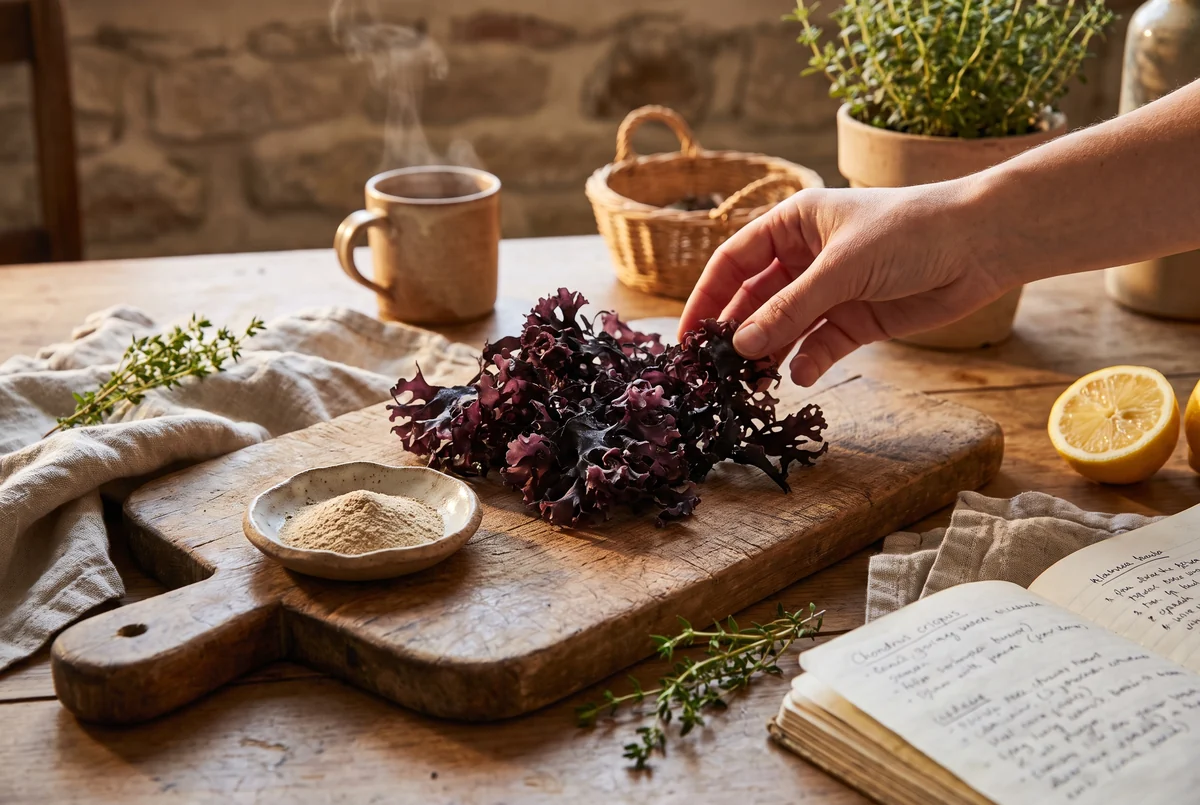
Irish moss, called mousse d'Irlande in French, is an edible red seaweed, Chondrus crispus, that grows on the rocky coasts of the North Atlantic. Nothing new under the sun, by the way: long before sea moss became a trend, people in Ireland were already eating it, and its domestic use is documented since at least 1809 (Collén et al., 2014). It is also the historical source of carrageenan, the natural gelling agent we will come back to further down.
Neither a moss, nor necessarily Irish
The name is misleading twice over. “Moss” is only a common name: this is not a land plant, still less the garden plant sold under the same name (so no point looking for it at the garden centre). As for “irish”, it points to the species and says nothing about where it was harvested. Only the label will tell you.
Your reliable landmark is the Latin name: Chondrus crispus, written in full on the pack.
Irish moss vs sea moss
In everyday use, sea moss and irish moss often mean the same seaweed, and here again it is the Latin name that settles it. It takes a few seconds to check, as long as you remember to look for it. Ignorance is a choice, and on this point, it is a choice that nobody has to make.
What does irish moss contain? What the tables say
To talk about sea moss benefits without embroidering, you have to start with what is inside. It seems obvious, and yet it is the step that gets skipped most often. The most solid reference remains the USDA table, from the US Department of Agriculture, drawn up on raw seaweed, still full of water.
| Component | Family | Per 100 g of raw seaweed |
|---|---|---|
| Water | Constituent | 81.3 g |
| Energy | Energy | 49 kcal |
| Protein | Macronutrient | 1.51 g |
| Carbohydrates | Macronutrient | 12.3 g |
| Fiber | Carbohydrates | 1.3 g |
| Calcium | Mineral | 72 mg |
| Iron | Mineral | 8.90 mg |
| Magnesium | Mineral | 144 mg |
| Potassium | Mineral | 63 mg |
| Sodium | Mineral | 67 mg |
| Zinc | Mineral | 1.95 mg |
| Folate (vitamin B9) | Vitamin | 182 µg |
These values are for fresh seaweed: the powder, dehydrated, is more concentrated and varies from batch to batch, so these figures cannot be applied to it as they stand. And honestly, nobody eats 100 g of seaweed in one go. In the kitchen you use a few grams, a bit like dosing a spice, and the 8.90 mg of iron in the table shrink accordingly on the plate.
A table gives a composition, not an effect.
You may also come across the “92 of 102 nutrients” line, repeated from site to site as if it were self-evident. Follow the trail and you will find nothing. No identifiable source stands behind it, neither an official table nor a study. A phrase that circulates a lot does not become true for that: I stick to what has been measured.
Carrageenan: why irish moss gels
How can a seaweed you measure out with a spoon set a whole cream? Try it: pour the powder into hot water, wait a few minutes, and the irish moss gel sets before your eyes. The first time, it feels a bit like a magic trick.
There is nothing magic about it, though. The one responsible is carrageenan. It is a set of long chains of sugars (sulfated galactose) lodged in the cell wall of the seaweed. In hot water, these chains unfold like a tangle being undone; as it cools, they hook onto each other and weave a network. Think of a fisherman's net dropped in a bucket: the water no longer runs away, it stays caught in the mesh.
A small detour through history, because it sheds light on what follows. Chondrus crispus is the original source of carrageenan (EFSA, 2018; Collén et al., 2014), even if the food additive E 407 now comes mostly from other seaweeds, of the genus Eucheuma. So two things need to be told apart, and they are too often confused: on one side the whole seaweed powder, which is a food; on the other the extracted and purified carrageenan, which is an additive, a long way from the carrageenan left in the seaweed.
In 2018, EFSA re-evaluated this additive and maintained a group acceptable daily intake of 75 mg per kilo of body weight per day, considered temporary for lack of sufficient data. This opinion concerns the extracted additive; the whole seaweed, eaten as a powder, is not assessed in it. It is a limit designed for an isolated ingredient, the kind found in processed foods, not for a whole seaweed that you crumble into a dessert.
Sea moss benefits: what we can honestly say
One caveat, just one, but a clear one. The online promises about the thyroid, immunity, slimming or skin are not backed by solid human trials. So I will not repeat them here, even though they would probably sell more bags.
Does that mean the seaweed has nothing to offer? Quite the opposite. It is first of all a sea food that contains minerals, magnesium, iron, calcium and zinc at the top, in the amounts measured by the USDA on raw seaweed. It is also a plant-based gelling agent that replaces animal gelatin in desserts, and being vegan since 1992, you can imagine I care about that. Finally, in raw cooking, the sea moss gel benefits show up as a hold that is hard to get otherwise: a cream that stands on the spoon, without going near a saucepan.
What bothers me in the sea moss craze is the backlash waiting around the corner. When a jar of gel promises to fix everything, it is the seaweed that ends up with a bad reputation it does not deserve. I prefer to see the irish sea moss benefits, those of Chondrus crispus, as those of an ingredient that enriches the plate, no more, no less. As part of a varied and balanced diet and a healthy lifestyle, irish moss finds its place among other foods: you add it, you replace nothing.
Irish moss and iodine: the real question is quantity
Let's get to iodine, the only really serious subject when it comes to sea moss benefits and side effects. Dried, seaweeds are on average the foods most concentrated in iodine, and their content varies strongly from one species to another, and even from one batch to another (ANSES, 2018). Should we worry?
A team of researchers analysed 30 commercial samples of two red seaweeds, including irish moss (Darias-Rosales et al., 2020). Irish moss showed the highest average content there, 3.86 ± 1.49 mg of iodine per kilo of dry matter. With these values, you would need to eat about 286 g a day to exceed the limit of 1,100 µg per day used by the authors. In other words, a big bowl of dry seaweed every day, a very long way from the teaspoon in a recipe.
This reassuring figure still calls for a clarification, and it matters. The authors use 1,100 µg per day, whereas ANSES relies on the limit set by EFSA for adults, which is 600 µg per day. I don't like it when the most convenient limit is the one that gets picked. So I redid the calculation with that limit and the average content from the study: it comes to about 155 g of dry powder per day. That is more than half of a 250 g bag, every day, or dozens of teaspoons. Nobody cooks like that.
Other batches can be much higher in iodine. These figures only hold for the samples analysed, and that is precisely why ANSES wants the iodine content to be shown on labels. I can only agree with it.
ANSES also advises against seaweed, without medical advice:
- in case of thyroid dysfunction;
- for people with heart disease or kidney failure;
- for those taking medication containing iodine or lithium;
- for pregnant or breastfeeding women.
It also calls for caution regarding children. And seaweed is not meant to correct an iodine deficiency: that is simply not its role. For everyone else, as part of a varied and balanced diet and a healthy lifestyle, a teaspoon of irish moss in a recipe stays very far from these quantities.
How to make sea moss gel and use irish moss powder without cooking it
At Biovie, we avoid cooking seaweed, and irish moss is no exception. Good news, its powder doesn't need it: hot water, without boiling, is enough to unfold the carrageenan chains. No saucepan, no flame, no burnt bottom.
Here are the three uses described on our product page:
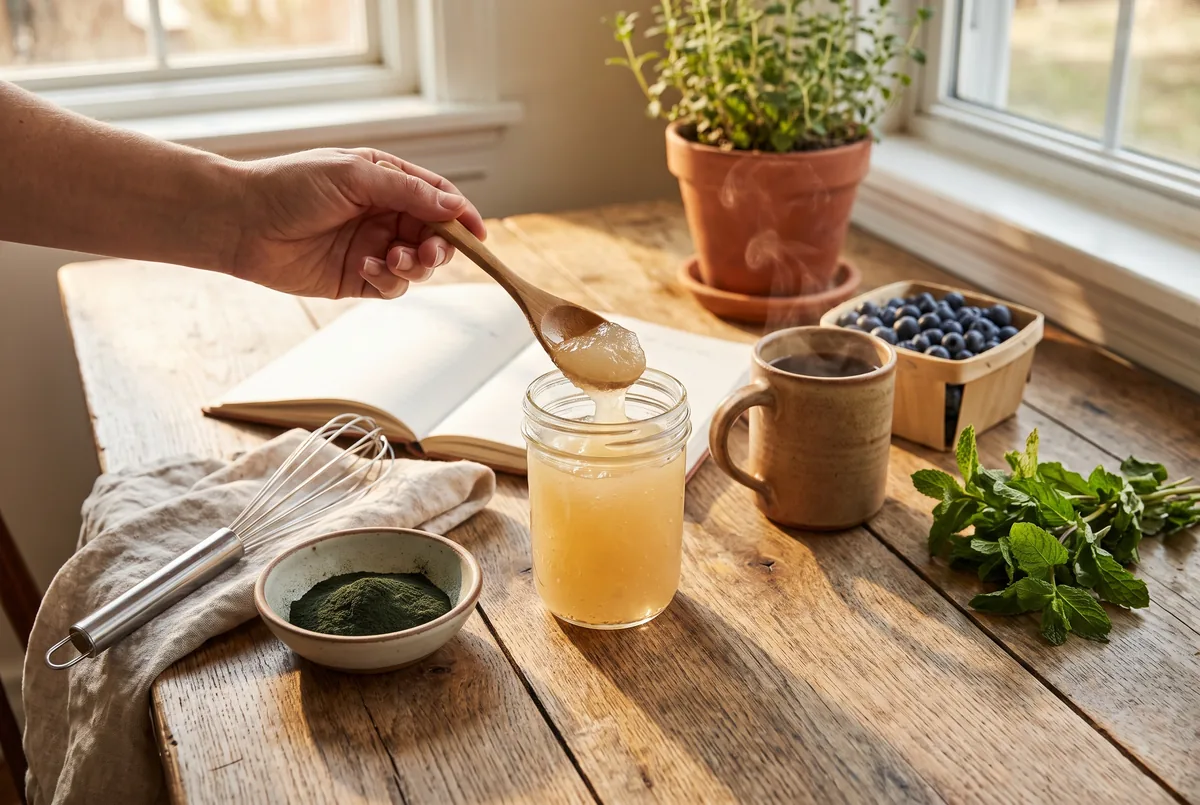
- For a gel, 1 teaspoon (2 to 3 g) of powder in 50 to 70 ml of hot but not boiling water: whisk or blend, then leave to thicken for 5 to 10 minutes.
- For a raw dessert, 5 to 10 g soaked in a cup of water for 1 to 3 days in the refrigerator, then drained, topped up with fresh water and blended.
- In a soup, off the heat: about 1 teaspoon per litre.
If you are wondering how to make sea moss gel for the first time, start with the gel. A bowl, a spoon, water from the kettle switched off just before it boils, and that's it. No special equipment, no chef's technique.
Storing the powder and the gel
The powder dislikes humidity and light: keep it tightly closed, in a cool cupboard. I don't say that out of principle. I once saw, in an organic shop, a bulk spirulina counter that had turned blue-green across the whole part exposed to light. A picture worth any speech. The gel keeps 3 to 4 days in the refrigerator, in an airtight jar, according to our product page.
That leaves the opened bag, which you reopen and close again recipe after recipe, and which picks up a little of the kitchen's humidity each time. The BocUp kit solves the problem with a simple bell and a small hand pump, with no electricity and not a single plastic bag: low tech the way I like it. It works with the glass jars you already have, if they have “shoulders” and a lid of 65 or 84 mm, with nothing else to buy. The powder stays protected from humidity and from pantry moths.
According to the manufacturer, fresh foods keep up to 5 times longer under vacuum: a vegetable soup, for example, goes from 2 days to 8 to 10 days. Vacuum replaces neither the fridge nor the freezer, and it does not sterilise: your gel therefore stays in the refrigerator. I talk about it at more length in an article on the advantages of vacuum sealing at home.
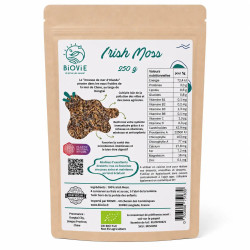
Here is the irish moss powder we offer.