


Here, fresh pasta makes way for thin slices of beetroot, softened in a lemon and olive oil marinade until pliable while keeping a slight crunch. Between two slices sits a plant-based pine nut cheese, lifted with shallot, chives and lemon zest. A drizzle of basil pesto oil finishes the plate. Cut into hearts, these ravioli make a very elegant starter for a festive meal or a dinner for two.
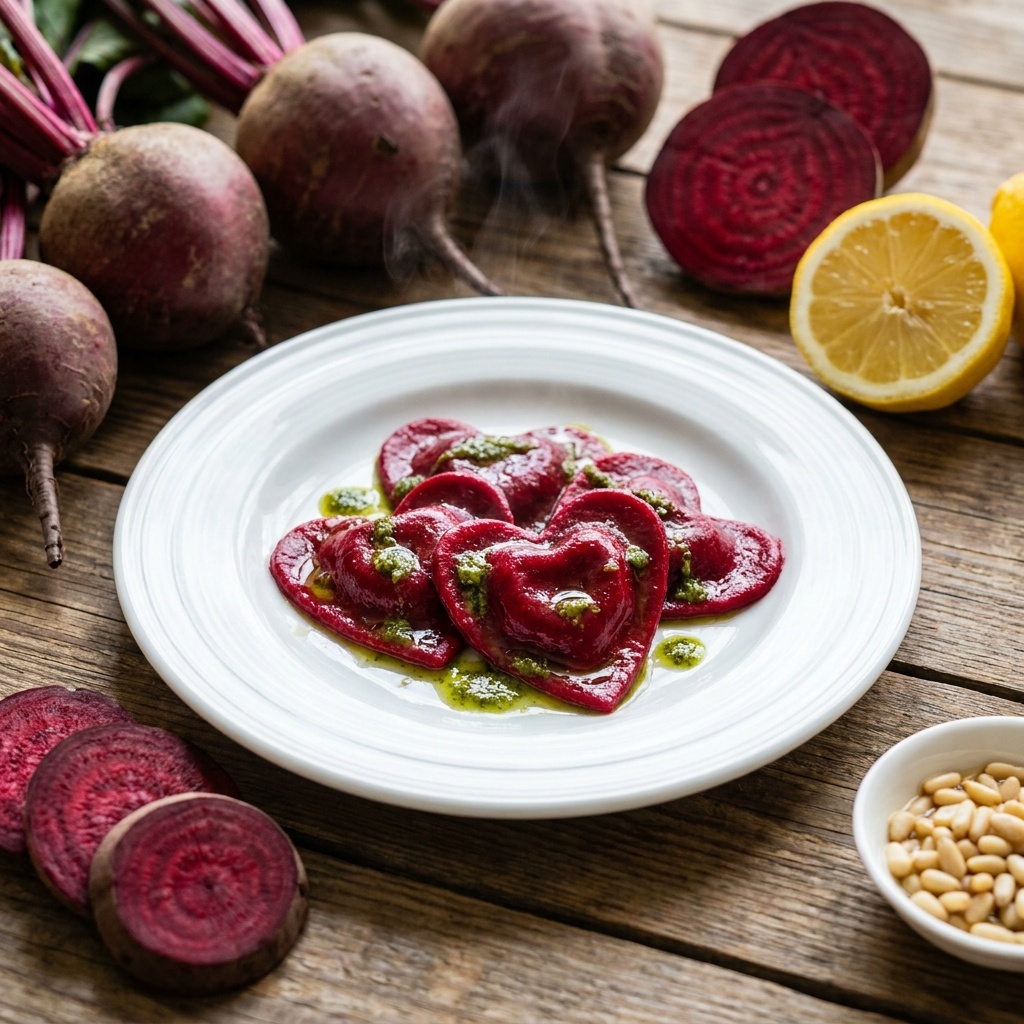
Raw beetroot ravioli with pine nut cheese and pesto oil

Share this article
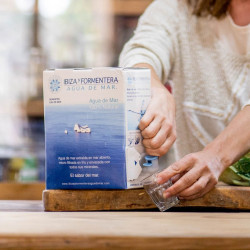
3L Microfiltered seawater
€13.90
Ingredients
Ravioli
- 3 to 4 large raw beetroots (red, golden or chioggia)
- the juice of 1/2 lemon
- 1 1/2 tablespoons extra virgin olive oil
- 1 pinch of sea salt (or the equivalent of 1 tablespoon - 15 ml - of seawater)
Pine nut cheese
- 150 g pine nuts, soaked for 2 hours
- 1 tablespoon finely chopped shallot
- 2 tablespoons snipped chives
- 2 teaspoons nutritional yeast flakes
- the zest of 1 unwaxed lemon
- 2 tablespoons lemon juice
- 1 tablespoon extra virgin olive oil
- 1 pinch of smoked salt, or sea salt (or the equivalent of 1 tablespoon - 15 ml - of seawater)
Pesto oil
- 1 large garlic clove
- 3 tablespoons snipped chives
- 20 g basil leaves
- 2 tablespoons lemon juice
- 3 tablespoons extra virgin olive oil
- 2 tablespoons filtered water
- 1/2 teaspoon honey
- 1 pinch of sea salt (or the equivalent of 1 tablespoon - 15 ml - of seawater)
Method
- Peel the beetroots and slice them very thinly with a mandoline.
- Cut the slices into hearts with a cookie cutter, or stack them and trim the edges to make squares.
- In a large bowl, whisk the lemon juice, olive oil and salt. Add the slices, toss to coat them well and leave to marinate for 1 to 2 hours.
- Blend all the pine nut cheese ingredients in a food processor until you have a thick, slightly grainy paste, similar to a fresh goat's cheese.
- Blend the pesto oil ingredients until you have a smooth, runny green oil.
- Place a teaspoon of cheese on a beetroot slice, cover with a second slice and press the edges lightly. Repeat with the rest.
- Arrange on a bed of baby leaves or rocket, drizzle with pesto oil, sprinkle with chives and serve straight away.
Tip
Alternate red, golden and chioggia beetroots for a very graphic dish, but marinate the red ones separately: they stain everything they touch. The pine nut cheese can be made the day before and even gains in flavour after a night in the fridge.
The full range Marine Plasma
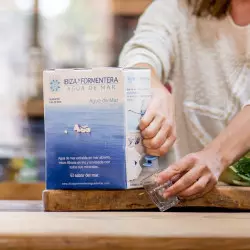
What is marine plasma ? So-called hypertonic marine plasma is simply seawater harvested and filtered under very specific conditions. Our supplier Ibiza Agua de Mar collects sea water from a depth of 25 meters off the coast of Ibiza in a UNESCO listed area. Concerning the harvest, here are the different physico-chemical parameters measured during the search for an optimal place for the harvest of hypertonic marine plasma, first on the radar with reading of the currents and according to the marine weather (wind, swell, rain. ..) and then by local measurement of these different parameters: taste of seawater, dissolved O2 level, PH level, redox level (ORP), salinity level (TDS), conductivity level ( PSU), alkalimetric title (TA), Pressure. It is the empirical practice of the harvesters and the reading of the various measuring instruments that makes it possible to decide on the best complex combination of these measures together to decide whether the harvest is triggered on the site or whether another location is sought. Where does marine plasma come from ? The marine plasma is collected in the high seas, off the coast of Ibiza, in a specific area classified as UNESCO with high planktonic activity and with a presence of tens of square kilometers of Posidonia. It is indeed in this specific area that lives the largest living organism listed on Earth, a posidonia herbarium of 80,000 to 200,000 years extending over 15 kilometers in length. Source: Sophie Arnaud-Haond, Carlos M. Duarte, Elena Diaz-Almela, Núria Marbà, Tomas Sintes, Ester A. Serrão: Implications of Extreme Life Span in Clonal Organisms: Millenary Clones in Meadows of the Threatened Seagrass Posidonia oceanica When is it best to take marine plasma ? The ideal is to consume marine plasma, which contains, let's remember, all the elements that make up Mendeleev's periodic table, in the morning when you get up, on an empty stomach. take 1/4 of hypertonic marine plasma to mix 3/4 of spring water or filtered water. What are the benefits of marine plasma ? Minerals are the "fuel" used primarily by our body, which is necessary for our cells to perform their functions optimally. They are also essential for the absorption of vitamins and are responsible for enzymatic processes in cells. Cells perform all their functions with maximum vitality and the precise capacity for organic, bioavailable, alkaline cellular nutrition. Thus, sea water becomes the best mineral drink since it contains all the elements of Mendeleev's periodic table. Another of the great benefits of seawater is its pH. As Otto Warbürg, father of cellular respiration and two-time Nobel laureate, said, “all diseases are acidic and where there is oxygen and alkalinity there can be no disease”. Due to the quality of our raw material, the hyper-oxygenated waters of Posidonia meadows (recognized by UNESCO as a World Heritage Site in 1999) and sea currents providing purity and clarity: Ibiza and Formentera Agua de Mar have an alkaline pH , between 8.1 and 8.4, which will help the body maintain a neutral pH through homeostasis. The ingestion of sea water is advised to control and maintain our PH, as well as an exceptional supplement for alkaline diets. The antioxidant and anti-acidity power produced by seawater is due to the alkalinity provided by the minerals. Drinking filtered seawater in a direct and controlled way is very beneficial for your health, because seawater is an excellent nutrient, containing most of the minerals of the periodic table and all of them dissolved in the best universal solvent available: l 'water. Seawater contains all the minerals of the periodic table of elements in a bioavailable way. It is thanks to this that foods cooked in seawater are rehydrated and remineralized to make foods with high nutritional power. The problem today is that our intake of minerals through food has dropped dramatically and what is causing this? The answer is very simple: pollution, soil depletion due to intensive agricultural production and our stressful pace of life have considerably reduced the quality of food and its mineral intake, drastically reducing the minimum contribution necessary for the proper functioning of the body. Seawater also helps us stay young, for a simple reason: the body regularly and cyclically regenerates all its cells, because their lifespan is limited in time. As we age, one of the first faculties the cell loses is the ability to hydrate. We know that the older we get, the less we drink, so drinking and ingesting seawater can help us "wake up" this ability to hydrate ourselves., 4 products
Discover the full range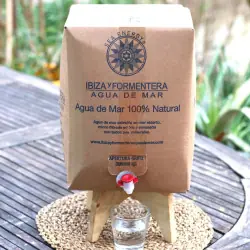

FAQ: your questions about raw beetroot ravioli
How do you prepare raw red beetroot?
Wash it, peel it with a vegetable peeler, then grate it or slice it very thinly with a mandoline. A marinade of lemon juice, olive oil and salt softens it in one to two hours, as with these ravioli. Wear gloves or work on a board you do not mind staining: its juice colours everything.
What is the difference between cooked and raw beetroot?
Raw beetroot is firm and crunchy, with a fresh, slightly earthy taste. Cooked, it becomes tender, sweeter and darker in colour. Raw, it lends itself to grated salads, carpaccios and marinated ravioli like these; you just need to slice it very thinly so that it is pleasant to eat.
What can you eat pine nuts with?
They are scattered over salads, find their way into pesto and stuffings, and can be blended into a cream or a plant-based cheese, as in this recipe where, soaked and then blended with lemon and herbs, they take on a texture close to fresh goat's cheese. Their mild, resinous flavour pairs well with basil, citrus fruit and root vegetables.
Which tree do pine nuts come from?
The pine nuts found in Europe come mainly from the stone pine, also called the umbrella pine, typical of the Mediterranean region. The seeds are hidden inside the pine cones, which take about three years to ripen, and then have to be extracted and shelled. Other pine species, notably in Asia, also produce smaller pine nuts.
Share this article