Is Nasturtium Edible? Flowers, Leaves and Seeds, What You Can Eat and How to Grow It
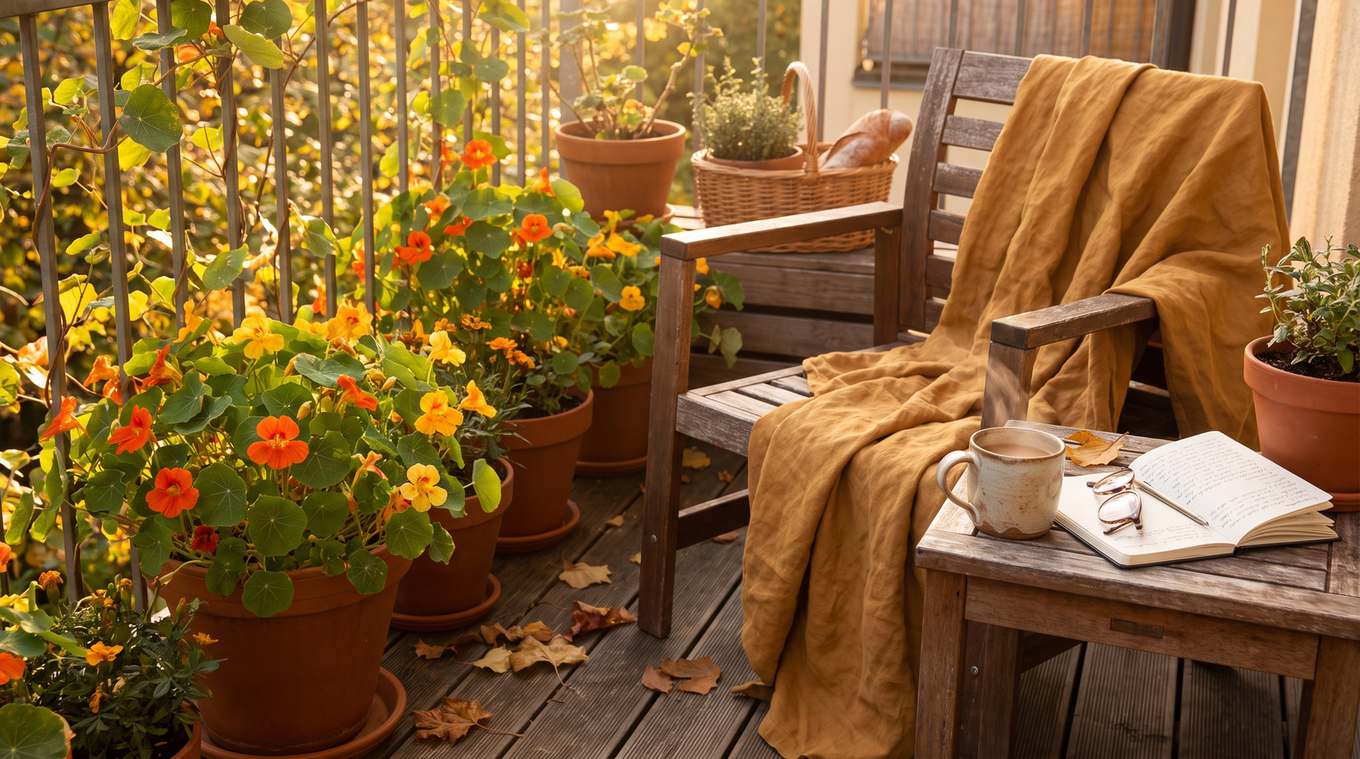
In October, nasturtiums are still spilling over the balcony. Is nasturtium edible? Almost entirely: the garden nasturtium, Tropaeolum majus, offers its flowers, leaves, buds and green seeds, to be eaten raw and fresh. Only one condition really matters: that it has never had any pesticide applied. As an ISTOM engineer, with about ten years spent supporting the conversion to organic farming at BioBourgogne, and founder of Biovie since 2007, I rely here on seven published sources, from laboratory analysis to ANSES.
The first frosts will soon wipe out all this green and orange. Before the plant turns black, it's worth knowing what deserves to end up on your plate rather than on the compost heap. Here, part by part, is how each piece tastes, where that distinctive bite comes from, the precautions to know about and how to sow it again in spring (no recipes, only the keys to picking it well).
Is nasturtium edible? Which kinds you can eat
Is nasturtium edible? The reference edible one is the garden nasturtium, Tropaeolum majus, the one that climbs fences and spills out of window boxes. Two reviews of the scientific literature describe its food uses alongside its ornamental role (Jakubczyk et al., 2018 ; Brondani et al., 2016). Its flowers, leaves, buds and green seeds are eaten raw.
Climbing or dwarf: the same species
Only the habit changes. One runs along a trellis, the other stays a compact clump, perfect for a pot. A climbing edible nasturtium is therefore eaten exactly like a dwarf one. The tuberous nasturtium (Tropaeolum tuberosum), on the other hand, is a different species, grown for its tubers: it falls outside the scope of this article.
Nasturtium and watercress: two different plants
Right, a quick note on vocabulary. The common name "nasturtium" is also the Latin name of the genus Nasturtium, which is watercress, Nasturtium officinale. They share a peppery taste, but belong to two distinct botanical genera.
A "non-edible" nasturtium?
In reality, the risk lies less in the species than in what it has been sprayed with. So is nasturtium edible? The species, yes. The ANSES points out that pesticide residues have been found on ornamental plants not intended for food, sometimes at high levels, including substances not authorised in the European Union, while specifying that the data remain patchy. A non-edible nasturtium is, first of all, a garden-centre nasturtium sprayed as an ornamental plant. The simplest approach: sow it yourself, or buy plants sold as edible or organic.
Edible nasturtium: flowers, leaves, buds and seeds
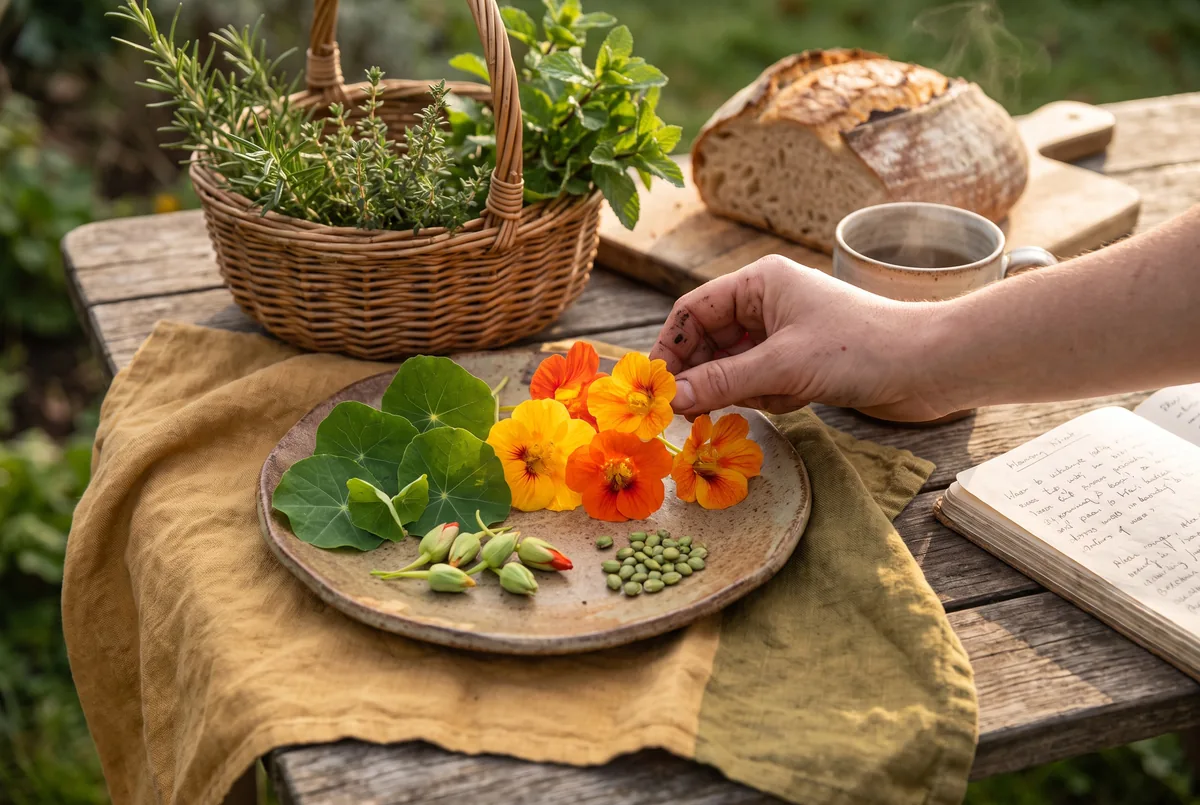
What part of nasturtium is edible? The flowers, leaves, flower buds and green seeds, raw. The flowers are mild then peppery, the leaves and seeds clearly sharper. Pick them from an unsprayed plant and eat them fresh, in small quantities.
The table below sums up the essentials.
Part
Taste
Raw use
When to pick
Flowers
Mild, then peppery
Whole or pulled apart, on a salad or a plate
In the morning, freshly opened
Leaves
Sharp
Young leaves whole, large leaves finely shredded
Young and tender, all season long
Flower buds
Sharp
Crunched raw, in small quantity
Still tightly closed
Green seeds
Very strong
In small quantity, often preserved in vinegar like capers
Green and plump, before they dry out
The flowers
The nasturtium flower is eaten whole or pulled apart, petals laid on a salad or at the edge of a plate. The first contact is mild, then the pepper arrives, like a small wave rising from the back of the mouth a few moments after the first bite. Pick it in the morning, freshly opened, while it is still firm and brightly coloured.
The leaves
Young leaves, round like little parasols, are the most tender: whole when they are small, finely shredded when they are large. A nasturtium leaf has a clearly sharper bite than a flower. A laboratory analysis of the plant's different parts found the highest total concentration of the compounds tracked in the leaves, glucotropaeolin and polyphenols included (Češlová et al., 2023). So you can eat nasturtium leaves without a second thought, raw, like a salad with some bite.
Buds and green seeds
Still closed, the flower buds have a clear bite, to be crunched raw. The seeds are picked green and plump, never dry and hard. A nasturtium seed should be tasted sparingly: it is the strongest part of the plant.
Gardeners often preserve them in vinegar, like capers, and use them as a condiment.
Where does the peppery taste of nasturtium come from?
Bite into a young leaf and wait. Nothing at first, then it stings. This delay has a very simple explanation: the plant stores an inactive molecule, glucotropaeolin (Češlová et al., 2023), and only converts it at the moment you chew.
When you chew or chop the plant, an enzyme it contains, myrosinase, cuts this molecule and releases isothiocyanates, the compounds responsible for the heat you feel rising on your tongue (Williams et al., 2009). Picture a kitchen with two closed drawers, the powder in one, the match in the other. As long as the leaf stays intact, nothing happens; chewing opens both drawers at the same time, and the heat is born in that instant.
The leaves show the highest total concentration of the compounds tracked, but all of them are also present in the flowers. The same analysis shows that freezing clearly reduced the glucotropaeolin content of the samples. There you go, that's why nasturtium is eaten fresh, picked and crunched straight away.
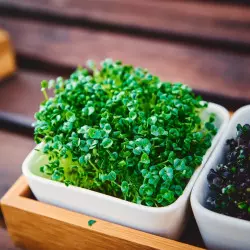
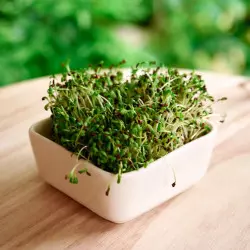
That leaves the likeness in taste with garden cress (Lepidium sativum). Glucotropaeolin is also the main glucosinolate of its seeds, which contain benzyl isothiocyanate (Williams et al., 2009): same starting molecule, same family of heat. If you like this taste, sprouted garden cress seeds offer a winter version, ready in a few days on a windowsill.
What does nasturtium contain? What the studies measured
Let's start with the colours. In 2005, Niizu and Rodriguez-Amaya measured in the laboratory, by chromatography (no measurement in humans), the lutein of the garden nasturtium, a yellow pigment: about 450 µg/g in yellow flowers, 350 µg/g in orange-brown flowers and 136 µg/g in leaves, which also contain 69 µg/g of beta-carotene. In practice, the bright yellow that lights up the plate is partly this very pigment, which you can see. These values are published without the study's abstract stating the weight basis: they serve to compare the parts of the plant with each other, not to set them against another food.
The review by Jakubczyk et al. (2018) also describes minerals in the plant (potassium, phosphorus, calcium, magnesium, zinc, copper, iron), anthocyanins, polyphenols and vitamin C, without quantifying them. These figures describe what nasturtium contains; none measures an effect in humans.
Honestly, nasturtium remains a condiment: a few flowers, a few leaves, as part of a varied and balanced diet and a healthy lifestyle. Its real contribution is bringing colour and fresh greenery to the plate, picked a couple of steps from the kitchen.
Precautions before eating it
What are the downsides of nasturtium? Few, and easy to avoid with a few simple habits.
Only eat unsprayed plants. No garden-centre plants sold as ornamentals, no florists' flowers: ANSES reports pesticide residues on these plants not intended for food.
Identify the plant with certainty before the first bite.
Keep it in its role as a condiment, a few flowers and a few leaves: its heat can irritate a sensitive stomach.
Taste the seeds in small quantity, as the review by Jakubczyk et al. (2018) reports a high erucic acid content in them.
During pregnancy, caution wins. A literature review reports no acute or subchronic toxicity of the plant, but notes that its extracts may have adverse effects during pregnancy, based on data obtained in animals (Brondani et al., 2016). As a precaution, it is better to avoid eating it regularly during pregnancy and to ask your doctor for advice.
To put the risk in perspective, one study gave a leaf extract to mice, rats and rabbits for 90 days, three whole months, without noting any notable toxicity, apart from slight variations in certain white blood cells in rats at the highest dose (Araújo et al., 2018). It is an extract, tested in animals: it sets no dose for humans.
Growing nasturtium in a pot or in the garden
Nasturtium is very forgiving. It grows fast and flowers for a long time, even in beginners' hands.
Sowing and position
Sow directly in place in spring, once the last frosts are over. Full sun or partial shade suit it. A rather poor soil suits it better than one that is too rich, which pushes the plant to make leaves at the expense of flowers. In a pot, water regularly, as the soil dries out quickly there.
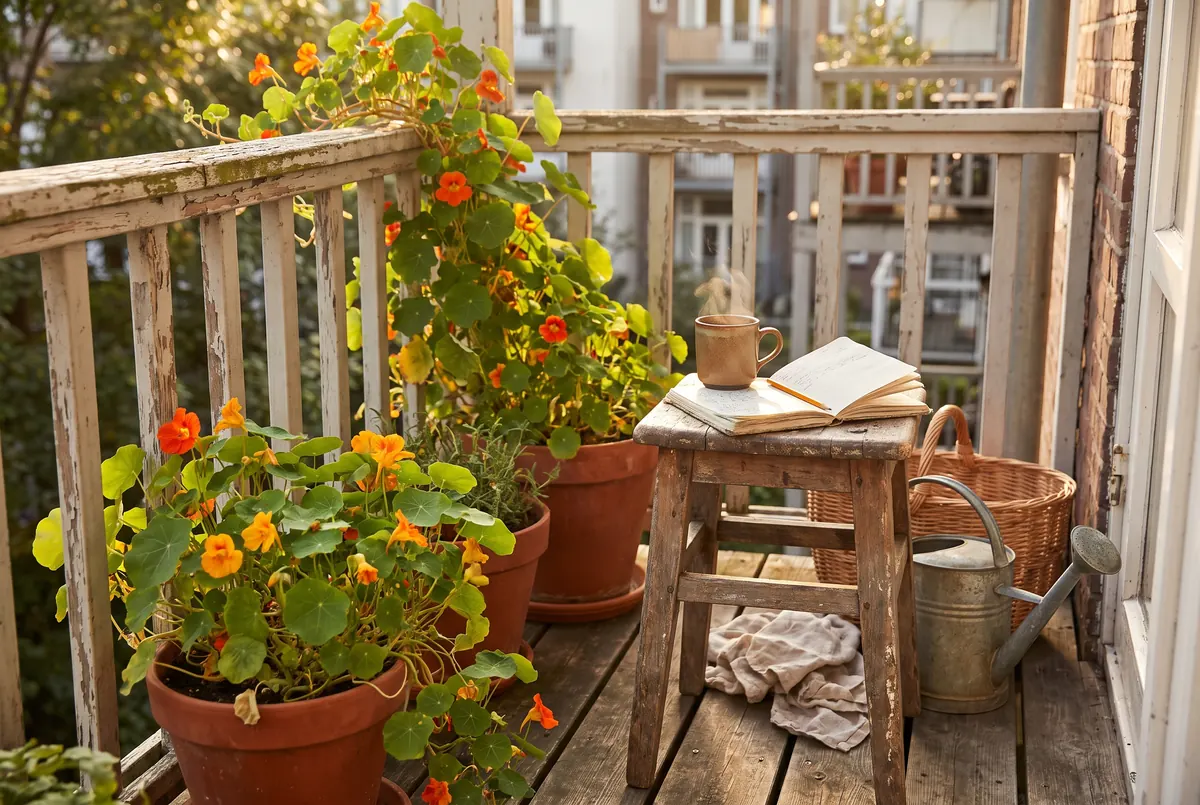
In a pot on the balcony
For a pot, choose a dwarf variety; for a trellis or a raised planter, take a climbing one instead, which will cascade along the railing until the first cold. Harvesting goes on through the summer, until the frosts. Let a few seeds dry on the plant: they will give you next year's seedlings.
As for a perennial edible nasturtium, don't count on it too much: in our climates, the garden nasturtium is grown as an annual, because it does not survive frost.
A companion plant in the vegetable garden
In the vegetable garden, many gardeners use it as a trap plant: aphids settle on it by preference, and you simply remove the invaded stems. This is a gardeners' practice, handed down from plot to plot, with no solid efficacy figure behind it. And it attracts pollinators, which does no harm among the vegetables. It's just common sense: watching nature.
After the frosts: keeping that peppery taste all winter
The first real frost blackens nasturtiums in a single night. End of the season.
To get that heat back until spring, sprouted seeds with a similar taste grow in a few days in the kitchen, with no garden or balcony: garden cress, which shares the same main molecule, sprouted rocket, mustard or radish. Sprouted seeds take over from nasturtium over the winter, in the same flavour family. The Mix Allegro combines leek, cress, rocket and alfalfa; the mustard seeds for sprouting bring a very frank heat.
The first step is tiny. A jar you already have and a few seeds rinsed morning and evening: that's all. A handful of sprouts on a slice of bread or a salad, as part of a varied and balanced diet and a healthy lifestyle, and the heat is back on the plate. To get started, see the seeds you can sprout, how to choose a sprouter and how to grow sprouted seeds at home.
And in spring, the seeds dried on the plant will take their place in the sun again.
Yes for the garden nasturtium, Tropaeolum majus, whether climbing or dwarf: its flowers, leaves, buds and green seeds are edible. The tuberous nasturtium is a different species, grown for its tubers. In every case, only eat unsprayed plants, never garden-centre plants sold as ornamentals.
Are nasturtium leaves edible?
Nasturtium leaves are good raw, preferably young, as they are more tender. They have a clearly sharper bite than the flowers: a laboratory analysis published in 2023 measured in them the highest total concentration of the compounds tracked in the plant. Crunch the small ones whole, shred the large ones.
What are the downsides of nasturtium?
Its downsides come mostly from its strong taste, to be dosed like a condiment, and from sprayed plants, to be avoided. Seeds should be eaten in small quantity, as a review reports a high erucic acid content in them. During pregnancy, it is better to avoid regular consumption and to ask your doctor for advice.
What does nasturtium contain?
Nasturtium contains lutein, a yellow pigment: about 450 µg/g in yellow flowers and 136 µg/g in leaves, according to a 2005 laboratory analysis. Minerals and vitamin C are also found in it. It is eaten as a condiment, as part of a varied and balanced diet and a healthy lifestyle.
Are nasturtium seeds edible?
Yes, nasturtium seeds are edible, provided you pick them green and plump, never dry. They are the strongest part of the plant: taste them in small quantity, all the more so as a scientific review reports a high erucic acid content in the seeds. Gardeners often preserve them in vinegar, like capers.
What does nasturtium taste like?
Nasturtium has a peppery taste, close to cress. The flowers are mild at first, the leaves sharper. This heat is born when you chew: an enzyme of the plant cuts glucotropaeolin, which is also the main glucosinolate of garden cress seeds, hence the likeness in taste between the two plants.
Until when does nasturtium flower?
Until the first frosts: nasturtium flowers from summer until the first frost, which blackens it in a single night. In our climates, it is grown as an annual. To keep that peppery taste in winter, sprouted garden cress or rocket seeds take over in a few days, in the kitchen.
The information presented in this article is provided for information purposes only and does not constitute medical advice. Consult a healthcare professional before making any change to your diet or supplementation.