What does 10:1 mushroom extract mean? Cordyceps and lion's mane, powder or extract: how to choose and measure your dose
From one page to the next, a teaspoon of mushroom powder never weighs the same. So, what does 10:1 mushroom extract mean? In reality, a 10:1 cordyceps extract comes from 10 kg of dried mushroom for 1 kg of powder, and a level teaspoon holds about 2 g of cordyceps powder, whereas 1 g of extract fits in half a teaspoon. These figures come from the Biovie product sheets and from the definition of the ratio published by the European Medicines Agency.
"How many teaspoons for 1 to 3 g of cordyceps?" A customer asked us this in mid-September. It is a sharper question than it looks: on the pages that rank at the top of Google, a teaspoon is worth 1 g, then 1 to 2 g, and nobody explains the gap.
As the son of a baker who was a Meilleur Ouvrier de France, I grew up with one certainty: in the bakery, flour is weighed, not counted in spoonfuls. I am an ISTOM engineer, I founded Biovie in 2007, and today we offer cordyceps and lion's mane in two forms, whole powder and 10:1 extract. So let's first understand what sets them apart, then learn to measure them accurately.
What does 10:1 mushroom extract mean, and what changes compared with powder?
A 10:1 extract is made from 10 kg of dried mushroom for 1 kg of final powder. The ratio describes the amount of raw material used, not an efficacy multiplied by ten. Powder, for its part, is the whole mushroom, dried and ground.
Powder: the whole mushroom, dried and ground
According to our product sheets, our cordyceps and lion's mane powders come from the fruiting body, the part of the mushroom you harvest (as opposed to the mycelium, the network of fine filaments hidden in the substrate). The lion's mane powder is made of 100% mushroom.
10:1 extract: a concentrated decoction, then dried
A 10:1 cordyceps extract follows a different path, and so does the lion's mane one: decoction in hot water, filtration, vacuum concentration, then spray drying, with no chemical solvent. In practice, picture a big pot of broth that you let reduce, then reduce again, until only a syrupy base remains, which you then dry into a fine powder. The fibres stay in the filter, and what has passed into the water stays in the powder. On a kitchen scale, a 10 kg sack of dry mushroom ends up as a one-kilo pouch.
What the ratio says, and what it does not say
The European Medicines Agency defines the drug/extract ratio (the "drug" here being the dried raw material) as the quantity of raw material relative to the quantity of native extract obtained (EMA, 2010). This ratio is normally given as a range, for example 3.0 to 5.5:1, and it simply tells you how much mushroom went into the pot. So, what does 10:1 mushroom extract mean for your spoon? It does not tell you what your spoonful contains, compound by compound.
Take beta-glucans, those complex sugars so often mentioned when people talk about mushrooms. An analytical method study (McCleary and Draga, 2016) shows that they are measured by difference, by subtracting the alpha-glucans (starch, glycogen) from the total glucans, and that the method chosen changes the result. A simple "polysaccharides" label therefore does not let you tell beta-glucans from starch.
And then, the part used matters. For lion's mane, a literature review (Friedman, 2015) describes hericenones in the fruiting bodies and erinacines in the mycelium. Two powders from the same mushroom can therefore have very different profiles. It is the same logic that leads us to choose one powder form over another, for other ingredients too.
Reading the label of a mushroom powder
The name is not enough. More than 350 species are linked to the genus Cordyceps, and only Cordyceps sinensis has been officially listed as a medicinal plant drug in China since 1964; natural substitutes and cultivated mycelia are also sold (Lin and Li, 2011). Reading "cordyceps" on a pouch is a bit like reading "cheese" on a label: you know the family, but you still have to find out what the product is.
To compare two products, four pieces of information do most of the work.
The species, in Latin.
The part used, fruiting body or mycelium, since the compounds are not the same in each.
The form: whole powder, or extract with its ratio.
The extraction method, at least in one line (hot water or another solvent).
At Biovie, our product sheets list organic Cordyceps sinensis and Hericium erinaceus from the Gutian district, Fujian province, China, certified EU organic (Ecocert), USDA Organic and Canada Organic, with an ISO 22000 quality system. Certificates of analysis are available on simple request at sav@biovie.fr. Honestly, when one name covers so many species, showing your papers seems to me the least a producer can do.
It is, by the way, the same reflex as for turmeric, when you look at how to choose an organic powder: origin and form matter as much as the name.
Grams and teaspoons: the conversion table
Why don't two spoonfuls of different powders show the same weight? A packed or airy powder does not take up the same volume for the same weight, exactly like flour. Here are the guidelines from our product sheets, with the duration of a pouch and the daily cost that we calculated.
Product
Level teaspoon
Daily guideline (product sheet)
Duration of a pouch
Cost per day (calculated)
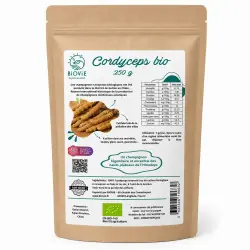
Cordyceps powder, 250 g, €28.90
About 2 g
0.5 to 1 g, 3 g at most
250 days at 1 g, 125 days at 2 g
€0.12 at 1 g, €0.23 at 2 g
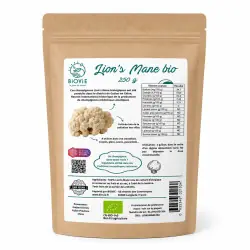
Lion's mane powder, 250 g, €28.90
About 2 to 3 g
1 to 3 g (½ to 1 teaspoon)
83 to 250 days
€0.12 to €0.35
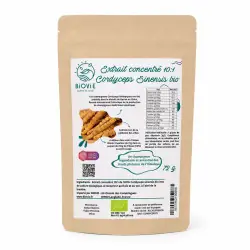
Cordyceps 10:1 extract, 72 g, €45.95
1 g for about ½ teaspoon
1 g, 3 g at most
72 days at 1 g
€0.64 at 1 g
Lion's mane 10:1 extract, 72 g, €45.95
1 g for ½ teaspoon
1 g, 3 g at most
72 days at 1 g
€0.64 at 1 g
To answer the question we started with, 1 to 3 g of cordyceps powder is about half a level teaspoon to one and a half level teaspoons, based on 2 g per teaspoon. There you go for cordyceps powder dosage per teaspoon. And how many grams of lion's mane powder a day? The product sheet says 1 to 3 g of powder, that is half to one level teaspoon, or 1 g of extract.
At 1 g a day, the extract costs about five times more than the powder, for a pouch that lasts a little over two months.
The most reliable habit: weigh your full, level teaspoon once on a kitchen scale accurate to a tenth of a gram, then keep that reference. It's just common sense. If you change spoon or product, start again.
Studies, for their part, count in grams of a specific form. In a randomized, double-blind, placebo-controlled trial of 30 participants aged 50 to 80 (neither they nor the researchers knew who was receiving the mushroom), volunteers took 3 g a day for 16 weeks, in three doses, of a preparation containing 96% dry lion's mane powder (Mori et al., 2009). To picture the amount, 3 g is one to one and a half level teaspoons of lion's mane powder.
As part of a varied and balanced diet and a healthy lifestyle, these figures remain guidelines: everyone at their own pace, starting at the low end of the range. A dedicated article explains which cordyceps dosage to consider depending on your goal.
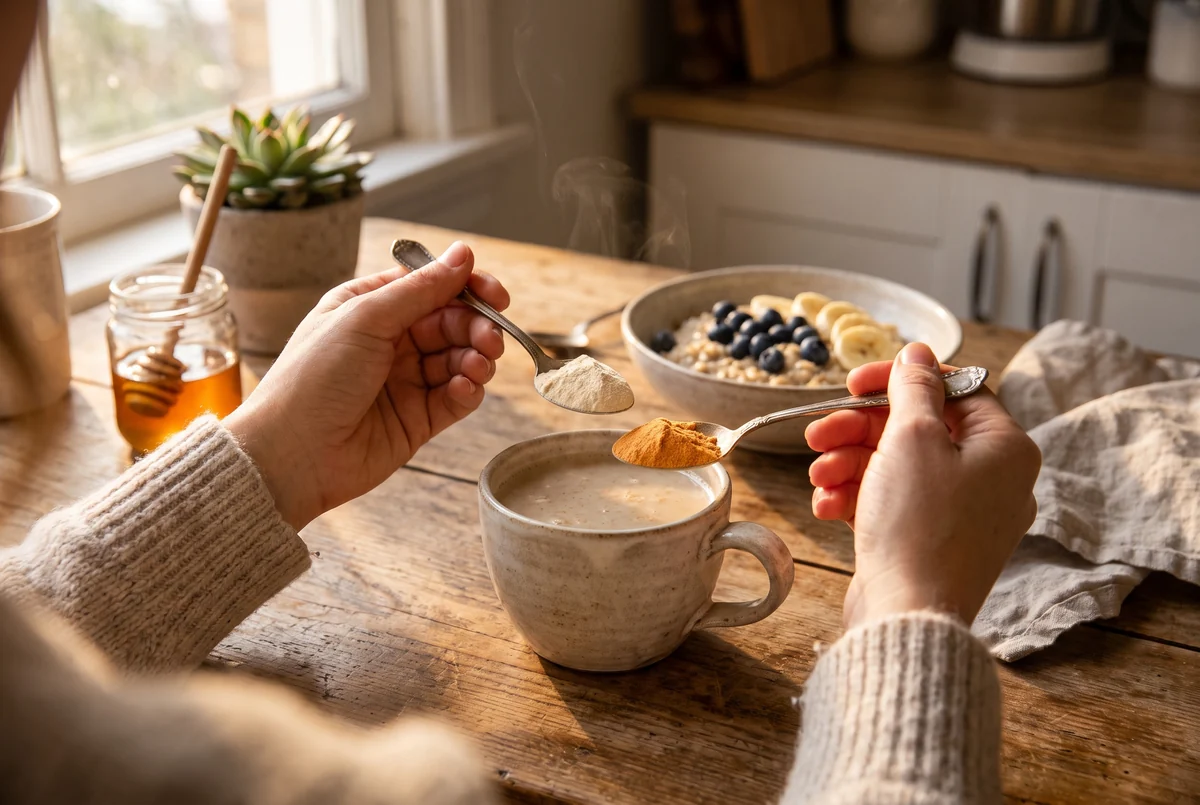
10:1 extracts dissolve in the drink, you just need to stir well. Whole powder behaves differently. It keeps the whole mushroom, fibres included, and mixes in rather than dissolves: the cordyceps powder and the lion's mane powder find their place in a smoothie or in a latte made with homemade tiger nut milk.
The Tikawa Vitalité pack starts from this idea: 720 g of Tikawa Classique lupin coffee, caffeine-free, and 72 g of 10:1 cordyceps extract, that is 792 g for €49.95. You pour the extract into the coffee pouch, shake for 30 seconds, and it then dissolves during brewing.
Depending on the method, each cup contains 0.5 to 0.9 g of extract, and the product sheet sets a maximum of 30 g of mix per day, about 3 g of extract. The pack makes 80 to 130 cups: 3 to 4 months at one cup a day, 6 to 8 weeks at two. At one cup a day, one pack therefore covers a season of breakfasts.
At the end of September, a customer asked us how long two packs would last: at one cup a day, about 6 to 8 months. A big cup takes more grounds, so divide 792 g by the weight of grounds in your cup to find your number of cups.
Right, coffee is not the only possible base. An organic golden milk powder or a raw cacao powder stirred into a hot drink will also take half a teaspoon of extract. As part of a varied and balanced diet and a healthy lifestyle, it is a simple way to add an ingredient to a habit you already have.
Storing your powders and extracts
A mushroom powder dislikes humidity. Keep your resealable kraft pouches in a cool, dry place away from light: under these conditions, our product sheets give a shelf life of 24 months. Two years is plenty of time to finish a pouch, even at the slowest pace in the table. Close the pouch after each use and always dip in a very dry spoon, because an extract designed to dissolve in water likes a wet spoon no more than humid air.
Our cordyceps sheets also mention a few precautions. Cordyceps is not recommended in case of allergy to mushrooms, pregnancy or breastfeeding.If you are taking anticoagulants, immunosuppressants, insulin or antihypertensive medication, ask your doctor for advice before taking it.
Two mushrooms make up this range: Cordyceps (Ophiocordyceps sinensis), offered as a food supplement in powder form, and Lion's Mane (Hericium erinaceus, crinière de lion), an edible mushroom in powder form to add to your drinks and preparations. Each is available as a plain powder or as a 10:1 concentrated extract, from certified organic cultivation. The composition, doses and precautions for use are given on each product page., 5
products
For a small budget and cooking use, the powder: from €0.12 to €0.35 a day.
For a small volume that dissolves in a drink, the 10:1 cordyceps extract or the 10:1 lion's mane extract, at €0.64 a day and 72 days per pouch at 1 g.
For a caffeine-free morning coffee, the Tikawa Vitalité pack.
As part of a varied and balanced diet and a healthy lifestyle, the simplest thing is still to start small: half a teaspoon in the drink you already have in the morning. Everyone moves at their own pace. And if tomorrow every mushroom pouch showed its species as clearly as its ratio, we would spend less time converting spoonfuls, and more time enjoying them.
Frequently asked questions
How many grams of cordyceps are in a teaspoon?
A level teaspoon holds about 2 g of cordyceps powder, according to the Biovie product sheet. For the 10:1 extract, 1 g corresponds to about half a level teaspoon. Since a packed spoonful holds more powder, the most reliable approach is still to weigh your own spoon once on a scale accurate to a tenth of a gram.
What does 10:1 mushroom extract mean?
A 10:1 extract is made from 10 kg of dried mushroom for 1 kg of final powder, by hot water decoction, concentration, then drying. According to the European Medicines Agency, this ratio expresses the quantity of raw material relative to the extract obtained. It does not tell you the content of a specific compound.
How many grams of lion's mane a day?
From 1 to 3 g of lion's mane powder a day, according to the Biovie product sheet, that is half to one level teaspoon. For the 10:1 extract, the guideline is 1 g a day, about half a level teaspoon, without exceeding 3 g. These guidelines apply as part of a varied and balanced diet and a healthy lifestyle.
How long does the Tikawa Vitalité pack last?
The Tikawa Vitalité pack lasts 3 to 4 months at one cup a day, and 6 to 8 weeks at two cups. Its 792 g of mix (720 g of lupin coffee and 72 g of 10:1 cordyceps extract) make 80 to 130 cups depending on the preparation method and the size of the cup.
How and when should you take cordyceps?
Cordyceps is taken in a drink, hot or cold: the 10:1 extract dissolves in it, and the whole powder mixes in when you stir well. The Biovie product sheet suggests taking it in the morning or early afternoon. Half a teaspoon of extract in a lupin coffee is a simple way to start.
When should you avoid cordyceps?
Cordyceps is not recommended in case of allergy to mushrooms, pregnancy or breastfeeding, according to the Biovie product sheets. If you are taking anticoagulants, immunosuppressants, insulin or antihypertensive medication, ask your doctor for advice first. If in doubt, a healthcare professional remains the best person to ask.
Where does your cordyceps come from, and do you have certificates of analysis?
Our cordyceps comes from the Gutian district, in Fujian province, China. It is certified EU organic (Ecocert), USDA Organic and Canada Organic, and produced under an ISO 22000 quality system. Certificates of analysis are available on request at sav@biovie.fr, for the powder as well as for the 10:1 extract.
Lin BQ, Li SP, 2011. Cordyceps as an Herbal Drug. In: Benzie IFF, Wachtel-Galor S (eds.), Herbal Medicine: Biomolecular and Clinical Aspects, 2nd ed., CRC Press/Taylor & Francis, chapter 5.
The information presented in this article is provided for informational purposes only and does not constitute medical advice. Please consult a healthcare professional before making any change to your diet or supplementation.