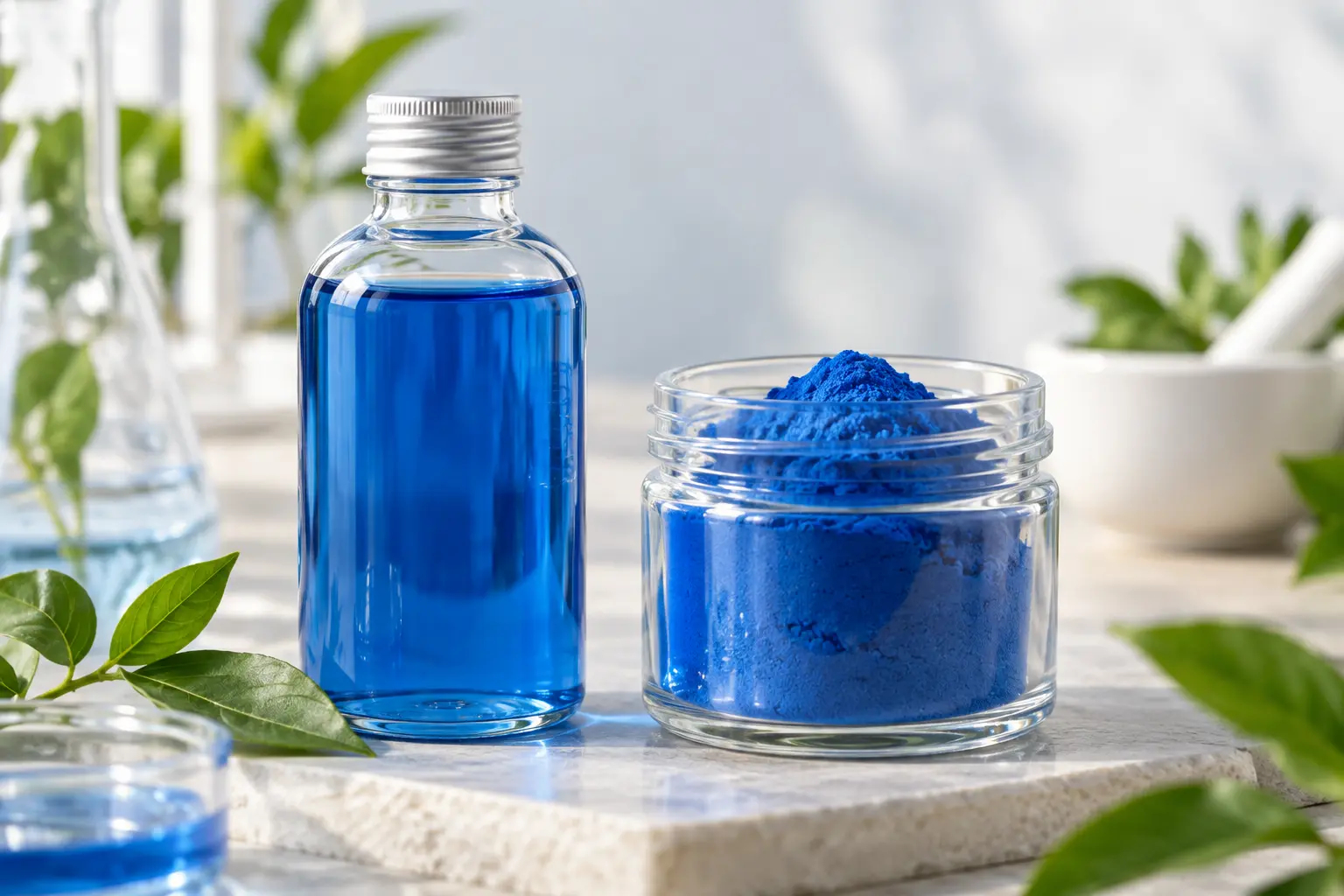
Because a standardized powder tells you in black and white how much active pigment you're buying, and because a protein as fragile as phycocyanin keeps better when it's dry. Liquid phycocyanin isn't a bad product: it's the same molecule, simply diluted in water and stabilized so it holds up in a bottle. But until the price has been brought back to the gram of active material, you're comparing containers, not products.
Put two bottles side by side on a table. Same deep blue, same word "phycocyanin" on the label, sometimes the same price. And yet, once you've done the multiplication, one of them can hold several times more pigment than the other. That's the calculation I'd like us to do together, nice and simple, with a calculator and two minutes to spare.
We've been selecting microalgae for Biovie since 2007, and I'm an ISTOM-trained engineer: comparing contents and bringing a price back to a common unit is what I do, so you get the best quality at the best price, and so I don't end up selling you water. Here's why we chose phycocyanin powder, and above all how to judge any product for yourself, ours or anyone else's. Like any ingredient of this kind, phycocyanin is best seen as part of a varied and balanced diet and a healthy lifestyle.
Phycocyanin powder or liquid: the same pigment, two very different formats
What exactly is phycocyanin?
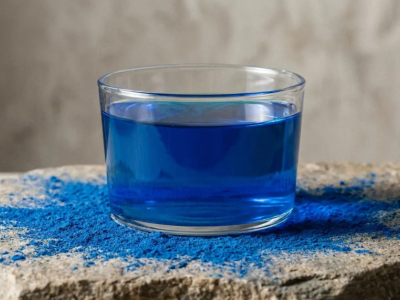
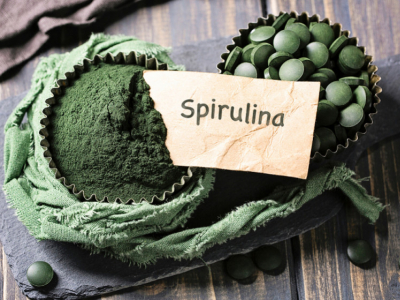
Phycocyanin is the blue pigment in spirulina. More precisely, it's a colored protein (a phycobiliprotein, to use the proper term) that the microalga uses to capture light. If you've ever opened a bag of spirulina, you've seen that very dark green, almost bluish: that's green chlorophyll mixed with this intense blue. To get phycocyanin on its own, the pigment is extracted with water, then separated from the rest of the alga. In everyday language, that's also what people call blue spirulina.
A literature review published in 2023 in Pharmaceuticals describes this journey well, from growing the spirulina all the way to the uses of the extracted pigment (Fernandes et al., 2023). If you remember only one thing from that work, make it this: phycocyanin is a protein, and like any protein, it's sensitive to heat, light and acidity. We'll come back to that, because it's the very heart of the matter.
Liquid or powder: what's really inside the container
On the market, you'll find two main families of phycocyanin extract:
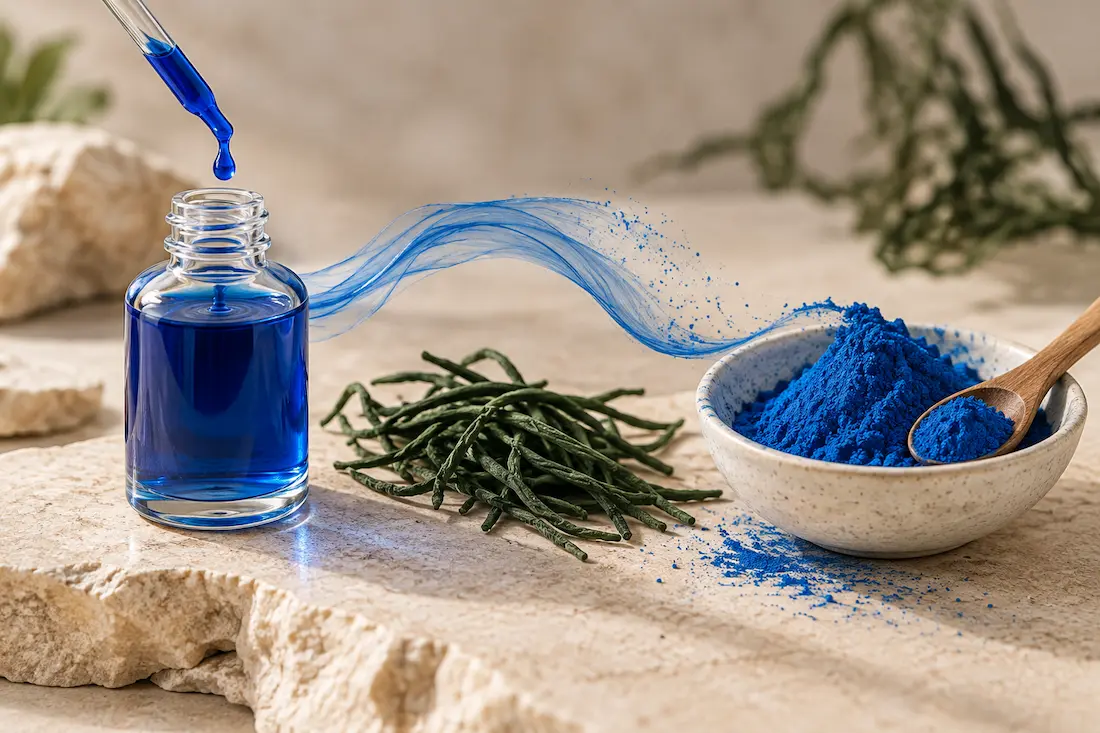
Liquid phycocyanin: the pigment is dissolved in water, usually with an ingredient that helps stabilize it (vegetable glycerin, citric acid or sugar, depending on the formula). It's sold in a bottle, its content is expressed in milligrams per liter (mg/L), and the dose is measured in milliliters.
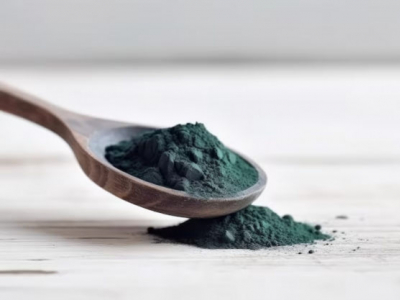
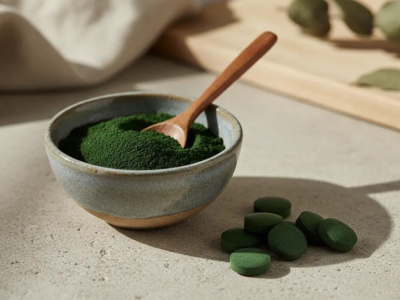
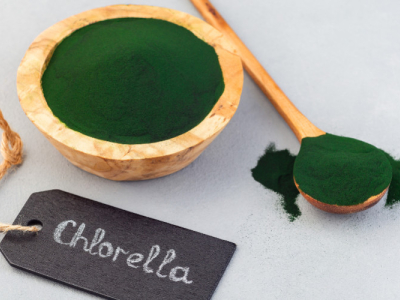
Phycocyanin powder: the extracted pigment is dried, then packed in a jar or a pouch. Its content is expressed as a percentage (or in mg per gram of powder), and the dose is weighed in grams.
The active pigment, C-phycocyanin, is the same in both cases. What changes is the matrix around it, and above all the concentration. A liquid is the same molecule with a lot of water around it; a powder is the same molecule without the water. Everything else follows from that: the price, how well it keeps, how you dose it.
Honestly, both formats make sense in their own way. The problem is the unit: one speaks in mg/L, the other in percent, and there's no way to compare them at a glance.
Liquid phycocyanin: what "5,000 mg/L" really means
5,000 mg/L sounds like a big number. Five thousand! But until you've done one multiplication, you have no idea how much phycocyanin actually ends up in your glass.
A concentration is not a dose
mg/L is a concentration: it tells you how much pigment a whole liter of product would contain. But nobody drinks a liter of phycocyanin. What matters is how much is in the dose you actually take.
Concretely, let's take a bottle at 5,000 mg/L, with a suggested dose of 15 ml a day (a dose you'll often see on this type of product). The calculation fits on one line:
5,000 mg/L × 0.015 L = 75 mg of phycocyanin per day.
75 mg is roughly the weight of three or four grains of rice. That's neither good nor bad in itself, it's simply what the dose really contains, and it says a lot more than "5,000". You can redo this calculation yourself on any bottle: concentration × dose volume = actual amount.
Another telling calculation, this time on the whole bottle. A 200 ml bottle at 5,000 mg/L contains 5,000 × 0.2 = 1,000 mg, which is exactly 1 gram of phycocyanin in total. One gram. At 15 ml a day, that bottle lasts just over 13 days.
And for a standardized powder?
With a powder, the reasoning is even more direct, since the unit is already the gram. If a phycocyanin powder is standardized to 36% phycocyanin, 1 g of powder provides 360 mg of pigment. 3 g provide 1,080 mg. You just multiply the weight of the dose by the percentage.
There you go: that's why you don't compare a bottle and a jar "by eye". You have to bring them back to the same unit, milligrams of phycocyanin per dose.
The A620/A280 purity ratio, explained simply
There's a second, more technical number you'll sometimes come across on a certificate of analysis: the A620/A280 ratio. It's measured with a spectrophotometer: at 620 nanometers you measure the blue, meaning the phycocyanin; at 280 nanometers, all the proteins present. The ratio tells you what share of the proteins is actually the blue pigment.
Picture a crowd in a stadium: A280 counts everyone, A620 counts only the blue jerseys. The higher the ratio, the "bluer" the crowd. The review by Fernandes et al. (2023) lists the thresholds used in the literature: above 0.7, it's called food grade; above 1.5, cosmetic grade; above 3.9, reagent grade; above 4.0, analytical grade. For food use, the first threshold is the useful benchmark.
Phycocyanin price: the calculation per gram of active material
Two products, two prices, two formats. As long as they don't speak the same unit, the price on the label tells you almost nothing. The right indicator is the price per gram of phycocyanin actually contained, what I call the active material.
The three-step method
Work out the total amount of phycocyanin in the product. For a liquid: concentration (in g/L) × bottle volume (in L). For a powder: jar weight (in g) × standardization (in %).
Divide the product's price by that amount. You get the price of one gram of phycocyanin.
Compare that number, and only that one. Do the same for the cost per day, starting from the suggested dose.
A little trick that makes everything simpler: for a 200 ml bottle at 5,000 mg/L, since it contains 1 g of phycocyanin in total, the price of the bottle is directly the price per gram of active material. If the bottle costs €20, you're paying €20 per gram of phycocyanin. No calculator needed.
It's exactly the same reasoning as for spirulina itself, when you compare a powder with fresh spirulina: bringing everything back to the kilo completely changes the picture (we went into detail in our article on the price of spirulina per kilo).
Let's apply the calculation to our own product
A calculation is only worth something if you're willing to apply it to yourself. So here's ours, in full transparency.
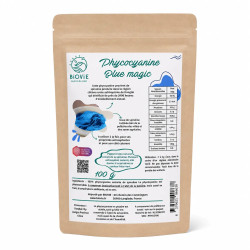
Our phycocyanin powder is a water extract of spirulina standardized to 36% phycocyanin, sold in a 100 g jar for €26.95:
Amount of phycocyanin in the jar: 100 g × 36% = 36 g.
Phycocyanin price per gram: €26.95 ÷ 36 = about €0.75.
At 1 g of powder a day (the low end of the suggested range): 360 mg of phycocyanin for about €0.27.
At 3 g a day (the high end of the range): 1,080 mg for about €0.81.
To put these numbers into everyday terms: this jar that fits in one hand holds as much pigment as 7.2 liters of liquid at 5,000 mg/L, the equivalent of 36 bottles of 200 ml. A whole box, sitting on a kitchen shelf. For a 200 ml bottle at 5,000 mg/L to work out at the same price per gram, it would have to cost about €0.75.
I'm not giving you this figure to say that everything else is too expensive, but so you can redo the calculation on any phycocyanin supplement, ours included.
You may have wondered why we don't offer liquid phycocyanin. It's not an oversight, and it's not a judgment on those who sell it. It's a catalog choice, based on three reasons.
1. A fragile protein keeps better dry
Let's go back to the nature of the pigment. Phycocyanin isn't a simple, sturdy molecule like a mineral: it's an assembly of proteins, a bit like a small wheel made of several interlocking spokes. As long as the wheel holds together, the blue stays bright. When it comes apart, the pigment loses its color and its structure.
And three things speed up that coming apart: heat, light and an environment that's too acidic. The review by Fernandes et al. (2023) places the pigment's comfort zone below 45 °C, at a pH of 5.5 to 6, away from light, and notes that it breaks down markedly between 47 and 69 °C. Another review, devoted specifically to the degradation of phycocyanin (Adjali et al., 2022), details the ways to stabilize it in solution: sugars, citric acid, salt, encapsulation.
That's the technical reason why liquid phycocyanin products generally contain a stabilizer: in water, the protein needs protecting. It's not a manufacturing flaw, it's a constraint of physics. A powder simply takes water out of the equation.
Let's be honest, though: dry doesn't mean eternal. A powder should be kept dry, away from light, with the jar tightly closed, and ideally used up within the months following opening.
2. A readable standardization, a dose you can weigh
With a powder, the unit of sale and the unit of dosage are the same: the gram. A 36% standardization can be checked, compared, displayed. And the dose you take matches exactly what's written: 1 g of powder is 360 mg of pigment, heavy hand on the spoon or not, as long as you weigh it.
It's also a question of traceability. In its 2017 opinion on food supplements containing spirulina, ANSES recommends favoring reliable, controlled supply channels with a clearly identified manufacturer (ANSES opinion 2014-SA-0096). That opinion is about spirulina, not specifically phycocyanin, but the principle holds for its extracts: a product whose content is clearly displayed and verifiable is a product you can ask precise questions about. It's the same spirit as for spirulina itself, which we discussed in our article on checking the quality of spirulina.
On the health side, let's be precise: to date, no health claim is authorized for phycocyanin in the EU register of health claims. Research is mainly interested in its antioxidant activity, observed mostly in the lab and in animals; a 2025 review points out that human data still needs to be consolidated (Mahanandia et al., 2025). So we present it for what it is: a concentrated spirulina pigment, to be used as part of a varied and balanced diet and a healthy lifestyle.
3. We don't ship water
Think of mint syrup. You buy the syrup and add the water yourself, from the tap. Nobody would dream of hauling pallets of ready-diluted mint drink from one end of the country to the other. It's just common sense. That's also why we don't sell isotonic marine plasma: we let you dilute the marine plasma at home.
Phycocyanin powder is the syrup. For the same amount of pigment, it avoids shipping the water and the stabilizer: less weight, less volume, less packaging. Remember the figure from earlier: 100 g of powder at 36% versus 7.2 liters of liquid at 5,000 mg/L. For us, shipping our parcels from Metz, the difference shows on every single box.
So what about liquid?
Well, of course, liquid has real strengths. It's ready to use, no weighing: you pour, you drink. Some people find it more pleasant, or easier to take along when traveling. For a short course, that convenience has real value. The liquid format isn't a bad choice: it's a different choice, and its concentration-to-price ratio deserves checking, just like any other product's. Ours included. We sell you the most concentrated form possible at the best price.
How to read any product page before you buy
Next time you're torn between two products, three questions are enough to decide. Thirty seconds of math is all that separates a gut-feeling purchase from an informed one.
What content is stated, and in what unit? mg/L for a liquid, a percentage or mg/g for a powder. If no content is stated at all, that's already telling you something.
How many mg of phycocyanin are in the suggested dose? Concentration × volume for a liquid, weight × standardization for a powder.
How much does one gram of phycocyanin cost, once you've done the math? Divide the price by the total amount of pigment in the product.
In reality, these three questions work for plenty of other products too, not just a phycocyanin supplement. An impressive number on a label never replaces a multiplication. And if you prefer whole microalgae to the isolated pigment, our article on chlorella, its benefits and precautions or our complete guide to spirulina will give you other benchmarks.
How to use it day to day, without overcomplicating things
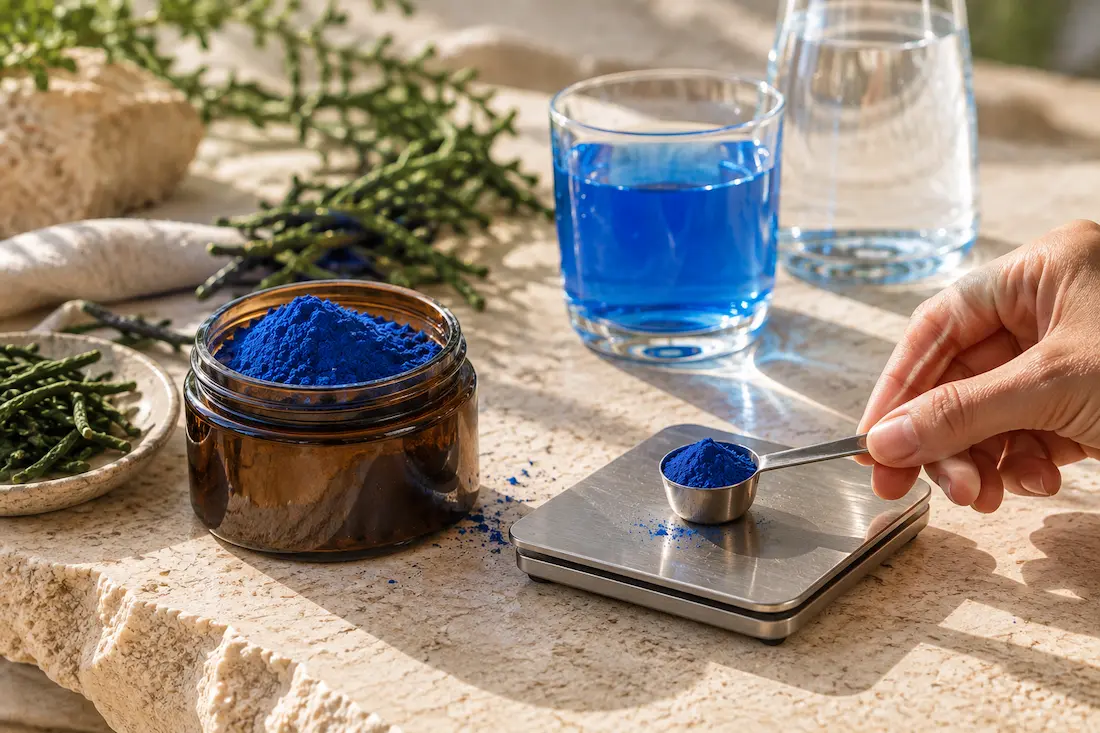
Phycocyanin powder dissolves in water (it's a water-soluble protein). No special equipment needed, although a milk frother for under €10 works wonders:
Start small: 1 g a day in the first week, the low end of the suggested range of 1 to 3 g. A small kitchen scale accurate to a tenth of a gram helps you train your eye at the beginning; after that, measuring with a spoon is easy.
Mix it cold: in a glass of water, a homemade tiger nut milk, a smoothie. Avoid hot drinks above 45 °C, which damage the pigment.
Drink it right away: in a very acidic juice, the blue can shift. Mix it at the last moment, along with your breakfast.
It's actually one of the little pleasures of this pigment: a pinch of powder in a pale smoothie, and the whole glass turns lagoon blue. Try it, you'll love it!
If you'd like to try, for a few weeks, a phycocyanin whose standardization you know exactly, and therefore the amount of pigment in every gram, you can start with our phycocyanin powder standardized to 36%: the math is already done for you.
Frequently asked questions about liquid and powdered phycocyanin
Is liquid phycocyanin less effective than powder?
It's not a question of effectiveness, since the molecule is the same. The difference is about quantity: at what looks like the same dose, a liquid and a powder don't provide anywhere near the same amount of pigment. Work out the milligrams of phycocyanin in the suggested dose: that's the number that lets you compare.
How many mg of phycocyanin should I take per day?
There's no official reference intake for phycocyanin. Follow the dose given by the manufacturer: for our powder standardized to 36%, 1 to 3 g a day, which is 360 to 1,080 mg of phycocyanin. For a liquid at 5,000 mg/L taken at 15 ml, that's 75 mg. Our complete guide to phycocyanin details how it's used in its different forms.
Why do some bottles show very high concentrations?
The more concentrated a liquid is, the less water it contains for the same amount of pigment: that's rather a good thing. But the mg/L figure alone tells you nothing about the price. Apply the same calculation: concentration × bottle volume, then price ÷ amount of pigment.
How can I check the real purity of a phycocyanin product before buying?
First look at the stated content (in mg/L or %). To go further, ask for the certificate of analysis for the batch: it may show the A620/A280 ratio. Above 0.7, the literature speaks of food grade (Fernandes et al., 2023).
Does phycocyanin powder dissolve well in water or juice?
Yes, it's water-soluble. Go for a cold or lukewarm drink, and drink it quickly if the juice is acidic, because acidity can alter the pigment's color and structure (Adjali et al., 2022).
Can I combine phycocyanin with whole spirulina?
Yes. Whole spirulina itself contains phycocyanin, along with everything else in the alga: protein, iron, pigments. The two complement each other in a routine, as long as you take each one's dose into account. You'll find what studies say about spirulina in our article spirulina and immunity.
Are there any precautions to take with phycocyanin?
Yes, as with any concentrated phycocyanin extract. ANSES advises against spirulina for people with phenylketonuria and those prone to allergies. If you're pregnant, breastfeeding or on medication, ask a healthcare professional for advice. We've detailed the precautions in our complete guide to phycocyanin.
In a nutshell
Liquid or powder, it's the same blue pigment. What changes is how much phycocyanin you're paying for, and how easily you can check it. We chose the powder because it keeps a fragile protein better, it displays a readable standardization, and it avoids shipping water. But the real message of this article is the calculation: concentration × volume, weight × standardization, price ÷ grams of active material. It works anywhere, for anyone.
There you go. Everyone at their own pace, and according to their own preferences: phycocyanin, in whatever form, has its place as part of a varied and balanced diet and a healthy lifestyle.
The information in this article is provided for informational purposes only and does not constitute medical advice. Consult a healthcare professional before making any change to your diet or supplementation.