

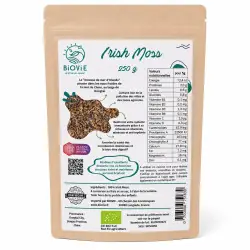

Organic Lion's Mane Powder - 250g
Lion's Mane powder, certified organic
250g pouch
No queries yet, leave the first!
Price:
€28.90
Tax included


Organic Lion's Mane Powder - 250g images


Organic Lion's Mane Mushroom powder 250 g
The "lion's mane" mushroom of Asian cuisine - Ecocert certified organic
The organic Lion's Mane mushroom powder (Hericium erinaceus) is used as an everyday culinary ingredient: 1 to 3 g per day in a stock, a smoothie, a soup or a latte is enough to enjoy its mild umami flavour. Ecocert certified, our 250 g organic Lion's Mane powder is made 100% from the whole mushroom, with no excipients or additives.
🍄 What is the Lion's Mane mushroom?
Lion's Mane - in French crinière de lion or hydne hérisson, sometimes called pompom blanc, or yamabushitake in Japan - is a mushroom like no other. Frankly, the first time you see one, you wonder whether it really is a mushroom. That cascade of white filaments, like a beard of ice clinging to a tree trunk, is quite spectacular.
Our powder is produced from the whole mushroom (Hericium erinaceus), grown in Ecocert-certified organic farming, then dried and ground into a fine powder.
The result? A versatile ingredient, neutral-tasting in powder form, that fits easily into your everyday eating.🍄 Taste profile and culinary uses of Lion's Mane
In Asian gastronomy, fresh Lion's Mane is often compared to certain seafood - lobster or crab - for its melting texture and its mild, slightly nutty umami flavour. In powder form, the taste is much more discreet, almost neutral. That is precisely what makes it so easy to use.
Here is how to use Lion's Mane powder every day :
- Stocks and soups : 1 teaspoon (about 2 g) in a hot stock - it dissolves in a few seconds. Personally, that is how I use it most often in the morning.
- Smoothies and lattes : golden latte, matcha latte, raw cacao latte - a teaspoon and it's done, with an imperceptible taste.
- Plant-based pâtés and spreads : mixed into a base of cashew nuts or soaked sunflower seeds, it adds a subtle umami note.
- Seasoning sauces : in a miso sauce, a vinaigrette or a curry, it blends in perfectly.
- Sprinkled over bowls : rice, quinoa, roasted vegetables - a pinch before serving.
Incidentally, if you are looking to combine several ingredients in the kitchen, our organic spirulina powder and our organic Cordyceps powder go very well with Lion's Mane in a morning smoothie or stock.
🍄 How to use Lion's Mane powder?Suggested use : 1 to 3 g per day (½ to 1 level teaspoon) in your culinary preparations or drinks. In the morning in a hot drink is the simplest. In the early afternoon in a smoothie works very well too.
Start with a small amount - half a teaspoon - and increase gradually to your taste. (The powder is concentrated, no need to add tonnes of it.)
Precautions for use :
Not recommended in case of mushroom allergy. If you are undergoing medical treatment, ask your healthcare professional for advice.
🍄 Frequently asked questions about Lion's Mane
How to use Lion's Mane powder in cooking?
Organic Lion's Mane powder (Hericium erinaceus) fits easily into everyday preparations: 1 to 2 g (one level teaspoon) in a hot stock, a smoothie, a latte, a soup or sprinkled over a bowl. Its taste in powder form is neutral to slightly nutty - it disappears in most recipes. Start with a small amount and increase to your preference.
What does the Lion's Mane mushroom taste like?
Fresh Lion's Mane has a mild umami flavour, often compared to lobster or crab in Asian gastronomy, with a melting texture. In organic powder form, the taste is much more discreet, almost neutral, so you can add it to any preparation without altering the flavour of the dish.
What is Lion's Mane called in French?
Lion's Mane has several names in French: crinière de lion (literal translation), hydne hérisson (common mycological name) and sometimes pompom blanc. Its scientific name is Hericium erinaceus. In Japan, it is called yamabushitake. It is the same mushroom under all these names.
Is organic Lion's Mane powder suitable in a latte or smoothie?
Yes, it is one of the most popular uses. Lion's Mane powder dissolves easily in hot drinks (golden latte, matcha latte, hot cacao) as well as in cold smoothies. Allow 1 to 2 g per drink - about one level teaspoon. It contains no caffeine and has no stimulating effect.
🍄 The organic Lion's Mane mushroom (Hericium erinaceus) has been appreciated for centuries in Asian cuisine. Its composition is detailed in the nutritional values table of the Practical info tab.
🍄 Composition of Lion's Mane
In practice, here is what you find in this mushroom:
- beta-glucans, soluble polysaccharides naturally present in mushrooms,
- protein and carbohydrate, the quantities of which per 100 g are given in the nutritional values table (Practical info tab).
🍄 A mushroom rooted in Asian culinary tradition
In Chinese and Japanese cuisine, fresh Lion's Mane has been cooked sautéed, grilled or in soup for centuries. Zen Buddhist monks used to eat it.
In organic powder form, it fits easily into everyday eating: hot drinks, smoothies and a variety of culinary preparations.
Biovie searched at length for a serious and internationally competitive supplier of Ecocert-certified mushrooms, including our organic Lion's Mane powder.
🍄 Our supplier, located in China, is mainly dedicated to producing natural extracts from mushrooms - in particular Cordyceps militaris, Lion's Mane, and other varieties of mushrooms. The company is recognised for its in-depth expertise in growing, extracting and processing fungal materials. Their premises have more than 20 tank reactors, a GMP-compliant API production line and several state-of-the-art analytical machines.
The company also has a 4,600 m² workshop for high-quality plant extracts, equipped with numerous facilities, including three 6-tonne multifunctional extraction tanks, a high-efficiency concentration tower, a resin adsorption column and a spray-drying tower. The analysis centre of their Research and Development department is equipped with a large number of instruments for inspecting the quality of their products.
🍄 The company is also committed to researching and developing food supplements of the highest quality on the market. With a department dedicated to organic farming in order to develop the research and sale of organic products, it holds EU/USDA/CANADA organic certificates and the ISO22000 quality and safety management system, as well as other related certificates.
> Feel free to also read our blog article: Organic farming in China
Best before: 05/11/2027
- Ingredients : 100% Lion's Mane mushroom powder (Hericium erinaceus), from organic farming, with no excipients or additives.
- Packaging : Resealable kraft packaging
Sustainable, recycled packaging certified "Plastic neutral by CSR"
- Storage : Store in a cool, dry place, away from light. Keep out of reach of children. The resealable kraft packaging protects the powder from moisture. Shelf life: 24 months under the stated conditions.
- Origin : Gutian District, Fujian Province, China
- Certifications : EU / USDA / Canada Organic Farming - Ecocert certified
Average nutritional values per 100 g of organic Lion's Mane powder :
| Nutritional values | per 100 g |
|---|---|
| Sodium (mg/100 g) | 34,1 |
| Energy (kJ/100 g) | 1560 |
| Carbohydrate (g/100 g | 84,3 |
| Protein (g/100 g) | 7,45 |
| Moisture (g/100 g) | 3,21 |
| Ash (g/100 g) | 5 |
| Total fat (g/100 g) | ND |
| Saturated fatty acids (g/100 g) | ND |
| Fructose (g/100 g) | ND |
| Glucose (g/100 g) | ND |
| Sucrose (g/100 g) | ND |
| Maltose (g/100 g) | ND |
| Lactose (g/100 g) | ND |
| Total sugars (g/100 g) | ND |
Updated: April 2026. Article checked by Éric Viard, founder of Biovie and ISTOM engineer, co-author of Algues au quotidien (Gallimard, 2024) - Best cookbook in the world, Gourmand Cookbook Awards 2025, and Best cookbook in France, Académie Nationale de Cuisine 2025.
The information presented in this article is provided for information purposes only and does not constitute medical advice. Consult a qualified healthcare professional before making any change to your diet. As part of a varied, balanced diet and a healthy lifestyle.
Wondering… ?
Everything you need to know before ordering.
Be the first to ask a question about this product!
Question about the product
Ask a question