



Fresh organic spirulina block - 400g images


Fresh organic spirulina block - 400g
No queries yet, leave the first!
Price:
€72.00
Product availability:
10-day DLC
Tax included
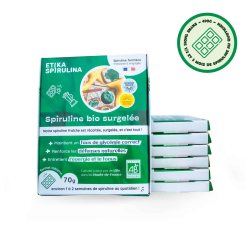
Fresh pressed spirulina
Certified organic farming
Made in France
400g block
SHIPPING EVERY THURSDAY VIA CHRONOFRESH IF ORDERED BEFORE
Tuesday 6 PM (SHIPPING ONLY IN FRANCE)
Ultra-fresh organic spirulina
(in the form of a block with a smooth texture)
Fresh spirulina is living spirulina that is simply pressed, never dried. : a creamy block of 400 g grown and harvested in Northern France, at a rate of 20 g per day - that is 20 servings per block. No drying, no heating, no processing: the excess water is removed, it is weighed, cut, and shipped under controlled refrigeration. The result: a texture similar to tofu, a neutral taste, and 16.9 mg of iron per 100 g.
Have you tried spirulina powder but its taste is really not for you? Do you want to incorporate it more easily into your diet? We have the solution !
Fresh spirulina, produced in northern France, is truly a game-changer in cooking.
Cultivated and harvested with the utmost care, this microalgae is gently pressed to remove excess water, and simply concentrate the spirulina in its purest form.Weighed and then cut into blocks in strict compliance with sanitary standards and the cold chain. You get a smooth and creamy block (which resembles tofu a bit), that you can easily cut with a knife, spread, or mix with your sweet or savory preparations.
Its taste is neutral, which allows it to be incorporated into your everyday meals.
Jamy explains everything in his report with Xavier, our producer:
🟩What are the differences with other spirulinas?
We were won over by its ease of use, soft texture, and truly surprised by its neutral taste: spirulina acts as a flavor enhancer, bringing an "umami" taste to your dishes but with a very mild, imperceptible flavor of its own. It is ideal for adding a beautiful green color to both savory and sweet dishes and provides all the benefits of spirulina without altering the taste. On the contrary, your cooking will be enhanced.
Concretely, the difference comes down to one word: nothing has been removed, nothing has been heated. Whereas powdered spirulina goes through a drying stage, fresh spirulina remains as it comes out of the basin, with just the water removed. It thus retains its natural enzymatic activity and creamy texture. Fresh spirulina is a raw, unprocessed food that can be cooked with-and this is precisely what makes all the difference in daily life.
🟩 How to use it?
- Cooked with olive oil or honey (natural preservatives), you can keep it in the fridge for up to 15-20 days.
Add creaminess to your morning spreads or tapenade toasts for appetizers, enhance the green of your guacamoles, spice up your vinaigrettes with this superfood, create original dessert creams, an astonishing tiramisu...
- We advise you to always pair it with a food rich in vitamin C (citrus fruits, lemon) to facilitate the absorption of nutrients (especially iron) by the body.
- Do not heat spirulina to preserve its nutritional properties.
- As a treatment: you can simply take a spoonful every morning. The recommended intake is 20g of fresh spirulina per day - the equivalent of a good tablespoon. That is 20 servings per block.
A cooking tip from our daily practice: mash the block with a fork and a squeeze of lemon before incorporating it. Iron is better absorbed in the presence of vitamin C, and the texture becomes a perfectly smooth cream in ten seconds. If the taste of seaweed still puts you off, our 12 tips to mask the taste of spirulina work very well with the fresh version too.
🟩 The benefits of consuming fresh spirulina
Isn't consuming spirulina as a food or a full-fledged condiment in your daily meals more stimulating than swallowing it mechanically every morning without even tasting it? Fresh spirulina is gradually becoming more popular, moving out of our pharmacies to reclaim its noble pure form in our kitchens. In addition to its very pleasant texture and umami quality, its main advantage lies in its nutritional richness and the bioavailability of its trace elements. Unprocessed, it retains all of its enzymatic activity, much like an apple that you bite into after picking it from the tree, that's when it's at its best !
It contains an average of 5695 mg of phycocyanins per 100g of fresh spirulina. Phycocyanin is the blue pigment characteristic of spirulina, currently at the center of numerous research studies - we have dedicated a complete guide on the blog.
🟩 What European regulations say
A 20 g serving of fresh spirulina provides 3.4 mg of iron, which is 24% of the reference nutritional values. As such, the health claims authorized by Regulation (EU) No 432/2012 for iron apply:
- Iron helps reduce fatigue.
- Iron contributes to the normal functioning of the immune system.
- Iron contributes to the normal transport of oxygen in the body.
- Iron contributes to the normal formation of red blood cells and hemoglobin.
- Iron contributes to normal energy metabolism.
Of course, as part of a varied and balanced diet and a healthy lifestyle.
🟩 Delivery
Price including shipping fees by Chronofresh
Shipment every Thursday right after harvest if the order is placed before Tuesday 6 PM.
Delivery in FRANCE only
🟩 To learn more about the use of spirulina, check out our blog articles:
How to consume spirulina ?
Spirulina and microcystins: check the quality !
Spirulina: The Complete Guide to Scientifically Proven Benefits
Spirulina and Weight Loss: What Scientific Studies Reveal
Spirulina and Immunity: How to Strengthen Your Natural Immune System
12 effective tips to mask the taste of spirulina
What is the price of spirulina? (price per kilo and per 100 g)
Blue spirulina: what is it and why is it being talked about so much ?
Algae and microalgae: benefits, nutrients, and recipes
🟩 And to listen to those who work with seaweed daily, we also have our podcast: Algae in Everyday Life, the Biovie Podcast.
Spirulina is now well-known for its nutritional density. Consuming it fresh means receiving it as it comes out of the basin - without drying, heating, or intermediate processing.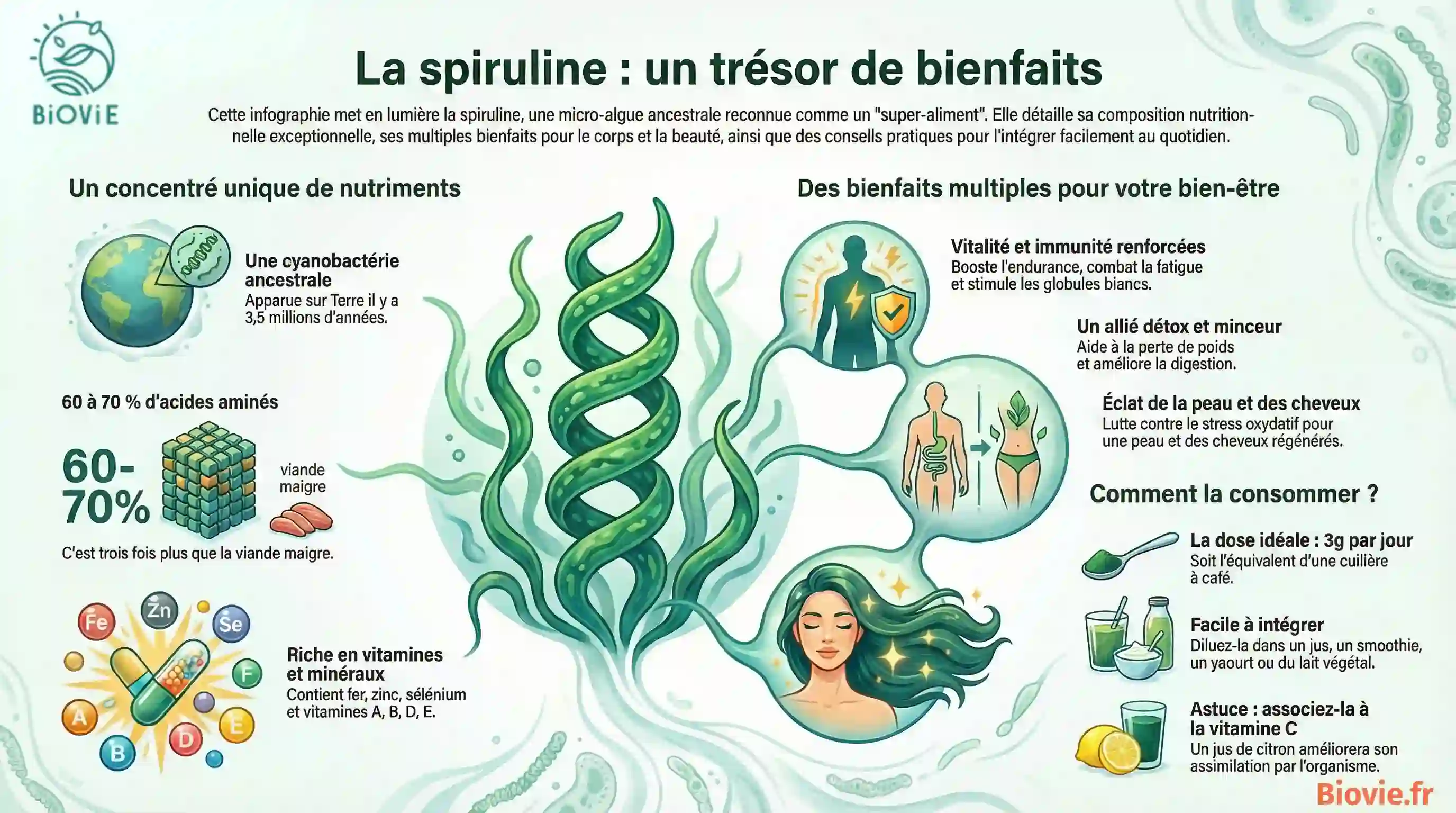
Rich in iron : it's not enough for it to contain iron, it also needs to be absorbable by the body! Its bioavailability is quite remarkable because spirulina is covered with a polysaccharide-type envelope rather than a cellulosic one. In plants, this cellulosic envelope contains phytates, which can trap iron and reduce its absorption by our body. This is not the case with spirulina.
The available studies on the bioavailability of iron from spirulina are encouraging, and it does not contain substances known to inhibit its absorption.
Finally, in addition to being well absorbed, the iron provided by spirulina is not harsh on the digestive system. With 16.9 mg per 100 g, our fresh block is rich in iron in the sense of European regulation - and Iron helps reduce fatigue and contributes to the normal transport of oxygen in the body.. To delve deeper into the subject: Plant-based iron: why algae outperforms red meat and Iron deficiency: the trio of spirulina, chlorella, and marine plasma.
Full of vitamins and minerals : andIt is distinguished by its content of minerals and trace elements (iron, zinc, selenium) as well as provitamin A (beta-carotene), B-group vitamins, and vitamin E. In its dry state, spirulina contains 60 to 70% protein, which is about three times more than lean meat of the same weight. In its fresh form, with the water not removed, the slab provides 17.6 g of protein per 100 g - as much as an egg, without cooking or processing. It also contains copper, zinc, and magnesium. Our article on the complete plant proteins Detail the amino acid profile.
Rich in pigments : Spirulina naturally concentrates several pigments and compounds that are the subject of active research - its phycocyanin (the blue pigment, 5695 mg per 100 g here), from ssuperoxide dismutase and beta-carotene, primarily. These molecules are sensitive to heat and light: the fresh form, having undergone neither drying nor heating, reaches you without having gone through these processes.
Two articles to delve deeper, without beating around the bush: Phycocyanin, proven benefits and dosages and Phycocyanin: is there a danger ?
Rich in chlorophyll : it is what gives spirulina its deep green color. And then there's a point that is often overlooked - spirulina has the ability to absorb heavy metals present in its cultivation environment. This is why it is essential to know where it comes from, to ensure it is not already laden with pollutants before entering your body. Our producer operates in closed ponds, with certified organic farming, in the North of France. That's why we emphasize so much on the traceability and control of microcystins.
For whom ? PAlmost everyone, or nearly so. Nutritional density, iron content, proteins, and pigments: spirulina can be incorporated into the daily diet of anyone, including seniors, as part of a varied and balanced diet.
Among athletes, the main argument remains iron - Iron contributes to the normal transport of oxygen in the body and to the normal formation of red blood cells. - to which is added a supply of complete plant proteins. It's concrete, measurable, and there's nothing magical about it.
On more debated topics, we prefer to refer you to studies rather than promise anything: Spirulina and weight loss, what studies reveal, , Spirulina and Immunity: 12 Studies Examined and chronic fatigue and lack of energy.
In cosmetics : theSpirulina is also used externally, as a mask, and it's a practice that many are discovering with pleasure. Its content of vitamin E, zinc, selenium, essential fatty acids, and beta-carotene makes it an ideal ingredient for homemade preparations applied to the skin or hair. Honestly, a fresh block is much easier to mash with a fork than a powder that needs rehydrating.
For the recipes and protocols, everything is detailed here: Spirulina and Hair, the Complete Guide, , Spirulina and hair: composition and results and Spirulina and tanning: preparing your skin for the sun.
🟩 Find the recipe for a on our blog Coco Spirulina After-Sun Mask ! !
This cyanobacterium also has benefits for the planet, as it performs photosynthesis. Indeed, it captures CO2 from the atmosphere and releases oxygen throughout its growth. Cultivated in ponds, without arable land, without plowing, and without long-distance transport: a way to produce proteins with a very low carbon footprint ;)
🟩 To learn more about its benefits, also check out our blog articles:
What is the price of spirulina ?
How to consume spirulina ?
Spirulina and microcystins: check the quality !
Spirulina: The Complete Guide to Scientifically Proven Benefits
Spirulina and Weight Loss: What Scientific Studies Reveal
Spirulina and Immunity: How to Strengthen Your Natural Immune System
Phycocyanin: benefits, dangers, and complete guide 2026
Blue spirulina: what is it and why is it being talked about so much ?
12 effective tips to mask the taste of spirulina
ETIKA SPIRULINA
Shilhi manages the NGO Etika Spirulina Philippines, which offers the establishment of low-tech and sustainable spirulina micro-farms and the training of local populations to democratize access to this super nutritious food.
Producing ecologically in Northern France: Xavier, on the other hand, the son of organic farmers, has always wanted to commit to a sustainable food transition and organic farming that would return to the heart of cities. Upon his return to France, he experimented with low-tech ponds of this green cyanobacteria on his parents' farm before joining an urban farm in Roubaix to launch larger productions and perfect their techniques: they managed to increase the shelf life of fresh spirulina from 2 days to 10 days, in a 100% natural way, thanks to strict production hygiene. A small revolution for the sale of this precious green paste !
Transmission of knowledge: After successfully producing high-quality spirulina in Northern France in a sustainable and ecological manner, while preserving its nutritional properties, Xavier is launching his own urban spirulina farm through a participatory project, and he goes even further: he is building an educational farm to share all this expertise. Cooking workshops, harvesting workshops, as well as training in low-tech family farming, everything is designed to spread the secrets and benefits of this extraordinary superfood to as many people as possible.
🟩 What does an urban and local micro-farm involve?
Waste management (everything is designed to be recycled or reused), reduction of energy footprint by choosing low-consumption appliances, solar panels, composting, wooden construction, eco-friendly packaging (compostable or reusable), natural cleaning products, bicycle delivery for the Lille metropolitan area…
🟩 Etika Spirulina has also partnered with local artisans to bring spirulina to unexpected places: soap, honey, beer, and even spirulina mochis! A true democratization of spirulina as an everyday food is underway.
🟩 Frankly, this is exactly the type of supply chain we have been looking for since 2007 at Biovie: short, traceable, certified organic, and supported by people we know and visit on-site. A microalgae produced in Roubaix and delivered to your home in a few days is also a very concrete answer to the question of transport and freshness. And if you're interested in the topic of algae supply chains, we discuss it at length in our podcast. Seaweed in everyday life.
Packaging : 400g slab.
Ingredients : 100% fresh spirulinaArthrospira platensis), certified organic farming.
DDM : 10 days in the refrigerator
Storage method : in the fridge at 4°C.
Recommended serving : 20 g per day, or 20 servings per block.
Delivery : shipped via Chronofresh once a week from the production site (separate package from your Biovie order), you will receive your spirulina at your home on Saturday morning.
Average nutritional values per 100g:
| Nutrient | Per 100 g | For a 20 g serving | % NRV* for 20 g |
| Energy | 402 kJ / 95 kcal | 80 kJ / 19 kcal | 1% |
| Fats | 1.5 g | 0.3 g | - |
| Saturated fatty acids | 0.8 g | 0.16 g | - |
| Carbohydrates | 2.8 g | 0.56 g | - |
| No sugars | Traces | Traces | - |
| Proteins | 17.6 g | 3.5 g | - |
| Salt | 0.51 g | 0.10 g | - |
| Iron | 16.9 mg | 3.4 mg | 24% |
| Magnesium | 51 mg | 10.2 mg | 3% |
| Beta-carotene | 70 mg | 14 mg | - |
| Phycocyanin | 5,695 mg | 1,139 mg | - |
* NRV: Nutrient Reference Values (Regulation EU No 1169/2011). No NRV is established for beta-carotene and phycocyanin.
🟩 Frequently Asked Questions About Fresh Spirulina
How much fresh spirulina should be taken per day ?
The recommended portion is 20 g of fresh spirulina per day, which is equivalent to a good tablespoon, or 20 servings in a 400 g block. This amount provides 3.4 mg of iron, which represents 24% of the reference nutritional values. If you are starting, begin with 5 to 10 g for a week, then gradually increase - each at their own pace.
What is the difference between fresh spirulina and spirulina powder ?
Fresh spirulina is simply pressed to remove excess water, without any drying or heating steps: it retains its creamy texture, enzymatic activity, and a neutral taste. Powdered spirulina, on the other hand, is dehydrated, making it much more concentrated by weight (60 to 70% protein compared to 17.6 g per 100 g when fresh) and more pronounced in taste. Practically, the two are not consumed in the same way: the fresh block is cooked like a food, while the powder is measured like an ingredient.
Does fresh spirulina really have a neutral taste ?
Yes, and that's what is most surprising. Fresh spirulina doesn't have the pronounced iodine taste associated with spirulina powder: it provides a very mild umami note, almost imperceptible, which acts as a flavor enhancer in both savory and sweet preparations. This is actually the number one reason why people put off by the powder opt for the fresh version.
How long does a block of fresh spirulina last ?
The cobblestone is preserved 10 days in the refrigerator at 4°C (Best before date indicated on the packaging). Cooked with olive oil or honey, which act as natural preservatives, the preparation can be kept fresh for 15 to 20 days. This duration of 10 days - compared to 2 days for standard fresh spirulina - is achieved in a 100% natural way thanks to strict production hygiene at our producer's facility.
Can fresh spirulina be cooked ?
No, it is better to avoid heating it. The pigments and enzymes in spirulina are sensitive to heat: it is therefore added at the end of preparation, cold or on a warm dish. Toasts, guacamole, vinaigrettes, hummus, dessert creams, tiramisu: it can be incorporated everywhere, as long as it doesn't go through the pan.
What can fresh spirulina be paired with to better absorb iron ?
Pair it with a food rich in vitamin C: lemon, orange, kiwi, raw bell pepper, parsley. Vitamin C enhances the absorption of non-heme iron from plant sources. A simple squeeze of lemon on your spirulina toast is enough - and as a bonus, it further lightens the texture.
Who should be cautious with spirulina ?
Spirulina is not recommended for individuals with hemochromatosis or phenylketonuria, and special caution is advised in cases of anticoagulant treatment, autoimmune disease, kidney disorders, as well as during pregnancy and breastfeeding. In all these cases, consult your doctor before starting. For everyone, it is better to choose spirulina with known origin and analyses: this is the focus of our article on the control of microcystins.
How can a fresh product be delivered to your home ?
Fresh spirulina leaves every Thursday, right after the harvest, by Chronofresh (refrigerated transport), for delivery on Saturday morning. Therefore, you must order before Tuesday at 6 p.m. The package is shipped directly from the production site, separately from the rest of your Biovie order, and the shipping costs are already included in the price. Delivery in France only.
Warning: The information presented in this document is provided for informational purposes only and does not constitute medical advice. Consult a qualified healthcare professional before making any changes to your diet or supplementation. As part of a varied and balanced diet and a healthy lifestyle.
Update: August 2026. Article approved by Éric Viard, founder of Biovie and engineer ISTOM, co-author of Seaweed in everyday life (Gallimard, 2024) - Best cookbook in the world, Gourmand Cookbook Awards 2025, and Best cookbook in France, National Academy of Cuisine 2025.
Wondering… ?
Everything you need to know before ordering.
Be the first to ask a question about this product!
Question about the product
Ask a question