Phycocyanin made in France: what are the benefits of this pigment?
Phycocyanin: benefits, uses and how to take blue spirulina
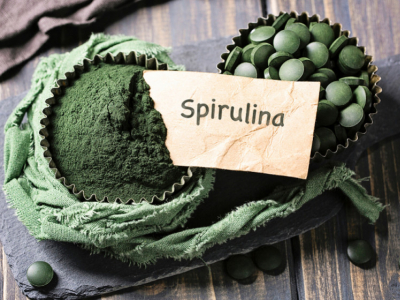
Phycocyanin is the blue pigment from spirulina: a coloured, naturally antioxidant protein that we extract from this micro-algae and concentrate. In plain terms, it is what gives spirulina its blue-green shimmer. You will also see it sold under the name "blue spirulina". It comes as a powder, dosed in grams, prized for its antioxidant properties - and, quite simply, because it turns a smoothie a spectacular shade of blue, with no taste and no additives. After more than thirty years in living foods, I can tell you that few foods make such an impression in a glass.
This is an article I cared about writing. Because there is a lot floating around about phycocyanin - some true, some overblown, and a fair bit of nonsense. My goal here is not to sell you a dream. It is to explain what this pigment actually is, what the science says today, how to choose it, and above all how to fit it into your everyday life without overcomplicating things.
So let us go round it together. What it is, where it comes from, what it is good for, which form to favour, and three or four raw recipe ideas to start using it this week. No dogma. Everyone at their own pace.
Phycocyanin is a blue pigment-protein found in spirulina (Arthrospira platensis). Its name comes from the Greek: phyco (algae) and cyan (blue). It is this pigment that, mixed with green chlorophyll, gives spirulina its famous blue-green hue. Isolated, it turns an intense blue - a rare blue in the food world, where nature mostly produces red, orange and green. This is why concentrated phycocyanin is often marketed as "blue spirulina": same molecule, catchier name.
Here is something that always surprises people: this deep blue is in fact a protein. Not a synthetic dye, not a mineral. A living, fragile molecule that belongs to the phycobiliprotein family. Inside the spirulina cell, it works as a light-capturing antenna for photosynthesis. We recover it by gently breaking open the cells, then concentrating the pigment.
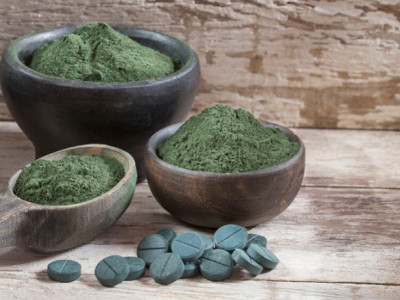
And where does spirulina fit in all this? Let us say spirulina is the complete food - protein, iron, beta-carotene - while phycocyanin is its coloured, concentrated extract. One nourishes broadly, the other targets one property. Plenty of people mix the two up, and that is perfectly normal. The short version: spirulina is the whole micro-algae, "blue spirulina" (phycocyanin) is the blue part pulled out and concentrated.
So, let us talk about those famous phycocyanin benefits - also searched as blue spirulina benefits. And let us be honest from the outset: this pigment is studied closely, the data keep stacking up, but we are still dealing with research - often in vitro or in animals, sometimes clinical. I will give you what we know, without overplaying it.
Its best-documented strength is its antioxidant power. A scientific review published in 2023 (Fernandes et al.) examined the properties of C-phycocyanin and, according to the study, confirms a notable capacity to neutralise certain free radicals - those unstable molecules that wear our cells down over time. That is argument number one, and it is solid.
Next comes the anti-inflammatory angle. Research (Liu et al., 2022) describes how phycocyanin may help modulate certain markers of inflammation at the cellular level. Another synthesis (Jiang et al., 2017), published around its biomedical applications, points in the same direction - while reminding us, and this matters, that most of these results still need confirmation in humans. That is where we stand: promising, not demonstrated as a treatment.
Personally, what interests me most is the felt effect in daily life. Many people describe, after a few weeks, a steadier kind of tone - not the jolt of a coffee, more of a background energy. Is it measurable in a lab? Not clearly yet. Do thousands of people report it? Yes. I am giving it to you as a field observation, not as a promise.
A word of caution, because I hold to that honesty. Phycocyanin is not a medicine. It cures nothing, it replaces no treatment. It fits within a varied and balanced diet, as a support - not as a miracle solution. Picture it less as a remedy and more as a coloured ally you add to your plate.
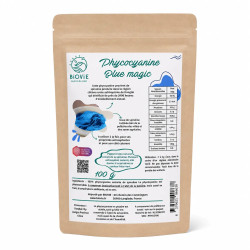
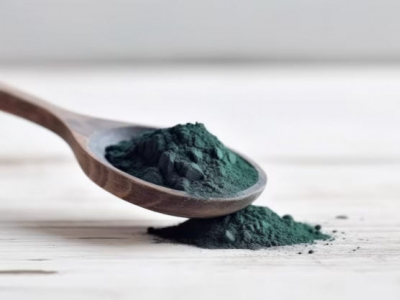
Fancy testing it for yourself? The phycocyanin we offer here at home comes as a powder, simply dosed at the tip of a spoon. It is the most versatile form, and by far the most economical to use.
How to choose a quality phycocyanin (blue spirulina)
Here is a real question, and one too rarely asked. Not all phycocyanins are equal, and the price per gram often hides huge differences in concentration. So, what should you actually look at?
First, the pigment concentration. This is the king of criteria. It is sometimes expressed through a purity ratio (phycocyanin compared to the other proteins). The higher it is, the more concentrated and active the extract. A heavily diluted powder will cost you less per pot, but a great deal more per gram of actual pigment. Compare like with like.
Next, the extraction method. A gentle cold extraction preserves the molecule - which is fragile, as I keep saying. Heat, on the other hand, degrades the pigment and makes it lose both its colour and its properties. A bright, deep blue is a good sign; a dull, greyish blue, much less so.
Third point: traceability and the quality of the source spirulina. Phycocyanin is only ever as good as the spirulina it comes from. Clean cultivation, testing for heavy metals and contaminants, ideally organic certification: these are the safeguards that count. Do not be swayed by an origin claim that sounds good on the label - what matters is the analysis, not the flag.
Honestly, it is common sense. You choose a phycocyanin the way you choose an olive oil: by concentration, by method, by how transparent the producer is. The rest is marketing.
How to use phycocyanin
Now for the practical part. This is where it all gets simple, and even a little playful.
Forms and dosage
Biovie phycocyanin comes as a powder, dosed in grams. A small dose is enough: generally we are talking of the order of one gram a day, the equivalent of a tip to half a teaspoon, to be adjusted according to the product and its degree of concentration. Always refer to the indication on the product sheet, because a highly concentrated extract is dosed more finely than a standard powder.
An important note on formats. You will come across liquid phycocyanin on the market, sometimes in little bottles. It exists, that is true. At Biovie, we have chosen powder: more stable, more concentrated, more flexible to dose, and far more economical day to day. No tablets, no capsules, no ampoules - just the pigment, as a powder, that you fold into whatever you drink or eat.
The right reflex: you stir it into cold or lukewarm preparations. Never into a scalding drink, which would destroy the pigment (and its lovely colour along with it). Cool water, a juice, a smoothie, a plant yoghurt: those are its playgrounds.
Raw recipe ideas
Three ways to enjoy it, tried and approved at home:
The cold "blue latte": a tip of phycocyanin in a glass of fresh plant milk (almond or coconut), a little agave syrup, give it a stir. Lagoon blue, zero artificial colouring.
The energy smoothie: banana, coconut milk, a spoon of almond butter, and the phycocyanin as a finishing touch. My children call it the "smurf smoothie".
Iced beads: dilute the phycocyanin in a little water, pour into an ice-cube tray, and drop a blue cube into a homemade lemonade. Guaranteed effect at drinks time.
You get the idea. It is playful, it has no marked taste, and it turns an ordinary glass into something that catches the eye. Living cuisine, for me, is also this: pleasure and colour.
Phycocyanin as a natural blue food colour
And since we are talking colour, this may be the most underrated use of all. Phycocyanin is one of the rare 100% natural blue food colours available in the kitchen. Where industry reaches for synthetic blue (the well-known E133), you have a plant-based alternative on hand, drawn from a micro-algae.
An analysis published in a scientific journal (referenced below) highlights the growing interest in C-phycocyanin as a natural food colorant, replacing artificial blues. Icings, creams, drinks, raw pastries: anywhere you dreamed of a bright blue without additives, it does the job. One rule only, always the same: no high-temperature cooking.
If you had to start with just one thing, I would say: grab a small pot of powder and have a go at the morning blue latte. It is the simplest test there is - and trying it is usually adopting it.
Your questions, our answers
What is phycocyanin and where does it come from?
Phycocyanin is the blue pigment-protein naturally found in spirulina (Arthrospira platensis). It is obtained by extracting and concentrating this pigment from the micro-algae. It is the molecule that gives spirulina its bluish shimmer, and in concentrated form it is sold as "blue spirulina". Its quality depends above all on the concentration of the extract and the cleanliness of the source spirulina, not on any particular geographic origin.
What is phycocyanin good for?
Phycocyanin is recognised mainly for its antioxidant properties, meaning its capacity to neutralise certain free radicals, as confirmed by a 2023 review (Fernandes et al.). Research also explores anti-inflammatory avenues, but most still needs confirmation in humans. It fits within a varied and balanced diet, as an antioxidant support - not as a treatment.
What is the difference between spirulina and phycocyanin (blue spirulina)?
Spirulina is the complete food: a micro-algae rich in protein, iron and beta-carotene. Phycocyanin is only one component of it: the blue pigment, extracted and concentrated, which is why it is sold as "blue spirulina". In short, spirulina nourishes broadly, while phycocyanin targets one specific property - its antioxidant power and its colour. One does not replace the other.
What are the side effects or disadvantages of phycocyanin?
Phycocyanin is generally well tolerated. As a precaution, it is not recommended for pregnant or breastfeeding women, young children (under 6), people with autoimmune conditions, hyperparathyroidism or gout, unless on medical advice. An overdose may cause mild digestive issues. When in doubt, ask a healthcare professional before supplementing.
How do you use phycocyanin as a natural blue food colour?
The simplest way is to add the powder to a cold or lukewarm preparation: water, juice, smoothie, plant yoghurt, plant milk, icings or raw pastries. Always avoid hot drinks and high-temperature cooking, which destroy the pigment. A tip of a spoon is enough to obtain a bright blue, making it a natural alternative to synthetic blues such as E133.
Is phycocyanin suitable for vegan or raw diets?
Absolutely. Phycocyanin comes from a micro-algae, so it is 100% plant-based, and it is used cold: it suits a vegan diet as well as a raw-food approach perfectly. It is even one of the rare natural blue colours compatible with living cuisine, with no cooking and no synthetic additives.
There you have it. You now know what phycocyanin is, what you can expect from it, how to choose it and how to use it without overcomplicating your life. Remember the essentials: a blue pigment, antioxidant, in powder form, dosed in grams, in cold preparations. The rest is pleasure and colour. Trying it is adopting it!
Disclaimer: the information presented in this article is provided for informational purposes and does not constitute medical advice. Consult a qualified healthcare professional before any change to your diet or supplementation, in particular in case of pregnancy, breastfeeding, ongoing treatment or an autoimmune condition. As part of a varied and balanced diet and a healthy lifestyle.