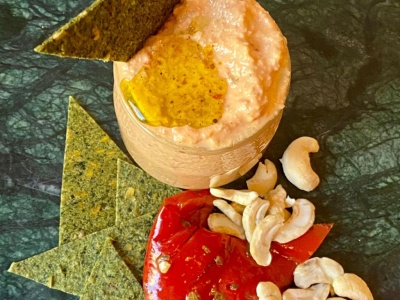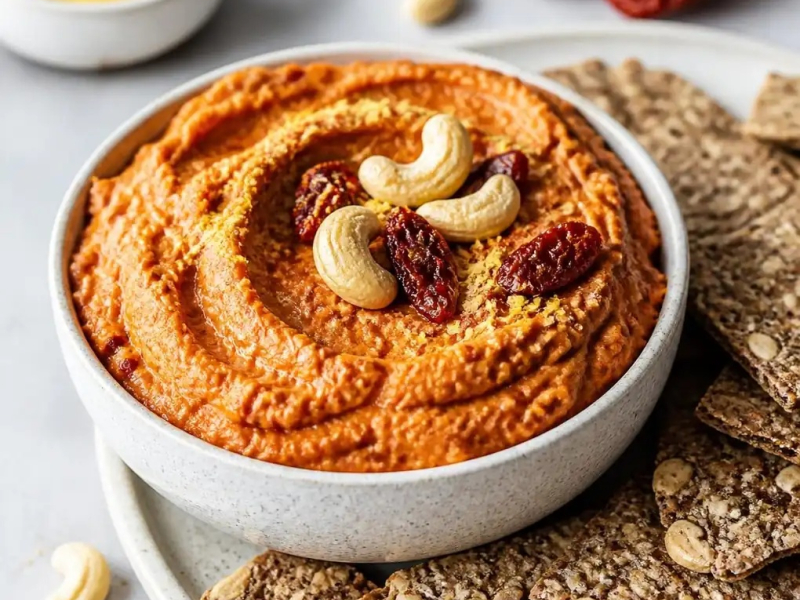


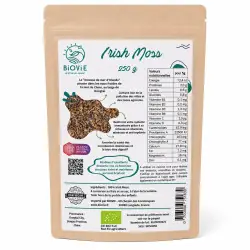

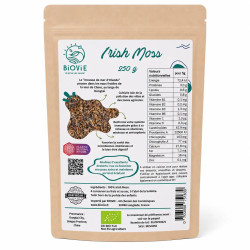
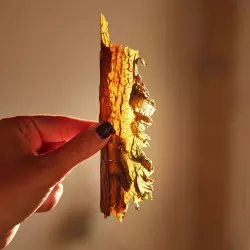
A fully raw pizza night, built from three separate preparations: a rich sun-dried tomato sauce, a dehydrated buckwheat crust, and a fermented vegan mozzarella with just the right tang. The result comes surprisingly close to the original. It takes patience, since both the crust and the cheese need time to come together, but very little active work - most of it happens while you're doing something else. Irish moss, a red seaweed, acts as the binder here: rehydrated and blended, it produces a neutral gel that gives structure to both the crust and the cheese, with no gelatin or dairy involved.
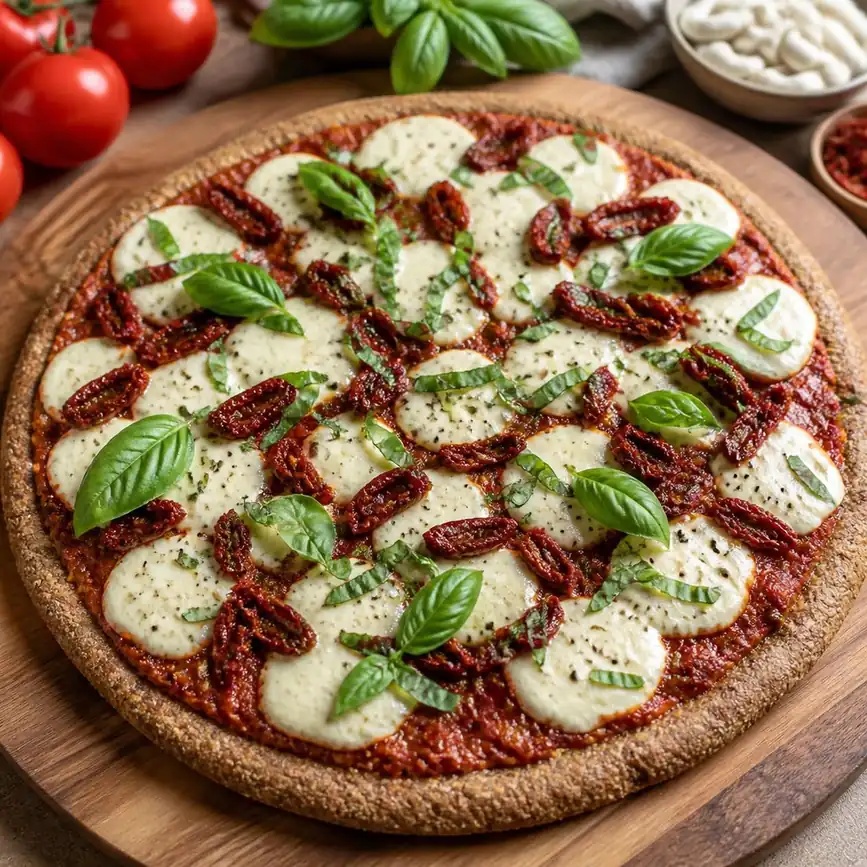
Raw Pizza with Sun-Dried Tomatoes and Vegan Mozzarella
Share this article
Ingredients
Sun-Dried Tomato Sauce
- 4 cups sun-dried tomatoes
- 12 cl filtered and hydrogenated water
- 12 cl olive oil
- 3 garlic cloves
- 1 tablespoon basil
- 1 tablespoon oregano
- 1/2 teaspoon sea salt
- The juice of half a lemon
Pizza Crust
- 3 cups buckwheat groats, soaked then dehydrated
- 1 cup psyllium husks
- 1 teaspoon sea salt
- 50 cl filtered and hydrogenated water
- 12 cl olive oil
- 12 cl Irish moss gel
- 1 tablespoon honey
- The juice of one lemon
Vegan Mozzarella
- 1 cup young coconut meat (about 2 coconuts)
- 1 cup cashews
- 6 cl Irish moss
- 1 teaspoon salt
- 1/4 teaspoon powdered starter culture (a kefir starter works very well)
- The juice of half a lemon
Preparation
The Sauce
- Blend all the sauce ingredients in a food processor until smooth. It should stay thick and rich; if it's too stiff to work with, loosen it with a splash of water, added very gradually.
The Crust
- Grind the buckwheat groats, psyllium, and salt together into a fine flour.
- Separately, blend the liquid ingredients for the crust.
- With the processor running, pour the liquid mixture in a thin stream over the flour and let it run until you get a smooth dough.
- Spread it out on a work surface dusted with buckwheat flour, as you would a classic pizza dough, shape it to fit your dehydrator tray, and dehydrate for 24 hours at 40°C.
The Mozzarella
- Blend all the cheese ingredients until perfectly smooth.
- Line a strainer set over a deep bowl with a cheesecloth (or a thin kitchen towel), making sure the bottom of the strainer doesn't touch the bottom of the bowl.
- Pour in the mixture, gather up the cloth, and twist it closed.
- Let it sit somewhere warm, for example on top of a running dehydrator, for about 24 hours. You'll get a soft cheese with a pleasant tang.
- Divide it into four, roll each portion into a ball, then slice it to top the pizza, or simply dot small spoonfuls across the surface.
Assembly
- Toss your vegetables of choice with a little olive oil and salt, and let them marinate for about thirty minutes.
- Assemble the pizza: sauce, mozzarella slices, marinated vegetables.
Tip
Don't try to shortcut the cheese's fermentation: that's what gives it its tang and sets it apart from a simple cashew cream. Twenty-four hours somewhere warm is a minimum, and the taste should be judged with a spoon, not a clock.
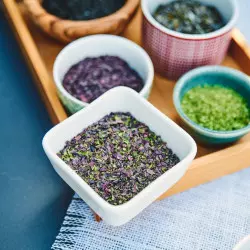
The full range Dry algae
10 products
FAQ: your questions about raw pizza and vegan mozzarella
How do you make a simple vegan pizza?
The quickest version is to keep a store-bought cooked base and only swap out the topping: tomato sauce, vegetables, and a vegan cheese. The version shown here goes further, with a raw dehydrated buckwheat crust, but there's nothing stopping you from starting with just the sun-dried tomato sauce and the cheese, which are made independently of each other.
How do you make vegan cheese?
The principle: a finely blended fatty base, a texturizing agent, and, for aged versions, fermentation. Here, cashews and young coconut meat form the base, Irish moss gives it body, and a kefir starter works on the mixture for twenty-four hours. It's this last step that brings the characteristic tang.
What ingredients are used to make vegan cheese?
Most often soaked nuts (cashews, almonds, macadamia), sometimes coconut, plus a binder: Irish moss, agar-agar, starch, or psyllium depending on the result you're after. Add to that salt, an acid (lemon, vinegar), and, for aged cheeses, a starter culture: kefir starter, probiotic capsule, rejuvelac, or koji.
How is faux cheese made?
The word simply refers to a cheese made without animal milk. The process follows the same logic as regular cheesemaking, just swapping the raw material: you start from a plant-based emulsion instead of milk, inoculate it, let it ferment, then drain it through a cheesecloth. That's exactly the method described above.
Share this article
Related articles