Green Montmorillonite Clay: How to Choose It and Use It With Care
Stirred into a bowl of water, green montmorillonite clay swells like a sponge: it is a smectite, a clay made of sheets that holds ions on its surface, chosen for its texture and used as a mask or poultice on the skin; for drinking, no health claim is authorized. At Biovie, we built this page on published sources, from scientific journals to ANSM notices.
On 17 September, we were asked a very simple question: which green clay should you choose? Over the years you forget the basic questions, which is a shame, because they are often the most valuable. This one can't be settled in a single line. Type it into Google: the first pages line up shop listings where the clay is "purifying" or "remineralizing", with no source and no named author. I'd rather start from the beginning, with what a montmorillonite really is.
What is green montmorillonite clay?
For an agronomist, clay is first a matter of soil, long before it is a matter of bathroom shelves. As an ISTOM-trained engineer, I have met it again since 2007, at Biovie, in a more domestic form: a powder you stir into a bowl. A clay is a stack of mineral sheets so thin that you can see them neither with the naked eye nor with a magnifying glass. In green montmorillonite clay, which belongs to the smectite family, water slips in between those sheets. And it swells (Moraes et al., 2017).
Picture a mille-feuille pastry whose every layer could drink up water and take on its faces tiny, electrically charged passengers: ions. This is what specialists call cation exchange capacity: the surface of the sheets holds ions and can swap them with the medium around it. The larger the surface on offer, the more seats on board.
For cosmetics, the review by Moraes and colleagues singles out four properties: specific surface area, that same exchange capacity, rheology (in other words, how the paste spreads and dries, which is what separates a pleasant mask from a plaster that cracks) and particle size. These are physical, measurable properties that can be compared from one clay to another. Not virtues, measurements.
The name comes from Montmorillon, in the Vienne, where this clay was described, and the one we offer at Biovie comes from Mont Ventoux, unheated. "Unheated" simply means that it has not undergone any industrial heat treatment. Nothing more, nothing less. I point it out because this kind of mention soon sounds like a promise printed on a bag, and it is not one.
Montmorillonite, illite, rassal: which clay should you choose?
Montmorillonite and illite are two green clays made of sheets. Montmorillonite, a smectite, swells strongly in water and holds more ions; illite swells little. The choice depends on the texture you want and on your skin type; neither has a higher "power" than the other (Moraes et al., 2017).
The trap is the color. "Green clay" is really a shade, much as "red wine" names a color and not a grape variety: illite and montmorillonite are two mineral species that both wear it. Hence the question that keeps coming up in searches: green clay, illite or montmorillonite?
Clay
Family
Behavior in water
Biovie product
Montmorillonite
Smectite, a clay with swelling sheets
Swells strongly: water slips in between the sheets
In short, it all comes down to behavior in water. For a paste that swells and holds a lot of water, montmorillonite is the logical choice; if you prefer a clay that swells little, look at illite.
None of these clays is "better" in the absolute, and your skin will have the last word. We have explained elsewhere how to choose your clay according to your skin type; and if rassal, a Moroccan clay traditionally used for washing, intrigues you, read the benefits of rassal clay in a dedicated article.
In cosmetics, clays are used for their ability to absorb water and grease, and for their texture, which forms a paste that is easy to apply (Moraes et al., 2017). Nothing new under the sun, by the way. They have long been found in spa therapy and aesthetic medicine, as masks and poultices, a practice that specialists call pelotherapy (Carretero, 2002).
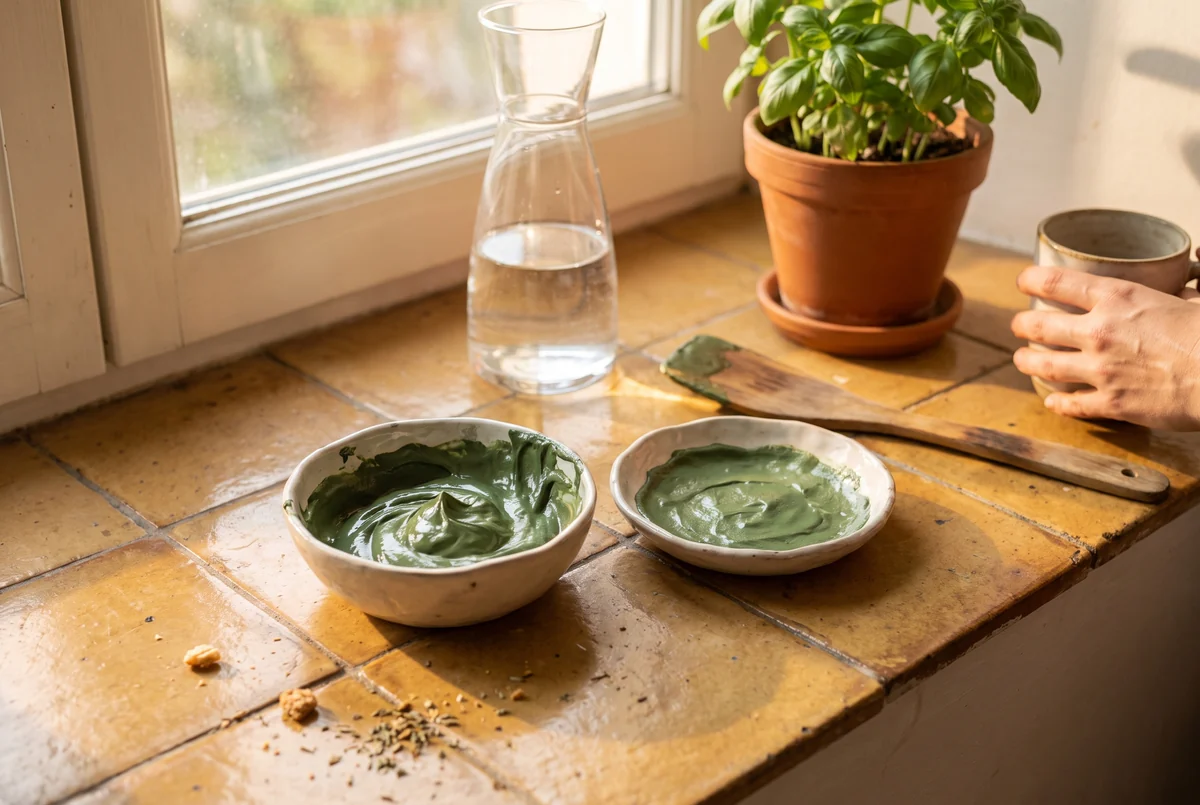
In daily life, green montmorillonite clay is used in two simple ways: as a mask on the face or hair, or applied as a poultice on the skin, mixed with water until it forms a paste. I deliberately stick to these descriptive words: used as a mask, applied as a poultice. You may find me timid. But words like "purifies" or "heals" have no place on a cosmetic clay, and doing without them does the clay no harm: it does not need powers lent to it to be useful.
for a toddler, see the article on white clay for babies, which is specifically about white clay.
A cosmetic clay remains a skin-care product: pain or inflammation calls for medical advice.
Can you drink green montmorillonite clay? What we know, what we don't know
Here we are. It is also one of the most frequent searches: drinking green montmorillonite clay. So, can you really drink it? In this article I present our clays for external use only, and nothing that follows is a recommendation to take one as a course. That does not stop me from telling you honestly what the authorities and the studies say.
Medicinal clay and clay sold as food: two different statuses
In France, several clays are medicines, regulated by the ANSM: diosmectite, attapulgite, beidellitic montmorillonite, kaolin. On 28 February 2019, in a recommendation updated on 16 March 2021, the agency asked that they no longer be used in children under 2 years old, as a precaution, because of the possible presence of traces of lead from the clay itself. Yes, from the clay itself: we are back to the soil, once again.
The ANSM specifies that a study in adults who took these medicines for 5 weeks showed no passage of lead into the blood, and that it is not aware of any case of lead poisoning linked to them. In plain terms, the precaution is aimed first at toddlers, and the agency does not describe a proven risk in adults. Diosmectite is not recommended for pregnant or breastfeeding women, and the other medicinal clays are reserved for adults.
Two statuses, two worlds. A clay sold as food or as a cosmetic product has no authorized health claim in the European Union, even when consumed as part of a varied and balanced diet and a healthy lifestyle.
What the trial in Ghana shows
One human trial deserves a closer look, because it is a serious one. It was carried out in Ghana, in a population heavily exposed to aflatoxins, toxins produced by molds on cereals and peanuts. It was a randomized, double-blind, placebo-controlled trial: neither the participants nor the researchers knew who was receiving the clay, which keeps the expectation of an effect from skewing the result.
Of 507 people screened, 177 were randomly assigned to a placebo, 1.5 g or 3 g per day of a processed calcium montmorillonite clay, for 3 months, and 162 completed the trial (Afriyie-Gyawu et al., 2008). To picture the sample size, think of a university lecture hall: a trial of modest size, known as phase IIa.
On tolerability, mild to moderate adverse effects (nausea, diarrhea, heartburn, dizziness) were noted over about 0.5% of person-time, with comparable frequencies in the three groups, placebo included. Put differently: across all the days accumulated by all the participants, these discomforts stayed rare, and no more frequent with the clay than with the placebo.
At 3 months, the blood markers of aflatoxin exposure (AFB1-albumin adducts) were significantly lower in both clay groups, meaning a gap that chance alone explains poorly; in urine, the AFM1 marker fell by up to 58% in median value in the 3 g group (Wang et al., 2008). A little over half less, then, on a mere marker of exposure. Blood vitamins A and E did not move, and minerals stayed stable, except for strontium, which rose in the 3 g group (Afriyie-Gyawu et al., 2008).
So of course, I understand reading these results with enthusiasm. What the trial does not prove matters as much as what it shows: it concerns one specific, purified and controlled clay, in a population exposed to aflatoxins, and it measures biological markers of exposure, without assessing any health benefit. It says nothing about a store-bought green clay taken "as a course", by the spoonful and by eye. It is a research lead specific to this trial, and in no way a claim validated by EFSA.
The two points of caution: metals and medicines
First point, metals. On 23 March 2016, the FDA, the American health authority, asked consumers not to use a bentonite clay sold as a powder, after finding high lead levels in its analyses; no case of poisoning had been confirmed at the time. A clay remains a mineral taken from the ground, with whatever that ground contains. This alert concerned one specific product, and that is precisely why origin and analyses matter.
Second point, medicines. Carretero's review points out that clays can alter the bioavailability of medicines taken at the same time, that is, the share of the medicine that actually reaches the body (Carretero, 2002). Go back to the mille-feuille and its seats on board: a surface that holds molecules does not sort between what you would like to let through and the rest.
For internal use, ask a doctor or a pharmacist for advice, especially if you are on medication, if you are pregnant, or if it is for a child. For a historical perspective, you can read our older article drinking your weight in clay over a lifetime with that distance in mind.
How to choose green montmorillonite clay: reading the label
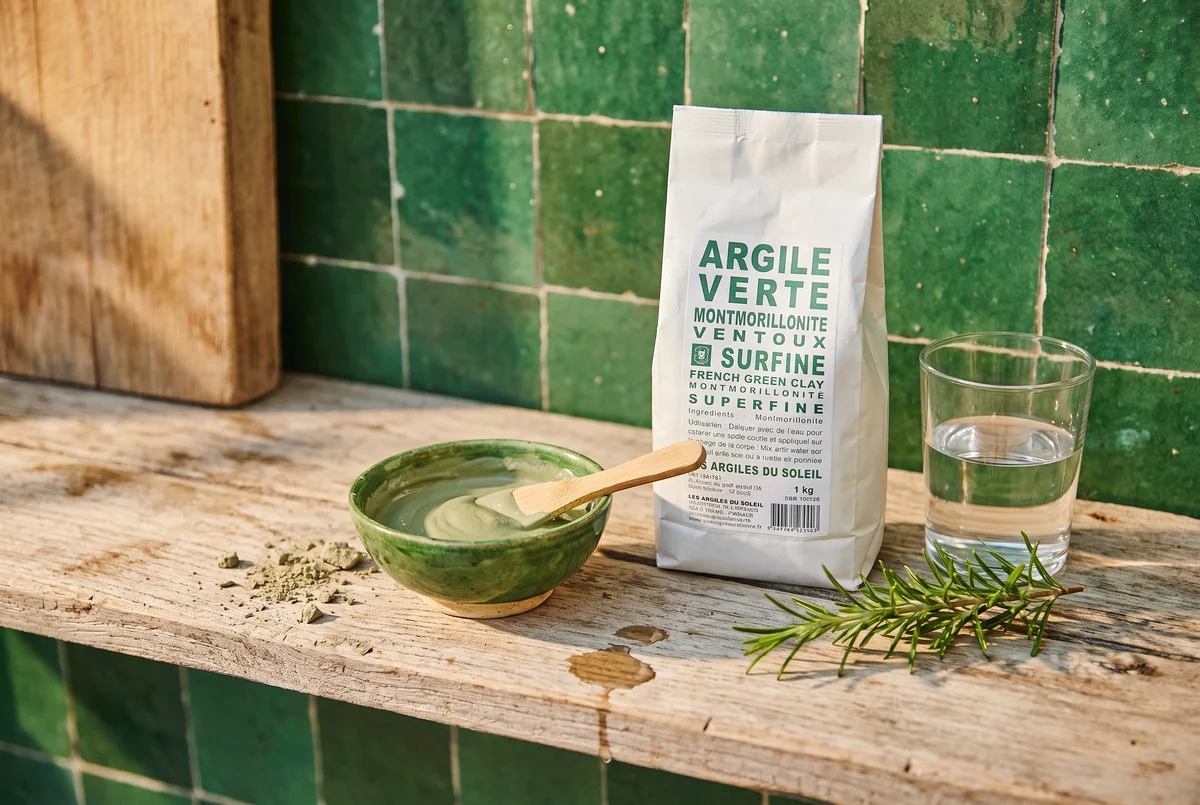
On a bag of clay, a few words always come back, and they say precise things, often more modest than you might think. A clay label reads like a technical data sheet: each mention describes a process, not a virtue.
"Superfine" and "ultra-ventilated" both refer to the fineness of the grinding and sieving of the powder, nothing else.
Unheated means without heat treatment.
The origin points to the deposit the clay was extracted from.
A superfine montmorillonite is simply ground and sieved more finely than another. It is milling, as with flour. Nothing magical in that.
I often say it, a bit bluntly: today, ignorance is a choice. Ask for the origin of the clay and, if internal use is being considered with a healthcare professional, whether heavy-metal analyses are available. Two simple questions, and the answer says a lot about how the product is monitored.
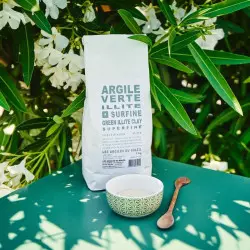
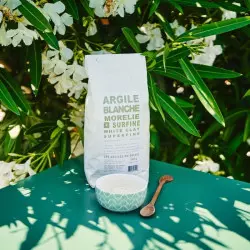
At Biovie, our montmorillonite comes from Mont Ventoux and is unheated; if you are looking instead for a clay that swells little, our unheated illite clay will do, and rassal clay and Morélie clay round out the range. Whatever the clay, the first step is the same: a spoonful of powder, a little water in a bowl, and a test on a small area of skin.
Shop listings will probably not leave the first pages of Google any time soon. So be it: every reader who knows what "smectite" or "unheated" means pulls the market toward more clarity, and that is good news for the clay itself. And if a mention on a bag leaves you puzzled, write to us!
What are the benefits of green montmorillonite clay?
Its strengths are first of all physical: in cosmetics, montmorillonite is used for its ability to absorb water and grease and for its texture, which forms a paste that is easy to apply as a mask or poultice. No health claim is authorized for a consumed clay, and a clay is no substitute for medical advice.
What is the difference between green clay, illite and montmorillonite?
"Green clay" names a color, shared by several mineral species: illite and montmorillonite are two green clays made of sheets. Montmorillonite, a smectite, swells strongly in water and holds more ions on its surface; illite swells little. The choice depends on the texture you are after and on your skin type.
How do you use green montmorillonite clay?
It is used as a mask or poultice on the skin, mixed with water until it forms a paste, after a test on a small area, then rinsed off with water. For proportions and combinations, our green clay mask recipes are gathered in a dedicated article on the Biovie blog.
Is green clay anti-inflammatory?
No claim of this kind is authorized for green clay, whether for external or internal use. Clay is used as a poultice like a cosmetic care product, for its texture and its absorbency; pain or inflammation calls for medical advice, and you should speak to a doctor or a pharmacist.
Can you drink green montmorillonite clay?
Nothing allows us to recommend it: no health claim is authorized for a consumed clay, even as part of a varied and balanced diet and a healthy lifestyle. A trial in Ghana concerned a specific, purified clay, and the ANSM limits medicinal clays according to age: before any internal use, ask a doctor or a pharmacist for advice.
What do "superfine" and "ultra-ventilated" mean?
These two mentions describe the fineness of the powder: "superfine" and "ultra-ventilated" both refer to grinding and sieving, which give particles that are more or less fine. They say nothing about any particular effectiveness; to choose well, also look at the origin of the deposit and any "unheated" mention.
The information presented in this article is provided for information only and does not constitute medical advice. Consult a healthcare professional before making any change to your diet or supplementation.