


Unheated Montmorillonite Clay from Mt Ventoux
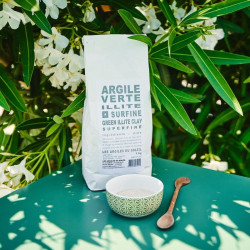
Unheated green Montmorillonite clay, 1kg bag
4
questions about the product
Price:
€10.40
Product availability:
In stock
Tax included


Unheated Montmorillonite Clay from Mt Ventoux images


Mont Ventoux Montmorillonite Clay, 1kg bag
We have been using clay for over twenty years with our six children and we have discovered The Clays of the Sun A few years ago, they became part of our family and travel health kit. We decided to list and offer you these clays, which are truly top quality, in France and perhaps in the world, as we are particularly well-positioned in France for clays.
💚 For more information, also check out our blog articles:
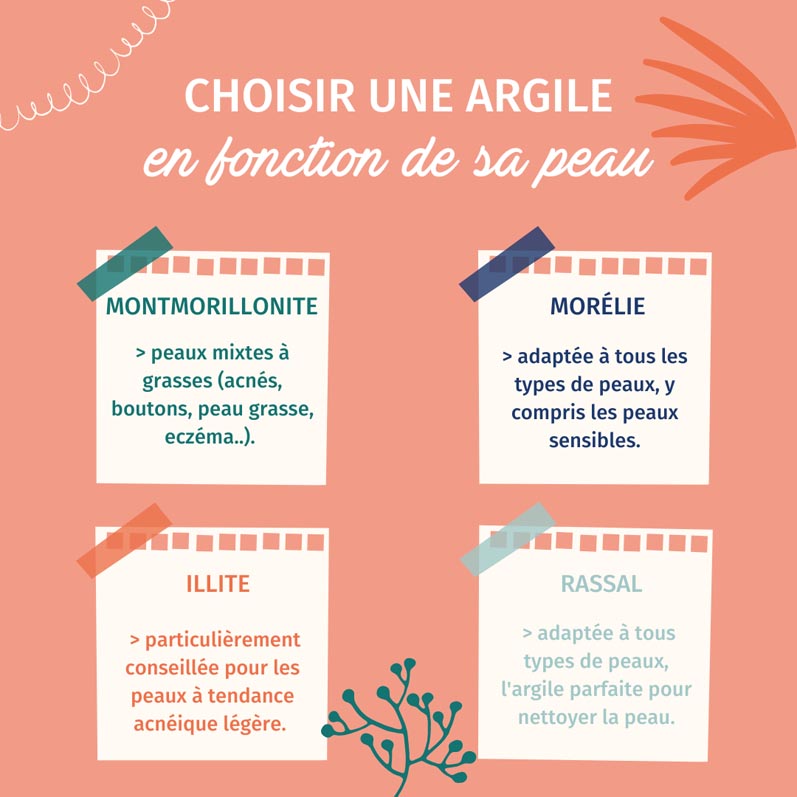
> Clay and Skin Type: How to Make the Right Choice ?
> Green clay face mask: how to achieve perfect skin ?
> How to use clay for your baby ?
💚 The health-related information in the videos below is based on the authors' experience and research. The authors of these videos do not provide any medical advice or prescribe the use of any technique as a medical treatment. We disclaim any responsibility for personal or collective consequences related to the use of the information contained in these videos:
💚 The Argiles du Soleil stand out from the clays typically found on the market and in pharmacies because they are:
- raw without transformation,
- not heated, simply sun-dried,
- unwashed,
- non-ionized,
- not tested on animals.
They therefore retain all their natural properties and their entire exchange surface.
💚 Montmorillonite is a type of green clay of volcanic origin from the smectite family. It is named after Montmorillon, a village located in Vienne where a deposit was discovered in 1847.
Of rare purity, its qualities and attractions are superior to any other green clay.
It has a particularly high concentration of silica (8 silicon atoms per sheet), as well as potassium, magnesium, iron, and manganese. This richness in trace elements and mineral salts, along with its neutral pH, makes it a preferred clay for decongesting, healing, and remineralizing.Montmorillonite is less absorbent than Illite, but much more adsorbent and remineralizing: this means that it particularly retains gases and toxins on its surface like a band-aid, stimulating self-healing through ionic exchanges.
Montmorillonite is also the preferred clay for treating issues with combination to oily skin (acne, pimples, oily skin, eczema, etc.). A cousin of Ghassoul, it is used in the same way. Mixed with a little water to form a paste, its slightly viscous texture makes it more comfortable for the skin than other clays.
> Some examples of the use of Montmorillonite:
- Homemade shampoos and shower gels
- Face mask
- Care for combination to oily skin (add a bit of clay to aloe vera gel to make a facial treatment)
- Oily hair care (add a little clay to your shampoo)
- A natural dressing to close a wound and accelerate healing
- In poultices: joint and muscle pain, bumps, bruises, sprains, burns, insect bites, migraines, abdominal pain...
- In toothpaste for oral health and better integration of orthodontic implants
Anecdote: NASA mentions the presence of Montmorillonite clay on Mars! A team of researchers suggests that this clay could be the catalyst for life on Earth at the level of nucleic acids. [ M. F. Aldersley et coll., 2011 ].
This small business located in Mons in the Gard works exclusively with clays from Vaucluse and Drôme, and provides sun-dried clays without any thermal intervention of absolutely exceptional quality. The Clays of the Sun are exported worldwide and are recommended by Dr. Jade Allègre, THE French specialist in clay. Discover a summary of his medical thesis on the use of clay internally on his site, or else his full thesis.
Environmental and social commitments of Argiles du Soleil:
- Complete sorting of all our waste (cardboard, plastics, plant materials...) ;
- Reduction of waste at the source by reusing packaging and labels transformed into padding for packing orders ;
- All the clays are French and sun-dried, so no mechanical process is involved (Vaucluse and Drôme, thus we reduce the environmental impact of supply and prioritize local jobs).
- For all office supplies and ink, we prioritize sustainable and recycled sources.
- Establishing a partnership for product packaging with French suppliers ;
- We prioritize employing people who live nearby to maximize employee well-being (no long commute to work) and to reduce CO² emissions by offering carpooling. ;
- Non-existence of a wage gap between men and women ;
- Scheduling adjustments to promote external activities (leisure, external work, family...) for everyone.
- Packaging: Available in a 1Kg bag.
Wondering… ?
Everything you need to know before ordering.
Hello there, is this green clay consumable or it's used for bathing?
Hello, We are not legally entitled to advise you to take the clay internally. According to Dr. Jade Allègre, specialist in clay treatment, all clays can be used in this way, the green ones are said to be more detoxifying than the others: Illite and Montmorillonite
Bonjour,
Pourriez vous me confirmer si l'argile montmorillonite peu etre ingéré?
Merci.
Murielle
Pourriez vous me confirmer si l'argile montmorillonite peu etre ingéré?
Merci.
Murielle
Bonjour, Nous n'avons pas le droit légalement de vous conseiller de prendre l'argile par voie interne ; pour cet usage, demandez conseil à un professionnel de santé.
Sur le plan de la texture : l'argile Illite peut contenir de manière normale jusqu'à 5 % de cristaux de quartz. Cela ne pose pas de problème mais donne une sensation de très petits cailloux en bouche. De ce fait, certaines personnes préfèrent une argile surfine comme la Montmorillonite (verte) ou la Morélie (blanche).
Hello can I use your clay to drink?
Hello, We do not have the legal right to advise you to take the clay internally. According to Dr. Jade Allègre, specialist in clay treatment, all clays can be used in this way, green ones are said to be more detoxifying than others: Illite and Montmorillonite. Illite clay can normally contain up to 5% quartz crystals. This is not a problem but gives a feeling of very small pebbles in the mouth. As a result, some people prefer a superfine clay such as Montmorillonite (green) or Morelia (white): https://www.biovie.fr/fr/argiles/361-argile-montmorillonite.html. You can also find information about various uses of clay on our blog: https://www.biovie.fr/fr/blog
Hello!
I d like to know : if your montmorillonite clay is calcium bentonite clay, and how much montmorillonite it contains (is it above 80 per Cent?) Thank you
I d like to know : if your montmorillonite clay is calcium bentonite clay, and how much montmorillonite it contains (is it above 80 per Cent?) Thank you
Bonjour, L'argile verte montmorillonite Ventoux est calcique, la quantité de montmorillonite est de 90 %.
Question about the product
Ask a question