How to use freeze-dried fruit: lychee, jackfruit and durian day to day
How to use freeze-dried fruit such as lychee, jackfruit or durian? Plain as a small handful, in a yogurt, rehydrated, ground into a powder or sprinkled on a dessert, measuring by the fresh-fruit equivalent and protecting the open bag from the humidity in the air. The amounts suggested here are calculated from the USDA composition tables and the Santé publique France guidelines.
You open a bag of freeze-dried jackfruit at the breakfast table, one piece crunches under your teeth, then a second, then your hand goes back in without much thought. Plenty of bags end up like that: nibbled for a few days, forgotten in a cupboard, found again all soft.
As an ISTOM engineer and the founder of Biovie since 2007, I would rather offer you a user guide: here is how to use freeze-dried fruit day to day, with five practical uses, a figure-based equivalence with fresh fruit to help you measure, and an explanation of what makes an open bag go soft.
Freeze-dried: what changes inside the bag?
Let's start from the fresh fruit. For 100 g of raw flesh, the USDA counts 81.8 g of water in lychee, 73.5 g in jackfruit and 65.0 g in durian. In practice, in a bite of fresh lychee, less than a fifth of what you chew is anything other than water.
Freeze-drying removes this water in a very particular way. The fruit is first frozen, then placed under vacuum, and its ice turns straight into vapor without ever becoming liquid again (that's sublimation, the phenomenon that slowly makes snow vanish from a mountain top in cold, dry weather). Since there is no liquid water and the temperature stays low, most forms of degradation are limited (Ratti, 2001).
What remains looks like a dry sponge. Every ice crystal that left has left a tiny void behind. This porous structure is what gives the crunch, and it is also what soaks up a liquid very quickly. Dehydrated fruit, dried with hot air, comes out more shrunken; I covered the difference between freeze-drying and dehydration in a separate article.
Lychee, jackfruit, durian: three fruits, three profiles
You can find other tropical fruits in freeze-dried form, but these three look so alike in the bag that you'd think they were interchangeable. Yet they don't start with the same water content at all, and that is what decides the amount.
Freeze-dried lychee
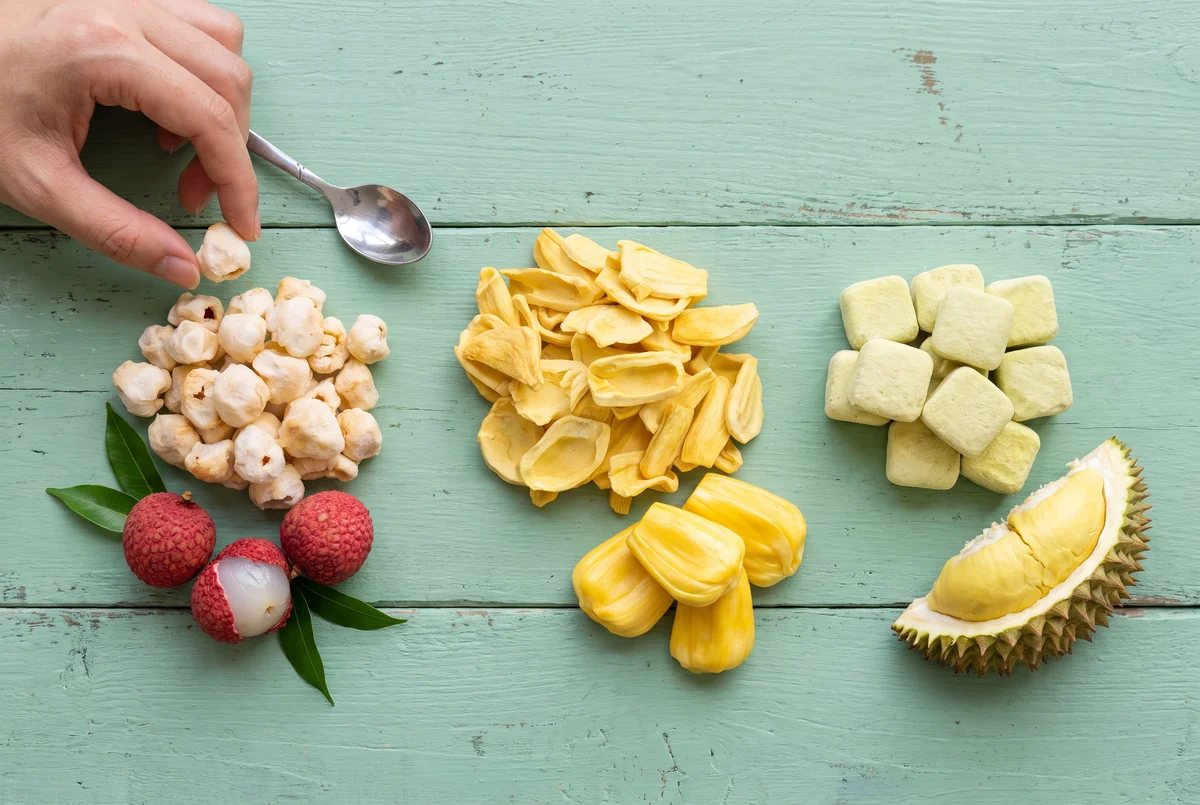
Lychee is the juiciest of the three, so it "shrinks" the most when dried. 20 g of freeze-dried lychee corresponds to about 110 g of fresh fruit. There you go, that's why a bag of freeze-dried lychee feels so light for its volume. A 20 g handful represents, in fresh fruit, more than a whole portion as defined by Santé publique France.
Freeze-dried jackfruit
With 73.5 g of water and 19.1 g of total sugars per 100 g of fresh fruit (USDA), jackfruit sits between the other two. Nearly a fifth of its fresh flesh is therefore natural sugar. 20 g of freeze-dried jackfruit corresponds to about 75 g of fresh. To know how to eat freeze-dried jackfruit, the five uses described further down apply as they are, keeping in mind that this sugar ends up concentrated in a very small volume.
Freeze-dried durian
It is the densest of the three, with 65.0 g of water and 147 kcal per 100 g of fresh fruit. 20 g of freeze-dried durian corresponds to about 57 g of fresh: the handful is therefore measured smaller. And then there's the smell, of course.
A chemical analysis of fresh Monthong durian flesh detected 44 odor-active compounds, 41 of them identified (Li et al., 2012). The most powerful are a fruity ester (ethyl 2-methylbutanoate), ethyl cinnamate, with a honey note, and sulfur compounds reminiscent of roasted onion. For the nose, that brings together a ripe-fruit note and a roasted-onion note, hence the surprise of the first bite. This study looked at fresh fruit, and nothing in the available sources says what becomes of this bouquet after freeze-drying.
How to eat freeze-dried durian when you've never dared try the fresh fruit? With one or two pieces, plain or as a powder in a yogurt, to make up your own mind. If its story intrigues you, our first article on freeze-dried durian was entirely devoted to it; it comes in a 200 g bag as freeze-dried Monthong durian.
How to use freeze-dried fruit day to day: five ways
Five gestures cover almost every situation, from breakfast to dessert:
plain, as a snack;
in a yogurt or a morning bowl;
rehydrated in a little cold water, juice or homemade tiger nut milk;
as a powder;
sprinkled on a dessert or a fruit salad, just before serving.
Plain, as a snack
This is the most obvious use, and the one where you go over the amount without noticing. A freeze-dried piece weighs almost nothing. It's better to measure by the fresh-fruit equivalent, taking out a small handful rather than dipping into the bag.
In a yogurt or a morning bowl
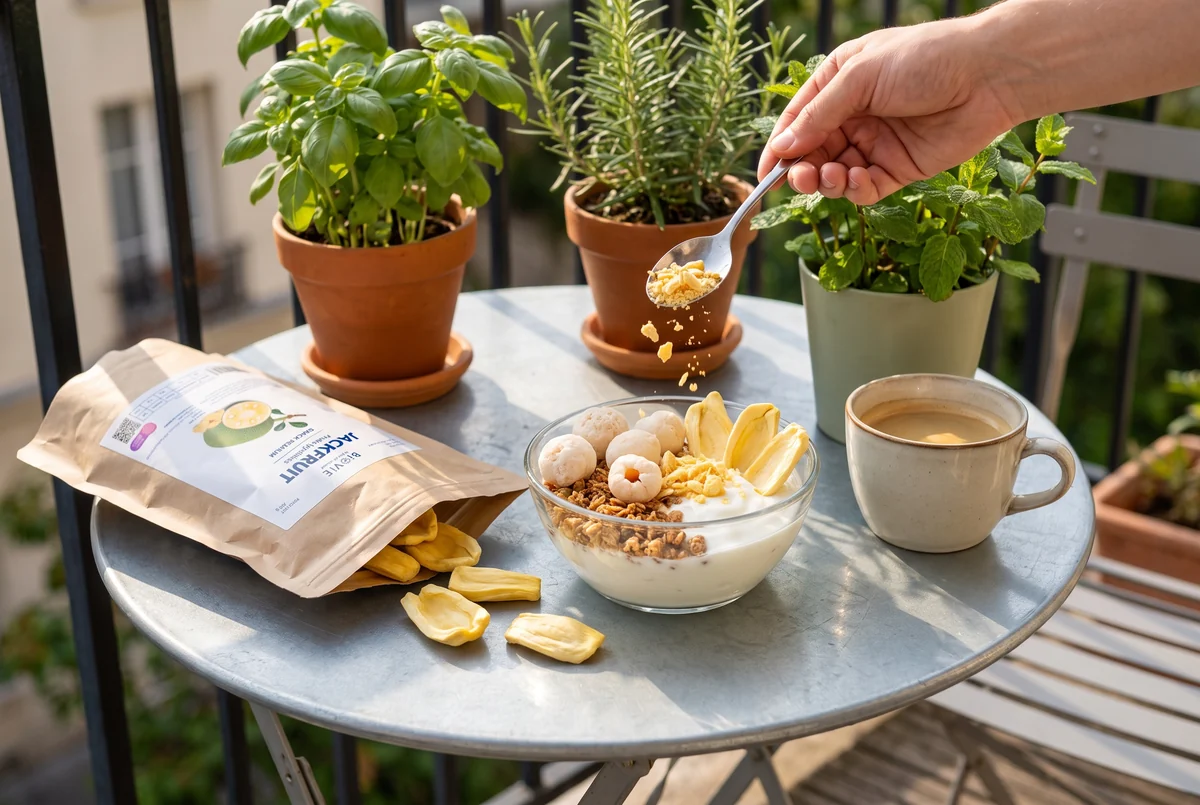
It all depends on the texture you're after. Added at the last moment, the pieces stay crunchy; put in the bowl a few minutes earlier, they drink up the moisture of the yogurt and turn soft, a direct consequence of their porous structure. As part of a varied and balanced diet and a healthy lifestyle, a few pieces in the bowl you already prepare is a simple way to add a fruit to your morning.
Rehydrated
Can you soak freeze-dried fruit? Yes. To get a texture close to the fruit, let the pieces soak in a little cold water, juice or homemade tiger nut milk. In theory, to get back to the weight of the fresh fruit, 20 g of freeze-dried fruit needs about 90 ml of liquid for lychee, 55 ml for jackfruit and 37 ml for durian (calculated from the USDA tables). For durian, that's barely more than two tablespoons. Start with less liquid, then adjust: the residual moisture and the size of the pieces vary from one bag to another.
As a powder
Honestly, this is the use people think of least, and yet it is one of the most flexible. Blended for a few seconds, the pieces become a freeze-dried fruit powder that flavors and colors a yogurt, a cream or a smoothie without adding any liquid. This powder takes up the humidity of the air even faster than the pieces: make it in a small quantity, just before you use it.
On a dessert or a fruit salad
Sprinkled at serving time over a fresh fruit salad or a cream, they add a crunchy contrast. Not before. Laid on a moist surface, they soften quickly.
How much? The fresh-fruit equivalent
For Santé publique France, an adult portion of fruit or vegetables weighs 80 to 100 g. Knowing how to use freeze-dried fruit starts with knowing how to measure it. A freeze-dried fruit has lost its water, and its weight no longer says much about what it represents. So how do you know how much to put in the bowl?
Fruit
Water per 100 g of fresh fruit
20 g of freeze-dried corresponds to
A portion of 80 to 100 g of fresh corresponds to
Lychee
81.8 g
about 110 g of fresh
15 to 18 g of freeze-dried
Jackfruit
73.5 g
about 75 g of fresh
21 to 27 g of freeze-dried
Durian
65.0 g
about 57 g of fresh
28 to 35 g of freeze-dried
The calculation starts from the dry matter of the fresh fruit, that is 100 minus the water: 18.2% for lychee, 26.5% for jackfruit and 35.0% for durian. We divide the weight of freeze-dried fruit by this dry matter, ignoring the product's residual moisture. These are therefore orders of magnitude, to be rounded without scruple. A portion of freeze-dried lychee looks tiny next to the same portion of fresh fruit, and that's normal: only the water is missing.
Freeze-drying concentrates the fruit's natural sugars into a small volume. Santé publique France reminds us, by the way, that dried fruits "naturally contain a lot of sugars".A handful is enough.The portion is measured on the fresh equivalent given in the table, and we're not here to fill a stomach, but to nourish an organism.
As part of a varied and balanced diet and a healthy lifestyle, these fruits find their place alongside fresh fruit, without replacing it.
Enjoy the flavor and nutrients of exotic fruits, harvested at maturity in Vietnam and preserved while respecting the nutritional qualities of the fruit., 11
products
Think of a boiled sweet left out on the table on a stormy day: its surface turns sticky. A freeze-dried fruit behaves the same way, because it is very dry and takes up the humidity of the air as soon as the bag is open. Beyond a critical water content, its matrix shifts from a "glassy" state, rigid and brittle, to a softer one: the fruit loses its crunch and may stick together (Moraga et al., 2011). This study, carried out on freeze-dried apple and banana slices, describes a general mechanism; it also shows that browning depends on water activity.
The right habits are simple. Close the bag right away, take out the amount you want with a perfectly dry spoon, then pour the rest into an airtight glass jar, kept in a dry place away from light.
To go further, there is vacuum sealing with the BocUp kit: a bell and a small hand pump, with no electricity and no plastic bag. It works with the glass jars you already have, provided they have "shoulders" and a lid of 65 or 84 mm, so there's nothing else to buy. By removing the air from the jar, you limit the uptake of humidity, and dry foods stay protected from moisture and moths. Even so, the vacuum replaces neither the fridge nor the freezer, and it does not sterilize (more on vacuum sealing at home).
How long, then? No source gives a figure for how long an open bag keeps: it all depends on the humidity it takes up. In reality, a softened piece is still usable, and in a yogurt it would have taken on that texture anyway.
As part of a varied and balanced diet and a healthy lifestyle, finishing the bag without wasting anything is also part of the pleasure. Next time you open one, take out a jar at the same time: it's the first step, and it costs nothing.
Frequently asked questions
What is the difference between freeze-dried and dehydrated?
Freeze-dried fruit is frozen and then dried under vacuum at low temperature: its ice turns straight into vapor, without liquid water, and it stays porous and crunchy. Dehydrated fruit is dried with hot air, which gives a more shrunken product. Our article on freeze-drying and dehydration details these differences.
What can fruit powder be used for?
Freeze-dried fruit powder flavors and colors a yogurt, a cream or a smoothie without adding any liquid. Just blend the pieces for a few seconds. Make it in a small quantity, just before use: very dry, it takes up the humidity of the air even faster than the pieces and then loses its texture.
Can you rehydrate freeze-dried fruit?
Yes, in a little cold water, juice or homemade tiger nut milk. In theory, to get back to the weight of the fresh fruit, 20 g of freeze-dried fruit needs about 90 ml of liquid for lychee, 55 ml for jackfruit and 37 ml for durian. It's better to start with less, then adjust.
How do you keep freeze-dried fruit crunchy?
By protecting it from the humidity in the air: close the bag right away, help yourself with a dry spoon and pour into an airtight glass jar, or vacuum-seal that jar with a BocUp. Beyond a critical water content, the fruit loses its crunch. A softened piece is still usable in a yogurt.
How much freeze-dried fruit should you eat per day?
Think in fresh equivalent. A portion of fruit of 80 to 100 g, according to Santé publique France, corresponds to about 15 to 18 g of freeze-dried lychee, 21 to 27 g of jackfruit or 28 to 35 g of durian. Like dried fruits, they concentrate natural sugars: a handful is enough.
How long does freeze-dried fruit keep once opened?
No reliable duration can be given: it depends on the humidity the fruit takes up after opening, and therefore on how you store it. A well-sealed glass jar, kept dry and away from light, or vacuum sealing with a BocUp, limits this uptake of humidity.
The information presented in this article is provided for informational purposes only and does not constitute medical advice. Consult a healthcare professional before making any change to your diet or supplementation.