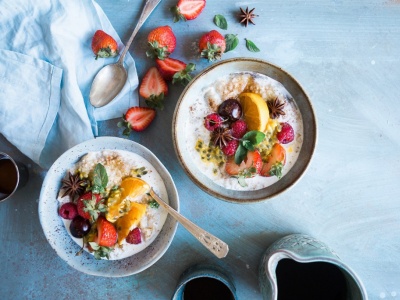
Plant-based milk is milk extracted from a plant or from cereals, legumes, oilseeds, tubers, etc.
It is an alternative to animal-based milk that contains neither lactose nor casein, making it compatible with a vegan diet. Plant-based milks address and prevent food intolerances to dairy products.
How to make plant-based milk?
Pasteurized plant-based milk cartons do not have the same taste or nutritional content as the ones you make at home. Indeed, these milks are produced industrially with pasteurization that destroys all enzymes as well as phytonutrients and heat-sensitive vitamins degraded by temperatures above 43°C. Additionally, at home, you can use almonds, hazelnuts, tiger nuts, etc., that you have soaked for at least one night, making them much more digestible than dry almonds, tiger nuts, or hazelnuts. Finally, you can use a larger quantity of ingredients than industrial plant-based milks. Read the labels; the quantities of almonds, rice, and hazelnuts will surprise you!
The simplest way to make plant-based milk is to use a powerful blender and a plant milk bag, or a machine to make plant-based milks at low temperature without heating.
What basic equipment is needed to make plant-based milk?
If you use a powerful blender, you can ideally soak the almonds, hazelnuts, tiger nuts, etc., for about one night. Then rinse and pour everything into the blender bowl with 1 liter of water and blend for 2 minutes. You can drink your milk straight from the bowl or strain it through a milk bag to filter out most of the fibers.
How to use plant-based milk?
Due to their mild flavor, plant-based milks offer multiple possibilities in organic and plant-based cooking. They can be used as an ingredient to make smoothies, raw agar agar flans, creams, and coulis. You can also use them as an ingredient in a raw soup, as a base for a sauce, to make a golden latte (golden mellow or golden milk), or a plant-based milk with raw cocoa.
To choose the healthiest plant-based milk for our body, it depends on what you are looking for.
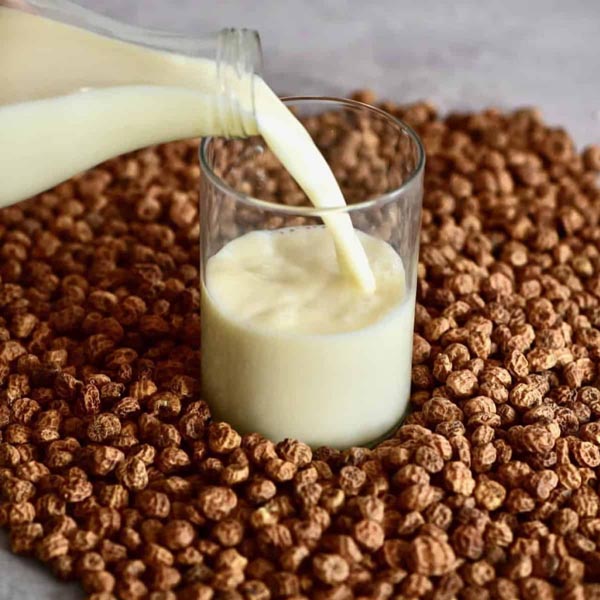
For flavor, tiger nut milk, almond milk, and hazelnut milk are probably the most appreciated, as their taste is very close to that of the nuts used.
Chestnut milk has a mild and subtle flavor.
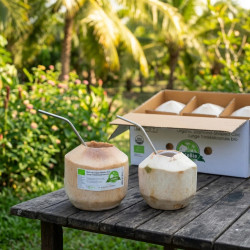
The most exotic and nourishing is undoubtedly coconut milk, ideally made with fresh coconut.
Rice or oat milk are the sweetest in taste, and they are more laborious to make at home. Rice milk is not raw.
All plant-based milks are less rich in protein than cow's milk. They contain neither lactose nor casein, which are responsible for intestinal flora disorders or intestinal permeability, and should therefore be avoided. The plant-based milks with the highest protein content are hazelnut, oat, and soy milk.
The richest in calcium is almond milk.
The most caloric are oat, rice, and hazelnut milk.
What is the best value for money plant-based milk?
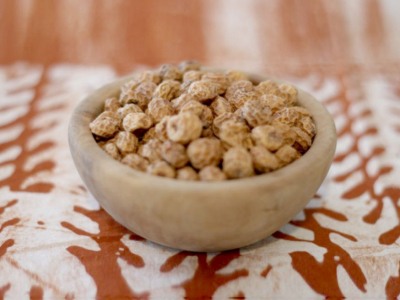
The best nutritional quality/price ratio remains tiger nut milk (tiger nuts cost half as much as almonds or hazelnuts), unbeatable in terms of price if you make it at home, for great nutritional quality.
Homemade or store-bought: what really changes
This is the question that always follows the previous one. Here are the four points where the gap is real - and the one where shop-bought milk keeps the advantage.
Composition: read the label on a carton
A homemade almond milk contains two ingredients: almonds and water. A shop-bought carton often shows only 2 to 7% almonds, topped up with water, an emulsifier, a stabiliser, sometimes sugar or a flavouring. That's the first shock when you compare labels: the price per litre looks reasonable, but what you're mostly buying is water.
The honest counterpoint: industrial milks are frequently fortified with calcium, vitamin D and B12, which your homemade version doesn't provide. For someone relying on that intake - a strict vegan diet, for instance - this isn't a minor detail, and it's worth making up for elsewhere on the plate.
Heat treatment
Cartons are pasteurised, often at ultra-high temperature, to keep for several months at room temperature. Above 43°C, enzymes are destroyed and heat-sensitive vitamins degrade - which is exactly what raw food aims to preserve. Homemade milk is drunk fresh, within two to three days, and never sees any heat.
The real cost, calculated per litre
Count on around 100 to 150 g of nuts or seeds for a litre of homemade milk. Depending on the ingredient, you end up with a cost comparable to, or even lower than, a good organic carton - with ten to twenty times more nuts in the glass. The equation becomes clearly favourable if you keep the okara (the strained pulp) for your biscuits, crackers or raw tart bases: nothing goes to waste.
Time, the real issue
This is where store-bought wins, no point denying it: opening a carton takes three seconds. Making a litre of homemade milk takes an overnight soak and five minutes in the morning - blending, straining through the nut-milk bag, cleaning up included. So the question isn't "which is better?" but "what are you willing to invest?". For us, the answer has been: homemade during the week for everyday use, a backup carton in the cupboard for busy days. There's no contradiction in doing both.
Packaging, often overlooked
A litre of shop-bought plant-based milk comes in a multi-layer carton - cardboard, polyethylene, sometimes aluminium - that's hard to recycle, plus a litre of water transported over hundreds of kilometres. Homemade milk only moves the dry matter: one kilo of almonds replaces eight to ten cartons. For equal use, this is where the gap is widest.