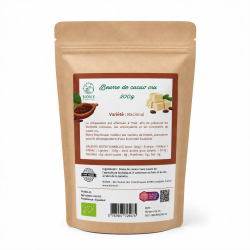



Raw organic fair trade cacao paste - 100% ceremonial quality cacao
Organic raw cocoa paste 100%, Nacional variety from Ecuador.
No sugar, no lecithin, no milk.
Unroasted beans, cold ground with a stone mill.
To grate, melt, or prepare as ceremonial cocoa.
No queries yet, leave the first!
Price:
€12.60
Product availability:
In stock
Tax included


Raw organic fair trade cacao paste - 100% ceremonial quality cacao images


100% organic raw cacao paste - ceremonial grade, Nacional variety from Ecuador
The raw cacao paste is cacao and nothing else: cold-ground beans, no sugar, no lecithin, no milk. You use it like a very intense dark chocolate bar - melted, grated, cut into chips - and it is also the classic base for ceremonial cacao. We have been working with Rrraw Cacao Factory for years, using Nacional variety beans bought directly in Ecuador.
In practical terms, you can melt it to make a chocolate mousse, cut it into chips to add to cakes with a rich cacao flavour, grate it into a smoothie, and why not try it in your savoury dishes: it also works as a spice! Some call it cocoa mass or cocoa liquor, others simply talk about raw chocolate at 100%. It is the same product.
🍫 You will find in our Raw Cacao Ebook and on our blog various recipes using cacao:Raw cacao yoghurt
Vegan chocolate mousse
🍫How much raw cacao paste per day?
It is the question we get asked most often, and curiously almost nobody answers it with figures. So here is our guide, built from the composition values published by the USDA FoodData Central for unsweetened cacao: approximately 1,297 mg of theobromine, 80 mg of caffeine and 327 mg of magnesium per 100 g.
- 5 to 10 g per day - daily use. One or two squares grated into a porridge, a smoothie, a plant-based yoghurt. That is roughly 65 to 130 mg of theobromine and 4 to 8 mg of caffeine, which is considerably less than a coffee. This is the level I recommend for starting out, and the one I follow myself most of the time.
- 10 to 20 g - sustained use. A hot cacao drink, a raw dessert, a morning preparation. Around 130 to 260 mg of theobromine and 8 to 16 mg of caffeine. Noticeable for people who are reactive to stimulants, especially late in the day.
- 25 to 40 g - ceremonial use. This is the range generally used for a cup of ceremonial cacao, i.e. 325 to 520 mg of theobromine. Keep it for occasional use, in the morning or early afternoon, and not every day.
There you go. These levels are not prescriptions. They are reference points. Everyone at their own pace, and sensitivity to theobromine varies a great deal from one person to another. If you are starting out, start low.
🍫 Why "raw" makes a difference
The word "raw" is everywhere these days, often for not much. Here, it rests on a measurable threshold. A study published in 2010 in the Journal of Agricultural and Food Chemistry (DOI 10.1021/jf102391q) tracked the degradation of epicatechin, the main flavanol in cacao, at each stage of bean processing. The result: the loss begins as soon as the bean exceeds 70 °C, and alkalisation - the so-called "Dutch" process used in industry - destroys up to 98 %.
Conventional cacao roasting is done between 120 and 150 °C. Stone-mill grinding, on the other hand, is done cold. That is the whole difference, and it is not cosmetic.
Another thing: the taste. An unroasted bean does not develop the toasted notes we are used to. It keeps its primary aromas - fruity, floral, sometimes slightly tangy. The first time, it is disconcerting. Then there is no going back.
Because there is a difference between Chocolate and Raw Cacao, watch this short video from the founder of Rrraw:
🍫 From bean to paste: how it is made
Made in the workshop in Paris: the raw cacao beans are shelled to keep only the nibs. The raw cacao nibs are then ground very finely, cold, in a stone mill for 3 days, with just a little cocoa butter. Thanks to this process without roasting or cooking, all the aromatic power of the raw cacao is preserved.
Three days of milling. For an industrial bar, count a few hours. This long time is what gives the smoothness on the palate without having to add anything at all.
Discover Eric's interview with Sébastien, former head of production at Rrraw chocolates, who explains everything there is to know!
🍫 The Nacional variety, and why this choice
The beans used are of the Nacional variety, bought directly from a cooperative in Ecuador with the SPP label. Nacional remains uncommon - it is estimated at around 2% of world production - and it has floral notes of jasmine and orange blossom, which makes it particularly interesting.
You should know that there are mainly 3 varieties of beans:
- Forastero: the most widely grown in the world, its yield is high and it is very resistant to disease. It has little aroma, however, and a pronounced bitterness. This is the one used in industrial chocolates.
- Trinitario: a hybrid of the other 2 varieties, it accounts for roughly 10/15% of world production. It is characterised by its cocoa butter content and much more developed aromas.
- Criollo: the noblest variety, its yield is low and global warming disrupts its production, which makes it exceptional. It has a powerful, fine and aromatic taste. Very low in acidity and almost without bitterness, criollo is the most interesting from an aromatic point of view. Criollo is also interesting for its fruity secondary aromas that linger on the palate, with notes of nuts, caramel and even blueberries! (it is the one closest to Nacional in terms of quality)
For us, beyond the quality of the final product, choosing a little-known variety also means helping small producers, preserving the ancestral know-how of local populations and helping this original, ancient variety to thrive.
Ceremonial cacao: what it really is
A ceremonial cacao - also called ceremony cacao - is a pure cacao, unroasted, not defatted and unsweetened, drunk as a hot beverage during a cacao ceremony or a meditative moment. Four criteria, not one more. Everything else - the golden packaging, the "activated" claims, the prices per gram - is marketing, not definition.
Let us go through these four criteria one by one, because this is where 90% of the products sold under this name fall short:
- Whole cacao. The whole bean is ground, cocoa butter included. So it is never powder, which is defatted cacao. A paste, a mass, a cacao "liquor": yes. A powder: no.
- Unroasted or very lightly heated. This is the criterion most often betrayed. See the 70 °C threshold above.
- No additives. No sugar, no lecithin, no flavouring, no milk. 100% cacao.
- Bean traceability. Variety, origin, cooperative. If the seller cannot name them, the "sacred" dimension of the product remains a story you are being told.
People also talk about sacred cacao, ritual cacao or ceremonial cacao: these are variants of the same term, with no technical distinction between them.
Our paste meets all four criteria. It is not a product designed for cacao ceremonies - it is a raw cacao which, by its very nature, suits that use. The nuance matters: we are not selling a ritual, we are selling an honest raw material.
🍫 Ceremonial cacao and raw cacao: what is the difference?
Frankly, this is the number one point of confusion, and I understand why: nobody takes the time to explain it.
"Raw cacao" describes a process. "Ceremonial cacao" describes a use. A raw cacao is a cacao whose bean has not exceeded the temperature threshold that degrades its compounds. A ceremonial cacao is a cacao drunk in a ritual context. The two terms are not on the same level, and that is why they partially overlap without being the same thing.
In practice: every quality ceremonial cacao is a raw cacao in paste form, but not every raw cacao is intended for ceremonial use. Whole raw cacao beans , for example, are raw without being suited to preparing a cup.
And then there is a commercial aspect that is often forgotten: the name "ceremonial" is not protected by any specification. No label, no control. Any cacao can claim it. It is precisely for this reason that we prefer to talk about what the product is - a 100% raw cacao paste of the Nacional variety - rather than what it might allow you to do.
🍫 Cacao in history: where the ritual comes from
The Olmecs (1500-400 BC) consumed the cacao bean ground into a hot drink with other spices, chilli and herbs. Over time, the Maya (600 BC) and the Aztecs (400 AD) intensified the cultivation of the cacao tree; the bean became sacred and was used in religious rituals. The first name of the cacao tree is in fact "Theobroma", meaning "food of the Gods" in Greek.
A symbol of abundance, the cacao drink remained a privilege for the upper classes and soldiers. The bean also became a currency of exchange at that time.
Arriving at the Spanish court in 1528, Europeans added sugar, vanilla and cinnamon to the cacao drink to reduce its bitterness. In the 17th century, cacao consumption gradually spread throughout Europe; roasting then became essential for preserving the beans, and little by little cacao became the chocolate we all know today.
Today, our knowledge and techniques allow us to skip the roasting step and preserve cacao without any food safety issue. But until then, the way chocolate was made had never been questioned. We are proud to offer you the products of one of the pioneers of raw cacao in France: Rrraw Cacao Factory.
A word of honesty along the way. The contemporary ceremonies practised in Europe are not a faithful reconstruction of a Mesoamerican ritual - the archaeological sources do not allow that level of detail. They are modern practices, inspired, sometimes passed down by Central American lineages, sometimes reconstructed. That takes nothing away from them. It is worth saying clearly.
🍫 Preparing a cup of ceremonial cacao
The protocol for a cacao ceremony comes down to five steps. Allow ten minutes.
1. Weigh your cacao. 25 to 40 g per person depending on your sensitivity. If it is your first time, stay at 20-25 g. Grate or finely chop the pieces: the paste will melt faster and more evenly.
2. Heat the liquid without boiling it. 200 to 250 ml of water, plant milk or a mix of both. Aim for 65 to 70 °C - the temperature of a green tea, when the steam rises but no bubbles form. Beyond that, you start to degrade the flavanols. A kitchen thermometer settles the matter in three seconds.
3. Pour over the cacao and whisk. Pour the hot liquid over the grated paste, let it melt for thirty seconds, then emulsify with a whisk or a milk frother. The emulsion matters: it completely changes the texture on the palate.
4. Season if you wish. A pinch of salt, a touch of cinnamon, mild chilli or vanilla. To sweeten, a little maple syrup or date powder. Always add after emulsifying, never before.
5. Drink slowly. It is a banal thing to write, but it is the only truly "ceremonial" step. A cup made with 30 g of cacao is drunk over fifteen to twenty minutes, not in three gulps.
For lighter everyday use, the raw cacao powder is better suited to the morning cup: less fatty, quicker to prepare.
🍫 What you should know before you start
You will often read that cacao contains phenylethylamine, the "love molecule", and that this is what explains the particular state felt during a ceremony. Let us be precise, because the pharmacological reality is more sober.
PEA is indeed present in chocolate, at levels of around 0.4 to 6.6 µg/g. But it is very largely broken down by monoamine oxidase as soon as it passes through the gut and liver. In other words: very little ingested PEA reaches the central nervous system in active form. This is not an opinion, it is basic pharmacokinetics.
We would rather tell you this than sell you a chemistry that does not exist.
Watch a video of our conversation on this subject with Yasmine from the Paris shop Rrraw Cacao Factory!
Composition of raw cacao
The raw cacao is a dense food. Here is what its composition allows us to say, and nothing more. The values quoted are the generic data from the USDA FoodData Central for unsweetened cacao, not an analysis of our batch.
A remarkable source of magnesium
327 mg of magnesium per 100 g. That is 87% of the nutrient reference values, well above the 15% threshold that allows the claim "source of magnesium".
The EU Regulation 432/2012 allows, for a food that is a source of magnesium, the following wording:
- Magnesium contributes to a reduction of tiredness and fatigue.
- Magnesium contributes to normal functioning of the nervous system.
- Magnesium contributes to normal muscle function.
- Magnesium contributes to normal energy-yielding metabolism.
These effects apply in the context of a varied and balanced diet and a healthy lifestyle. In practice, 10 g of paste provides around 33 mg of magnesium, i.e. 9% of the NRV. Useful, but it is not a supplement: it is a food.
Flavanols
The absence of roasting and alkalisation preserves the flavanols in cacao, first and foremost epicatechin, whereas industrial processes destroy most of them (up to 98% for alkalisation, according to the 2010 study cited in the How to use tab).
The raw cocoa butter from the same process completes the range, for those who want the fat without the bitterness.
Theobromine, without exaggeration
1,297 mg per 100 g. Theobromine is an alkaloid of the methylxanthine family, like caffeine.
Its elimination half-life is 6 to 10 hours in humans, compared with 3 to 5 for caffeine. Hence the practical advice: avoid large doses after 16:00.
Contrary to what you often read, theobromine is not exclusive to cacao. It is also found in tea, kola nut and several species ofIlex, including maté.
We sell this product. We would have every interest in saying more about it. But an argument that cannot be sourced is not an argument, it is advertising - and you deserve better than that.
🍫 Also see our blog article:> How to use cocoa powder?
Our partner: Rrraw Cacao Factory
Rrraw was originally launched by Sébastien Marr, an expert in plant fermentation and sprouting and a follower of raw food.
After discovering raw cacao in America - where the taste is not always there - he set himself a mission on his return to France: to reconcile taste excellence with nutritional common sense.
Rrraw Cacao is a quality chocolate with flavours suited to our French palate.
🍫 The supply chain, named and verifiable
Exactly where this paste comes from:
- Country : Ecuador
- Region : Esmeraldas province, on the north-west coast
- Variety : Nacional, fine flavour cacao, around 2% of world production
- Cooperative : UOPROCAE, a union of cacao producer organisations
- Import : SolAlter, direct, with no trading intermediary
- Labels : SPP (Small Producers' Symbol) and organic farming
There you go. Six lines, six verifiable pieces of information. It is not much to write, and yet none of the competitors we looked at on this market goes beyond a "respectful origin". When a seller cannot name their cooperative, it is almost always because they buy on the wholesale market.
These very low-yield Nacional variety cacao trees produce a grand cru that reveals rare and subtle flavours.
🍫 From the raw bean: the three fermentations
How do you obtain a raw cacao bean ?
The beans undergo 3 fermentations, then a rinse and sun-drying below 42 °C. A very precise process that makes it possible to skip roasting while keeping the bean intact during transport. This brings out all the primary aromas of the cacao.
42 °C for drying, under 70 °C for grinding: it is this double constraint that defines a true raw cacao, and it is also what makes it more expensive to produce. Sun-drying takes days where an industrial dryer takes hours.
For all its other products, Rrraw Cacao Factory uses only natural products (dried fruit, spices), no allergens (such as milk, soya, tree nuts) and has even replaced coconut sugar with date powder, to further improve the nutritional profile of its chocolates.
🍫 A long-standing commitment: Cœur de Forêt
Rrraw worked for several years with the association Cœur de Forêt, which fights to protect primary forest and the native populations who live there. The cacao trees grew there in the shade of the forests, far from the opacity of the industrial chocolate supply chain. This history explains the way Rrraw still builds its agroforestry supply today.
Discover the links between Rrraw and the association Cœur de Forêt in this short video from France 2:
The founder of Rrraw explains the story of his raw cacao products:
Best before: 05/01/2027
Composition and allergens
Ingredients : 100% raw cacao paste (Theobroma cacao), Nacional variety, from organic farming.
Nothing added : no sugar, no lecithin, no flavouring, no milk, no added fat other than the cocoa butter naturally present in the bean.
Allergens : no allergens requiring mandatory declaration in the product. Made in a workshop that handles tree nuts and sesame.
Indicative nutritional values
Generic values per 100 g of unsweetened cacao, according to the USDA FoodData Central. They do not replace the batch analysis:
- Magnesium: approximately 327 mg, i.e. 87% of the NRV
- Theobromine: approximately 1,297 mg
- Caffeine: approximately 80 mg
- Fat: mostly cocoa butter, including a significant share of stearic acid and oleic acid
Storage and packaging
Best before : 15 months from the date of manufacture
Packaging : Resealable 200g or 1kg pouch.
Store the paste away from light, heat and humidity, between 15 and 20 °C, in its resealed pouch. No refrigerator: thermal shock causes the cocoa butter to bloom on the surface. This blooming is harmless, it only alters the appearance. Keep the pouch away from strong-smelling foods; fatty cacao picks up odours with disconcerting ease.
Precautions for use
- Children. The EFSA sets a threshold of 3 mg of caffeine per kg of body weight for children and adolescents. Pure raw cacao, at 1,297 mg of theobromine per 100 g, is not recommended for young children.
- Pregnancy and breastfeeding. The EFSA sets the limit at 200 mg of caffeine per day during pregnancy, from all sources combined. At 80 mg of caffeine per 100 g, the paste remains compatible with moderate use, but ask your healthcare professional for advice, particularly for ceremonial doses.
- Medication. If you take antidepressants, in particular monoamine oxidase inhibitors (MAOIs), talk to your doctor before any high-dose use. The same precaution applies in the case of heart treatment or rhythm disorders.
- Sensitivity to stimulants. Reflux, palpitations, sleep disturbances: reduce the dose or move your intake to earlier in the day.
- Pets. Theobromine is toxic to dogs and cats. Keep the paste out of their reach. See the FAQ below.
Frequently asked questions
What is the difference between ceremonial cacao and raw cacao?
"Raw cacao" describes a process: the bean has not exceeded the temperature threshold that degrades its compounds, around 70 °C. "Ceremonial cacao" describes a use: a pure cacao drunk as a hot beverage in a ritual setting. Every quality ceremonial cacao is a raw cacao in paste form, but not every raw cacao is intended for ceremonial use. No specification protects the name "ceremonial".
How much raw cacao paste per day?
Three reference levels: 5 to 10 g for daily use, 10 to 20 g for sustained use, 25 to 40 g for an occasional ceremonial cup. At 40 g, you consume around 520 mg of theobromine and 32 mg of caffeine. Start low, especially if you are sensitive to stimulants.
At what temperature should ceremonial cacao be prepared?
Between 65 and 70 °C, never boiling. Above 70 °C, the degradation of epicatechin begins, as shown by a study published in 2010 in the Journal of Agricultural and Food Chemistry. Visual cue: the steam rises, but no bubbles form at the bottom of the pan.
Does ceremonial cacao present any danger?
At usual doses, no, for an adult in good health. The reported adverse effects are almost always due to overdosing: palpitations, headaches, nausea, insomnia. They are linked to theobromine and caffeine, not to a psychoactive substance. Caution is called for during pregnancy, antidepressant or heart treatment, and in children.
Can you consume raw cacao with antidepressants?
Ask your doctor for advice. Cacao contains amines (including phenylethylamine and tyramine) that are metabolised by monoamine oxidase. In the case of MAOI treatment, this degradation pathway is inhibited, which justifies particular caution. For other classes of antidepressants, medical advice remains the right approach before use at a ceremonial dose.
Is cacao dangerous for dogs?
Yes, and it must be taken seriously. According to the Belgian Poison Control Centre , the first symptoms appear from 20 mg of theobromine per kg of body weight, become serious at 40 mg/kg, cause convulsions at 60 mg/kg and can be lethal above 80 mg/kg. With 1,297 mg of theobromine per 100 g, 15 g of this paste is enough to trigger symptoms in a 10 kg dog. The half-life in dogs is 17.5 hours, compared with 6 to 10 in humans. Store the pouch up high, and contact a vet in the event of ingestion.
What can replace cacao paste in a recipe?
The closest substitute is a mix of raw cacao powder and raw cocoa butter, in a proportion of roughly two thirds powder to one third butter. A 100% dark chocolate from the shops also works, but it is roasted: you lose the point of raw and the aromatic profile changes completely.
How should raw cacao paste be stored?
Resealed pouch, away from light, between 15 and 20 °C, away from any heat source and strong-smelling foods. No refrigerator. The best-before date is 15 months after manufacture, but the paste keeps well beyond that: with no free water, it hardly degrades at all, it only loses aromatic intensity.
Packaging and logistics
The short supply chain and just-in-time manufacturing from bean to bar avoid transport between several intermediaries. Our packaging, 90% of it, is made to measure with recycled and/or recyclable paper/cardboard from French or European manufacturers; it is packaging with no wasted space.
The packaging, logistics and quality control of Rrraw products are handled by an ESAT (sheltered workshop) that welcomes 65 adults with disabilities, mainly motor and mental, and offers them paid work, enabling appropriate support and preparation for independence, whether financial or social.
Updated: August 2026. Page validated by Éric Viard, founder of Biovie and ISTOMengineer, co-author of "Algues au quotidien" (Gallimard, 2024) - Best cookbook in the world, Gourmand Cookbook Awards 2025, and Best cookbook in France, Académie Nationale de Cuisine 2025.
Disclaimer: The information presented on this page is provided for information purposes only and does not constitute medical advice. Consult a qualified healthcare professional before making any change to your diet or supplementation. As part of a varied and balanced diet and a healthy lifestyle.
The documents that back up what we write about this product. Every document is dated; we remove those that are no longer valid.
Biovie organic certificate
Valid until 31/03/2027Wondering… ?
Everything you need to know before ordering.
Be the first to ask a question about this product!
Question about the product
Ask a question