









Two ingredients, a blender and a strainer: homemade almond milk needs nothing more, and tasting it next to a store-bought carton is usually enough to make you never go back. The difference comes down to the soaking first, which is far from decorative: almonds rehydrated overnight grind much more finely and give a truly creamy milk, whereas dry almonds produce a greyish, bland drink. The second point to watch is the blending: stop the blender when the almonds are reduced to a coarse paste, without trying to pulverize them. Blending for too long lets very fine particles through the filter and gives a gritty milk. The rest takes only a few minutes, and the pulp left in the filter should not be thrown away: it becomes the base for crackers or cookies.
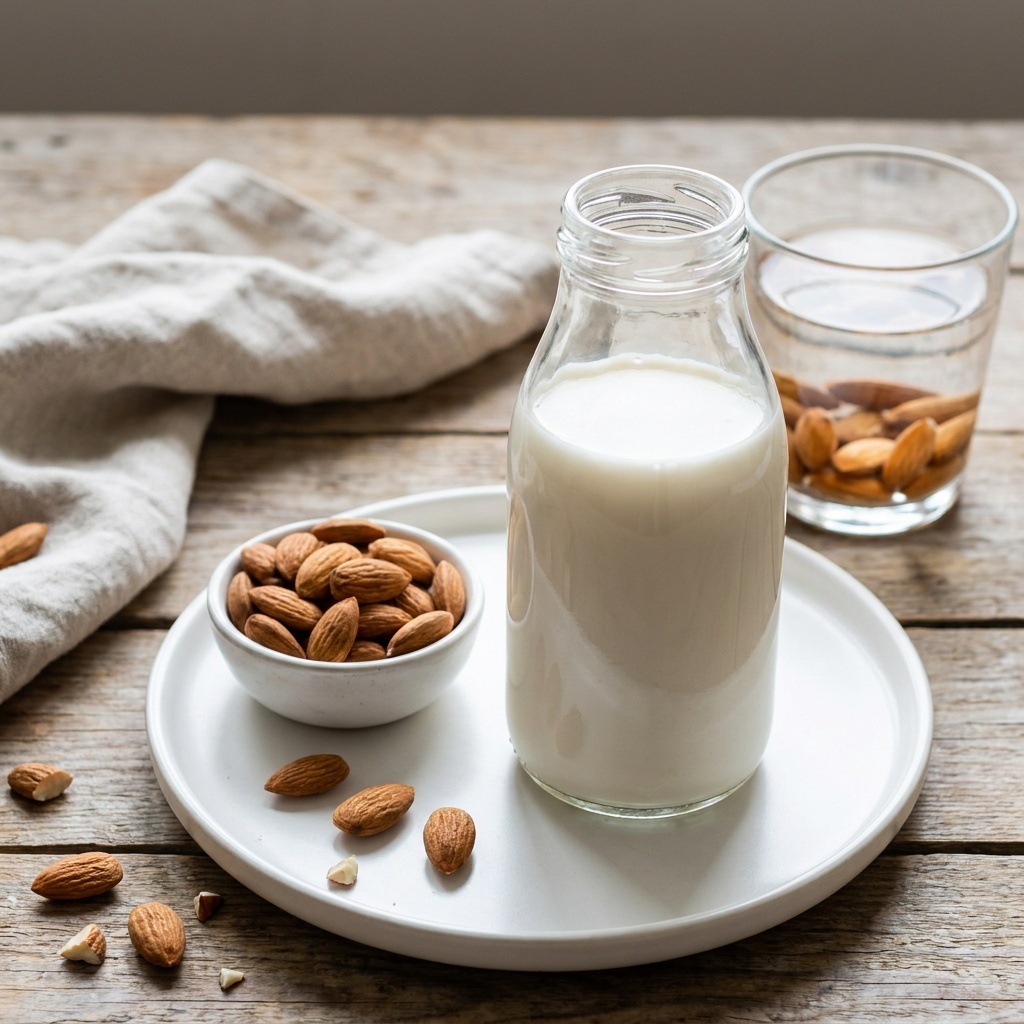
Homemade Raw Almond Milk, Just Two Ingredients
Share this article

Organic activated whole almonds
€18.90 In stock
Ingredients
- 280 g raw almonds, with or without skin, or activated almonds
- 1.1 liters of filtered and hydrogenated water for blending, to be adjusted to the consistency you like
- Extra filtered and hydrogenated water for soaking
Preparation
- Place the almonds in a large bowl and cover them generously with water.
- Leave to soak in the fridge overnight, or for at least 4 hours: this is the decisive step for a creamy milk.
- Drain the almonds, discard the soaking water and rinse them thoroughly.
- Put them in the blender with 1.1 liters of fresh water and blend for 1 to 2 minutes, until the almonds are reduced to a coarse paste, without pulverizing them completely.
- Hold a nut milk bag over a large bowl and slowly pour in the mixture.
- Close the bag and squeeze firmly to extract all the liquid.
- Pour into a sealed bottle and keep in the fridge for up to three days.
Tip
Shake the bottle before each use: with no additives, the milk separates naturally, which is rather a good sign. For a richer milk, reduce the water to 800 ml; for a lighter drink, go up to 1.3 liters. A medjool date or a spoonful of honey blended with the almonds sweetens it, and a pinch of cinnamon flavors it. If you are in a hurry or did not have time to soak the almonds, you can also blend 2 tablespoons of activated almond purée with 500 ml of water: the milk is ready in one minute, with no straining. The pulp left in the bag keeps for two days in the fridge; dried in a dehydrator, it becomes an almond flour that goes straight into a cracker or cookie dough.
The full range Oilseeds, nuts, seeds
Fair trade tiger nut from Niger, Amazon nuts from Bolivia, activated buckwheat from Brittany, and activated oilseed purées made in Alsace by Kaly: this range brings together oilseeds and seeds of raw quality, most of them soaked then dehydrated at low temperature (activation). To get started with activation, an activated almond or hazelnut purée is easier to use than a whole oilseed you have to soak yourself. For everyday raw cooking, tiger nut (whole, sliced or as a purée) comes in several formats suited to different uses, from homemade plant milk to crunchy snacks., 20 products
Discover the full range


FAQ: your questions about homemade almond milk
How many almonds do you need for 1 liter of almond milk?
You generally need between 100 and 250 g of almonds for 1 liter of water, depending on how rich you want it. With 100 g you get a light drink, close to store-bought ones. Around 250 g per liter, as in this recipe which uses 280 g for 1.1 liters, the milk becomes truly creamy, ideal for coffee, porridge or desserts. The simplest approach is to start with this generous proportion, then thin the milk with a little water if you find it too thick.
What is the point of making your own almond milk?
The main advantage of homemade almond milk is its composition: almonds and water, with no added sugar, no thickener and no flavoring, and with a proportion of almonds often well above that of store-bought drinks. It is naturally lactose-free. It fits into a varied diet rather than replacing animal milk.
What are the contraindications of almond milk?
The main contraindication concerns people allergic to tree nuts: almond milk must then be strictly avoided. It is also not suitable as the main milk for infants and young children, as it does not cover their needs for protein, calcium and fat: ask a pediatrician for advice. Finally, people following a low-oxalate diet, for example in the case of kidney stones, may limit their consumption after medical advice.
Share this article
Related articles
