


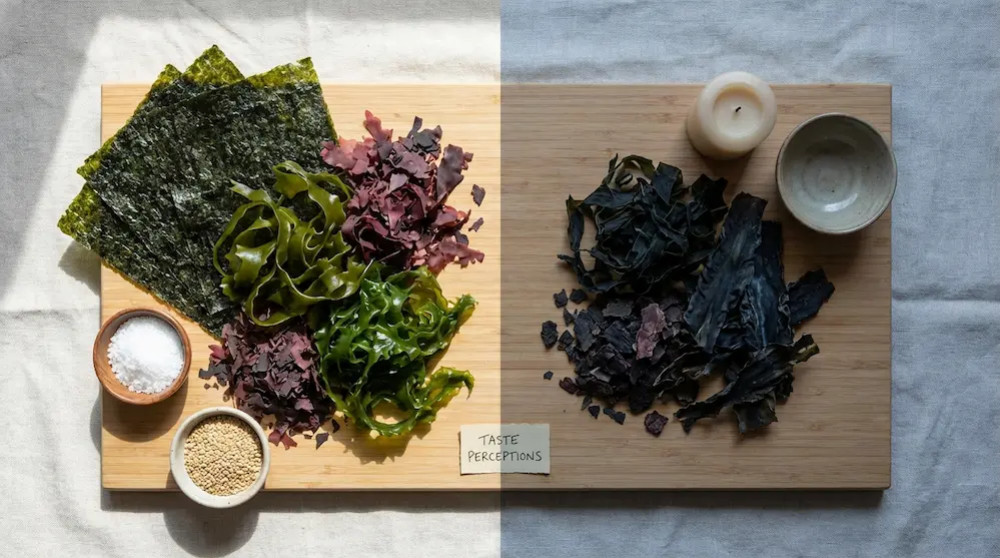

You tried seaweed once, grimaced, and concluded that "it's not for you." What if this aversion had a scientific explanation as precise as the cilantro gene? The short answer: yes, probably. About 25% of the population exhibits a genetic hypersensitivity to bitter and sulfur compounds - what are known as "supertasters." For these individuals, the iodine taste of seaweed is not just unpleasant, it is downright invasive. And it's not a matter of bad will. It's biology. The good news: once you understand what is happening in your taste buds and olfactory receptors, you can choose the right algae for your genetic profile, and change your relationship to marine superfoods with numerous benefits in a few weeks.
What you perceive in seaweed is not iodine.
Let's start with a revelation that unsettles just about everyone when I share it during my workshops: iodine has no taste. Nor smell, for that matter. Not at the concentrations found in edible seaweed.
Iodine is odorless and tasteless - the true revelation
When you say "algae have a iodized taste", you accurately describe a real sensation in your mouth. But what you perceive is not iodine itself. This is a vocabulary confusion so widespread that it has become the norm, even among nutrition professionals.
Iodine is a trace mineral element. At dietary concentrations, it is physiologically neutral in terms of taste and smell. It is simply not the one that triggers the strong, sometimes repulsive marine sensation that we associate with seaweed.
So why have we been talking about a "iodized taste" for decades? Because seaweed is indeed very rich in iodine, and the mental association has become established in everyday language. To delve deeper into this topic, our article on the Seaweed, iodine, and the thyroid demystifies this relationship in detail.
What are the real compounds responsible for the marine taste ?
What you smell and taste in seaweed are primarily volatile organic compounds:
- Dimethyl sulfide (DMS) - it is the main sulfur compound produced during the natural decomposition of algae. Some people can detect it at concentrations below 33 nanograms per liter. For these individuals, the slightest marine effluence is immediately perceived. For others, this threshold is much higher.
- Terpenes and phenols - responsible for vegetal, herbaceous, or slightly bitter notes depending on the species.
- Methyl mercaptans - other sulfur compounds present in varying degrees depending on the algae and their freshness.
It's exactly the same phenomenon as the "smell of the sea" on a beach. You don't smell iodine - you smell the organic compounds produced by marine life. This revelation has an immediate practical consequence: since specific organic compounds are involved, some species of algae contain very few of them. And for sensitive individuals, choosing the right algae according to its genetic taste profile change everything.

Are you familiar with the OR6A2 gene, cilantro, and the genetics of taste ?
If you have ever heard of the "cilantro gene," you intuitively understand the principle. For those who are not familiar, here is the story - because it is directly useful for understanding your aversion to the taste of seaweed.
How OR6A2 turns cilantro into soap for 10-15% of people
In 2012, a study conducted by researchers from 23andMe (Eriksson et al., arXiv:1209.2096) analyzed the genetic data of over 14,000 people to understand why some find cilantro delicious while others perceive it as tasting like soap or bugs. The identified culprit: a polymorphism in the gene. OR6A2, located on chromosome 11. In individuals carrying the rs72921001 variant of this gene - about 10 to 15% of the population - the corresponding olfactory receptor is overexpressed and detects aldehydes present in fresh cilantro with extreme sensitivity.
It is not a defect. It is a perfectly functional genetic variant, likely inherited from a time when this olfactory sensitivity was used to detect potentially dangerous foods. The topic has gone viral in France - with over 94,000 views on the Parisien's video, coverage by France Inter, TF1, and Futura Sciences. And it opens a very direct door to understanding the aversion to algae.
Do similar mechanisms exist for algae ?
This is where you need to be honest with yourself - and this honesty is, I believe, what distinguishes authoritative content from roughly simplified content.
As of today, no study has identified a bitter taste gene algae specific gene responsible for theaversion to the taste of seaweed. There is no direct equivalent of the OR6A2 gene for algae. However, several families of genetically variable receptors are involved in the perception of compounds characteristic of algae:
- The Olfactory receptors OR11H7 and OR1A1 are associated with highly variable detection thresholds for sulfur compounds. People with certain variants of these genes can detect DMS at concentrations 50 to 100 times lower than average.
- The TAS2R receptors (bitter taste gene family) play a complementary role - developed in the following section.
The parallel OR6A2 coriander algae is scientifically sound. The same families of receptors are involved, the same mechanisms of genetic variation are at play. What can be stated with certainty: sensitivity to marine flavors varies significantly from one person to another, and this variation has a robust genetic basis.
This aligns with the fascinating conclusions of epigenetics: our genes are not a fate. Our article on theEpigenetics and the control of your health explore precisely these mechanisms of biological plasticity.
Supertasters, non-tasters: your DNA programs your relationship with seaweed
Parallel to the olfactory dimension, there is the gustatory dimension - and here, the scientific data is much more solid.
The TAS2R genes and the perception of bitter taste
The gene family TAS2R code for bitter taste receptors. We have 25 different ones. Among them, TAS2R38 is one of the most well-studied: its variants determine sensitivity to bitter compounds called PROP and PTC. According to the work of Bartoshuk et al. (Journal of the American Dietetic Association, 1994) and the research of Tepper (Annual Review of Nutrition, 2008), the variants of TAS2R38 divide the population into three groups:
- The non-tasters (approximately 25% of the population): low sensitivity to bitter taste, perceive seaweed as simply "marine" or even flavorful.
- Medium-tasters (approximately 50%): intermediate sensitivity, may appreciate seaweed with a bit of familiarity.
- Supertasters (approximately 25%): marked hypersensitivity to bitter compounds, and often also to sulfur compounds. These individuals perceive marine flavors 2 to 3 times more intensely than the average person.
25% of the population is hypersensitive - are you a supertaster ?
Some signals that suggest you belong to the group Supertaster seaweed :
- You find coffee without sugar frankly difficult to swallow.
- Very dark chocolate (85% and above) seems really bitter to you, whereas others find it delicious.
- You have always "sensed" foods that are slightly fermented, a bit overripe, or a bit too marine, well before others at the table.
- Raw cruciferous vegetables have long seemed almost repulsive to you.
Being a supertaster is not a flaw. It is a neurosensory characteristic. There is also an additional avenue to explore: our relationship with intense flavors is largely conditioned by exposure to them. Ultra-processed foods and their bliss point. A palate accustomed to hyper-dosed industrial flavors will naturally have more difficulty appreciating the marine subtlety of seaweed.
Taste profile and likelihood of aversion to seaweed
By combining olfactory sensitivity to sulfur compounds and gustatory sensitivity to bitter compounds, four profiles can be outlined:
- Profile 1 - low olfactory AND gustatory sensitivity: you can probably eat any seaweed without any particular problem.
- Profile 2 - high taste sensitivity, standard olfactory sensitivity: You will appreciate seaweeds with an umami taste (nori, kombu) but will resist seaweeds with a pronounced sulfurous profile.
- Profile 3 - high olfactory sensitivity, standard taste sensitivity: The smell is more of a problem for you than the taste. Well-preserved dried seaweed may suffice.
- Profile 4 - double hypersensitivity: you are probably among the 10-15% of people for whom integrating algae really requires a gradual and methodical approach.
Not all seaweeds are the same - a guide by aromatic profile
I sometimes meet people who tell me "not to eat seaweed." My first question is always the same: have you tried fresh dulse? In nine out of ten cases, the answer is no.
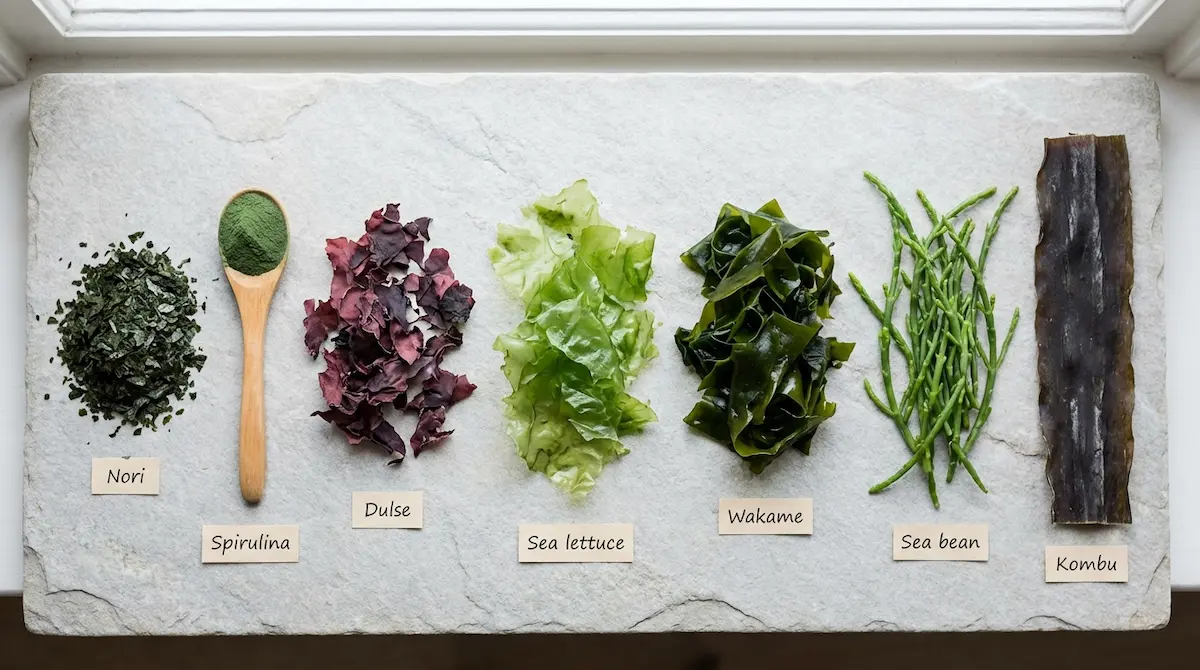
To go further on the virtues of edible seaweeds - dulse, wakame, sea lettuce, sea beans, our comprehensive guide details each aromatic profile in detail.
Seaweeds ranked from mildest to most intense
In terms of taste of seaweed and accessibility for genetically sensitive individuals:
- Nori - dominant umami profile (dried mushroom, slightly sweet), practically none marine olfactory receptor intensely stimulated. It is the reference algae for beginners. At Biovie, you can find it in raw, untoasted leaves - a quality that is almost impossible to find elsewhere. To discover all its advantages: the 7 benefits of nori seaweed. ⭐ Perfect for beginners.