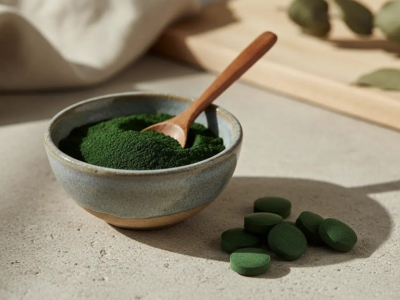
Superfoods for Dogs and Cats: The Complete Biovie Guide
Superfoods for dogs and cats (spirulina, marine plasma, green clay, barley grass, chlorella, klamath) are increasingly used in an approach of natural feeding for dogs and cats.
In this Biovie 2026 guide, I share with you the essentials of what I have observed in 33 years of living food, with my own companions as well as in the feedback from our breeder and animal naturopath clients: precise dosages by weight, methods of introduction, and precautions. The goal: to help you choose the superfoods that suit your dog or cat, without being swayed by trends, in respect of living beings.
Why give superfoods to your dog or cat?
A natural dog food supplement, based on raw superfoods, is added to the ration: spirulina, barley grass, marine plasma, clay. According to FEDIAF 2024 recommendations, an adult dog in maintenance needs about 2 g of high-quality protein per kilogram of body weight per day, 3.5 g for a sporting dog or a pregnant female. Superfoods do not replace a balanced diet.
Spirulina for dogs and cats
Spirulina (Arthrospira platensis) is a freshwater microalgae consumed since the Aztecs. It contains 55 to 70% complete proteins (dry matter), 15 to 20% phycocyanin, a blue pigment, and 8 to 10% essential fatty acids including gamma-linolenic acid (GLA).
For both dogs and cats, spirulina for dogs (or for cats) is used for:
Supplement the protein intake of a homemade or semi-homemade diet
Tolerance and acceptance
A study, conducted by Cordioli and colleagues in 2023 and published in Animals (Cordioli et al., 2023, PubMed Central), evaluated the palatability of spirulina in 40 dogs and 40 cats, at increasing doses. The animals accepted intakes of up to 2 g/day well, without notable digestive issues. The review by Kulpys et al. (2023) on Arthrospira in canine nutrition confirms this good tolerance profile.
Spirulina dog dosage: reference dose by weight
The average recommended dose for a course is 50 mg of spirulina per kilogram of body weight per day. Specifically, for guidance:
Cat or small dog (less than 10 kg): 0.5 to 1.5 g/day (a small pinch to 1/2 teaspoon)
Medium dog (10 to 25 kg): 1.5 to 3 g/day (1/2 to 1 level teaspoon)
Large dog (more than 25 kg): 3 to 5 g/day (1 to 2 level teaspoons)
Start systematically at a quarter of the dose for 7 days, then gradually increase over 2 weeks. Prefer a course of 3 weeks to be repeated 3 to 4 times a year (seasonal changes, molting, vaccination period). For more on consumption methods, our guide how to consume spirulina offers six practical uses applicable to the animal's diet.
Fresh, frozen, or powdered: which form to choose?
The quality of spirulina primarily depends on its place of production. The ANSES reminded in its 2017-SA-0244 opinion of the risks of contamination with heavy metals, microcystins, and PCBs associated with spirulinas produced in certain Asian areas. Always prefer a French spirulina, without preservatives or additives.
The fresh spirulina certified in France (400 g), the most vibrant form, to be kept in the freezer; pasty texture, ideal when mixed with food
French spirulina is very safe, but some precautions are necessary:
Puppies and kittens under 2 months: to be avoided (digestive system still immature)
Animal on anticoagulants: consult the veterinarian (possible interaction with phycocyanin)
Chronic renal failure: adjust dosages (significant protein intake)
Canine epilepsy: caution, one case reported in the literature
Possible mild effects at the start of treatment: soft stools, slight temporary fatigue; they disappear when the dose is reduced, otherwise stop and ask your veterinarian for advice
Marine plasma
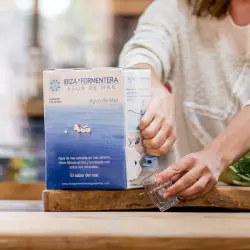
Marine plasma is microfiltered seawater, collected in oceanic vortex areas where plankton density is maximal.
The hypertonic marine plasma (natural marine concentration) must be diluted for animal consumption to replicate the concentration of the internal environment. The rule: 3 volumes of spring water for 1 volume of hypertonic plasma.
Cat or small dog (less than 10 kg): 50 to 100 ml/day of isotonic plasma
A practical tip we've observed for years with our clients: provide your pet with two bowls of water : one with pure water, the other with water mineralized with isotonic marine plasma. Simply observe which one your animal prefers.
Contraindications of marine plasma in animals
Few, but important to know: animals on a strict salt-free diet (decompensated heart failure, severe renal hypertension) should not receive marine plasma without explicit veterinary approval. The same applies to animals on long-term diuretics. For healthy animals, isotonic plasma is perfectly tolerated.
Green clay for dogs: traditional uses and precautions
Green clay for dogs is probably the oldest of all superfoods for animals. A naturalistic observation reported since antiquity: injured wild animals systematically seek a damp, clayey place to roll in. This tradition is well-documented in the French reference book The Healing Clay by Dr. Jade Allègre (re-ed. 2022).
Green clay for dogs: internal use
Internal use: Add a level teaspoon of superfine green clay per 10 kg of weight to a bowl of spring water, let it sit for 2 to 3 hours, then give the clay-infused water to your pet (without the sediment). In case of diarrhea, consult your veterinarian.
Limit this use to a maximum of 3 weeks (clay also absorbs some useful minerals) and keep clay intake at least 2 hours away from any potential treatment. If diarrhea persists for more than 48 hours, consult a veterinarian.
Montmorillonite, Illite, or Morélie: which one to choose?
Not all green clays are equal. Here are our three non-heated Biovie clays, and their use for animals:
Morélie (white clay), the gentlest. Perfect for the sensitive skin of kittens and very young animals (external use only).
The golden rules of clay
Three absolute rules, passed down by tradition and confirmed by observation: containers made of glass or ceramic, spoon made of wood, spring or filtered water (never metal, which inhibits the activity of the clay). Always use non-heated, sun-dried clay : heat destroys the electrocolloidal properties.
Barley grass and chlorella
After algae and clay, here are two green products that can be added in small quantity to the bowl.
Recommended dosage: 1/4 to 1 teaspoon per day depending on weight, in a course of up to 21 days, then 1 week off.
Barley grass for dogs
Barley grass is the young barley shoot (15-20 cm) harvested before heading.
Cat or small dog (less than 10 kg): a pinch (0.5 g) per day
Medium dog (10 to 25 kg): 1/2 to 1 teaspoon per day
Large dog (more than 25 kg): 1 to 2 teaspoons per day
Courses of 3 weeks, 3 to 4 times a year. Avoid chlorella in puppies and kittens under 3 months old.
The wild Klamath algae (Aphanizomenon flos-aquae) is a cyanophyte microalgae harvested in the wild from the volcanic Upper Klamath Lake (Oregon, USA). Unlike cultivated spirulina, it grows in a unique ecosystem from volcanic ash.
Reference dosage: a pinch for a cat or small dog, 1/2 teaspoon for a medium dog. Short course of 10-14 days. Avoid if on antidepressant treatment (MAOIs).
How to Introduce Superfoods into the Diet?
The success of supplementation relies less on the ideal dose than on the gradual introduction. The digestive system of dogs and cats adapts, but it must be supported.
Start Very Gradually
Begin with a quarter of the recommended dose for the first 7 days, then increase to half for 7 days, and finally reach the full dose from the 15th day. This gradual introduction limits initial digestive issues (soft stools, food refusal) and allows the intestinal flora to adapt.
Mix Intelligently
Spirulina, chlorella, and barley grass powder mix ideally with a wet ration (pâté, homemade ration, BARF), their bitterness is then covered by the fat of the meat or broth. On dry kibble, sprinkle just before serving and slightly moisten with a bit of warm water or isotonic marine plasma. Marine plasma can replace all or part of the usual drinking water.
Course or Maintenance?
Two complementary approaches:
In a course (3 weeks, 3-4 times/year) for spirulina, chlorella, barley grass, and klamath, during seasonal changes or molting periods
For occasional use for marine plasma and for green clay, on veterinary advice if your animal shows a symptom
Precautions, Interactions, and Foods to Avoid
Before any supplementation, keep in mind that superfoods do not replace veterinary advice, especially for an animal under treatment or suffering from a chronic condition (kidney failure, diabetes, hypothyroidism, epilepsy, cancer).
Interactions to be aware of:
Anticoagulants + spirulina or klamath: phycocyanin can enhance the effect, veterinary advice is imperative
Diuretics + marine plasma: risk of electrolyte imbalance
Clay + oral treatment: space out doses by at least 2 hours
Antiepileptic treatment: caution with spirulina
Essential reminder: some human foods are toxic for dogs and cats, even in small quantities. Never give your pet:
Chocolate (theobromine)
Onion, garlic, chives (sulfur compounds)
Grapes and raisins (acute kidney failure)
Avocado (persin)
Xylitol (sweetener, severe hypoglycemia in dogs)
Alcohol and caffeine
Cow's milk (for adult cats, poorly tolerated)
Signs to immediately stop any supplementation: repeated vomiting, persistent diarrhea beyond 48 hours, loss of appetite for more than 48 hours, unusual lethargy. Consult your veterinarian.
FAQ, your questions about superfoods for dogs and cats
Is spirulina good for dogs and cats?
Yes, spirulina is well tolerated by healthy dogs and cats. Always start with a small dose and avoid in puppies under 2 months.
What dose of spirulina should be given to a dog?
The average recommended dose is 50 mg of spirulina per kilogram of body weight per day. Specifically: 0.5 to 1.5 g/day for a dog under 10 kg, 1.5 to 3 g/day for a dog between 10 and 25 kg, and 3 to 5 g/day for a dog over 25 kg. Mix with wet food or sprinkle on kibble, in a 3-week course 3 to 4 times a year.
Can green clay be given to a dog?
Talk to your veterinarian first. Green clay (montmorillonite or illite) is given in small quantities: mix 1 teaspoon per 10 kg of weight in a little spring water, to be added to the food bowl or left available in a second bowl. Limit to a maximum of 3 weeks. If diarrhea persists for more than 48 hours, consult a veterinarian.
How to use marine plasma for an elderly dog or cat?
Marine plasma is microfiltered seawater. Dilute in isotonic form (3 parts water to 1 part hypertonic plasma). Count 50 to 100 ml/day for a cat or small dog, 200 ml/day for a dog over 10 kg. Contraindicated in case of a strict salt-free diet.
What are the dangers of spirulina for a dog?
Spirulina is very safe when sourced from a reliable producer (ideally France, outside Asia to limit heavy metal contamination). Possible mild side effects: digestive issues (soft stools, vomiting) at high doses, rare allergic reactions, temporary fatigue at the start of a course. Avoid in puppies under 2 months and in cases of kidney failure or anticoagulant treatment without veterinary advice.
Chlorella or spirulina: which one to choose for my dog?
Both can be used in courses, alternating them, with the reference doses given above.
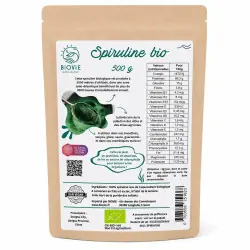
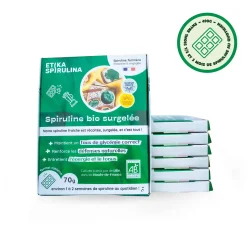
Biovie organic spirulina comes in 4 formats: fresh, grown in a greenhouse by Etika; frozen fresh, produced in northern France by Etika Spirulina; powder, from organic aquaculture; and phycocyanin, the concentrated extract of the blue pigment, almost tasteless but intensely colorful. To start a regular routine, powder is the most economical and the easiest to dose; for freshness, choose fresh or frozen spirulina of French origin, closer to the harvest. Phycocyanin suits anyone looking for a concentrated extract with a discreet taste, to add to a preparation without changing its flavor., 4
products
"For over thirty years, I have fed my own animals, dogs, cats, chickens, with the superfoods we produce at Biovie. I have seen my animals accept these additions to their bowl very well, provided they are introduced gradually. My only advice: always prioritize quality, always start gradually, and always observe your companion, they will show you themselves what they accept."
Disclaimer: The information presented in this article is provided for informational purposes and does not constitute veterinary advice. Consult a qualified animal health professional before making any significant changes to your dog or cat's diet or supplementation, especially in cases of chronic illness, ongoing treatment, pregnancy, or for a very young or very old animal.