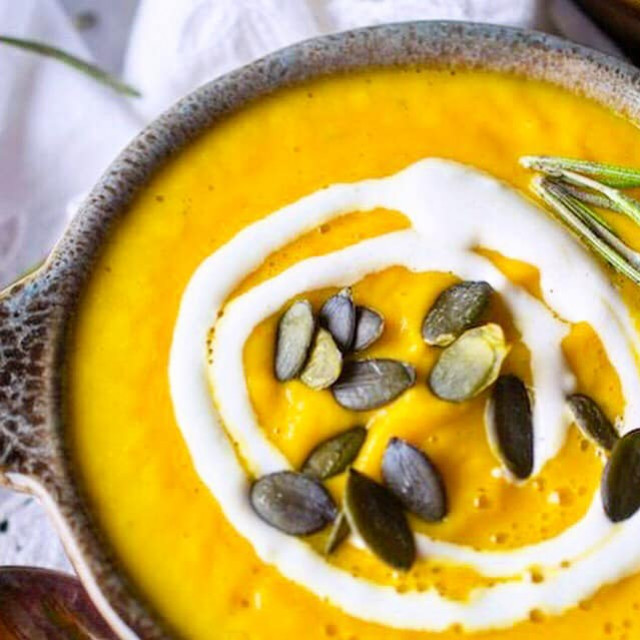
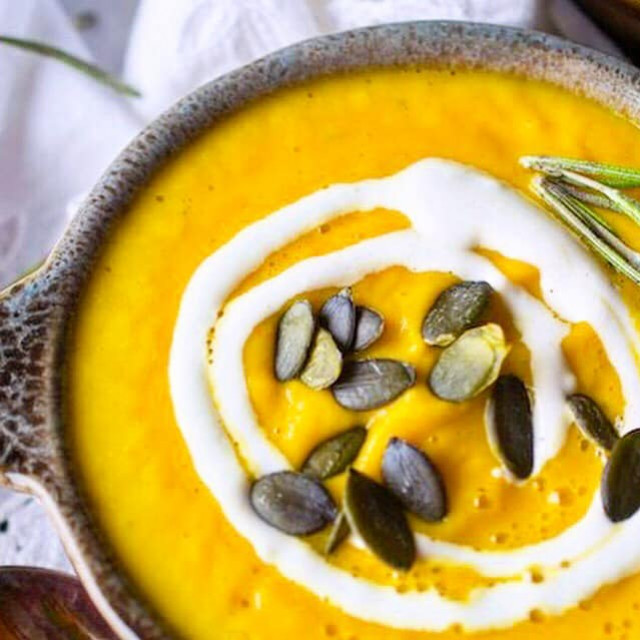
Are you looking for a raw and comforting recipe, perfect for autumn? This raw pumpkin soup combines sweetness and color. Rich in water, sweet and colorful, it is made in five minutes in the blender. And yes, you can absolutely eat pumpkin raw, as long as you choose the right squash. Today I am sharing the recipe, and everything you need to know before you get out the blender, in the spirit of what living food is.
Pumpkin is one of the most hydrating vegetables of the season, with nearly 90% water (source: ANSES Ciqual table). In practical terms? A bowl of this soup is already a big glass of water, in a tasty and colorful version. Handy when the air turns cooler and we tend to drink less.
In terms of composition, it contains:
Potassium: about 340 mg per 100 g according to Ciqual, or 17% of the NRV. Potassium contributes to normal muscle function and to the normal functioning of the nervous system.
Beta-carotene: the orange pigment that gives the flesh its color, and that the body converts into vitamin A.
Gentle fibers.
And then there is the argument close to my heart: raw, pumpkin keeps its firm texture and fresh taste. That is the whole spirit of living food. To go further, I recommend this article on five misconceptions about living food that really deserve to be debunked.
Can you eat pumpkin raw?
Yes, pumpkin can be eaten raw, just like red kuri squash, butternut or sweet dumpling. These mild-fleshed squashes blend very well, in a soup, a velouté, or even grated in a salad. No digestive problem for most people, in reasonable quantities.
One rule, however. Only one, but it matters: always taste a small raw piece before making your soup. If the flesh is clearly bitter, spit it out and throw the squash away. This bitterness is not a detail, it signals the presence of cucurbitacins, natural compounds that some squashes produce in large quantities (often ornamental squashes, or squashes grown from saved seeds in the vegetable garden).
ANSES is clear on this: these substances withstand cooking and can cause serious digestive problems. The good news? A non-bitter pumpkin from the shop does not carry this risk. Taste is your best ally. Bitter, throw it away. Mild, enjoy it.
The raw pumpkin soup recipe
Ingredients (for 2 to 3 bowls)
750 g of pumpkin flesh
1 red bell pepper
20 cl of filtered water
1 fresh onion
1 cup of coconut cream
1 garlic clove
2 cups of infused fresh rosemary
1 tsp of dried thyme
1 tsp of turmeric
1 tsp (about 5 ml) of marine plasma (or ½ tsp of sea salt)
Pepper to taste
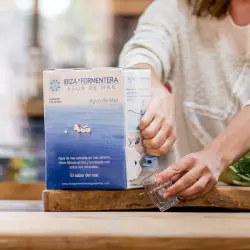
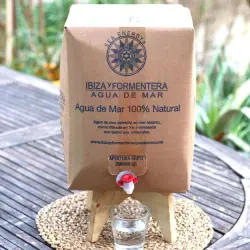
For the mineral touch, it is marine plasma that we use at home: a few milliliters are enough to lift the soup while bringing the minerals of seawater. Measure it with a spoon, never at random.
Blend until you achieve a smooth and creamy texture.
Serve immediately.
Tip: if you prefer a warm soup, blend a little longer to heat it slightly, never exceeding 42°C. Beyond that, it is no longer a raw soup.
The little extra
Just before serving, add a teaspoon of raw olive oil or a few sprouted seeds. You add roundness and that little crunch that changes everything in a velouté. Honestly, it is the move I recommend most often.
Pumpkin or winter squash?
People mix them up all the time, and yet they are two quite distinct cousins. The pumpkin (citrouille) belongs to the species Cucurbita pepo, the winter squash (potiron) to Cucurbita maxima. Pumpkin has slightly more stringy flesh and a more vegetal taste; winter squash is sweeter and more melting, with that chestnut note we love in the kitchen.
For a raw soup, both work very well. My field advice, after quite a few trials: red kuri squash (potimarron, a variety of Cucurbita maxima) remains the easiest to work with raw. Its skin is thin, you can keep it after a good wash, and its mild flesh blends effortlessly. An excellent starting point if you are new to raw food.
Frequently asked questions
Is it safe to eat pumpkin raw?
Yes, as long as it is not bitter. Taste a small raw piece before cooking: if the flavor is mild, there is no problem. If the flesh is bitter, throw the squash away, because bitterness signals cucurbitacins, which are best avoided.
What does raw pumpkin contain?
It contains nearly 90% water (ANSES Ciqual table), potassium, beta-carotene and gentle fibers. It can be eaten raw, blended into a soup or velouté, or grated into a salad.
Do I need to peel the pumpkin for a raw soup?
For pumpkin, yes: its skin is thick and tough. Red kuri squash, on the other hand, can be blended with its thin skin once well washed, which adds fiber and color.
Pumpkin or winter squash for a raw soup?
Both work. Winter squash (and especially red kuri) is milder and more melting when raw, so it is easier for beginners. Pumpkin gives a soup with a more vegetal taste.
How long does a raw pumpkin soup keep?
It is best enjoyed fresh, right after preparation. You can keep it up to 24 hours in the refrigerator, in an airtight container. Stir before serving.
What is marine plasma ?
So-called hypertonic marine plasma is simply seawater harvested and filtered under very specific conditions.
Our supplier Ibiza Agua de Mar collects sea water from a depth of 25 meters off the coast of Ibiza in a UNESCO listed area.
Concerning the harvest, here are the different physico-chemical parameters measured during the search for an optimal place for the harvest of hypertonic marine plasma, first on the radar with reading of the currents and according to the marine weather (wind, swell, rain. ..) and then by local measurement of these different parameters: taste of seawater, dissolved O2 level, PH level, redox level (ORP), salinity level (TDS), conductivity level ( PSU), alkalimetric title (TA), Pressure. It is the empirical practice of the harvesters and the reading of the various measuring instruments that makes it possible to decide on the best complex combination of these measures together to decide whether the harvest is triggered on the site or whether another location is sought.
Where does marine plasma come from ?
The marine plasma is collected in the high seas, off the coast of Ibiza, in a specific area classified as UNESCO with high planktonic activity and with a presence of tens of square kilometers of Posidonia. It is indeed in this specific area that lives the largest living organism listed on Earth, a posidonia herbarium of 80,000 to 200,000 years extending over 15 kilometers in length.
Source: Sophie Arnaud-Haond, Carlos M. Duarte, Elena Diaz-Almela, Núria Marbà, Tomas Sintes, Ester A. Serrão: Implications of Extreme Life Span in Clonal Organisms: Millenary Clones in Meadows of the Threatened Seagrass Posidonia oceanica
When is it best to take marine plasma ?
The ideal is to consume marine plasma, which contains, let's remember, all the elements that make up Mendeleev's periodic table, in the morning when you get up, on an empty stomach. take 1/4 of hypertonic marine plasma to mix 3/4 of spring water or filtered water.
What are the benefits of marine plasma ?
Minerals are the "fuel" used primarily by our body, which is necessary for our cells to perform their functions optimally. They are also essential for the absorption of vitamins and are responsible for enzymatic processes in cells. Cells perform all their functions with maximum vitality and the precise capacity for organic, bioavailable, alkaline cellular nutrition. Thus, sea water becomes the best mineral drink since it contains all the elements of Mendeleev's periodic table.
Another of the great benefits of seawater is its pH. As Otto Warbürg, father of cellular respiration and two-time Nobel laureate, said, “all diseases are acidic and where there is oxygen and alkalinity there can be no disease”. Due to the quality of our raw material, the hyper-oxygenated waters of Posidonia meadows (recognized by UNESCO as a World Heritage Site in 1999) and sea currents providing purity and clarity: Ibiza and Formentera Agua de Mar have an alkaline pH , between 8.1 and 8.4, which will help the body maintain a neutral pH through homeostasis. The ingestion of sea water is advised to control and maintain our PH, as well as an exceptional supplement for alkaline diets.
The antioxidant and anti-acidity power produced by seawater is due to the alkalinity provided by the minerals.
Drinking filtered seawater in a direct and controlled way is very beneficial for your health, because seawater is an excellent nutrient, containing most of the minerals of the periodic table and all of them dissolved in the best universal solvent available: l 'water.
Seawater contains all the minerals of the periodic table of elements in a bioavailable way. It is thanks to this that foods cooked in seawater are rehydrated and remineralized to make foods with high nutritional power. The problem today is that our intake of minerals through food has dropped dramatically and what is causing this? The answer is very simple: pollution, soil depletion due to intensive agricultural production and our stressful pace of life have considerably reduced the quality of food and its mineral intake, drastically reducing the minimum contribution necessary for the proper functioning of the body.
Seawater also helps us stay young, for a simple reason: the body regularly and cyclically regenerates all its cells, because their lifespan is limited in time. As we age, one of the first faculties the cell loses is the ability to hydrate. We know that the older we get, the less we drink, so drinking and ingesting seawater can help us "wake up" this ability to hydrate ourselves., 4
products
This raw pumpkin soup is five minutes of blender for a soft, colorful bowl as autumn settles in. Try it with red kuri squash to begin with, always taste the flesh first, and add your sprouted seeds at the last moment. Try it and you will adopt it!
Want to extend the mineral intake of your raw recipes? Discover our whole range of marine plasma, the seawater we filter for living cuisine, from the 750 ml size to the 3 liter one.
Disclaimer: The information presented in this article is provided for informational purposes and does not constitute medical advice. Consult a qualified healthcare professional before making any change to your diet or supplementation. As part of a varied and balanced diet and a healthy lifestyle.