









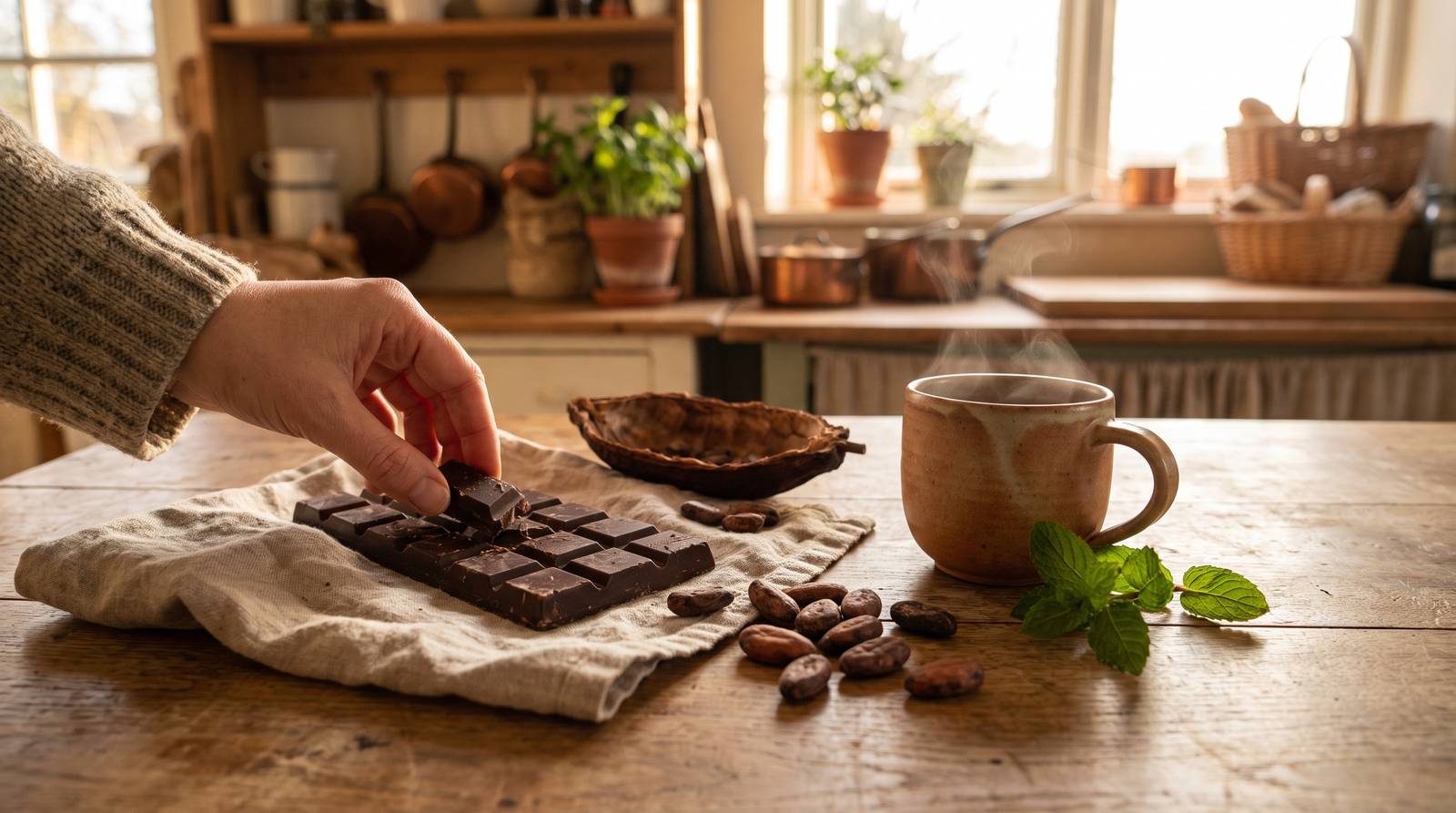
Lead and cadmium in dark chocolate make the news whenever a bar test comes out, but the cadmium comes from the soil where the cacao tree grows, and it is no reason to give up your bar: Europe caps its level according to the percentage of cocoa, and chocolate accounts for less than 3% of our exposure, as long as you choose well and watch your portion. At Biovie, we draw these benchmarks from Anses (2026), from Regulation (EU) 2023/915 and from EFSA (2009).
Every time a bar test makes the headlines, the same question comes back, and you end up typing "lead and cadmium in dark chocolate" into a search bar, wondering whether the square you have with your afternoon snack should go back in the cupboard. This time, though, the news does not come from the chocolate aisle, it comes from the fields: on 2 October 2026, the French government published in the Journal officiel texts lowering the cadmium allowed in phosphate fertilisers to 60 mg per kg of P2O5 on 1 January 2027, down from 90 (La France Agricole, 2026). A third less cadmium in every bag of fertiliser. And a further reduction is already out for public consultation.
I am an ISTOM engineer, trained in tropical agronomy. The question of soils has never left me since my studies. That works out well: this story begins with the soil, long before the bar.
Why is there cadmium in dark chocolate?
Cadmium is a metal that occurs naturally in some soils, no more, no less. The cacao tree draws it up through its roots along with water, then stores part of it in its beans. The more cocoa a chocolate contains, the more cadmium it can bring, hence the higher levels in dark chocolate.

The soil, more than the farming
A literature review published in 2021, based on a meta-analysis of 780 soil and plant pairs, gives an easy benchmark to remember: the bean contains on average about twice the cadmium content of the soil where the tree grows (Vanderschueren et al., 2021). If the soil is loaded, the bean will be twice as loaded: it is the soil that sets the tone. The cacao tree is not a "hyperaccumulator" (those plants able to concentrate a metal at extraordinary levels) for all that: it makes do with the soil it is given.
And here, geography speaks for itself. In Latin America, more than half of bean samples exceed 0.60 mg/kg, more than one bean in two, then, linked to young soils naturally rich in cadmium. According to this review, the origin there is mainly geological, much more than linked to phosphate fertilisers. It is not first a matter of farming practices, it is a matter of rock.
In France, the picture is reversed. In our farmland soils, fertilisers supply more than 80% of cadmium inputs, 55% of them from mineral phosphate fertilisers alone (Anses, 2026). A contradiction? No. Both findings hold together: on one side we are talking about the tropical soils of cacao plantations, on the other about the French fields where our wheat and potatoes grow.
In the bean, cadmium stays in the non-fat part
To make chocolate, beans are ground into a paste, which can then be pressed to separate the cocoa butter from the powder. Think of the oil mill in our villages of the Gard: the oil flows out on one side, the pressed residue stays in the press. Well, with cocoa, cadmium follows the residue. Laboratory analyses carried out in Brazil on 90 samples of beans and their derived products show that the metal tends to stay in the non-fat fraction, the powder, rather than in the cocoa butter (Oliveira et al., 2021).
As far as cadmium goes, then, it is the cocoa dry matter that counts.
What the European regulation sets according to cocoa content
The European legislator followed the same logic as the bean. To limit cadmium in dark chocolate, Regulation (EU) 2023/915 reasons in "total cocoa dry matter", that is, the butter and the powder together, without their water. On a standard dark bar, the percentage printed on the wrapper is close to it, without always being strictly identical (that would be too easy).
| Product (Regulation (EU) 2023/915) | Maximum cadmium level |
|---|---|
| Milk chocolate with less than 30% total cocoa dry matter | 0.10 mg/kg |
| Chocolate with less than 50% total cocoa dry matter; milk chocolate with 30% or more | 0.30 mg/kg |
| Chocolate with 50% or more total cocoa dry matter | 0.80 mg/kg |
| Cocoa powder sold to the final consumer or used in sweetened cocoa powder (drinking chocolate) | 0.60 mg/kg |
As you can see, the cap rises with the cocoa, and that is not a favour granted to chocolate makers. The logic is that of the bean: cadmium follows the dry matter, so a chocolate richer in cocoa mechanically carries more, and the legislator took that into account. 0.80 mg per kilo is less than a thousandth of a gram, spread over a whole kilo of chocolate.
A cap is not an actual level. It is the line beyond which a product can no longer be sold in Europe, a bit like the motorway speed limit, which does not tell you how fast cars really drive. The bars on the market generally sit below it. The table says what is allowed; your bar, for its part, generally contains less.
How much of your cadmium exposure does chocolate account for?
According to Anses (2026), chocolate accounts for less than 3% of dietary exposure to cadmium, in all age groups. The big contributors are elsewhere, on the everyday plate: cereal-based foods (bread, breakfast cereals, pastries, biscuits, pasta), then potatoes and some vegetables.
Picture the pie chart of your exposure: chocolate takes a slice so thin you can barely make it out, while bread and cereals carve out the biggest portions. As a baker's son, "raised on gluten" all through my childhood, I note this with a slightly tight smile. The square at snack time is therefore not the great culprit people imagine. Far from it.
So why is it talked about so much? Because overall exposure remains too high for part of the population, and there, the figures are no longer a laughing matter. In the EAT3 total diet study, 23 to 27% of children and 1.4 to 1.7% of adults exceed the tolerable daily intake. The Esteban study (2014 to 2016) goes further: 47.6% of 18 to 60 year olds exceed the critical urinary threshold of 0.5 µg of cadmium per gram of creatinine (Anses, 2026). About one child in four, and almost one adult in two for the urinary marker: the subject is serious, but it goes well beyond the bar.
Cadmium has this particular feature: it builds up in the body over the years, a bit like limescale at the bottom of a kettle. Prolonged exposure mainly affects the kidneys and bones (osteoporosis, fractures), and Anses reminds us that it is classified as carcinogenic, mutagenic and toxic for reproduction. In 2009, EFSA set a tolerable weekly intake of 2.5 µg per kg of body weight (EFSA, 2009): for a 60 kg adult, 150 µg per week. A quantity invisible to the naked eye, and yet it can be measured.
And it is upstream that things are finally moving.
Anses recommends limiting the cadmium in phosphate fertilisers to 20 mg per kg of P2O5 at most; France moves to 60 mg on 1 January 2027 (La France Agricole, 2026). Of course, it is real progress, and I welcome it. But the gap with the recommendation remains one to three, after decades of spreading this metal with fertilisers without measuring what it left in our soils. We looked at the harvest of the year, rarely at the soil we were leaving behind.
To go beyond chocolate, I have gathered the seven reflexes for limiting cadmium day to day, and another article takes stock of what science says about eliminating cadmium. In short, as part of a varied and balanced diet and a healthy lifestyle, the square of chocolate keeps its place: it is the everyday plate that tips the scales.
Three benchmarks for choosing your bar
What remains is the practical question, the one that probably brought you here: which bar to choose? Nobody can point you to the ideal bar, and I distrust those who claim to. What we can do, though, is learn to read the one we are holding in our hands.
Where the cocoa comes from
Latin American beans are on average more heavily loaded (Vanderschueren et al., 2021). Does that mean going off to hunt for African dark chocolate with no cadmium? Zero exists nowhere. Origin remains a first clue, nothing more: makers often blend beans from several origins to meet the European limits, and the review sees this as the most realistic route in the short term.
The right reflex is to look at the stated origin, then ask the maker for its cadmium analyses. Some already publish them, and it is a transparency I would like to see become widespread. I would, however, be wary of any promise about a specific country: the available data do not allow origins to be ranked one by one.
The cocoa percentage
More cocoa means more dry matter, so more possible cadmium for the same amount (Oliveira et al., 2021; Regulation (EU) 2023/915). Should you run from 85%? Not at all. A very intense chocolate is often eaten in smaller amounts, a little is enough for it (that is part of its charm). And to the question "which dark chocolate has no cadmium?", the honest answer is that there is none: we only aim for a less loaded chocolate. If you are wondering about raw cocoa, I have gone into what sets raw cocoa apart from dark chocolate elsewhere.
Organic or not?
Here, I may surprise a few of you: organic does not change the geology of the soil. In the American study covering 72 cocoa-based products, organic products were even significantly more often loaded with cadmium and lead (Hands et al., 2024). The sample is American, and this result says nothing against organic farming: for the cadmium in organic dark chocolate, it is the soil that decides, not the label. I, who accompanied organic conversions for years, see no contradiction: the specification frames the grower's practices, it does not choose the rock under the tree.
The portion: the benchmark that matters most
Here is the calculation that most articles on the subject are missing. It is a worst case, with a bar assumed to sit exactly at the legal cap; no measured level goes into this calculation:
- 60 kg adult: 60 × 2.5 = 150 µg per week of tolerable intake (EFSA, 2009);
- a bar with 50% cocoa or more, at the cap of 0.80 mg/kg, supplies 0.8 µg of cadmium per gram;
- 10 g a day (about two squares) make 56 µg per week, about 37% of the tolerable intake;
- 20 g a day: 112 µg, or about 75%;
- for a 30 kg child, the tolerable intake falls to 75 µg per week, and the same 10 g a day would cover about 75% of it.
Two squares a day in the worst case is a good third of an adult's weekly budget; for a child, it is already three quarters. Hence the caution with children, who also get their share of cadmium through bread and cereals. Still, bear in mind that this calculation darkens the picture on purpose: actual levels are generally below the cap, in the American study the medians stayed under the thresholds (Hands et al., 2024), and chocolate accounts for less than 3% of exposure (Anses, 2026).
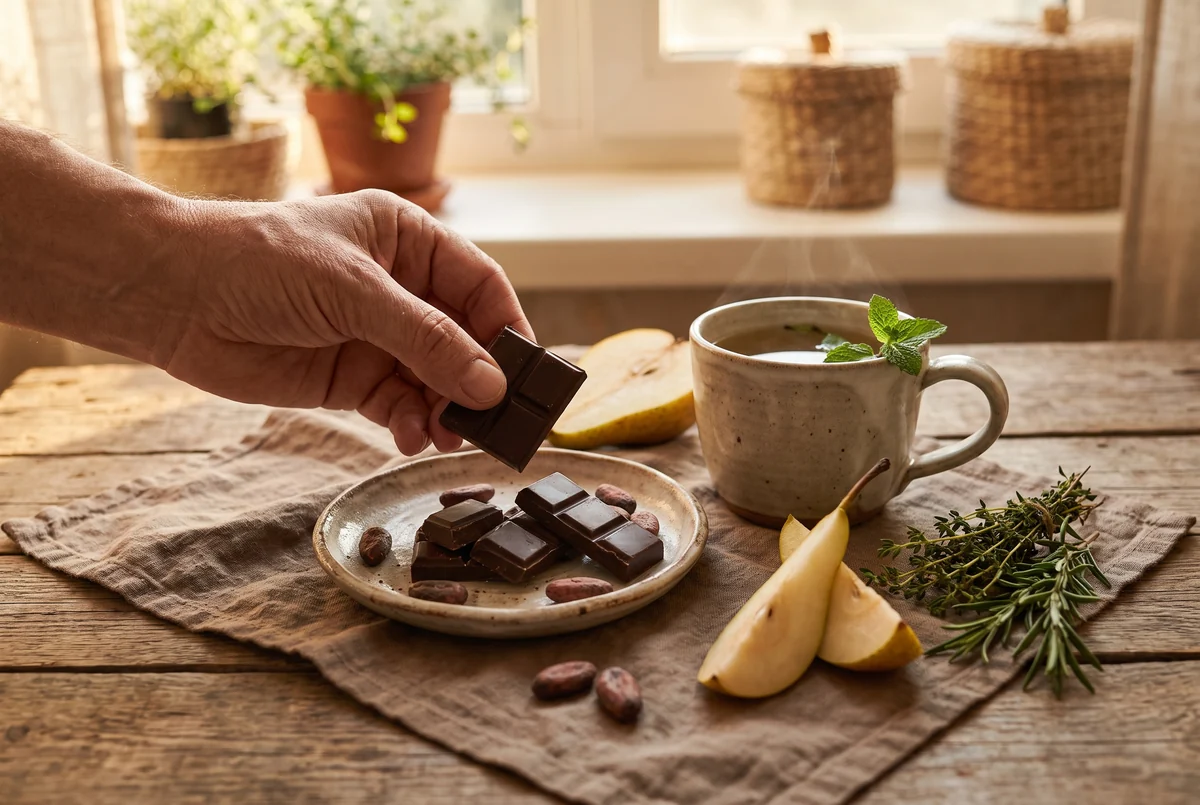
One very simple gesture, starting this week: break off your squares in advance and put them on a saucer, rather than nibbling straight from the bar. That way you know what you are eating. As part of a varied and balanced diet and a healthy lifestyle, a few squares savoured slowly have their place, especially if you alternate bars and origins.
Lead and cadmium in dark chocolate: how to read the tests
The figures that keep circulating on cadmium and lead in dark chocolate often come from one and the same American study. Hands et al. (2024) analysed 72 cocoa-based products bought in the United States between 2014 and 2022: 43% exceeded the Californian threshold (Proposition 65) for lead, 35% for cadmium, and none for arsenic. Put like that, lead and cadmium in dark chocolate sound frightening. Except that the medians stayed under those thresholds, and that the exceedances came from a few heavily loaded products. Out of ten products in the sample, three or four above the Californian threshold for cadmium: a minority, driven by a few extreme cases.
And above all, it all comes down to the unit.
The Californian threshold is a dose per day, 4.1 µg of cadmium for one serving, whereas Europe sets a concentration, in mg per kg of product. You don't compare kilometres and kilometres per hour. "35% exceed" therefore does not mean "35% would be illegal in Europe".
I knew the days when you went to the library and the journals to find information, and I take from it a sentence I know is a bit blunt: today, ignorance is a choice. The European regulation and the Anses opinion are freely accessible, and all it takes is a look at the unit of a figure to know whether it really concerns you. As part of a varied and balanced diet and a healthy lifestyle, dark chocolate keeps its place, provided you choose it and portion it.
Let's hope that in a few years the cadmium analysis will appear on bars as naturally as the cocoa percentage. In the meantime, the next time a test of lead and cadmium in dark chocolate makes the headlines, look at the unit first, then at the origin of your beans. And if you know a maker who already publishes its analyses, write to me!
Frequently asked questions
Why does chocolate contain cadmium?
Because the cacao tree draws up the cadmium that occurs naturally in the soil and stores it in its beans, which contain on average about twice as much as the soil the tree grows in. Latin American beans are on average more heavily loaded, because of young soils rich in cadmium, according to a review published in 2021.
Can you eat dark chocolate every day?
Yes, in reasonable amounts. In the worst case of a dark bar at the European cap of 0.80 mg/kg, 10 g a day, or about two squares, represent about 37% of the tolerable weekly intake of a 60 kg adult. Actual levels are generally lower, and caution matters more for children.
Does the cadmium in chocolate cause symptoms?
No, there is no immediate effect to expect from a tasting. The risk described by Anses comes from accumulation in the body over the years, all dietary sources combined, with possible effects on the kidneys and bones. Chocolate accounts for less than 3% of this exposure.
Which dark chocolate contains the least cadmium?
No single bar can be named with certainty, but three clues help. Latin American beans are on average more heavily loaded; a lower cocoa percentage brings less dry matter, so less possible cadmium; and finally, some makers publish their analyses, which is the most reliable benchmark.
Does organic dark chocolate contain less cadmium?
No, not automatically. Cadmium comes mainly from the geology of the soil, which the organic label does not change. In an American study of 72 cocoa-based products, organic products were even more often loaded with cadmium and lead. This result concerns the American market and does not call organic farming into question.
Is there a dark chocolate with no cadmium?
No, no chocolate made from cocoa beans contains zero. Cocoa butter holds very little, because the metal stays mainly in the non-fat part, the one that gives the powder. You can, however, choose a less loaded chocolate by looking at the origin of the beans and the analyses published by the maker.
References
- Anses, 2026. What is cadmium and what are the health risks? Synthèse de l'expertise « Priorisation des leviers d'action pour réduire l'imprégnation de la population française au cadmium selon une approche d'exposition agrégée » (saisine 2023-AUTO-0150, rapport). Anses (Agence nationale de sécurité sanitaire de l'alimentation, de l'environnement et du travail).
- Commission européenne, 2023. Règlement (UE) 2023/915 de la Commission du 25 avril 2023 concernant les teneurs maximales pour certains contaminants dans les denrées alimentaires. Journal officiel de l'Union européenne, L 119, p. 103.
- EFSA, panel CONTAM, 2009. Cadmium in food: Scientific Opinion of the Panel on Contaminants in the Food Chain. EFSA Journal, 980, 1-139.
- Vanderschueren R., Argüello D., Blommaert H., Montalvo D., Barraza F., Maurice L., Schreck E., Schulin R., Lewis C., Vazquez J. L., Umaharan P., Chavez E., Sarret G., Smolders E., 2021. Mitigating the level of cadmium in cacao products: Reviewing the transfer of cadmium from soil to chocolate bar. Science of the Total Environment, 781, 146779.
- Oliveira A. P. F., Milani R. F., Efraim P., Morgano M. A., Tfouni S. A. V., 2021. Cd and Pb in cocoa beans: Occurrence and effects of chocolate processing. Food Control, 119, 107455.
- Hands J. M., Anderson M. L., Cooperman T., Balsky J. E., Frame L. A., 2024. A multi-year heavy metal analysis of 72 dark chocolate and cocoa products in the USA. Frontiers in Nutrition, 11.
- La France Agricole, 2026. Engrais : le gouvernement décide de réduire plus rapidement les teneurs en cadmium. La France Agricole, 2 octobre 2026.
Updated: November 2026. Article written and validated by Éric Viard, founder of Biovie since 2007 and ISTOM engineer, co-author of « Algues au quotidien » (Gallimard, 2024), Best cookbook in the world, Gourmand Cookbook Awards 2025, and Best cookbook in France, Académie Nationale de Cuisine 2025.
The information presented in this article is provided for information purposes only and does not constitute medical advice. Consult a healthcare professional before making any change to your diet or supplementation.