Why cadmium is so hard to remove once fixed
This is the starting point, and it's the one everybody skips. When you absorb cadmium, your body eliminates only a tiny fraction of it each day. The rest accumulates, mainly in the kidneys. Its biological half-life is estimated at between 10 and 20 years in renal tissue - sometimes more, up to 30 years according to recent work (Satarug et al., 2017). In concrete terms: a microgram absorbed at age 30 is still there, half of it, when you turn 45 or 50. Your body keeps a counter, and it doesn't reset to zero.
Why this persistence? Because of a protein that was supposed to protect you: metallothionein. When cadmium enters a cell, the body captures it within this protein to limit its immediate toxicity. Good news in the short term - except that this cadmium-metallothionein complex is then stored in the kidney, where it stays trapped for years. The cage that protects becomes the cage that retains. This is the physiological reason why cadmium isn't easily "flushed" out of an organ: it isn't freely circulating, it's sequestered.
And it's far from harmless. The kidney concentrates roughly a third of the body's cadmium burden, and the data on low-dose nephrotoxicity keep mounting (Satarug et al., 2020). The IARC has classified cadmium as a proven human carcinogen (Group 1) since 1993. The EFSA set a tolerable weekly intake of 2.5 µg/kg of body weight (EFSA, 2011) - and the problem raised by ANSES is precisely that a large share of the population exceeds it.
The conclusion isn't discouraging, it's strategic: since removing already-fixed cadmium isn't realistic through nutrition, the whole game is played on the incoming flow and on the terrain. Reducing what you absorb today means acting on the next 50 years of your counter. That's where nutrition becomes a real - and demonstrated - lever.
The essential distinction: systemic chelation or intestinal binding?
Before getting into the practical side, we need to clear up two words that are constantly confused, and this misunderstanding is at the root of most of the dubious promises you'll read online.
Systemic chelation: it's medical, and it's not our subject
Chelation, in the strict medical sense, consists of administering a molecule (EDTA, DMSA, DMPS) that binds to the metal already present in the blood and tissues in order to flush it out through the urine. It's a therapeutic act, reserved for acute poisoning, performed in a hospital setting under medical supervision. It's neither harmless nor risk-free: poorly conducted, chelation can throw essential minerals out of balance and strain the kidneys. This is not Biovie's territory, and it must never be self-administered. If you suspect a real poisoning, that calls for a medical consultation, not a course of supplements.
Intestinal binding: it's nutritional, and that's where you can act
Intestinal binding is something else entirely. Certain fibers and cell walls (the chlorella cell wall, alginates from brown seaweeds, pectins from fruit) have the ability to bind to the cadmium present in the digestive tract - the cadmium from your current meal - before it gets absorbed. The captured metal then leaves with the stool. We don't touch the cadmium already stored: we reduce the absorption of the day's dietary dose. It's a modest but real, factual mechanism, and perfectly consistent with what nutrition can legitimately claim.
Hold on to this image: medical chelation empties part of the reservoir, under medical control; intestinal binding, for its part, tightens the funnel at the entrance. The 4 tiers that follow all act on the entrance and on the terrain - never on a promise to "drain" the tissues.
Tier 1: intestinal binding (reducing what comes in)
This is the first line of defense, the most direct one, and the one on which the literature is most telling.
Chlorella (cell-wall broken)
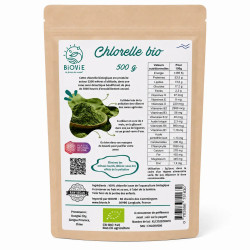
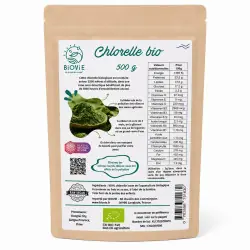
Chlorella is a freshwater micro-algae whose cell wall has an affinity for metals. In rats exposed to cadmium, a supply of chlorella increases the fecal and urinary excretion of the metal and reduces its accumulation in the tissues (Shim et al., 2009; confirmed by Lee et al., 2009). The mechanism proposed is intestinal binding by the cell wall. To stay honest: these results are obtained in animals. We're talking about support for reducing absorption, not proof of tissue elimination in humans.
Two conditions, for me, are non-negotiable. First, the chlorella must be cell-wall broken: without that, it's very poorly assimilable and the benefit collapses. Second, it must be analyzed batch by batch, because an algae that binds metals can also concentrate them if it's poorly cultivated - that's the whole paradox, and that's where traceability makes the difference. As for usage, the literature explores intakes on the order of 3 to 5 grams per day, before meals. At Biovie, we always think in grams - never in capsules or tablets.
Alginates and fucoidans from brown seaweeds
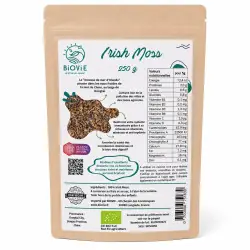
Brown seaweeds - kombu, wakame, dulse, ascophyllum - are rich in alginates, soluble fibers that form a gel in the intestine and trap certain metal ions. The historical work on sodium alginate showed a reduction in strontium absorption reaching as much as 83% in animals and 50% in humans for 1.5 g, without disturbing calcium (Carr & Nolan, Nature, 1968). The principle - capturing divalent cations in the digestive tract - has been extended to other metals of the same nature as cadmium. This is exactly the role of Tier 1: a barrier effect at mealtime. And it's the subject I know best, since it's precisely what we develop in Algues au quotidien: making seaweed a reflex rather than an occasional cure.
Pectins from fruit
Simpler and even more everyday: the pectins from apples, lemons and berries are polyelectrolytes that also take part in binding metals in the intestine. This isn't a supplement, it's your fruit bowl - one more reason to keep it full.
Spirulina, as a complement
Spirulina doesn't have chlorella's binding cell wall, but it provides proteins and minerals that come into play in Tier 2 (see below). I mention it here as a complement, not as the main binding agent.
Tier 2: nutritional antagonists (taking up the space)
Here's the most elegant lever, and the most overlooked. Cadmium has no doorway of its own in the intestine: it borrows the ones meant for essential minerals. More precisely, it passes through the DMT1 transporter (shared with iron) when concentrated, and through ZIP14 (shared with zinc) at lower doses (Fujishiro et al., 2017). In other words, cadmium passes itself off as iron and zinc at intestinal customs.
The consequence is crystal clear: the more optimal your iron, zinc, selenium and calcium status, the fewer transporters are left available to let cadmium through. The competition works in your favor. Conversely - and this is the trap - a silent iron or zinc deficiency throws the door wide open. That's why the people most exposed to cadmium absorption aren't the ones you'd expect: they're often those who are deficient, particularly during very restrictive diets, pregnancy, growth or menopause.
The strategy, then, isn't to stuff yourself with minerals, but to aim for a correct status - ideally verified by a blood test. Seaweeds and spirulina provide iron and trace elements in food form; a varied diet does the rest.
Tier 3: supporting glutathione and phase II enzymes (reinforcing the terrain)
The first two tiers close the tap. The third reinforces the house. Your body has an internal detoxification system - the phase II enzymes and glutathione, your major antioxidant. We can support their activity through diet.
Sulforaphane and sprouted brassicas
The leader is sulforaphane, a molecule derived from brassicas (broccoli, radish, red cabbage, mustard, watercress, arugula). It activates the Nrf2/Keap1 pathway, the master switch that triggers the production of protective phase II enzymes - glutathione, SOD, NQO1, and even the metallothioneins (Dinkova-Kostova et al., 2017). And there's a detail that changes everything: young sprouts concentrate 10 to 100 times more precursor (glucoraphanin) than the mature plant (Fahey, Zhang & Talalay, 1997). A handful of three-day-old broccoli sprouts beats a big head of mature broccoli.
Hence my reflex: grow them at home. It's fresh, it costs next to nothing, and with a sprouter like the EasyGreen Sol you get a harvest every few days, without even thinking about it. It's the quintessential Tier 3 move.
Alliums
Garlic, onion and shallot provide sulfur compounds that also take part in supporting the glutathione system. Nothing exotic: just cooking that smells good and works for you.
NAC (N-acetylcysteine), with caution
N-acetylcysteine is a precursor of glutathione. In vitro, on rat liver cells exposed to cadmium, co-treatment with NAC raised cell viability from 40% to 86%, with an increase in antioxidant enzymes (Tedesco et al., 2010). This is mechanistically interesting - but these are cellular data, not a human protocol. I mention it for its role in supporting antioxidant status and the glutathione system, while staying cautious: no blind self-supplementation, especially in case of medical treatment, where interactions are possible.
Tier 4: protective antioxidants (limiting the damage)
Cadmium exerts part of its toxicity through the oxidative stress it generates. The fourth tier therefore consists of supporting the body's general antioxidant defenses: vitamin C, vitamin E, and polyphenols (green tea, berries, lightly sweetened cocoa, aromatic herbs). We stay within a simple and honest framing - these intakes contribute to supporting the body's antioxidant defenses, within the framework of a varied diet. It's not a treatment, it's a terrain you maintain, in the same way you sleep and you move.
The integrated daily protocol
Put end to end, this doesn't look like a constraining cure but like a routine. Here's how I structure it, in concrete terms.
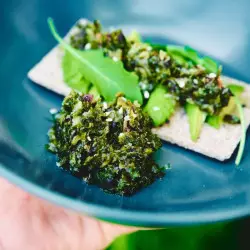
In the morning. A teaspoon of seaweed flakes (dulse or wakame) sprinkled over breakfast or into a broth (Tier 1), and a handful of broccoli sprouts on the day's first plate of raw vegetables (Tier 3). If you want a plant-based milk, go for hemp, tigernut, almond or coconut - never oat, a possible cadmium hyperaccumulator.
Day to day. Pectin-rich fruit (Tier 1), alliums in your cooking (Tier 3), polyphenols (green tea, berries) in place of sugar (Tier 4), and a varied diet that maintains your iron, zinc, selenium and calcium status (Tier 2).
Each quarter. A cure of cell-wall-broken chlorella, on the order of 3 to 5 g/day on an empty stomach in the morning, for about three weeks (Tier 1).
Once a year. A blood test for zinc / selenium / iron / calcium to make sure no deficiency is leaving the door open (Tier 2).
All of this within the framework of a varied and balanced diet and a healthy lifestyle. The idea isn't perfection, it's consistency.
What to avoid
Let me say it plainly, because it's just as important as what to do.
"Cadmium detox" promises without rigor. Any site that guarantees to eliminate or decontaminate your body of its fixed cadmium steps outside what science supports. Be wary of claims without sources.
Excess of hyperaccumulator foods. Some plants concentrate cadmium more heavily: sunflower (seeds), flax, rice (especially brown). No reason to ban them - they're good foods - but no point in making them the base of every meal, every day.
Self-medication with chelators. EDTA, DMSA, DMPS bought online without medical supervision: that's a real danger to the kidneys and to mineral balance. Chelation, if indicated, is a matter for the doctor, full stop.
FAQ: your questions about cadmium elimination
How do you remove cadmium from your body?
You don't significantly remove the cadmium already fixed in your tissues through nutrition: its renal half-life is 10 to 20 years and it's sequestered there within metallothioneins. You can, however, act effectively upstream - reduce its absorption at each meal (binding fibers like chlorella and the alginates of brown seaweeds), optimize your zinc and iron status to limit intestinal passage, and support your detoxification enzymes. That's the logic of the 4 tiers of nutritional protection.
The word "detox" is misleading. There is no cure that empties the tissues of their cadmium. What is demonstrated is support for the physiological pathways: limiting the metal's entry (Tier 1 and 2) and reinforcing the glutathione system and phase II enzymes via the sulforaphane of sprouted brassicas (Tier 3). It's a terrain strategy, a daily one, not a miracle protocol.
Important nuance. In animals, chlorella increases cadmium excretion and reduces its accumulation by limiting its intestinal absorption (Shim et al., 2009). It's an action of binding within the digestive tract, on the metal from the meal - not proof of elimination of cadmium already stored in the organs in humans. It must be cell-wall broken and analyzed batch by batch. Useful for prevention, yes; miracle molecule, no.
How long does it take to detox cadmium?
Given a half-life of 10 to 20 years, the existing store doesn't disappear in a few weeks - it fades over decades. That's precisely why the useful strategy isn't a short cure but a lasting habit that reduces the metal's entry over the long term.
Can the body remove cadmium naturally?
The body does eliminate a very small fraction of cadmium each day, mainly through the kidneys, but far too slowly to undo the accumulation of years. You don't get rid of the bodily store at will. The useful and accessible action concerns the incoming flow: absorbing less, day after day, acts on the accumulation of the decades to come. A portion of seaweed, broccoli sprouts, pectin-rich fruit and a good mineral status do more, over time, than an occasional cure meant to "clean out."
Brown seaweeds (kombu, wakame, dulse) for their alginates, cell-wall-broken chlorella, pectin-rich fruit (apple, lemon, berries), sprouted brassicas (broccoli, radish, red cabbage) for sulforaphane, and foods that support a good iron and zinc status. All of it within a varied and balanced diet.
How do I find out my cadmium level?
Through a urinary cadmium measurement (cadmiuria), prescribed and interpreted by a doctor (a general practitioner or an occupational medicine physician). It's the reference test for estimating chronic impregnation. Don't rely on unvalidated "detox tests." In case of suggestive symptoms or occupational exposure, that's the approach to follow.
What should you avoid to fight cadmium?
Combine the four levels: intestinal binding (cell-wall-broken chlorella, brown seaweed alginates, pectins), nutritional antagonism (optimal iron, zinc, selenium, calcium status), glutathione and phase II enzyme support (sulforaphane, alliums), and antioxidant defenses (vitamins C and E, polyphenols). Each is modest on its own; together, they form a coherent strategy. And avoid the traps: unsourced "detox" promises, an excess of hyperaccumulator foods, and any self-medication with chelators.
In conclusion
There's no "reset" button for cadmium. That's the scientific truth, and it's also good news in disguise: it means the real levers are neither expensive, nor complicated, nor risky. They fit into a routine - a spoonful of seaweed, a handful of sprouts, some fruit, a good mineral status, antioxidants. Four tiers that, put together, reduce what you absorb and reinforce your terrain, day after day, within the framework of a varied and balanced diet.
If you want to understand where cadmium comes from and why ANSES sounded the alarm, go read the pillar article "Cadmium in food." And if you want to take action, start with the simplest thing: putting seaweed back on your table. It's what we do at home every day - and it's the whole point of Algues au quotidien.