Isotonic sea water: how long it keeps after opening, and which container to choose
How long does isotonic sea water keep after opening? Mixed one part plasma to three parts spring water, it goes in the fridge and is drunk within 24 hours; an opened bottle keeps 3 weeks, and a Bag-in-Box pouch lets no air in. The price is the other surprise: the same litre of sea water can cost €23.87 or €3.19, depending on the container. For daily cooking use, bulk drinking sea water means the 3 L or 15 L Bag-in-Box. At Biovie we sell all three formats, and this page draws on their supplier sheets and on the EFSA and WHO benchmarks for sodium.
“We use sea water every day at home and the small bottles are costing us a lot: is there a bigger format that keeps once it's opened?” That's the question we get, in exactly those very down-to-earth words, and it's almost word for word the one customer service gets today. It deserves better than an opinion. It deserves numbers.
I founded Biovie in 2007 and I'm an ISTOM engineer: occupational habit, I bring everything down to a common unit before comparing anything (the litre for price, the day for use). A label on its own doesn't say much. So there you go, the full calculation, with what the supplier says about keeping after opening, and what they don't say.
Bottle, Bag-in-Box, spray: what really sets the formats apart
Let's start with good news: in all three formats, it's sea water. Sea water from Ibiza and Formentera, in the Mediterranean, with about 36 g/L of dissolved salts and a pH of 8.1 to 8.4 according to the supplier's sheets. And those salts count like any other salt, as part of a varied and balanced diet and a healthy lifestyle. What changes from one format to another is the depth of collection and the fineness of filtration, which is where they differ.
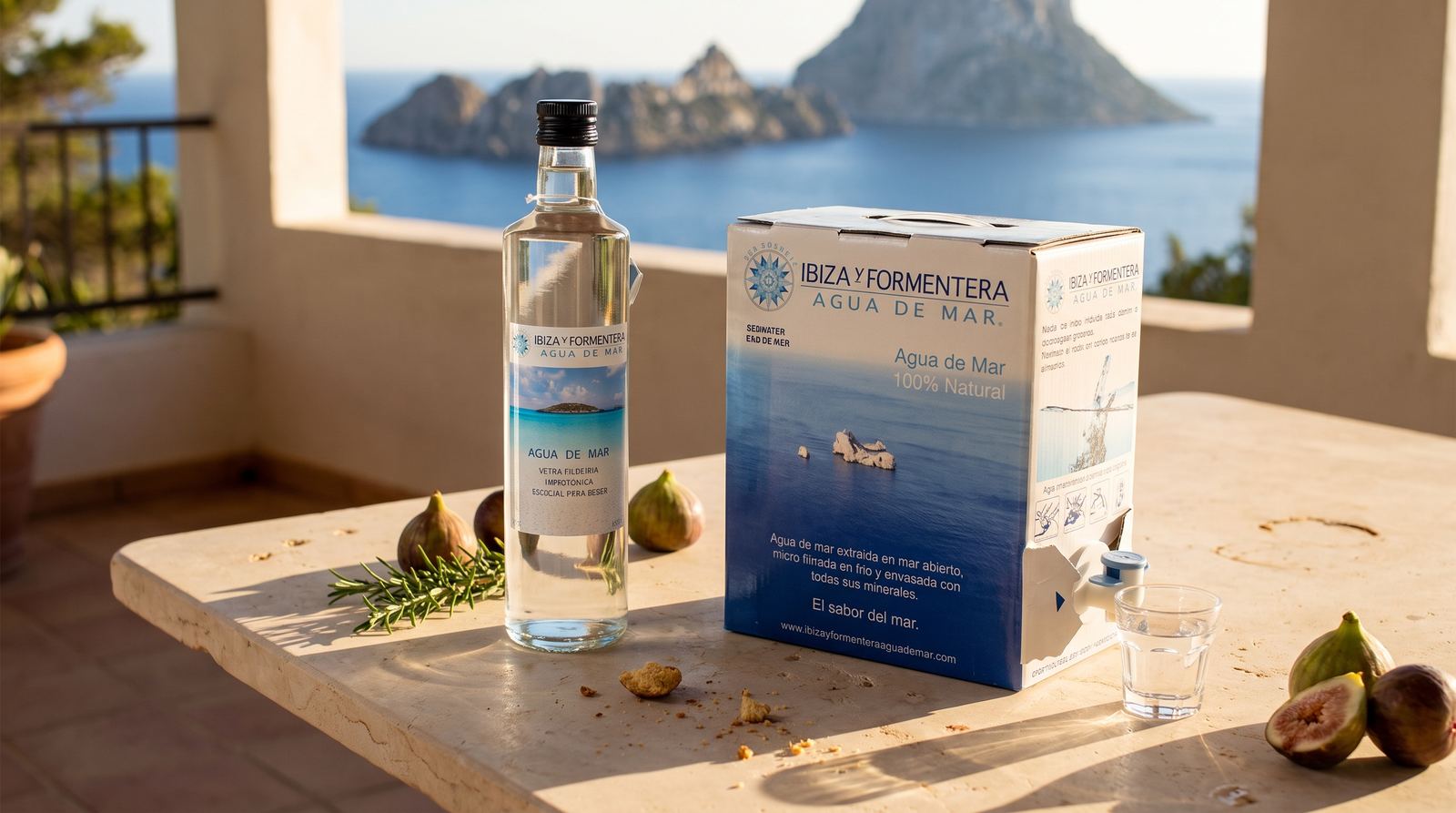
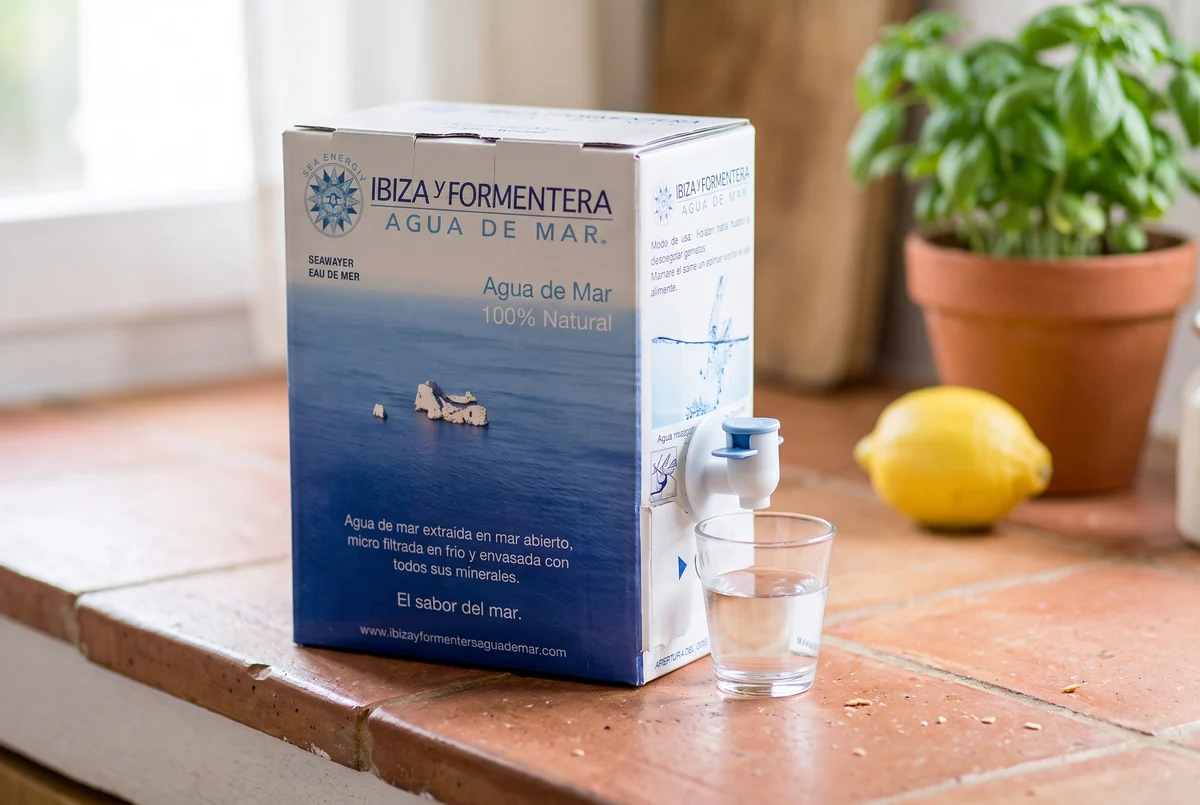
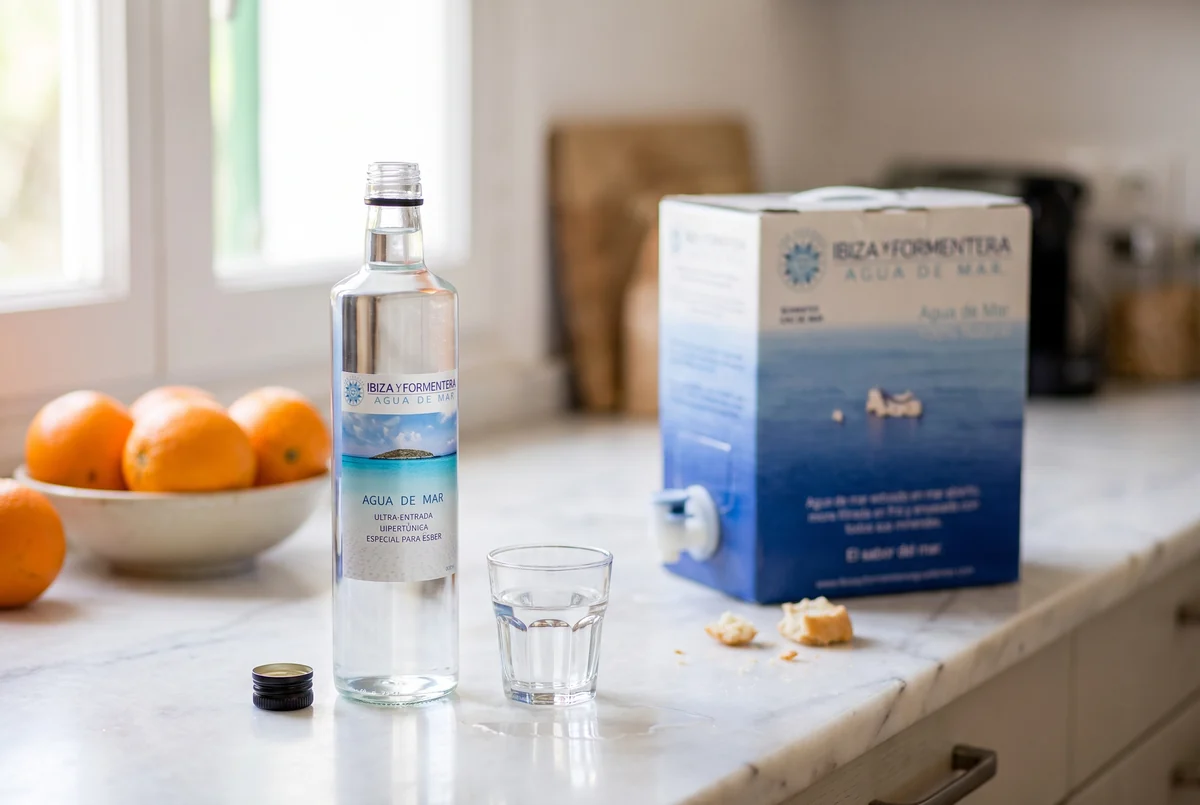
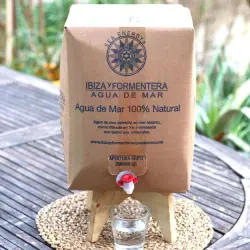
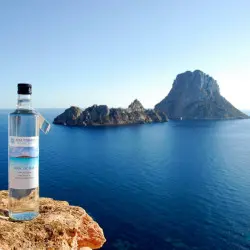
The 0.75 L bottle first. Glass, and water drawn from 15 to 25 metres deep, micro-filtered then ultra-filtered to 0.01 micron. On the other side, the cartons. The Bag-in-Box 3 L and 15 L are high-density polyethylene pouches slipped into a carton, with a dispensing tap, and their water, drawn at 2 to 3 metres, is cold micro-filtered to 0.22 micron.
A micron is a thousandth of a millimetre, which is to say nothing at all to the naked eye. So here's an image: put a marble next to a football, and you have roughly the ratio between the pores of the bottle's filter and those of the Bag-in-Box filter, about twenty times wider. Both filtrations are very fine; the bottle's is finer. That's a real difference.
There's also a 100 ml marine plasma spray, handy away from home, in a bag or a jacket pocket. The market also offers small single-serve formats, convenient when travelling; before making them a daily habit, work out their price per litre, you'll sometimes be surprised. For hypertonic sea water by the litre, the marine plasma bulk size with us is the two Bag-in-Box.
A short aside on the salt content, because the numbers don't always match: you'll sometimes read 35 g per kilo, the reference salinity of oceanographers (Millero et al., 2008). The 36 g/L on the sheet doesn't contradict it, since one is measured per kilo, the other per litre, and this plasma comes from the Mediterranean. Two articles complement this one: how to choose between isotonic and hypertonic plasma, and the Mediterranean origin of this plasma.
What does sea water really cost in daily use?
On the sheets, the bottle is listed at €17.90, the 3 L Bag-in-Box at €13.90 and the 15 L at €47.90 (prices including VAT, noted on 1 November 2026). At first glance, the small format is therefore the most affordable.
The method fits on one line, and it works for any product in your cupboard: price ÷ volume in litres × daily quantity in litres. For the example, I'm taking the 30 ml a day given as the use on the bottle's sheet; it's not a dosage recommendation, just a basis for the calculation.
Format
Price incl. VAT
Price per litre
Cost per day (30 ml)
How long one container lasts
Glass bottle 0.75 L
€17.90
€23.87
€0.72 (€21.48 for 30 days)
25 days
Bag-in-Box 3 L
€13.90
€4.63 (€4.17 with the 10% discount from 6 units)
€0.14 (€4.17 for 30 days)
100 days
Bag-in-Box 15 L
€47.90
€3.19
€0.10 (€2.87 for 30 days)
about 500 days
The same litre therefore costs about five times more in a bottle than in a 3 L Bag-in-Box, and more than seven times more than in the 15 L. Put another way: a month of bottles (€21.48) costs more than an entire 3 L Bag-in-Box, which lasts 100 days. And the price of sea water per litre drops even further, to €4.17 in the 3 L, with the 10% discount granted from 6 units.
So why pay five times more for the same litre? There are valid reasons, and I won't pretend otherwise: the glass, the ultra-filtration, the deep pumping with a finer measurement of the filtration parameters. The bottled sea water is meant for use as a food supplement, the Bag-in-Box water for culinary use.
With isotonic sea water (1 part plasma to 3 parts spring water, as the sheet suggests), 30 ml of mixture contains 7.5 ml of plasma, and the daily cost of the sea water is divided by four: about €0.18 in the bottle, €0.035 in the 3 L and €0.024 in the 15 L.
How long does sea water keep after opening, isotonic mix included?
An opened bottle keeps for 3 weeks, away from light and heat; an opened Bag-in-Box keeps longer, because its pouch doesn't take in air, but the supplier gives no figure for how long; the isotonic mix, for its part, is drunk within 24 hours, kept in the fridge. Here, format by format, are the storage instructions for marine plasma after opening.
Format
Before opening
After opening
Where to keep it
Glass bottle 0.75 L
Cool, dry place; best-before date 3 years after production
3 weeks
Away from light, away from hot places in summer
Bag-in-Box 3 L and 15 L
Between +5 and +35 °C, away from direct sunlight; best-before date 3 years after production
no opening as such, drawn off without oxygen
Away from light; fridge not required
Isotonic mix (1 to 3)
Not applicable
24 hours
In the fridge
Light, precisely. I remember a bulk spirulina counter in an organic shop whose exposed part had turned blue-green. That's the kind of image you don't forget. Different product, same common sense: whatever you keep open goes away from light and heat.
Why the pouch changes everything
Think of a tube of toothpaste. You squeeze it, it flattens, and nothing comes in to replace what goes out. The Bag-in-Box pouch works the same way: it collapses as you empty it, and air doesn't get in as you pour. A bottle is the opposite: it draws in a little air with every glass poured, and the emptier it gets, the more the remaining water shares the space with that air.
Wine offers a telling comparison, and winemakers didn't wait for sea water to ask themselves about the container. An experimental study followed red and white wines for 18 months, in glass, in Bag-in-Box and in PET plastic bottles (Ghidossi et al., 2012): the Bag-in-Box behaved close to glass, whereas plain PET let the white wine deteriorate markedly from 6 months. It's a study on wine, not on sea water: it shows the role of the container, nothing more.
Good hygiene habits
A few simple reflexes, which are more common sense than science:
Don't drink straight from the bottle.
Close the bottle right after each pour.
Don't touch the Bag-in-Box tap, neither with your fingers nor with the rim of the glass.
Don't decant the Bag-in-Box into a bottle: the supplier advises against it, and you would lose the whole point of a pouch that doesn't take in air.
And what about the rest of your food?
Why stop at plasma? That logic, limiting contact with air, also applies to what you keep in jars. It's the whole principle of vacuum sealing at home with the BocUp kit: a bell and a small hand pump, no electricity and no plastic bag, used on the glass jars you already have at home, as long as they have “shoulders” and a 65 or 84 mm lid. You reproduce in miniature what industry does, nothing more complicated. According to the manufacturer, fresh foods keep up to 5 times longer (a vegetable soup 8 to 10 days instead of 2), and dry foods stay safe from humidity and moths. Vacuum replaces neither the fridge nor the freezer and doesn't sterilise; the plasma, for its part, already has its pouch.
Bulk sea water or bottle: which format for which household?
The glass bottle of food-supplement grade suits one person, anyone who cares about glass or who cooks with it: according to the supplier, the plasma can replace salt. At 30 ml a day, it lasts 25 days, a few days more than the 3 weeks advised once opened; at around 36 ml a day, it's finished in time. I'd rather be honest: it costs more per litre, and what it has going for it is the glass and the finest filtration of the three.
For daily use by one or two people, the 3 L Bag-in-Box is the most logical format for culinary use: 100 days at 30 ml a day. If I could keep only one, it would be that one.
The 15 L Bag-in-Box is meant for large family consumption; a carton that size is a family choice, not an impulse buy. On your own, at 30 ml a day, it would take about 500 days to get through it: it makes sense when several people share it, bearing in mind that its duration after opening is not given as a figure.
Sea water is, first of all, salt water, which is easy to forget when you drink it in a small glass. For standard sea water, oceanographers give 469.0 mmol of sodium per kilo at a salinity of 35 (Millero et al., 2008), or about 10.8 g of sodium per kilo.
Applied to the 36 g/L on the sheet, that gives about 11 g of sodium per litre, so about 0.33 g for 30 ml of pure plasma and 0.08 g for 30 ml of isotonic mix. These are orders of magnitude that we calculated from the oceanic reference, to be read as such.
Those 0.33 g represent close to one sixth of the 2 g of sodium a day that EFSA retains as a safe and adequate intake for adults (EFSA, 2019). In other words, a small 30 ml glass already weighs in, sodium-wise, as a clearly visible share of the day. That's not nothing, and I'd rather you knew before buying than after.
WHO, for its part, recommends staying under 2 g of sodium a day, which is 5 g of salt (WHO, 2012). Same figure, two readings. EFSA presents it as a safe and adequate intake, WHO as a ceiling not to be exceeded: in both cases, the plasma's sodium adds to that of your meals, as part of a varied and balanced diet and a healthy lifestyle.
The supplier advises against the hypertonic version in cases of high blood pressure or a salt-free diet, and recommends medical advice in cases of pregnancy, breastfeeding, hyperthyroidism, heart disease or organ transplant. These precautions come down to sodium. We've gathered what science says about the precautions in a separate article.
The simplest step is within reach: take your bottle or your carton, read the price and the volume, and redo the calculation. In one minute, you'll know what your morning glass really costs you. And if you find a better way to compare, write to me!
What is marine plasma ?
So-called hypertonic marine plasma is simply seawater harvested and filtered under very specific conditions.
Our supplier Ibiza Agua de Mar collects sea water from a depth of 25 meters off the coast of Ibiza in a UNESCO listed area.
Concerning the harvest, here are the different physico-chemical parameters measured during the search for an optimal place for the harvest of hypertonic marine plasma, first on the radar with reading of the currents and according to the marine weather (wind, swell, rain. ..) and then by local measurement of these different parameters: taste of seawater, dissolved O2 level, PH level, redox level (ORP), salinity level (TDS), conductivity level ( PSU), alkalimetric title (TA), Pressure. It is the empirical practice of the harvesters and the reading of the various measuring instruments that makes it possible to decide on the best complex combination of these measures together to decide whether the harvest is triggered on the site or whether another location is sought.
Where does marine plasma come from ?
The marine plasma is collected in the high seas, off the coast of Ibiza, in a specific area classified as UNESCO with high planktonic activity and with a presence of tens of square kilometers of Posidonia. It is indeed in this specific area that lives the largest living organism listed on Earth, a posidonia herbarium of 80,000 to 200,000 years extending over 15 kilometers in length.
Source: Sophie Arnaud-Haond, Carlos M. Duarte, Elena Diaz-Almela, Núria Marbà, Tomas Sintes, Ester A. Serrão: Implications of Extreme Life Span in Clonal Organisms: Millenary Clones in Meadows of the Threatened Seagrass Posidonia oceanica
When is it best to take marine plasma ?
The ideal is to consume marine plasma, which contains, let's remember, all the elements that make up Mendeleev's periodic table, in the morning when you get up, on an empty stomach. take 1/4 of hypertonic marine plasma to mix 3/4 of spring water or filtered water.
What are the benefits of marine plasma ?
Minerals are the "fuel" used primarily by our body, which is necessary for our cells to perform their functions optimally. They are also essential for the absorption of vitamins and are responsible for enzymatic processes in cells. Cells perform all their functions with maximum vitality and the precise capacity for organic, bioavailable, alkaline cellular nutrition. Thus, sea water becomes the best mineral drink since it contains all the elements of Mendeleev's periodic table.
Another of the great benefits of seawater is its pH. As Otto Warbürg, father of cellular respiration and two-time Nobel laureate, said, “all diseases are acidic and where there is oxygen and alkalinity there can be no disease”. Due to the quality of our raw material, the hyper-oxygenated waters of Posidonia meadows (recognized by UNESCO as a World Heritage Site in 1999) and sea currents providing purity and clarity: Ibiza and Formentera Agua de Mar have an alkaline pH , between 8.1 and 8.4, which will help the body maintain a neutral pH through homeostasis. The ingestion of sea water is advised to control and maintain our PH, as well as an exceptional supplement for alkaline diets.
The antioxidant and anti-acidity power produced by seawater is due to the alkalinity provided by the minerals.
Drinking filtered seawater in a direct and controlled way is very beneficial for your health, because seawater is an excellent nutrient, containing most of the minerals of the periodic table and all of them dissolved in the best universal solvent available: l 'water.
Seawater contains all the minerals of the periodic table of elements in a bioavailable way. It is thanks to this that foods cooked in seawater are rehydrated and remineralized to make foods with high nutritional power. The problem today is that our intake of minerals through food has dropped dramatically and what is causing this? The answer is very simple: pollution, soil depletion due to intensive agricultural production and our stressful pace of life have considerably reduced the quality of food and its mineral intake, drastically reducing the minimum contribution necessary for the proper functioning of the body.
Seawater also helps us stay young, for a simple reason: the body regularly and cyclically regenerates all its cells, because their lifespan is limited in time. As we age, one of the first faculties the cell loses is the ability to hydrate. We know that the older we get, the less we drink, so drinking and ingesting seawater can help us "wake up" this ability to hydrate ourselves., 4
products
Is there a bulk format of sea water that keeps once opened?
Yes: the 3 L and 15 L Bag-in-Box. Their polyethylene pouch collapses as you pour, without letting air in, which sets them apart from a bottle that takes in a little air with every glass. The supplier gives no figure for how long they keep after opening: store them away from light.
How long does sea water keep after opening?
An opened 0.75 L bottle keeps for 3 weeks, away from light and heat, according to the supplier. An opened Bag-in-Box keeps longer, since its pouch doesn't take in air, but with no figure given. Mixed with spring water, the plasma is drunk within 24 hours and kept in the fridge.
Does sea water need to be kept in the fridge?
No, not for pure plasma in Bag-in-Box: the supplier states storage between +5 and +35 °C, away from direct sunlight, and the fridge is not required. It becomes necessary for the isotonic mix, one part plasma to three parts spring water, which is kept cool and drunk within 24 hours.
Can you decant a Bag-in-Box into a bottle?
The supplier advises against it. When you decant, the water is back in contact with air and you lose the point of the pouch, which collapses as you pour without letting air in. It's better to serve straight from the tap, into a clean glass, without touching the tap with your fingers.
What is the salt content of sea water?
This Mediterranean plasma contains about 36 g of dissolved salts per litre, according to the supplier's sheet. Oceanographers use a reference salinity of 35 g per kilo for standard sea water: the two figures are close, one measured per litre, the other per kilo, and they don't concern the same sea.
Is it good to drink sea water?
It all depends on the quantity: 30 ml of pure plasma provides about 0.33 g of sodium, close to one sixth of the 2 g a day retained by EFSA. It is consumed as part of a varied and balanced diet and a healthy lifestyle, and the hypertonic version is advised against in cases of high blood pressure or a salt-free diet.
How much does sea water cost per day?
From €0.72 to €0.10 a day for 30 ml of pure plasma, depending on the format: €0.72 in the 0.75 L bottle, €0.14 in the 3 L Bag-in-Box and €0.10 in the 15 L, at the prices noted on 1 November 2026. In the isotonic version, one part to three of spring water, the cost is divided by four.
References
EFSA Panel on Nutrition, Novel Foods and Food Allergens (NDA), Turck D., Castenmiller J., de Henauw S. et al. (2019). Dietary reference values for sodium. EFSA Journal, 17(9):5778.
The information presented in this article is provided for information only and does not constitute medical advice. Consult a healthcare professional before making any change to your diet or supplementation.